
In the News


We’re devoted to revolutionizing the way our clients do business. Sometimes that gets us noticed.

No big deal.

Posts by Ryan Suydam:

Is Your Project Evaluation Plan Measuring all the Metrics You Need?

Posted by Ryan Suydam on Apr 9, 2014

clientsatisfactionAdding client feedback results to your project evaluation plan provides an incredible return on investment. Conversely, by failing to identify key satisfaction metrics, your projects are less efficient, and you have less insight in to the mindset of your clients. Ask yourself, in the modern competitive business environment, can your firm afford to overlook anything -- let alone the satisfaction of your clients?

Our easy to use client satisfaction solution, The Client Feedback Tool, allows clients to quickly and easily provide insightful data that will ensure that projects stay on course, and meet or exceed expectations. Utilizing our tool, asking your clients how your processes work takes them only two minutes to complete - but the information provided gives both parties valuable data to assure effective, successful projects.

Based on our research, including 100K pieces of data from our clients, we've listed 4 ways that feedback will add to your bottom line.

  • Identify your top 10% most loyal clients. Do you have a way to identify which clients value you most?  Using the information provided using the Client Feedback Tool, our clients have identified their top 10% most loyal clients and converted this knowledge into increased billings, increasing fees by 3% to their top-rating clients.  For a $10 million firm, this translates into roughly $30k in additional profit each year.
     
  • Retain one client on the "bubble." One-third of our subscribers came to us after losing a major client.  In every case, these firms were surprised by the defection and realized they were blind to a pattern of problems the client never brought to light.  Frequent feedback greatly reduces the chances of this happening.

    According to PSMJ Resources: 

    • AEC firms spend four times more money replacing a client than the costs of retaining one.  
    • Even if you replace the lost revenue of a departed client, the added cost of winning a new client typically exceeds $22k.
     
  • Increase marketing efficiency by 3%. The average AEC firm spends 11% of their revenue marketing, while seeing only 25% of pursued work turns into billable work.  Adding client feedback informs you of your market successes and identifies where your firm’s strengths are.  By marketing your strengths to your best market sectors, you’ll not only target the markets that are most satisfying (and profitable), you will also reduce wasted effort pursuing work that doesn't match your firm's core services.  Even a 3% increase in efficiency will save a $10 million firm over $33k a year.
  • Reduce key staff departure by 5%. PSMJ Resources again reports that replacing your best staff costs in excess of $100k per departure.  Most key staff don’t leave for better salary. They leave because they feel unappreciated, unvalued, and because they feel their growth is not supported.  Quantitative feedback gives you the tools and information to recognize performance.  In fact, your clients will be directly recognizing your staff’s efforts as they provide feedback.  Research based on nearly 10 years of helping our clients collect feedback indicates that their clients rate staff performance as "Exceptional" 22% of the time.  This satisfying work environment will help retain (and identify) your best people, saving an average of $67k each year.

It’s simple, regardless of firm size, incorporating feedback in to your project evaluation plan can increase profits 13% or more just by applying these tools and strategies.

Garnering the client feedback metrics needed for your project evaluation plan is easy with a simple and powerful system like The Client Feedback Tool.  

The Project Performance Equation: Firm Metrics + Client Metrics = Success

Posted by Ryan Suydam on Jan 14, 2014

PROJECT PERFORMANCE

As the New Year begins, most businesses, including ours, look for ways to drive even greater success than last year. If you are like most professional services firms, you evaluate project performance based largely on the efficiency with which the project is completed.  Unfortunately for most firms, they only look at half of the equation.

Evaluate Client Feedback for the Full Picture

Client feedback should focus on helping clients achieve the long-term success they desire by measuring all the metrics important to project performance. As the title suggests, this includes measuring both financial metrics and client metrics. Client metrics measure how well your process is meeting your client’s expectations at each stage of the project. If your team is not asking whether their client’s expectations are being met, they are making three dangerous assumptions:

  1. An existing project delivery process will meet a new client's expectations (or a new project manager will meet an existing client’s expectation)
  2. A client’s expectations of the project manager they have worked with before is not influenced by external factors
  3. You and the client have the same understanding of project communication, deliverables, etc.

Benefits of Client Feedback

When your firm uses real-time, project-based feedback, you give your clients the opportunity to share their changing preferences and priorities with you throughout the project. You eliminate the assumptions that can result in poor project performance and unmet expectations. You strengthen your relationships with your clients as they realize that you really care about their goals. Ultimately, because the feedback you request is designed to benefit your client, you also give them the ability to help you help them achieve the success they desire.

Some of the benefits of improving your project performance and creating success for your firm include:

  • Establishing a reputation as experts, elite players with a premium brand.
  • Reducing or eliminating re-work and scope creep
  • Becoming the ‘go-to’ firm
  • Impacting the bottom line by providing a steady stream of profitable work

As 2014 gets underway, let’s challenge ourselves. Instead of measuring the same things you have in the past and expecting different results, take the strategic step of tracking the metrics that matter. Just like, Peter Drucker says, “what is measured improves”.  So the question to ask yourself is: Are you measuring the metrics needed to create the success you desire? Click below to learn more about measuring client metrics to create firm success. 


Project Survey - Just Click the Dot for Details!

Posted by Ryan Suydam on Dec 4, 2013

CFT ButtonAs a project manager you have more to do in any given day than you can possibly get done. Sound about right? And, as if you don’t have enough to do, you sit through team meetings, office meetings, and visits from the top leadership where they remind you how important it is to ensure your clients are your top priority while also achieving strong profits. Okay. Now for the big question – how do you balance both priorities?
Do you remember the EASY button? Well I think Staples© was really onto something with that. I can’t tell you how many times I’ve wished I had one of those to handle tasks that I knew were important but that I struggled to get completed. Have you ever wished you had one to measure how things were going with your clients? Wouldn’t it be great to have a one button solution when your supervisor asks you how things are going with your clients?

Well, now you do. The answer – send your clients project surveys!

Client Feedback Tool grew out of an architectural firm so I definitely get it! As strongly as I believe that getting feedback from your clients is essential to building strong and lasting relationships, I am well aware that time is the one thing project managers in the A&E industry have in limited supply!

So you may be wondering, he just acknowledged that project managers have no time for extra steps in the project management process and yet he is suggesting that we send project surveys to our clients? Fair enough. The truth is that it takes less than 2 minutes to send your clients a survey. And, the information you get will save you so much time!

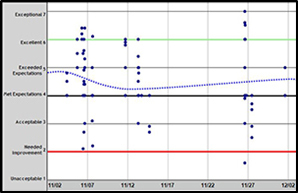
cft plotterEvery time one of our clients sends a survey, their clients’ responses are logged onto a scatter plot like the one in this figure. One of several reporting options, the scatter plot analyzes how well client expectations are being met. It takes less than a minute to run and you can schedule it as a weekly or monthly recurring report. Our clients see a snapshot of what their clients are saying. Are you starting to see how this will give you the information you need?

Each of our surveys consists of about 6 – 8 questions asking how well client expectations in different categories are being met. The blue dots represent individual pieces of feedback from one of those surveys. With a 4.0 indicating that the client’s expectations are being met, this one chart can be your very own EASY button!

With one quick glance you can see that overall you and your team are meeting, or exceeding, your clients’ expectations. But there’s more.

When you click on any of the blue dots, you immediately see:

  • What project that piece of feedback is associated with
  • What question was being asked
  • Who answered the question
  • Any specific comments by the respondent

It’s important to note that using project surveys does not replace the ongoing conversations you have with your clients.  However, with a strong feedback process you can, in about 5 minutes a day, get the details you need and get back to managing your projects. If there are ever any challenging responses, a simple click on the blue dot gives you the information you need to begin finding a resolution before their concerns become problems.

In addition to seeing the results for the clients you manage overall, you will have the ability to see a scatter plot for each individual client as well. Now, with your very own EASY button, the next time you are asked ‘how are things going’, you will have the information at your fingertips!

Interested in learning more about using project surveys?


Project Conflict - Cause for Stress, or a Path to New Ideas?

Posted by Ryan Suydam on Nov 5, 2013

project ConflictIf you ask friends or colleagues how they feel about conflict, you will likely know their answer even before they speak. Their body language will tell you immediately. That is because most people view conflict as having to do with arguments, agitation, and to an extreme extent, hostility. But what if we reframe the way we look at conflict? Is there a way to see conflict as an opportunity if we accept the fact that conflict is essentially about the gaps in expectations that happen when individuals interact?

Project teams work hard to match their deliverables to their clients’ expectations. However, we all know there are, at times, bumps in the road and that project conflict can occur when your team’s understanding of deliverables, communication, or schedule is different than your client’s. There is certainly no magic to ensuring this doesn’t happen but there are three actions you can take to minimize the frequency and to actually turn these gaps in expectations into an opportunity to learn more about your clients.

Don’t avoid it or ignore it. Just because you are not aware of the gap between your clients’ expectations and what your team is delivering does not mean that the gap doesn’t exist. Both you and your client make assumptions related to their project every day. You assume that the way you have done 50 projects in the past that are just like this one is the way to progress on this one. Your client may have expectations (or a vision) about what the deliverable will look like that is different than what you are planning. It happens. However, if throughout the project you ask questions, you will catch these gaps in expectations as soon as they occur. And, the sooner you and your client have a conversation about the difference in your expectations, the sooner your project gets back on a healthy track.

Don’t blame anyone. I have heard many A/E/C firms speak of having difficult clients. Their (clients) expectations are unrealistic, they are inconsistent, they just expect you to read their minds and know exactly how they want things done. This may be true. But beyond the obvious problem with telling your clients they are wrong, playing the blame game may create an attitude on your team that your clients will pick up on. By looking at project conflict as nothing more than a gap in expectations, you and your team will have the opportunity to learn more about each client. As you solicit feedback from your clients, you will close any gaps in expectations and be recognized as their expert.

Communication – the great conflict alleviator. You can avoid having conflict escalate or go unresolved, by communicating regularly with your clients. Asking for feedback on a regular basis lets you keep a pulse on whether or not there are any expectation gaps. You will quickly see if there any issues that need to come to the surface? By asking for feedback and following up, you will keep the channels of communication open. And, you will give your clients the opportunity to share with you their ideas and thoughts about how they would like you to serve them.

Getting regular feedback lets you build an easy rapport with clients. The Client Feedback Tool process is easy and comfortable for both you and your clients. Integrated into your existing project management system, the feedback you receive provides you with new ideas about your clients’ preferences. We hear a lot about being your client’s trusted advisor. In addition to being their trusted advisor, you will also become the expert at how each individual client prefers to be served.

Learn more about using feedback as an opportunity to turn conflict into client loyalty and trust.

"I just love working with you.." Client Evaluation Fallacies.

Posted by Ryan Suydam on Sep 18, 2013

100 percent2Your firm is committed to using client evaluation surveys to ensure project success. So what do you do when your client gives you all high marks and you just know it isn’t true?

Recently one of our clients shared a story with me in which she was faced with this situation. Megan had been working on a project for Dee for several months. During this time there were a lot of times – certainly more than typical – when Dee came back with comments like, ‘well, that is fine but…’ Megan continued to feel that as hard as she tried to meet Dee’s expectations, there was something that was just not adding up.

For a number of years, Megan’s firm had elected to use client evaluation surveys. As a result, and because Megan really wanted to create a successful project for Dee, she decided to send her a survey. The survey asked Dee to consider specific points in the project process. It gave her a chance to share her thoughts on how things were going. The goal of the survey was to hear what Dee felt was important and to allow Megan to uncover what processes Dee felt were working well and which ones might be adjusted to work a little more smoothly.

Much to her surprise, the survey came back with all top scores and the comment, “I just love working with Megan!”  

Since her purpose was not to receive accolades but to serve her client more successfully, Megan gave Dee a call. She told her she really appreciated her taking the time to complete the client evaluation survey but she was a little concerned with the high scores. She told Dee, “I really enjoy working with you as well but I just feel that there is some way in which I could be serving you better.” Dee told her that she gave her the high marks because she knew other people would be looking at the scores. She said she really did like working with Megan and didn’t want her to get into any trouble.

Megan thanked Dee and told her she really appreciated her thinking of her. She was quick to add, however, that she (and her firm) actually appreciate knowing what their clients are thinking even if the survey comes back saying that the client is not completely happy with something. She pointed out that the reason her firm uses client evaluation surveys is because they are committed to providing their clients with the best possible experience.

So how does the story end? Megan and Dee had an excellent conversation. They talked about the processes Megan was using on the project and agreed on a few minor adjustments that Dee felt would really work a little better for her. In the end, the client evaluation survey actually worked just as intended. Even though the high scores did not accurately reflect what was going on in the project at that time, it opened the door to an excellent conversation.
 

A Fresh Perspective on Performance and Evaluation

Posted by Ryan Suydam on Jul 9, 2013

Many of us are familiar with the idea of measurement improving outcome. Whether it’s Karl Pearson’s Law: “That which is measured improves” or the concept of losing weight by counting calories, we understand that measuring results is crucial to understanding how to improve results

Performance and Evaluation, Client FeedbackBut it’s not just the act of measuring – it’s measuring the RIGHT things and then utilizing what was learned from the results. When trying to improve the performance and evaluation of your team or team members, what should be measured (and how) become critical questions. 

Professional services organizations are beginning to follow the lead of other industries and explore areas such as Voice of the Customer (VOC), Client Experience Management (CEM), and Enterprise Feedback Management (EFM). And while 86% of organizations across all industries employ some form of customer/client feedback as part of their performance and evaluation strategy, only 5% of professional services firms do so. 

If you are planning to implement a feedback process, consider these three key steps to creating an effective performance and evaluation strategy powered by client feedback. 

  1. Any measurement strategy should promote desired employee performance. Therefore, it’s important to measure things employees can control or greatly influence. If employees feel they are being held accountable for measurements beyond their sphere of control, they may reject the system, game the system, or lose hope. So when capturing client-centered metrics like feedback, don’t focus on the scores provided by clients. If you focus on feedback scores, rather than what employees do with scores, they may avoid feedback in the most critical situations. Instead, measure, monitor, and promote the successes of those who gather the most feedback, maintain the highest response rates, and follow-up most effectively to challenging feedback. 
     
  2. Craft questions that measure improvable actions. Keep personalities out of your surveys. People don’t change quickly or easily. When faced with personal criticism, most people will reject the information. Instead, focus on the processes and practices of delivering the service. Processes are more easily documented, adjusted, and customized to a client. 
     
  3. Measure early, measure often. Monitoring client expectations-the real source of success as a professional service organization-is just as critical as managing your income statement and balance sheet. You look at your financial reports every month, and carefully track progress over time – but when was the last time you looked at metrics from your clients’ perspective? How well are you doing for them? To maximize performance with clients, feedback cannot be a once a year (or once every five years) activity. Track constantly, during projects, when you have time to create better outcomes for your clients.

    The most important way to measure staff performance in a professional service firm is from the clients’ perspective. It’s really the client’s perception of reality that matters most. To summarize, to best measure performance and evaluate it from the client’s perspective:  make it easy and comfortable for the client to offer their feedback, have questions focus how well the process worked for them, and ask them often throughout a project, not just at the end.

    Top 10 Feedback Techniques for Project Delivery

    Posted by Ryan Suydam on May 14, 2013
    This guest blog was written by Ryan Suydam.

    Project delivery is all about taking an idea from concept through to production. Firms want their projects completed in the fastest and most cost-efficient manner possible, all without sacrificing quality. Incorporating feedback into a firm’s process helps the team perform at their best, while the very act of asking for feedback shows clients proactive and professional care. To help jumpstart your client feedback process, we’ve listed the top 10 feedback techniques to facilitate project delivery. 

    Feedback Techniques1. Make it Comfortable.

    When requesting feedback make sure the process is comfortable to use for all parties. The more comfortable the process, the more likely both parties are to participate. A comfortable process means clients will not feel put on the spot and concerned about a confrontation. Focus questions on processes, not personalities, and offer a flexible answer scale to capture subtle nuances of perceptions. 

    2. Create Actionable Results.
    An effective feedback technique requires data to enable follow-up. Be sure you are asking questions that allow you to retrieve measurable, actionable data. If the questions are too vague or too open ended, you won’t have the information that you need to take action.  

    3. Process Focused.

    The questions asked should be about process rather than people or products. We aren’t looking to find out how well the client “liked” us, but rather where our process is working great and where it might need some improvement.  

    4. Go Beyond Satisfaction.

    Ask your clients questions focused on their expectations, instead of their satisfaction, because satisfaction is the expected norm. The client’s perception of how you performed compared to their expectations is the key to knowing where to improve your project delivery process. Additionally, you’ll find 500% more exceptionally positive feedback than you will challenging feedback – and we all love to discover good news. 

    5. Reduce Liability.

    When asking for feedback, focus on questions that can reduce liability and encourage positive outcomes. Just by asking for feedback throughout a project, you are creating a record of the service perceptions all along the way, reducing the chance of a lawsuit and increasing your ability to meet their needs. Feedback helps keep you and your client aligned on a common goal - a successful project outcome. 

    6. Don’t Wait.

    Collect feedback throughout the project, not just at the end - when it’s too late to improve that project. Response rates are highest when the client senses his feedback might improve the project outcome. Once the project is over, the incentive to respond is gone. 

    7. Make it Trackable.

    Tracking feedback responses isn’t complicated, but making sure everyone on your team gets the feedback they need, reviews it, and takes appropriate action can be much more challenging. Deploy good tools to capture who is asking for feedback, who’s responding, and who takes what action on each critical response. 

    8. Use Instant Alerts.

    Collect feedback in a way that you can be instantly alerted to new feedback and drive real-time follow-up.  A good system will establish score thresholds that indicate, in real-time, when follow-up is required for exceptional circumstances. Make sure the right people are alerted so nothing falls through the cracks. 

    9. Keep the Client First.

    Structure your feedback techniques so that it is quick and easy for the client to give you feedback. Don’t waste their time with long surveys or questions with answers that only matter to you.  Response rates are higher with multiple short surveys over a period of time, than with one or two long surveys sent less frequently. 

    10. Follow up.

    Don’t neglect the follow up! A survey should always start a conversation, not replace one. Typically, follow-up is simply a personal acknowledgement that you saw and read the response. However, if any special situations were noted (either in scores or comments) be sure you open a dialogue to show how the feedback will change the process and project going forward. 

    Each of these feedback techniques focus on a deliberate approach to your feedback collection efforts. Set your goals to collect actionable feedback in way that is easy for the client. Make understanding the results and following up easy for you too. See feedback as the opportunity that it is to improve your process, reduce your liability and become your client’s expert.

    Interested in learning more about how you can start collecting client feedback?

    Most Recent News Mentions

    We’re changing the way project-based firms operate.

    People can’t help but notice.
    Who will be next?

    Check out our latest newsworthy work: