
In the News


We’re devoted to revolutionizing the way our clients do business. Sometimes that gets us noticed.

No big deal.

Posts by Sarah Gonnella:

Management of Change: Conclusion

Posted by Sarah Gonnella on Nov 21, 2014

describe the image
We have reached it, the exciting conclusion to our series on Management of Change.  It is here where we will reiterate our most important change messages and send you on your way to successful changes in your organization. 

We started our series defining crucial concepts, i.e. change includes anything that takes a company from its current state to a new, desired state and that it takes the buy-in and adoption of the people in the company in order for change to be successful.

This statement encompasses several ideas and focused areas, each of which we explored during this series.   

  • The executive piece focused on the leadership required as company change agents – establishing goals, creating clear direction and modeling the new, desired behaviors.
  • Our financial commentary focused on the numbers of change: establishing numerical baselines, checkpoints, and the financial ranges indicating success.
  • The project management information recognized your company’s project managers as those best suited to manage and evaluate the change process, since that’s what they already do for your clients.
  • The marketing article acknowledged the multifaceted role marketing plays: the industry researcher who sees the need for change; the communicator/positioner for your company, your clients and your employees; and an area that needs to embrace the change themselves.
  • Our final focused blog piece from the human resources perspective really explored the people – the most important part – of change.  If the people in your company aren’t clear on change, all the spreadsheets and tools in the world won’t make it work.  

Information Technology – yet another key aspect of change

We investigated, at a high level, about each area and their responsibility toward change and the adoption of that change.  We also made reference to some of the tools that can contribute to this change process. For example, in the executive focus we made reference to an executive dashboard to help leaders keep abreast of their company changes.  Furthermore, project managers are very technically savvy with their project management software.  Marketing, also, has technology that they have to employ to keep abreast of changes in their jobs.  The common denominator to all this and more is … technology.  Partnering with your IT department allows for smoother change.  And, like all the other roles, technology plays a dual role offering technology that empowers employees in potentially two ways: 

1) As a new technology that companies can now use, changing the way they do their work.

In Aaron Jones’ article, “Change Management: 8 Tips to Successfully Implement a New Technology” he states “Companies that have been through successful implementations of new technology understood employee concerns and addressed those concerns early in the process” and offers the following steps for successfully integrating a new technology.

  • Select the Right Technology
  • Check References
  • Involve Employees  
  • Get all Personnel Involved Once a New Technology is
  • Focus on Training
  • Document Everything
  • Create Short Terms Wins
  • Demonstrate No Fear  

2) As a technology that helps manage the change process itself. 

In Henry Hornstein’s article, “Using A Change Management Approach To Implement IT Programs” he explains, “The importance of managing organizational change effectively has compelled a growing number of organizations to incorporate the discipline into major initiatives of all sorts, from the introduction of IT software packages to business process and organizational structure changes. The contribution of effective change management/leadership to the achievement of positive results cannot be ignored … when combining high usage of innovative Human Resource Management (HRM) practices with high usage of information and communication technologies (ICT), in change initiatives.” 

The single most important thing to keep in mind when implementing change is to understand why the change must happen.  There are three steps to implementing change:

  1. Un-Paralyze your Organization - Develop a persuasive reason both why the change must happen and if it weren’t to happen, what would the negative impacts be. This creates a motivating reason why the change must happen. 
  2. Show Benefits to Individuals - Individuals that are impacted by the change need to understand how it will benefit them. People want to be in the know. So communication and managing expectations are key.
  3. Re-establish Standards – When employees feel they are constantly in flux and don’t know what to do, it creates uncertainty. Implementing change in a phased approach with continued reinforcement of those expectations helps people feel they know what is expected. Change will happen once you have a good QC process and a well-established protocol of what is expected.

Change in the end

It all leads to one conclusion.  Change is never done alone.  It takes the interactivity of every aspect of an organization (leaders, individual contributors, tools) to make change management successful. 

Gone are the days of five year plans.  Today’s speed of business requires an agile organization who can change even as frequently as 12 – 18 months.  Having a comprehensive and thorough management of change process is the only way businesses can survive … and flourish.

And remember that friend who asked about the investment return from the beginning of our series?  After reading each blog piece and taking the time to process each area’s responsibility toward the success of change, you can now tell your friend that the initial investment may indeed be huge, but because you have been given the necessary information for effective change management, we will ALL be able to prove enormous returns!



Management of Change Series: Impacting User Adoption

Posted by Sarah Gonnella on Oct 8, 2014

01-18-24 User Impact Managing Change-Banner

A friend comes to you and asks for your advice regarding a great investment they discovered with a huge money down initial investment but with – and here’s the kicker – no idea of the ROI. 

Your advice?  Never invest unless you know what you’ll get in return, right?

Yet, thousands of companies today are operating their business without knowing if there will be any return on the investments on initiatives or significant purchases each day.   

WHY do companies do this and HOW can they realize the necessary ROI?

They answer is right in front of us - effective management of change.

This article is the first in an exciting and informative series where we focus our attention on this invasive corporate conundrum and how an effectively run Management of Change Program can positively impact your bottom line.  What’s even more engaging about this series is that we will look at the benefits of change management from a variety of perspectives:  Executive, Finance, Project Management, Marketing, and HR. 

In this introduction piece, we will concentrate on two key definitions including change management and user adoption.

Change Management

Change Management is a term often bandied about as the vague yet intended scapegoat for why things don’t go well in an organization.  While many people certainly understand the concept, there is in fact a real definition.  Generally, change management is the process of moving an organization from its current status to a defined desired status.  However, few understand the importance or the specifics as to what makes an effective management of change program. 

According to mindtools.com’s article “Change Management Making Organization Change Happen Effectively,” “Change management is a structured approach for ensuring that changes are thoroughly and smoothly implemented, and that the lasting benefits of change are achieved.  The focus is on the wider impacts of change, particularly on people and how they, as individuals and teams, move from the current situation to the new one.”  I’ve added the boldface font to make two very important points:  1) that change management requires a structured approach for lasting benefits and 2) change management requires not only a change in process but a change in the people involved. 

User Adoption

Which brings us to our next definition regarding the people involved in the change, User Adoption.  Broadly, it means the people in the company using and taking full advantage of the changed environment.  We all know that getting people to change is always a difficult task:  people are naturally resistant to change - even if change means their work lives will be easier - because the initial adjustment to their lives seems too big a barrier.  Now, taking that broad definition into a more specific level, we can clarify it as the following:  successful user adoption requires a clearly defined and financially measured goal requiring training, clear communication/marketing and leadership buy-in in order to be successful. 

Management of Change and ROI

Now, let’s get back to ROI.

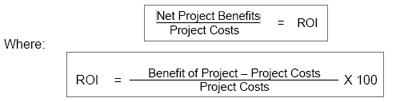
For a change to be considered advantageous, there has to be a compelling business case which will look at the cost of the project weighted against the benefits the company will gain. If the benefits outweigh the costs, the ROI is positive.  The formula for calculating Return on Investment (ROI)[2] is:

MOCblog


NATALIE PETOUHOFF, PHD, TAMRA CHANDLER and BETH MONTAG-SCHMALTZ, “The Business Impact of Change Management,” 2006 Volume 9 Issue 3.

In other words, the difficulties of change must be overcome by the positives, i.e. an ROI both financially and personally for those involved. 

Two other important items that many people forget when calculating ROI are a) the amount of resources and time change takes as well as b) the opportunity and efficiency costs of NOT making the change both of which also directly impact ROI

Looking forward …

We have established our key terms, change management and user adoption.  Now let’s look at management of change programs - which reap the benefits to your organization’s bottom line - from the different perspectives mentioned above through focusing on user adoption.  Next week, An Executive’s User Adoption Story. 


How My Life Teaching Moment Helped with Client Conflict Resolution

Posted by Sarah Gonnella on Oct 3, 2014

conflict resolutionHave you ever had a moment in your life that stands out as a teaching moment that has made you who you are today? My moment transformed and prepared me as a Project Manager and Owner to tackle difficult conversations. Let’s face it, whether personal or in the workplace, we are constantly faced with resolving conflict.  At the same time, I have learned (or found) that not everyone is comfortable with expressing what needs to be said. So, it really resonated with me when a couple years ago I discovered a tool that has made conflict resolution easier. More about that in a minute. 

My Story

My teaching moment was when I was in sixth grade.  I had a teacher I felt was not being fair. I expressed to my mother my frustration to see if she could help. She told me that she could go to this teacher and have a conversation, but that the teacher would probably respond better if I addressed the issue head on. She coached me on how to have the conversation so I had the tools to handle the conversation on my own.

I was nervous as I entered her classroom. I asked the teacher if she had a moment that we could step outside of the class and talk. I told her how I felt and wanted to bring it to her attention to see how we could resolve the issue. The teacher was impressed and happy that I brought it to her attention. We came up with a solution and each day after I felt that I was respected and developed a better relationship with that teacher.  Each day I look back at that experience, I realize that was the moment I learned to speak up about concerns and not fear the hard conversation to resolve conflict.

Resolving Conflict

By no means am I an expert at resolving conflict. However, I have learned that avoiding the subject and hoping it goes away rarely works. Additionally, conflict doesn’t have to be looked at as negative. Sometimes opportunities flourish from conflict. The other person might be feeling the same way and because you took the time to say something your relationship improved.  A great resource for learning more about conflict resolution is Mindtools. Below are some tips I have learned throughout the years to help resolve client issues:

  1. Perception is Reality - The definition of conflict is to be incompatible. So in order to resolve conflict, the first step is to listen and understand the other person’s or group’s point of view.  We all come from different experiences that influence us and can lead us to make assumptions. So it’s important to understand that someone else’s views may have nothing to do with you, but be based on their past experience.  So with that, we must also realize that perception is the truth no matter if you think it’s true or not. Once you put your mind around that fact you can begin to focus on what can be done to resolve the issue.
     
  2. Managing Expectations Managing expectations with a client requires being proactive vs. reactive. Once a client is frustrated with multiple things that have built up over time, it takes a lot more work to resolve the issue and sometimes is too late. For professional services firms that need to manage clients, a great tool to help with this is the Client Feedback Tool. The only way you can really know what a client is thinking is to ask. This tool allows a firm to check-in with their clients using two minute surveys throughout the project. When you do this, you uncover things your firm has done that your clients love (so you can continue to do more of the same) as well as things that your client would like you to change if only slightly. This doesn’t remove the need for picking up the phone and calling, but it is great for letting you know there is an issue before it gets unmanageable. And, it is very comfortable for clients to let you know things you might not think to ask on the phone and that they might feel were perhaps not worth mentioning on a project call. However, knowing allows you to adjust your service delivery and make you even more valuable to them.
     
  3. Take Action – When a person does speak up about an issue, it’s important to follow-up, follow-up, follow-up and take action! Keep in mind that this doesn’t mean that you go against best practices or things you know are not in the best interest of the client or your firm. The feedback just brings out in the open something that matters to your client. It gives everybody a moment to collect their thoughts and then have a discussion. When you do, it’s important to communicate concerns you have and any consequences after fully understanding the client.  At the end of the discussion and meetings, a recap of action items, who is responsible and due dates can help you get back on track.

So the next time you encounter an issue with a client, I hope my story and tips help you think about ways you can deal with conflict resolution. Be sure to share your conflict resolution tips or stories. Should you want to provide your employees a way to manage expectations, we invite you to take a tour of the Client Feedback Tool. 


Top 5 Ways to Get the Most Out of Your Deltek Vision System

Posted by Sarah Gonnella on Sep 12, 2014

changeIt’s not so much that firms don’t already know they aren’t taking advantage of their Deltek Vision system as much as they sometimes just don’t know where to start. I hear it almost every time I’m at a conference talking to clients. “We aren’t utilizing the system to its full potential”. Knowing you aren’t is half the battle. The harder part is figuring out what to focus on and getting the buy-in to do something about it. Below are five tips on how to get the most out of your Deltek Vision system. 

  1. Make it a Priority – We see it every day, firms deal with inefficiencies causing them to lose money each day they are not addressed. If you don’t make it a priority, who will?  Make a list of all of the things keeping you from focusing on your job, i.e. inefficiencies, duplication, lack of report, insight on trends, etc.  Then go to each role within the firm and make the same list from them. This is where you start. By applying the 80/20 rule you can reduce that list down to your priority list.
     
  2. Take Advantage of New Technology – Is your firm guilty of ignoring technological enhancements? Businesses that stay with the “old way” of doing things fall behind their competition. But change is so hard!  You know what they say, the only thing constant is change. New tools like mobile access to timesheets, expense reports, and CRM are available. Not to mention InDesign integration, expense receipt attachments and so many more enhancements of Deltek Vision. Yet, has your firm taken advantage of these new features? Fear of change, lack of understanding what’s available, inadequate IT support are some of the reasons we tend to hear despite their employees saying they need these new features. To learn about the latest enhancements and take advantage of them. Check out our What’s New in Vision webinar and be sure to read our monthly newsletter. Not receiving it? Contact us.
     
  3. Collaborate as a Team – Do you have teammates or are you dealing with the isolation effect? The modern business world is reliant on teams. Ultimately the success of your business is impacted by your teams ability to be productive together.  There is no “I” in team. You have to rely on others while they rely on you and that includes providing accessibility throughout the company. Collaboration can only happen with trust. So identifying where the trust issue sits and resolving it is key. Seek out new and innovative ways to work as team. Contact our collaboration queen for more information. 
     
  4. Improve Employee Skills – How can someone learn if you don’t edumacate ‘em? Through Osmosis! Employees typically want to do the right thing, but without the right tools or training, it makes it hard and sometimes impossible. Does your staff have access to the right metrics or information to make quick decisions? Do you know what is included and have you been trained on the latest enhancements? Full Sail Partners can help you train your employees by utilizing the priority list identified in item #1. You don’t know what you don’t know and that sometimes it is a firm’s worst enemy. To learn on demand, view our past archive section or contact us.
     
  5. Push the Envelope – Wish there was a feature or way to do something in Vision? You might just find that it’s been tackled before. Your consultant can provide great insight on the possibilities as they have worked with hundreds of firms. It seems every day I run into a client that discovers the awesome power of workflows to accomplish there challenge. Workflows can save time to free you up for more productive activities. They can automate repetitive tasks, alert users of record changes, and enable your firm to streamline process through automation. When something isn’t possible with stored procedures or workflows, there is still an option. In Customer Care, you can also submit a “new idea”. The more people that submit on a topic, the higher up on the priority list is goes.

Put on your walking shoes and “just do it”. Just like you do with a project or a marketing plan, you have to plan out what is needed and the results you expect to see. You don’t have to do it alone. Full Sail Partners is here to help guide you so your firm can get the most out of your Deltek Vision system. 


What to Look for in a CRM Consultant

Posted by Sarah Gonnella on Jul 24, 2014

describe the imageThe other day I had a prospect call looking for a CRM (Client Relationship Management) software, but what he found was a CRM Consultant vs. a “salesperson”. Don’t get me wrong, I absolutely want to sell software…to the right fitting firm. As with most calls, the caller wanted to set-up a time for a demonstration. The issue with immediately showing the software without a discovery is that it tends to be a waste of the client's time and mine. Without understanding the prospect's challenges, and ultimately how the software will help the client’s marketing strategy, a demonstration is futile. A CRM system isn’t a magic bullet. So when you are looking for a new CRM software, it’s important to also evaluate who will assist you beyond the sale. Below is what to look for in a CRM Consultant:

1. A Results-Oriented CRM Consultant Identifies Firm Needs

When speaking to a client or potential client, a CRM Consultant asks probing questions to evaluate the firm’s current processes, their challenges, and ultimately what they were looking to accomplish. As a CRM Consultant, it’s important to understand the firm’s level of sophistication related to marketing processes and measurement. Just like a growing baby, each firm is at a different growth stage. A baby must learn to roll over, crawl, stand, walk, and then run and so must a firm. You can’t expect to immediately start running. Some firms’ processes are advanced despite the fact that they have no CRM system. Others have no processes at all. A firm must start somewhere. So as a consultant, it’s important to understand the firm’s marketing maturity before establishing a CRM implementation for that firm. 

During the above mentioned call, the prospect was a little taken back when I told him that our system wasn’t the right fit for his needs. Ultimately, he was looking for another type of software. Although it ended up not being a lead, the prospect was thankful for my honesty as I took the time to understand what his firm needed and helped guide him down a better search path.

2. A Vigilant CRM Consultant Engages Key Players Throughout Implementation

After establishing needs, it’s important to make sure you have the right players. As outlined in this previous blog article, 8 Reasons for a Successful Implementation, it’s important to ensure executive buy-in during the sales process. Just as important is having the right CRM champion and with an ERP (Enterprise Resource Planning) system it’s important to get finance involved. All of these key players must be a part of not only the implementation, but also the sales process. When involvement from any of these roles is lacking, the likelihood of success is lessened. It is the role of the CRM Consultant to make sure that these key players are established from the beginning, and play their part through the implementation. These key roles play a huge part in the roll out of the system and must also engage other end users to ensure all departments, divisions, markets, and offices are represented.

3. It is the Duty of a CRM Consultant to Look to the Future

When going through an implementation, a misconception that many firms have is that once the implementation is complete, so is the development of your CRM. What worked today won’t necessarily work tomorrow. As your marketing strategy and the competitive landscape changes, your CRM system must continue to evolve. Your CRM Consultant should look to resolve short-term and long-term needs, as well as, think about strategic marketing plans. For example, do you plan to open a new office, go into a new market or start a new service line?  A CRM Consultant is there to guide your firm on metrics that would be valuable to access your marketing traction.

4. Your CRM Consultant Should Be a Strategic Partner

A CRM Consultant should be more than a trainer or a vendor. Treating one as such is a common mistake made by firms seeking to hire a CRM Consultant. So how do you know if you have a consultant or a vendor? If we look at the basic definition of a vendor, “a person or company offering something for sale”, we can see there is no value-added beyond the sale. Whereas a consultant is “a person who provides expert advice professionally”. A value-added CRM Consultant should have a background in marketing and be able to help your firm adapt the system to your marketing strategy. A consultant will:

  • Ask strategic questions to better understand your business needs
  • Provide best practices and facilitate your company in adapting the system to gain insight on metrics that matter
  • Go beyond showing you how to just use the system
  • Help you understand how to increase user adoption
  • Look at ways to improve your business and your clients

Ultimately, your CRM Consultant should be a partner that understands your business needs whom you can rely on to help you as new needs arise. If your firm is looking to improve your CRM processes or looking for a CRM, be sure to check out Full Sail Partners’ webinar on Managing Your CRM System and Beyond! The webinar provides insight on CRM objectives, clean-up, set-up of your system, metrics that matter, and how to engage finance.


Be sure to add a comment to let us know if this article and webinar were helpful or reach out to us personally via email, phone or LinkedIn

The Importance of Project KPIs for Project Based Firms

Posted by Sarah Gonnella on Jul 14, 2014

Project KPIsBecoming a champion of project management is as easy as solving a puzzle. The puzzle is rather complex and requires specialized training with a very specific kind of expertise, but a puzzle nonetheless.  So what does it mean to be a project based firm? What do project managers do? What do project KPI’s have to do with project management?  As with all puzzles, the best way to solve is to take the puzzle apart, piece by piece, and decode it.
Puzzle One: Am I a project based firm?

Interestingly, business theorists debate as to what determines “a project based firm”.  There is not a hard-and-fast rule for defining whether or not you’re project based and would need the services of a project manager. So let’s just stick with the basics.  The most obvious way to decide is if you have a business model where you perform “projects,” “jobs,” or “services” for external clients.  Ultimately, you are offering your expertise – NOT your goods – to an external customer.

The Project Management Institute says that a project “is a temporary group activity designed to produce a unique product, service or result like building a bridge, relief after a natural disaster or expansion of sales into a new market.”  Examples of project based companies include:

  • Management Consulting Firms
  • Architecture, Engineering or Construction Companies
  • System Integrators
  • Advertising Agencies

If you’re goods oriented (you sell software or insurance) or operationally oriented (i.e. you manage clients’ IT structure), you are not naturally a project based firm.  We could expand our definition by looking at your business organizational structure – project based firms tend to organize around their projects or jobs.  In a non-project based firm, “a business may include separate departments for manufacturing, accounting, marketing, and human resources because the organization is based around functions, not projects, …” (Miranda Morley, Demand Media, “What Is the Difference Between Project Based & Non-Project Based Organizations?”)

Puzzle Two: Am I a Project Manager?           

Most of us have a general understanding of project management, but we can go to the Project Management Institute (pmi.org) for a good definition – “project management is the application of knowledge, skills and techniques to execute projects effectively and efficiently.  It’s a strategic competency for organizations, enabling them to tie project results to business goals – and thus, better compete in their markets. Project Managers Initiate, Plan, Execute, Monitor and Control, and Close their projects.”  

Many would argue that there is more to being a Project Manager. I would argue that communication and follow-up are key areas required to be a successful Project Manager. However, the basics of being a project manager revolve around the delivery of a project. 

Puzzle Three: What are Project KPI’s for Project Management?

KPI’s are Key Performance Indicators and they are quantifiable, measurable indicators of goal attainment.  They are the very backbone as to what makes projects succeed or fail – which is directly tied, in your project based firm, to your company’s success or failure.  When given a new project, Project Managers create KPI’s to:

  • Initiate the project and its deliverables
  • Plan project details
  • Execute those details
  • Monitor and control each step in the project
  • Close the project upon completion of the deliverable and the project post-mortem

Some subject examples of project management KPI’s are adherence/deviation of budgets, milestones, and task times.  Here are some sample KPI’s that might be part of a project plan: 

  • Determine percent of rework attributable to requirements definitions. 
  • Conclude deviation of planned ROI
  • Establish cost of managing processes

For more information on writing project KPI’s, refer to “KPIs | Writing, Establishing, and Measuring" by Full Sail Partners, Inc.

Bonus Round…

Although joining a game show is potentially a quick way to make some money, it’s the savvy business owner who aligns his project based firm with project KPI’s. This alignment helps ensure the firm’s bottom line is replete with positive cash flow and employees who are happy, because they know their jobs and how to be professionally successful.  No, we shouldn’t rely on a game show host to guide us to riches, but we can depend on consultants at Full Sail Partners to help guide us to metrics that matter.  And don’t worry about buying a vowel, just turn over your mouse to this webinar and see how achievable all your goals are.


5 Key Reasons Why Business Collaboration Tools are the Future

Posted by Sarah Gonnella on Apr 3, 2014

business collaboration, collaboration toolsBusiness communication continues to change with each generation. The quantity and speed of information has exploded and firms are seeking new ways to handle the pressure of information overload. Are business collaboration tools the answer? We predict that these 5 reasons demonstrate why collaboration tools are the way of the future.   
  1. Reduce Dependency on Email | Imagine a world of no email. I know it sounds crazy, right? However, if you had a designated space that colleagues, sub-consultants, vendors, and clients used to collaborate about specific initiatives, projects, or marketing efforts, wouldn’t it be nice to capture all of those thoughts in an organized fashion in one area? When you think about some of the biggest challenges with email and the fact that colleagues are not always down the hall anymore, it makes sense that businesses are looking beyond email. Here are some of the things that can be improved through business collaboration tools where email consistently fails:

      • Eliminate forgotten or missed requests
      • Categorizing comments, notes, files, tasks, and requests
      • Capturing ideas, competitive intelligence, or ways to improve your business that are easily searchable
  2. Personal Meets Business | The line of business and personal continues to blur. When was the last time you worked 9-5? People are working at all times of the night and answering questions while watching their favorite TV show. Business colleagues and clients are now connected to us on Facebook and personal activities and responsibilities need to be accomplished sometimes during the work day. Social collaboration and business collaboration tend to have the same needs: to share files, ideas, assignments, calendar of events, etc. Wouldn’t it be nice to organize both business and personal in one tool? Collaboration tools like Kona are making this possible.

  3. Make Life Easier | Employees are looking at ways to balance their work and personal life, as well as, have more flexibility with their schedule. Not all tasks need to be done during work hours or even at their desk. Virtualization is becoming more common, requested, and needed in corporate America. Disasters or state emergencies have made that even more apparent. Collaboration tools are designed with mobility and accessibility in mind. Additionally, they allow people to access information and other individuals anywhere and anytime with the comfort that the information is readily available in the cloud.
     
  4. Instant Access | Business collaboration is not just for internal communication, but is also being requested by clients. Clients are looking for a better way to communicate and a better client experience. No more excuses of lost emails. Clients can instantly ping you with a question and you can immediately respond with an answer through the use of collaboration tools. What client wouldn’t like to immediately IM or video chat with their consultant to resolve issues? Setting expectations of this instant access is important. Alternatively, you could set a schedule that you are available for client questions at a particular time each day and quickly answer those pending questions in one collaboration tool.
     
  5. Integration | Collaboration tools are becoming more and more integrated with other business tools. Not only are they now integrated with our ERP, CRM and Outlook, but collaboration tools integrate with other sharing tools like Dropbox, Box, Google docs, Skype, and the list goes on. The ease of use and social familiarity increases the likelihood of usability. Integration makes it even easier for users to access data in one place through connectors.  

Business collaboration tools are all about working more effectively as a team. Let us know what you think. Has your firm been contemplating collaboration tools? See what others are saying: 

Why Team Collaboration Tools are Essential for Productivity

Posted by Sarah Gonnella on Mar 12, 2014

Team Collaboration ToolsWhat are the major productivity killers for firms in the Professional Services? For most firms, some of the biggest ones revolve around information overload, duplicated effort and other inefficiencies. 
Fortunately, team collaboration tools can address each of these areas — and thus have a positive impact on the productivity of individuals and teams throughout an organization. 

First, let’s consider the element of information overload — which for many people is exemplified in the form of an overflowing email inbox. We all know the frustration of seeing fifteen different emails with the same subject line, where people are actually commenting each other’s earlier messages — and then trying to untangle the sequence of the discussion to make some sense of it. Not only does this type of information overload take time to sort through, but the reality is that with so many emails piling up, important messages can get lost or go unread. 

Another major factor that negatively affects productivity is duplication of effort. It’s common for multiple people in a firm to be working on the same problem — but is some cases, rather than working as a team, they’re operating in unconnected silos. Even if the whole team was in the same meeting, subsets of the group may have informal follow-up meetings, or even chance encounters in a hallway. Any one of these can result in parallel (and duplicated) efforts. 

Inefficiencies come in a variety of flavors, ranging from the annoying to the scary. One of my favorites is the issue of document versioning. This is especially likely when multiple people are working separately on the same document. Unless a firm has a solid solution in place, it’s all too likely for multiple versions of a document to spring to life, each with its own edits and authors. Sorting through the different versions to create one final document can be a time-consuming source of frustration. 

Real team collaboration is a beautiful thing

Now let’s switch gears and talk about some of the productivity gains a firm can realize by implementing effective team collaboration tools. 

One of the most essential functions that collaboration tools perform is organizing team members’ communications into a centralized repository of conversations around specific tasks and issues within the project. In the Kona tool, for example, individuals can have conversations with one colleague, a small group within the team, or the entire team. They can also see the various subtasks, view a centralized project calendar and share information with the entire team. 

Team collaboration tools can enable project managers to set up their groups so that certain members are able to see all conversations, while others have a more limited view. This capability can be especially critical when collaborating with clients. 

Kona in particular has found an effective way to address the problem of sharing documents among members of a team – one that ensures that everyone is working off the latest version. Instead of sending colleagues the actual document as an email attachment, users can send links to where the master files are stored (including such online services as Dropbox, Box or Google Drive). 

Last but not least, when collaboration tools are web-enabled, like Kona, they’re ideal for optimizing the way people work in the real world. After all, not all of our productive time is spent at work; we can also be productive when we’re in between doing other tasks, whether at home, on business trips or elsewhere. Team collaboration tools allow individuals to continue being productive, wherever and whenever inspiration hits. 

Summing up

Until a firm finds an effective way to address factors like information overload, duplication of effort, and inefficiencies, its productivity will probably suffer. Team collaboration solutions may hold the key to making the most of your team’s collective abilities — and at the same time, minimizing the overlaps, dropped balls and other issues that may be limiting your productivity.


Improving Collaboration in the Workplace Starts by Avoiding These Common Mistakes

Posted by Sarah Gonnella on Jan 29, 2014

Almost everyone has heard Thomas Edison’s famous quotation about genius being “one percent inspiration and ninety-nine percent perspiration.” Far fewer people stop to wonder exactly what Edison was sweating about. 

Improving Collaboration in the WorkplaceThe answer is, Edison was not only working on the various inventions for which he’s well-known, but also on the emerging discipline of R&D itself. Even as he and his team were cranking out one technological marvel after another, one of Edison’s ongoing areas of interest was in improving collaboration in the workplace. 

According to Sarah Miller Caldicott (who happens to be Edison’s great grandniece), the world’s most prolific inventor developed a methodical approach to nurturing teamwork and innovation among his workers. In her book on the subject, Midnight Lunch: The Four Phases of Team Collaboration Success From Thomas Edison’s Lab, she describes the little-known, behind-the-scenes processes that Edison pioneered to create and sustain high-performing teams. 

Caldicott does a great job of finding insights into Edison’s approach that have relevance for businesses today, so I highly recommend checking out her book. In case you don’t have time to read it yourself, I’ve synthesized some of Caldicott’s key observations with current best practices in collaboration. For starters, I’ve identified three major areas where organizations often make mistakes that prevent them from improving collaboration in the workplace. 

Mistake # 1: Keep doing business the old way.

It’s natural to keep using the same tools and processes that have worked for you in the past. However, your competition is probably hard at work trying to figure out a faster, cheaper way to put you out of business. So “sticking to what works” may put your organization in an increasingly vulnerable position. Fortunately, there’s a constantly expanding variety of tools that can help you maximize your ability to collaborate. 

One of Edison’s interesting approaches to fostering collaboration was the “midnight lunch.” These were regularly scheduled but informal get-togethers where his engineers got to know and trust one another better, increasing their ability to communicate and work as a team. In today’s business environment, technologies like Kona and Skype may make it easier for teams to exchange ideas, but many people who write about collaboration still point to the effectiveness of starting with face-to-face meetings and then evolving to virtual collaboration as time progresses. 

In Edison’s day, the products of collaboration were obviously analog — although many of their ideas existed only in their heads, a great deal existed on paper as well. If a team member left, much of their work and insights could literally be passed out among team members. In today’s world, we are meeting the need by creating central repositories of files and communication — so if a team member leaves, all their intellectual property doesn’t leave with them. 

Mistake # 2: Assemble the wrong type of team.

The ideal size team for collaboration depends on a variety of factors — including the complexity of the work, the products the group is expected to generate (and the timeframe for doing so), and how often, if ever, the team needs to convene in person. 

For what it’s worth, Edison preferred smaller, more cohesive teams of between two and eight members, according to Caldicott. In addition to hosting the “midnight lunches” mentioned above, Edison also tried to ensure a mix of disciplines and areas of expertise on each of his teams; Edison’s light bulb team, for example, included chemists, mathematicians, and glassblowers. To put it another way, Edison and his colleagues were focusing on diversity decades before the term was ever used in a business management context! 

Mistake # 3: Take your eye off the ball.

One other lesson to be learned from Edison is to take the long view on collaboration. Real impact is not a short-term gain or achievement, but rather an investment of energy and resources that will eventually bear fruit. 

Taking this perspective, it’s easier to realize that mistakes can be just as instructive as successes. When Edison was only 22, he had his first flop:  An electronic vote recorder that legislators declined to adopt. Following that experience, Edison changed his focus to the consumer instead, and never regretted the decision. 

Another lesson Edison teaches us is to keep an eye on the market, and be ready to make adjustments as necessary. For example, he and his team ushered in the era of electricity, and then continued to invent new applications that used the increasingly available power source; other inventors ignored electricity at their peril. (For a more recent example of how not to do things, look no further than Kodak, which failed to adapt to market changes and is playing catch-up with hundreds of more innovative, nimbler companies.) 

Has the light bulb over your head turned on yet?

Most companies would consider themselves to be phenomenally successful to have even one innovation on the level of the light bulb, the motion picture, the phonograph, or any of the hundreds of other inventions and patents credited to the Wizard of Menlo Park. But by making the most of the collaborative tools and strategies for improving collaboration in the workplace mentioned above, your company can at least maximize the chance that your teams will do their very best work. 


Measuring Marketing ROI: Building a Better Relationship with Accounting

Posted by Sarah Gonnella on Dec 11, 2013

When it comes to proving the value of marketing efforts, often professional services marketers have to prove their worth to the financial department through a language that they understand – Marketing Metrics! This often means a series of pre-determined metrics for measuring marketing ROI (return on investment). 

describe the imageMarketers are often challenged with measuring marketing ROI. Many times it’s because we are don’t have access to the right type of data or in some cases it’s because we don’t know what to measure. This is where having a good relationship with finance can help you be a better marketer. To better develop the relationship and expectations between marketing and finance, we suggest fostering a relationship of understanding and sharing. 

Having the financial department on your side is one of the greatest feats any marketer can accomplish – If finance buys in, you can be assured that it is only a matter of time until everyone else falls in place! 

No matter how copasetic our relationship is with our financial department, we have to be ready to report on marketing ROI at a moment’s notice so here are some steps to take to gain a better relationship. 

Talking the Talk 

If you are looking at building a better relationship with accounting, in my experience the first bridge to cross is to put yourself in their shoes. When you think about what functions accounting is responsible for, you can easily understand their hesitancy to buy in to the marketing plan without cold hard data to evaluate. Instead of running from this hurdle, attack it straight on! Schedule a kick-off meeting with finance to address the plan, and allow them to voice any concerns. 

The goal during the kick-off session is to ease accounting’s anxiety.  Allow the finance department a chance to express their suggestions and concerns. Continue to reassure the finance team that through the marketing metrics established by your firm, you will be consistently measuring marketing ROI throughout the year to ensure that the marketing team’s plans and efforts stay on track.

Walking the Walk 

The quickest way to gain buy in is to lead by example. You know your job better than finance knows your job. Identify areas that your marketing efforts affect that might not be easily identified.  One way a Marketer can begin to do this on their own is to think about the data that you need to do their job better. Come to the kick off meeting ready to show your finance team that you understand their concerns, by identifying previously overlooked metrics for measuring marketing ROI. This will demonstrate to finance that you are looking at metrics that can help impact the growth of the company and further prove your value to the firm. 

If you are interested in learning more, review this blog article that discusses evaluating your business growth plan with metrics. This introduction can be applied to developing marketing metrics that help identify how your efforts are helping the firm grow. 

Here are important questions marketers can ask accounting to start the conversation on how the firm can start measuring marketing ROI:

  1. Retaining & Gaining Clients: I’m looking to understand our total customer growth. Do we have a way to determine by percentage and revenue the amount of our work we’ve received is new vs. existing clients throughout the year?
  2. Pursuing the Right Client: I’m been looking at how we can be more strategic in our pursuit of clients. Would it be beneficial to advise you when I see we are pursuing more work with clients that we are having AR issues with?
  3. Forecasting and Backlog: Can you help me understand what our break-even is and do we have a way to see what our current backlog is? I’d like to help make sure we have enough business coming in the pipeline for each market or division.
  4. Effectiveness: Can you help me better understand how I affect the bottom line? Developing metrics that help you understand the financials behind your results can help you fine tune your approach. 

Often times your finance team is not questioning the value of the marketing team -- they are however questioning the tactics (and results!) being used. Often times as marketers we can get lost down in the weeds and lose sight of the overall firm goals. By proving efforts through metrics and marketing ROI, we start speaking a language that our financial team can understand. 

As professional services marketers, start showing your finance team that you care by measuring marketing ROI, and building better relationships between marketing and finance to demonstrate the value of promotional efforts.

For more information, view the below webinar: 

Most Recent News Mentions

We’re changing the way project-based firms operate.

People can’t help but notice.
Who will be next?

Check out our latest newsworthy work: