

Should I Migrate? 6 ERP Data Migration Considerations
 When evaluating a CRM or ERP system, a critical component of the decision-making process is assessing the data migration effort. Beyond the software and consulting costs, data migration presents its own set of challenges and expenses. As organizations move to the latest ERP systems, such as Deltek or similar ones, understanding the migration process becomes key to ensuring a smooth transition.
So, when you're asking yourself, "Should I migrate my existing data to a new ERP system?", here are the 6 essential questions you should ask:
#1 How Valuable is the Data?
One of the first steps in the data migration process is to understand how valuable the data is to your current and future business operations. In today’s world of data-driven decision-making, your data is likely more valuable than ever.
With the rise of the latest software development, high-quality, accurate data has become a business asset. Data that isn’t frequently updated or no longer relevant might not be worth migrating. However, real-time data on sales, finance, and customer interactions should be prioritized. In some cases, you may need to archive historical data rather than fully migrate it.
When considering whether to bring data to the new system, consider these four questions:
- Is the data frequently updated and is it accurate?
- How often is the data accessed/needed?
- Do you use the data in reports?
- Do you need the data to make business decisions?
- If your answer to these questions is rare or never, then the data is probably not worth migrating to the new system.
#2 How Organized is the Data?
Organized data is essential for smooth ERP migration. Data that isn’t structured properly or with inaccuracies will cause significant roadblocks during migration. ERP migrations should be focused on data cleanliness and consistency.
Some existing data that is being considered for migration may not be consistent across a given data field in a database record. For instance, inconsistencies in key fields (e.g., a phone number field containing text instead of numbers) will need to be corrected before data is moved. Migrating to any latest ERP system requires standardizing data fields to ensure compatibility.
So, evaluating the amount of manual clean-up required can help determine if the information is worth migrating.
#3 How Long Would It Take Someone to Manually Enter the Data?
One of the main concerns in an ERP migration is the sheer volume of data that needs to be transferred. As mentioned earlier, certain data is more efficiently entered manually into the new system. It is crucial to evaluate the effort versus the cost. Small data sets or data fields with only a few records may be better handled manually, but large-scale migrations benefit significantly from automation.
If a particular field contains only 50 data records, is it worth the cost of migrating it programmatically to the new system? On the flip side, underestimating the time and effort required for manual data entry can significantly extend the implementation timeline. Our experience has shown that when a firm opts out of a recommended data migration based on analysis, the success rate of the overall implementation tends to decrease substantially.
#4 Is A Conversion Utility Available for my Data?
In today’s ERP landscape, conversion utilities are often available to help automate and simplify the data migration process. These tools can significantly reduce costs and time, especially when migrating to popular ERP systems like Deltek. If a conversion utility is not available, working with a data migration expert who can create custom scripts may be necessary. Be sure you evaluate the cost of these custom tools before starting your migration process.
#5 What is the Data Migration Vendor’s Migration Process?
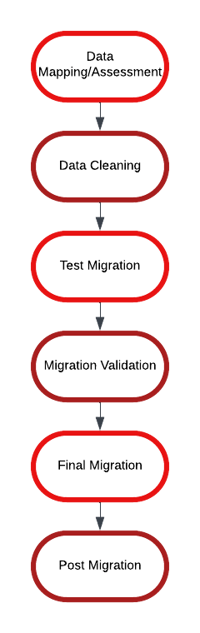
Selecting a vendor with a well-defined and proven migration methodology that addresses the preservation, security, and speed of migrating your business data is key to a successful ERP migration. As an example, below is Full Sail Partners’ migration methodology:
- Data Mapping/Assessment – This step involves defining the scope, outlining the migration strategy and approach, and establishing the desired timeline. A proposal will be provided, detailing the costs involved.
- Data Cleansing – During the mapping phase, data that needs cleansing will be identified. The necessary data will be cleaned and organized in the current system to prepare it for migration. The data migration expert will also analyze the existing data and ask relevant questions to assess its quality. Improving the quality of source data in the current system enhances the success of automated data conversion.
- Test Migration – Once the migration scripts are created and the data is verified with the client, a test database will be set up for review.
- Migration Validation – After receiving the test database, the client will examine the data in the new system to confirm it has migrated as expected.
- Final Migration – After the data is validated, a final migration date is scheduled. Typically, all data is backed up based on the timing of a firm's billing cycle or payroll cycle. The final migration is performed over a couple-day period. Once the final migration is complete and reconciled the system is ready for use, minimizing downtime between the old and new systems.
- Post Migration – If any issues with the data are discovered after the final migration, occasional post-migration updates may be required to address those issues.
#6 How Experienced is the Migration Expert?
ERP migrations are complex projects, and the expertise of the migration team can make or break the process. Experienced ERP consultants and migration specialists focus on data strategy and digital transformation.
Most data migrations require a mapping document. This defines the scope and ensures that the data will be imported correctly. An experienced data migration consultant provides this mapping document as well as valuable insight on potential issues that might occur during the data migration process. Before proceeding with data migration, it's important to understand the role and expertise of the data migration specialist within the firm.
Is their primary responsibility focused on data migration, or are they handling multiple tasks? Do they have experience migrating data like yours? A seasoned migration expert typically specializes in this area, dedicating most of their time to migration. Selecting the right expert is crucial, as it can minimize post-migration cleanup and ensure the data is accurately and efficiently transferred to the new system. be necessary. Be sure you evaluate the cost of these custom tools before starting your migration process.
Data Migration Success Involves a Well-Thought-Out Plan
In many cases, migrating data is a must when implementing a new ERP system. However, by considering these 6 critical factors—data value, organization, manual entry requirements, available conversion utilities, vendor process, and expert experience—you can ensure a smoother transition and get the most out of your new system.
Data migration has evolved significantly over the years. Still, the key to success lies in a well-thought-out plan, comprehensive data assessments, and collaboration with experienced vendors and experts. If you're still unsure about your data migration process, then see how Full Sail Partners can help you with personalized migration strategies tailored to your specific needs by clicking the image below.

 With growing global political tensions, trade wars and volatile markets, one would assume that mergers and acquisitions (M&A) activity would slow down. However, this has not been the case. As a result of US tax reforms and a reduction in the US regulatory climate, firms are retaining larger amounts of cash reserves. Furthermore, according to a recent
  Mergers and acquisitions (M&A) in the architectural and engineering (A&E) industry are on the rise. Unfortunately, many firms are not prepared to successfully implement the M&A process. With an acquisition, it is imperative that the “buying” entity have a well-defined set of procedures to easily onboard the incoming firm. In the case of a merger, all involved firms would need a set plan which would dictate the transition to a new firm. However, first a firm must decide the direction it will take regarding the M&A process and evaluate how it will affect the current organization’s structure.