In the News


We’re devoted to revolutionizing the way our clients do business. Sometimes that gets us noticed.

No big deal.

Posts by Full Sail Partners:

Deltek Vision and Adobe InDesign: Stop Focusing on the Boilerplate

Posted by Full Sail Partners on Feb 19, 2015

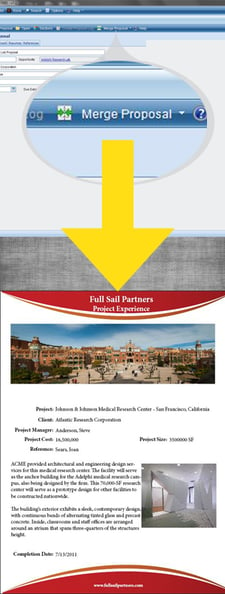
I think by now we can all agree: The ability to automate proposals with InDesign and Deltek Vision is the greatest thing to happen to proposal creation since the copy and paste function! In this blog we are going to dive deeper in to the realm of automating information out of Vision in to InDesign and take a look at the two coolest ‘outside of the box’ features currently available. If you are just looking to get started with automating information from Vision to InDesign be sure to check out this previous blog.
detelk vision adobe indesign integration

It is important to continue looking at ways to increase efficiency throughout the entire procurement process. From proposals to the short-list interview, integrating Deltek Vision and Adobe InDesign can give your firm the competitive advantage needed to wow the client. Answer in days, not weeks. Spend less time on boilerplate material and more time on compelling, tailored responses that will further set your firm apart from the competition.

So, how can we use the Adobe InDesign and Deltek Vision integration in new powerful ways? Let’s get started with my two favorite outside of the box features:

1.  Create new, customized, cover sheets while preserving your firm branding.

Utilize the power of integration to create customized cover sheets for each new proposal. By utilizing the powerful template system created by Deltek you are able to wow the client by creating a beautiful combination of your firm branding and project specific information.  This marriage of project-specific information and targeted marketing media will allow you to quickly separate your firm from the competition with the first thing the client sees – the proposal cover!

2.  Stand above the rest and break away from the chains of PowerPoint

You’ve landed that ever elusive short-list presentation. Congratulations! Now you have to win it, or all of the work that you did was for naught. This is your opportunity to separate yourself from the competition. You can basically guarantee that the other short-listed firms are going to present a boring old standardized PowerPoint presentation. This is your chance to stand out and relate to the client on a personal level.

How does the Adobe InDesign and Deltek Vision integration help your presentations stand out from the rest? Simple:

  • First impressions are everything | Too many professional services firms fail to differentiate their firm from the competition and let the client mistakenly believe that the decision boils down to price. By creating your presentation in InDesign, you are able to break away from the design restrictions of PowerPoint and instantly differentiate yourself from the competition.
  • Eliminate mistakes | How embarrassing is it when our proposals and presentations reflect two different sets of data? Avoid this pitfall by automating all client and project specific information directly from your Deltek Vision system.
  • Reinforce your firm branding | Your firm spent countless combined man hours putting together a proposal that got you to the short-list stage. At this point the client likely feels like they know your firm on a basic level. So why change your overall branding now, and start anew? By creating your proposal and presentation from the same set of templates and data-sources, you reinforce your firm branding at every stage of the sales process.

These are two of my favorite ways to use the Adobe InDesign and Deltek Vision integration to make my life easier. Are you thinking outside of the box and using this functionality in any neat ways? We would love to hear - please comment below.

Not currently integrating your Deltek Vision system with Adobe InDesign? Click below to learn how to begin:
Technology service offerings continue to grow as Heath Harris & Wayne Johnstone Join Full Sail Partners

Posted by Full Sail Partners on Feb 17, 2015

Full Sail Partners, a Deltek Premier Partner, is pleased to announce that Heath Harris, and Wayne Johnstone, have joined the Full Sail Partners’ team. These new hires highlight a continuing effort to further bolster the information technology service offerings of the firm. Both of these employees have the skills and knowledge to help clients optimize their IT solution systems to grow and enhance their operations.

Heath Harris is a well-rounded network specialist with 10 years of experience focused on providing Deltek Vision installations, data migrations, upgrades, and customization for small to medium sized firms. As an IT Consultant, Heath will help firms leverage their investments in the Deltek Vision platform by ensuring that systems are optimized for efficiency and advising clients on how to use technology solutions to meet their business objectives.

“I am thrilled to be joining the Full Sail Partners’ team," said Heath Harris. “I am excited to join a company with the passion for helping clients utilize technology to drive and manage profitable growth. I look forward to collaborating with clients and implementing the right solution for their needs.”

As a Product Developer, Wayne Johnstone assists in the development of custom solutions to automate critical business processes for professional services firms. His extensive background in .NET development, SQL programming, and solution architecture surrounding Web based development technologies provides Full Sail Partners with the expertise required to provide solutions that will bridge the gap between independent silos of information.

"Becoming a part of the Full Sail Partners’ team is a wonderful opportunity," said Wayne Johnstone. "In both the professional services industry and the technology community, the Full Sail Partners’ team is known for developing innovative technology solutions to assist professional service firms optimize their business. I'm really looking forward to working with the talented product development group to advance our offerings and continue to deliver solutions that help our customers grow their firms, and get better business results."

As business continues to grow for professional services firms, these recent hiring’s are indicative of Full Sail Partners’ commitment to helping clients excel in today’s quickly-changing economic environment

“Historically, automation has focused on the reduction of manual processes internal to Deltek Vision,” said Wes Renfroe, VP of Technology, “but many of our clients are embracing next generation solutions in the cloud to further augment their processes. With the addition of Wayne and Heath, Full Sail Partners’ development efforts are focusing on enabling clients to integrate their data in Deltek Vision to and from other disparate sources.”

Interested in meeting the rest of the crew? Check out are updated staff page!


Inside the client mind: Is your brand what you think it is?

Posted by Full Sail Partners on Feb 5, 2015

clientmindTo thrive in the professional services industry, client satisfaction must always remain a top concern. All successful project-based firms have the resources and ability to deliver high quality projects. This ability does not separate truly successful firms – it is the bare minimum needed to enter the conversation.

What truly separates one professional services firm from another is the capability to understand how they are perceived by their clients and utilize this information to build more meaningful relationships. How many people reading this blog can truly say that they know how their clients perceive them? I’d guess not many of us could answer that question.

Unfortunately most firms fail to recognize the impact that the client experience throughout the lifespan of the project plays on the overall perception of the firm in the clients mind. This failure to leverage feedback and ensure a positive project experience equates to a failure in your brand.

Utilize feedback to dig in to the client mind

So – how DO we utilize feedback to establish our brand in the clients mind, and differentiate ourselves from our competition? Let’s examine three key factors:

  • Open the lines of communications between your clients and your project managers – The experience your clients have with your firm is based on communication.  Provide the means for clear, honest and timely communication. 
  • Put your clients mind at ease - Improve your bottom line knowing your clients expectations. Avoid dissatisfied clients that can too often become “former clients”. 
  • Go above and beyond the standard - Strengthen project delivery by focusing on specific client expectations that can only be identified through open communication channels. Know your deliverables. 

Improved communication between your project managers and your client is crucial to the ongoing profitability and viability of your firm – coincidentally, it just so happens to be a key factor to establishing your brand in the mind of the client and winning new business. So, how do we continue to develop our brand, and improve the lines of communications with our clients? Register for this free webinar on March 4th to find out:


Top 5 Fears Keeping You From an ERP Implementation

Posted by Full Sail Partners on Jan 28, 2015

describe the imageMy momma was always full of advice. Some I took with great results, but others … well let’s just say I had to learn the lesson the hard way. At this stage in our lives, we’ve all moved on from those tender years where momma was our greatest guide, but we are all still attuned to receiving advice from those more experienced. Or at least we should be. Take for example, the ERP Implementation process:

Most savvy business professionals know the ERP acronym, but not all have taken the advice.  But why?  What’s keeping some companies from “pulling the trigger” and bringing this all important piece to their success puzzle – especially when their competitors are?  In my years talking and working with a variety of firms, I have gathered the top five fears why companies, like yours, haven’t completed an ERP Implementation. 

1)      You say: “It’s going to cost too much.”

We hear:  Fear of Being Out of Control

We solve: An ERP system will address this fear by managing costs and stopping       financial leaks.

Problem:  The industry says that ERP implementation can be expensive and many companies wonder where the money is coming from. Many function under the notion that it’s easier to just do the quick fix and move on.

Solution:  The right ERP system, implemented correctly with the aid of the right consultants, will fix those expensive leaks in processes. Furthermore, with a detailed IT growth plan and the information from the new ERP, the initial costs will be recouped and you’ll be well on your way to a better financial and technologically focused picture.

2)      You say: “I don’t have the time to research an ERP.”

We hear:  Fear of Where to Start

We solve:  Taking the first step with an ERP and controlling your future will eliminate this fear.

Problem:  It can be daunting to think about the work it will require to research and discover the right consulting firm who will help find and implement the right ERP. But, in this scenario, consumers are being reactive rather than proactive - spending days living those old clichés “with your head in the sand putting out fires.” 

Solution:  It’s time to take action - focus on goals and the future. An ERP is a planning, forward-looking mechanism designed to give control over an organization’s future. If the research and work is done at the beginning of the ERP implementation, energy will be focused on the future. 

3)      You say:  “It’s going to take too long to implement.”

We hear:  Fear of Failure

We solve:  An ERP system helps you succeed by pulling together all your information for a clear picture of your newly improved organization.

Problem:  When you run a lean organization, all internal resources are at full capacity unable to see the big picture which makes for silo’d company data inhibiting the ability to see the big picture. Not having a clear picture serves only to stunt a firm’s growth:  it’s this lack of encompassing visibility which keeps a firm from being able to make intelligent decisions or to understand trends, because they are lacking departments and systems that are connected to each other.

Solution:  A good ERP system will pull together all this disparate data giving users the clear picture they need to move forward and giving everyone the gift of time. Yes, ERP implementations require some work and time to evaluate and establish new processes, establish goals, and get everything running smoothly, but the more attention is focused on the consultants and the implementation, the faster you will reap the benefits and feel the relief.

4)      You say:  “It’s going to require too much change in my current processes.”

We hear:  Fear of Change

We solve:  An ERP consultant will guide you through change.

Problem:  Even a bad process can feel comfortable, familiar. And in the fast-paced business world, we all have to find comfort where we can. It’s understandable to want to avoid the work, unfamiliarity, and making changes to numerous business processes. But what’s more important is that your competitors are already using their ERP systems. They will be on “the latest and greatest” while you are still floundering with “this is the way we’ve always done it.”

Solution:  Here’s where the right consultant can really help. Someone who knows their way through the maze of settings; who knows the latest and most relevant business processes; and who, most of all, knows YOUR business and YOUR industry. Once the consultant tailors the ERP implementation to what are now highly efficient business processes, you’ll be able to appreciate the value of the phrase, “change is good.”

5)      You say:  “No one will use the system, anyway.”

We hear:  Fear of Unknown

We solve:  An ERP is such a supportive tool, it will quickly become a familiar part of your world.

Problem:  So after all the trouble of researching and implementing and ERP; the real fear is, “Will I really use it or just revert back to our old ways?”  Once the shine wears off of a new ERP system, there will be some effort every person will have to make to make the changes permanent. HuffPost Healthy article, “How Long Does It Actually Take to Form a New Habit? (Backed by Science)” tells us that, “On average, it takes more than two months before a new behavior becomes automatic -- 66 days to be exact.” 

Solution:  That’s great news, because in a little over two months, with a focused effort, everyone, including you, will have turned these new processes into automatic actions. What’s more, the new processes will have included regular reviews of data giving a clear picture of the entire organization allowing responsible action for your future. We also recommend understanding more about the 8 key ways to make your implementation a success

ERP Implementation Fears Laid To Rest!

Some (or all) of these fears may have indeed been on your mind as you contemplated your company’s future success. To learn more about ERP implementation, the benefits and the return on the financial and time investment, check out Full Sail Partners’ whitepaper, “Could Your Firm Benefit from an Enterprise Resource Planning System?”

In the end, while momma’s advice may not have included an ERP implementation, her wise words still resonate and are perfectly applicable to this journey “Nothing tried, nothing gained!” Obstacles are just opportunities waiting to be discovered!


5 Practical Tips to Preparing Your 2015 Marketing Budget

Posted by Full Sail Partners on Dec 17, 2014

describe the imageIt’s that time again: year end.  No, not year-end resolutions, but the time of the year finance is stressing about year-end close and emphasizing that a 2015 marketing budget is needed.


So how many of you look at last year’s numbers and slap on an increase and submit? Be honest! However, how many things have changed since your last budget? The competitive landscape has completely changed for us and many of our clients. So we thought we might do a review to remind firms to get back to the basics when planning your marketing budget. 

Marketing Budget Methods

There are several budgeting methods when putting together your marketing budget. The Society for Marketing Professional Services (SMPS) Marketing Handbook for the Construction and Design Professional, 3rd Edition by BNi Building News, 2014 highlights 4 different methods: 

  1. Projection Method – is for steady businesses with well-established marketing approaches and which relies on costs from prior years separated into soft or hard costs.
  2. Percentage Method – allocates a fixed amount of resources dedicated to acquisition and total net service revenue to fund activities that support getting work
  3. Goal-based Method – bases “bottom up” budget based on revenue goals and the implementation tasks that need to be accomplished to meet them. 
  4. Ratio Method – is a more complex method incorporating ROI mentality with a strong ability to meet revenue goals and with every dollar spent being tied to a return.  This is for more mature market segments and fairly large projects.

5 Practical Tips

Developing a marketing plan is more than what conferences will you attend and what cool promotional items can we buy this year. When planning your marketing budget for the year it’s important to think about the long-term financial success of the firm.  Below are 5 practical tips for professional services firms to help guide you as you develop this year’s marketing budget: 

  1. Analyze the current state of affairs – Internal and external research should be conducted. This includes doing a SWOT analysis. The SWOT should be conducted with all leaders within your firm and is a great starting place to start your strategic marketing plan.
  2. Tie your marketing budget to you marketing plan – The most basic mistake is not understanding what your goals are. Your budget will come from the tactics you plan to take to accomplish your goals. Be sure to translate goals into day-to-day actions. Here is more on how to establish goals or Key Performance Indicators and establish goals based on the SMART guidelines.
  3. Budget for nurturing existing clients – Firms are always thinking about how to catch the next big fish and commonly overlook where most of their revenue comes from. At the end of the year evaluate where most of your business came from. What would happen if you lost that business? Firm should budget for client nurturing not only throughout the year, but on a daily basis as they execute their projects. It costs a firm 5-7 times more to gain a new client then to keep an existing one. One way of nurturing clients is to be proactive and institute a client feedback process.  
  4. Execution is key – Communicating what is expected and following up monthly and quarterly helps you change course when something isn’t working. It takes everyone understanding what is expected and then executing on their part. This includes billing your time to the right code and evaluating your goals versus actuals. If it doesn’t line up then what needs to change? A budget isn’t set in stone, you can make modifications throughout the year when something isn’t working. Knowing it isn’t working is what is critical.
  5. More is not necessarily better – Spending more does not equate to achieving more success. To prove this, Deltek conducted their annual clarity report among its clients and found that high achieving firms did not spend more on their marketing budget then those of their counterparts contrary to belief.  They found that high achieving firms however are able to differentiate themselves by focusing on executing more efficiently.

In planning for the upcoming year, we hope these five tips help you develop your marketing budget. Be sure to check out our past webinar crafting a marketing plan and be sure to add a comment to share your tips! 


Management of Change: Conclusion

Posted by Full Sail Partners on Nov 21, 2014

describe the image
We have reached it, the exciting conclusion to our series on Management of Change.  It is here where we will reiterate our most important change messages and send you on your way to successful changes in your organization. 

We started our series defining crucial concepts, i.e. change includes anything that takes a company from its current state to a new, desired state and that it takes the buy-in and adoption of the people in the company in order for change to be successful.

This statement encompasses several ideas and focused areas, each of which we explored during this series.   

  • The executive piece focused on the leadership required as company change agents – establishing goals, creating clear direction and modeling the new, desired behaviors.
  • Our financial commentary focused on the numbers of change: establishing numerical baselines, checkpoints, and the financial ranges indicating success.
  • The project management information recognized your company’s project managers as those best suited to manage and evaluate the change process, since that’s what they already do for your clients.
  • The marketing article acknowledged the multifaceted role marketing plays: the industry researcher who sees the need for change; the communicator/positioner for your company, your clients and your employees; and an area that needs to embrace the change themselves.
  • Our final focused blog piece from the human resources perspective really explored the people – the most important part – of change.  If the people in your company aren’t clear on change, all the spreadsheets and tools in the world won’t make it work.  

Information Technology – yet another key aspect of change

We investigated, at a high level, about each area and their responsibility toward change and the adoption of that change.  We also made reference to some of the tools that can contribute to this change process. For example, in the executive focus we made reference to an executive dashboard to help leaders keep abreast of their company changes.  Furthermore, project managers are very technically savvy with their project management software.  Marketing, also, has technology that they have to employ to keep abreast of changes in their jobs.  The common denominator to all this and more is … technology.  Partnering with your IT department allows for smoother change.  And, like all the other roles, technology plays a dual role offering technology that empowers employees in potentially two ways: 

1) As a new technology that companies can now use, changing the way they do their work.

In Aaron Jones’ article, “Change Management: 8 Tips to Successfully Implement a New Technology” he states “Companies that have been through successful implementations of new technology understood employee concerns and addressed those concerns early in the process” and offers the following steps for successfully integrating a new technology.

  • Select the Right Technology
  • Check References
  • Involve Employees  
  • Get all Personnel Involved Once a New Technology is
  • Focus on Training
  • Document Everything
  • Create Short Terms Wins
  • Demonstrate No Fear  

2) As a technology that helps manage the change process itself. 

In Henry Hornstein’s article, “Using A Change Management Approach To Implement IT Programs” he explains, “The importance of managing organizational change effectively has compelled a growing number of organizations to incorporate the discipline into major initiatives of all sorts, from the introduction of IT software packages to business process and organizational structure changes. The contribution of effective change management/leadership to the achievement of positive results cannot be ignored … when combining high usage of innovative Human Resource Management (HRM) practices with high usage of information and communication technologies (ICT), in change initiatives.” 

The single most important thing to keep in mind when implementing change is to understand why the change must happen.  There are three steps to implementing change:

  1. Un-Paralyze your Organization - Develop a persuasive reason both why the change must happen and if it weren’t to happen, what would the negative impacts be. This creates a motivating reason why the change must happen. 
  2. Show Benefits to Individuals - Individuals that are impacted by the change need to understand how it will benefit them. People want to be in the know. So communication and managing expectations are key.
  3. Re-establish Standards – When employees feel they are constantly in flux and don’t know what to do, it creates uncertainty. Implementing change in a phased approach with continued reinforcement of those expectations helps people feel they know what is expected. Change will happen once you have a good QC process and a well-established protocol of what is expected.

Change in the end

It all leads to one conclusion.  Change is never done alone.  It takes the interactivity of every aspect of an organization (leaders, individual contributors, tools) to make change management successful. 

Gone are the days of five year plans.  Today’s speed of business requires an agile organization who can change even as frequently as 12 – 18 months.  Having a comprehensive and thorough management of change process is the only way businesses can survive … and flourish.

And remember that friend who asked about the investment return from the beginning of our series?  After reading each blog piece and taking the time to process each area’s responsibility toward the success of change, you can now tell your friend that the initial investment may indeed be huge, but because you have been given the necessary information for effective change management, we will ALL be able to prove enormous returns!


Management of Change Series: The Role of Marketing and Change

Posted by Full Sail Partners on Nov 6, 2014

management of change marketingIn our Management of Change series, we have focused on a variety of perspectives including executive, financial and project management.  This week, we will take a look at change from the perspective of the marketing professional.  In most companies, marketing plays multiple roles:  it is 1) the external research department, 2) the positioner/communicator of key public messaging and 3) the business driver with the executive team. 
What’s in it for me?

Each of these roles has its own perspective on change. Let’s look at each of these “hats” worn by marketing and explore “what’s in it” for each of them.

  • First, the external researcher.  An important aspect of marketing’s job is to constantly keep abreast of the industry and the economy.  To do that, we are on a continual research and analysis quest with particular focus on the external factors that may (or may not) impact our business.  As the economic detective, we are often the first to uncover the clues to market change. 
     
  • Second, the positioner/communicator.  Once marketing has discovered even the tiniest seeds of change, our job is to react: by trumpeting the change internally with the rest of the executive team and then by responding to the change through market communications to customers, i.e. “market positioning.” 

    • Once we’ve unearthed change, we must work internally with the executive team to first determine that business changes are needed within the organization.  We then work to  carefully construct communications to help everyone understand what’s happening in the company and the impact of the change on their work – keeping things positive and accurate.
       
    • In positioning, marketers must put themselves into the very heads of their customers, both current and prospective, as well as competitors and industry analysts.  Marketing must know what’s important to each and communicate accordingly – through social media, through articles/papers, through presentations, and a variety of other mechanisms. These external communications help demonstrate that the company is well-informed and well-equipped to handle a changing environment while still providing value to customers. 
  • Third, the executive team participant.  As we’ve mentioned, we in marketing, usually in support of the executive team, are always researching the industry landscape in our quest to forecast the business’s future and position our company accordingly.  And when we determine that changes must be made, marketing’s job is to act as the jealous guardian for our customers (both current and future) and their company’s position in the industry.  

The article, “10 Principles of Change Management” describes some of marketing’s role in internal change.

Too often, change leaders make the mistake of believing that others understand the issues, feel the need to change, and see the new direction as clearly as they do. The best change programs reinforce core messages through regular, timely advice that is both inspirational and practicable. Communications flow … from the bottom and … from the top, and are targeted to provide employees the right information at the right time and to solicit their input and feedback. Often this will require overcommunication through multiple, redundant channels. 

The change within

There’s more.  While marketing is a front-runner to internal changes, we must also be prepared to change our own processes, especially our technology.  Forbes.com calls this concept “Adaptive Marketing,” which is “a new approach marketers must take to survive the significant changes put in front of us. The premise was and is that marketing will change rapidly and radically, caused by the technologies now at marketers’ and their customers’ disposal.”  The piece goes on to describe that the “ability to implement process changes and calculate careful organizational impacts will differentiate those CMOs that say they want to change from those that know how to make change happen. As any other functional executive who has been through change management would tell marketers, technology does not solve bad processes, it just makes the problem more obvious.”

In Summary

The Management of Change is a significant reality in the lifecycle of any company.  But with the help of the marketing team’s efforts to:

1) Constantly research and discover external impact that will require responsive change

2) Champion change within the executive team and communicate change within the rest of the organization

3) Clearly position change back into the industry and to customers

4) Manage company change within marketing itself,

the company’s adaptation to new external realities and subsequent adoption of new market positions can reap many rewards. When a company demonstrates that it is on top of this constant cycle, the engendered confidence from its customer base will grow exponentially. 


Management of Change Series: Impacting User Adoption

Posted by Full Sail Partners on Oct 8, 2014

01-18-24 User Impact Managing Change-Banner

A friend comes to you and asks for your advice regarding a great investment they discovered with a huge money down initial investment but with – and here’s the kicker – no idea of the ROI. 

Your advice?  Never invest unless you know what you’ll get in return, right?

Yet, thousands of companies today are operating their business without knowing if there will be any return on the investments on initiatives or significant purchases each day.   

WHY do companies do this and HOW can they realize the necessary ROI?

They answer is right in front of us - effective management of change.

This article is the first in an exciting and informative series where we focus our attention on this invasive corporate conundrum and how an effectively run Management of Change Program can positively impact your bottom line.  What’s even more engaging about this series is that we will look at the benefits of change management from a variety of perspectives:  Executive, Finance, Project Management, Marketing, and HR. 

In this introduction piece, we will concentrate on two key definitions including change management and user adoption.

Change Management

Change Management is a term often bandied about as the vague yet intended scapegoat for why things don’t go well in an organization.  While many people certainly understand the concept, there is in fact a real definition.  Generally, change management is the process of moving an organization from its current status to a defined desired status.  However, few understand the importance or the specifics as to what makes an effective management of change program. 

According to mindtools.com’s article “Change Management Making Organization Change Happen Effectively,” “Change management is a structured approach for ensuring that changes are thoroughly and smoothly implemented, and that the lasting benefits of change are achieved.  The focus is on the wider impacts of change, particularly on people and how they, as individuals and teams, move from the current situation to the new one.”  I’ve added the boldface font to make two very important points:  1) that change management requires a structured approach for lasting benefits and 2) change management requires not only a change in process but a change in the people involved. 

User Adoption

Which brings us to our next definition regarding the people involved in the change, User Adoption.  Broadly, it means the people in the company using and taking full advantage of the changed environment.  We all know that getting people to change is always a difficult task:  people are naturally resistant to change - even if change means their work lives will be easier - because the initial adjustment to their lives seems too big a barrier.  Now, taking that broad definition into a more specific level, we can clarify it as the following:  successful user adoption requires a clearly defined and financially measured goal requiring training, clear communication/marketing and leadership buy-in in order to be successful. 

Management of Change and ROI

Now, let’s get back to ROI.

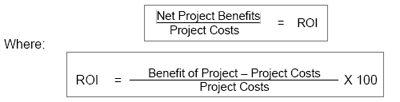
For a change to be considered advantageous, there has to be a compelling business case which will look at the cost of the project weighted against the benefits the company will gain. If the benefits outweigh the costs, the ROI is positive.  The formula for calculating Return on Investment (ROI)[2] is:

MOCblog


NATALIE PETOUHOFF, PHD, TAMRA CHANDLER and BETH MONTAG-SCHMALTZ, “The Business Impact of Change Management,” 2006 Volume 9 Issue 3.

In other words, the difficulties of change must be overcome by the positives, i.e. an ROI both financially and personally for those involved. 

Two other important items that many people forget when calculating ROI are a) the amount of resources and time change takes as well as b) the opportunity and efficiency costs of NOT making the change both of which also directly impact ROI

Looking forward …

We have established our key terms, change management and user adoption.  Now let’s look at management of change programs - which reap the benefits to your organization’s bottom line - from the different perspectives mentioned above through focusing on user adoption.  Next week, An Executive’s User Adoption Story. 


How My Life Teaching Moment Helped with Client Conflict Resolution

Posted by Full Sail Partners on Oct 3, 2014

conflict resolutionHave you ever had a moment in your life that stands out as a teaching moment that has made you who you are today? My moment transformed and prepared me as a Project Manager and Owner to tackle difficult conversations. Let’s face it, whether personal or in the workplace, we are constantly faced with resolving conflict.  At the same time, I have learned (or found) that not everyone is comfortable with expressing what needs to be said. So, it really resonated with me when a couple years ago I discovered a tool that has made conflict resolution easier. More about that in a minute. 

My Story

My teaching moment was when I was in sixth grade.  I had a teacher I felt was not being fair. I expressed to my mother my frustration to see if she could help. She told me that she could go to this teacher and have a conversation, but that the teacher would probably respond better if I addressed the issue head on. She coached me on how to have the conversation so I had the tools to handle the conversation on my own.

I was nervous as I entered her classroom. I asked the teacher if she had a moment that we could step outside of the class and talk. I told her how I felt and wanted to bring it to her attention to see how we could resolve the issue. The teacher was impressed and happy that I brought it to her attention. We came up with a solution and each day after I felt that I was respected and developed a better relationship with that teacher.  Each day I look back at that experience, I realize that was the moment I learned to speak up about concerns and not fear the hard conversation to resolve conflict.

Resolving Conflict

By no means am I an expert at resolving conflict. However, I have learned that avoiding the subject and hoping it goes away rarely works. Additionally, conflict doesn’t have to be looked at as negative. Sometimes opportunities flourish from conflict. The other person might be feeling the same way and because you took the time to say something your relationship improved.  A great resource for learning more about conflict resolution is Mindtools. Below are some tips I have learned throughout the years to help resolve client issues:

  1. Perception is Reality - The definition of conflict is to be incompatible. So in order to resolve conflict, the first step is to listen and understand the other person’s or group’s point of view.  We all come from different experiences that influence us and can lead us to make assumptions. So it’s important to understand that someone else’s views may have nothing to do with you, but be based on their past experience.  So with that, we must also realize that perception is the truth no matter if you think it’s true or not. Once you put your mind around that fact you can begin to focus on what can be done to resolve the issue.
     
  2. Managing Expectations Managing expectations with a client requires being proactive vs. reactive. Once a client is frustrated with multiple things that have built up over time, it takes a lot more work to resolve the issue and sometimes is too late. For professional services firms that need to manage clients, a great tool to help with this is the Client Feedback Tool. The only way you can really know what a client is thinking is to ask. This tool allows a firm to check-in with their clients using two minute surveys throughout the project. When you do this, you uncover things your firm has done that your clients love (so you can continue to do more of the same) as well as things that your client would like you to change if only slightly. This doesn’t remove the need for picking up the phone and calling, but it is great for letting you know there is an issue before it gets unmanageable. And, it is very comfortable for clients to let you know things you might not think to ask on the phone and that they might feel were perhaps not worth mentioning on a project call. However, knowing allows you to adjust your service delivery and make you even more valuable to them.
     
  3. Take Action – When a person does speak up about an issue, it’s important to follow-up, follow-up, follow-up and take action! Keep in mind that this doesn’t mean that you go against best practices or things you know are not in the best interest of the client or your firm. The feedback just brings out in the open something that matters to your client. It gives everybody a moment to collect their thoughts and then have a discussion. When you do, it’s important to communicate concerns you have and any consequences after fully understanding the client.  At the end of the discussion and meetings, a recap of action items, who is responsible and due dates can help you get back on track.

So the next time you encounter an issue with a client, I hope my story and tips help you think about ways you can deal with conflict resolution. Be sure to share your conflict resolution tips or stories. Should you want to provide your employees a way to manage expectations, we invite you to take a tour of the Client Feedback Tool. 


Project Based ERP: It’s Time to Tackle This

Posted by Full Sail Partners on Sep 17, 2014

Project Based ERP TackleProject based ERP.  You’re probably wondering to yourself, “what is this anyway?”  We’ve all heard of Enterprise Resource Planning (ERP) systems, but now the industry added the words “project based.”  It probably feels like they are just layering more words … and difficulty.  So let me make some sense out of this for you. 
Project Based ERP Straight Talk

Traditionally, ERP’s have primarily been associated with companies manufacturing products: a key factor in ERP is the merging of IT, HR, Finance, and Marketing data with product operations and inventory management. 

In services firms and consulting businesses like yours, however, some alterations must be made for the ERP system to show the data they need to achieve their goal – high profit and high revenue in a skills based environment – hence the addition of “project based” to our discussion about ERP systems.  Your services business deals with a model where intellectual property is what you produce.  You don’t have the evils of shelf life, production lines, or parts departments.  Instead, your lives are geared toward a consistent evaluation of process, of skill, and of running the perfect project.   

Get Down to Business

Project based firms are exceedingly good at running projects.  They can create a GANNT chart that’s a thing of beauty, they can set achievable deliverables, and they meet or exceed every deadline.  But finding an ERP system that’s attuned especially to services and not manufacturing – now that’s tougher.  It takes dedication, knowledge and the focused energy of the right team to get it all together.  

  • An ERP Consultant whose job is to master-mind all the necessary pieces to banish redundant, useless old processes and make your project’s business goals a realty.

  • A Project Manager focused solely on gathering and maneuvering all the professionals to make achieving your project goals a success.

  • Your IT, HR, Marketing/Sales, Finance as the true heroes to making things happen.

So What Are You Going To Get Out Of It?

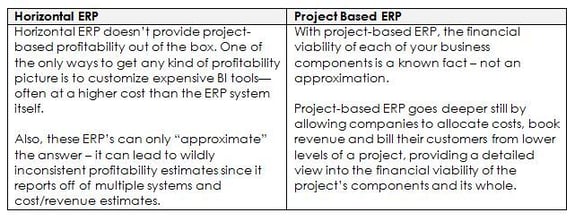
I know, I know.  “It’s expensive to add new software.”  “It’s a lot of work and we’re already pretty busy.”  I’ve heard this and more.  But let me tell you – you can’t afford NOT to add a project based ERP system!  The table below details those differences:

blog2

Brass Tacks

Still need more?  Here’s the slam-dunk.  According to “Managing Your Consulting Firm for Growth,” an IDC Info-doc, ERP systems built from the ground up with projects as a core process give firms the tools to make the most effective decisions in these critical areas:

Lifecycle process across customers, projects and employees.

Details on projects that help optimize profitability and lower risks.

• Manage and optimize an integrated portfolio of services – using data to learn how to do more of what “works” and eliminate what isn’t “working” (i.e. what’s not profitable).

• Find the “right” customers and have the data to eliminate unprofitable customers.

• Manage the future by understanding the past and using data to make fast, accurate course corrections.

A project based ERP system will combine the
strengths of 
Marketing/Sales, IT, HR, Finance together with
project management software 
to help eliminate project waste.

Bottom Line

Your dedicated employees joined with the support of organizations like Full Sail Partners, Inc.  will make your project based firm as successful as possible by using your greatest resource – a specifically designed project based ERP system.  And while it’s rad here in California to just “ride the waves,” when it comes to running your project based firm, using a project based ERP is your best choice.  Dude. 


Most Recent News Mentions

We’re changing the way project-based firms operate.

People can’t help but notice.
Who will be next?

Check out our latest newsworthy work:

Recent Posts