
In the News


We’re devoted to revolutionizing the way our clients do business. Sometimes that gets us noticed.

No big deal.

Posts about Client Relationships (3):

How My Life Teaching Moment Helped with Client Conflict Resolution

Posted by Sarah Gonnella on Oct 3, 2014

conflict resolutionHave you ever had a moment in your life that stands out as a teaching moment that has made you who you are today? My moment transformed and prepared me as a Project Manager and Owner to tackle difficult conversations. Let’s face it, whether personal or in the workplace, we are constantly faced with resolving conflict.  At the same time, I have learned (or found) that not everyone is comfortable with expressing what needs to be said. So, it really resonated with me when a couple years ago I discovered a tool that has made conflict resolution easier. More about that in a minute. 

My Story

My teaching moment was when I was in sixth grade.  I had a teacher I felt was not being fair. I expressed to my mother my frustration to see if she could help. She told me that she could go to this teacher and have a conversation, but that the teacher would probably respond better if I addressed the issue head on. She coached me on how to have the conversation so I had the tools to handle the conversation on my own.

I was nervous as I entered her classroom. I asked the teacher if she had a moment that we could step outside of the class and talk. I told her how I felt and wanted to bring it to her attention to see how we could resolve the issue. The teacher was impressed and happy that I brought it to her attention. We came up with a solution and each day after I felt that I was respected and developed a better relationship with that teacher.  Each day I look back at that experience, I realize that was the moment I learned to speak up about concerns and not fear the hard conversation to resolve conflict.

Resolving Conflict

By no means am I an expert at resolving conflict. However, I have learned that avoiding the subject and hoping it goes away rarely works. Additionally, conflict doesn’t have to be looked at as negative. Sometimes opportunities flourish from conflict. The other person might be feeling the same way and because you took the time to say something your relationship improved.  A great resource for learning more about conflict resolution is Mindtools. Below are some tips I have learned throughout the years to help resolve client issues:

  1. Perception is Reality - The definition of conflict is to be incompatible. So in order to resolve conflict, the first step is to listen and understand the other person’s or group’s point of view.  We all come from different experiences that influence us and can lead us to make assumptions. So it’s important to understand that someone else’s views may have nothing to do with you, but be based on their past experience.  So with that, we must also realize that perception is the truth no matter if you think it’s true or not. Once you put your mind around that fact you can begin to focus on what can be done to resolve the issue.
     
  2. Managing Expectations Managing expectations with a client requires being proactive vs. reactive. Once a client is frustrated with multiple things that have built up over time, it takes a lot more work to resolve the issue and sometimes is too late. For professional services firms that need to manage clients, a great tool to help with this is the Client Feedback Tool. The only way you can really know what a client is thinking is to ask. This tool allows a firm to check-in with their clients using two minute surveys throughout the project. When you do this, you uncover things your firm has done that your clients love (so you can continue to do more of the same) as well as things that your client would like you to change if only slightly. This doesn’t remove the need for picking up the phone and calling, but it is great for letting you know there is an issue before it gets unmanageable. And, it is very comfortable for clients to let you know things you might not think to ask on the phone and that they might feel were perhaps not worth mentioning on a project call. However, knowing allows you to adjust your service delivery and make you even more valuable to them.
     
  3. Take Action – When a person does speak up about an issue, it’s important to follow-up, follow-up, follow-up and take action! Keep in mind that this doesn’t mean that you go against best practices or things you know are not in the best interest of the client or your firm. The feedback just brings out in the open something that matters to your client. It gives everybody a moment to collect their thoughts and then have a discussion. When you do, it’s important to communicate concerns you have and any consequences after fully understanding the client.  At the end of the discussion and meetings, a recap of action items, who is responsible and due dates can help you get back on track.

So the next time you encounter an issue with a client, I hope my story and tips help you think about ways you can deal with conflict resolution. Be sure to share your conflict resolution tips or stories. Should you want to provide your employees a way to manage expectations, we invite you to take a tour of the Client Feedback Tool. 

 

Putting Yourself on a Shelf: Marketing Services Based Businesses

Posted by Admin on Aug 28, 2014

Consumers. Buyers. Clients. Users. Customers. You want ‘em, you need ‘em! and it doesn’t matter what kind of business you own.  Or does it? Marketing services based businesses can be a tricky task. 

Identifying and marketing to your consumers

is both formulaic and highly individual,

because what you’re marketing makes all the difference.

In other words, if you’re a product based firm or a services based firm, your marketing efforts will certainly have some similarities but marketing to each of these audiences will also have their own needs.

Let’s first start with definitions.  

marketing services based businesses

Product based firm – you’re an organization with a solid, tangible product to offer its customers:  you can package it and put it on a “shelf.” Marketing is pretty easy – you might even say it’s “textbook” (taught in every marketing class across the country).

Services based firm – an organization that has people as its primary offering, i.e. a process or an expertise.  And since you can’t package people or put a process on a shelf, you have to market differently. 

A bit of both – Sometimes you’re some sort of hybrid between a products business and services firm.  Maybe you sell a product and offer services to back up that product.  Maybe you offer services with some ancillary products.  Whatever your mix of products and services, your marketing efforts will have to vary depending on your target market for each.

Who says it best?

So let’s get down to business and start marketing.   

When you’re marketing a product, you let your product speak for itself, tell its own story of how buying the product will solve the customers’ problems.  You can do things like show your product in action - think cars careening down the highway or a newly cleaned floor.

With marketing services based businesses, it’s a bit different.  Yet still much the same.

Like products, services solve problems.  Marketing your services business will still show problems being solved but as told by the current clients of your services: as the old adage says, people buy from people.  Think of a company like “Angie’s List” which sells services of professionals as told by the users of those services.  With services, your biggest marketing tool is your clients.  In services, you can’t parade your product for your potential customers, but you can show those who have successfully used your services. 

Client Feedback Tool. The key to marketing services based businesses.

But how do you know the stories of your clients?  You ask them.  And in the services world, your best friend is client surveys, specifically, a Client Feedback Tool which companies like Full Sail Partners use to periodically and regularly gather information from clients about engagements.

Sometimes customers need a voice (other than just talking with a project manager) through which to offer their feedback.  A Client Feedback Tool offers survey questions which your clients can use to offer their thoughts on the engagement:  these can either be constructive points as to areas for improvement or compliments on the engagement which are really helping their work lives.  And, with the right marketing professional, both can be used to your services business’ advantage, because once you know how your customers are feeling, you can take action.  In marketing, no news is not necessarily good news; the more information you are armed with, the better marketing can do its job.

Never underestimate the value of retention

Marketing your services business is a bit different but can be better once you find your audience because of one word – RETENTION.  If you have happy customers, not only can they contribute to your marketing efforts, but keeping these same happy customers is the real boon to your bottom line.  According to Forbes.com “Five Customer Retention Tips for Entrepreneurs” 

For those who feel that customer retention plays a relatively minor role in helping a company grow a healthy bottom line, here are a few statistics you might be interested in. According to Bain and Co., a 5% increase in customer retention can increase a company’s profitability by 75%. And if those numbers don’t impress you, Gartner Group statistics tell us that 80% of your company’s future revenue will come from just 20% of your existing customers. Still not sold on customer retention? One final statistic provided by Lee Resource Inc. should give you plenty to think about: Attracting new customers will cost your company 5 times more than keeping an existing customer.   

When it comes to marketing services based businesses, happy clients are your secret weapon

Marketing your services business requires some tweaks to your marketing that differ slightly from product businesses.  Your chief marketing tool is your current customers as they proselytize your message.  Not only are they reaching new customers, but if they are happy enough to share your good work, it looks like you will have a long-term relationship making your bottom line even that much happier. 

Yes, it may be a bit daunting to come up with different marketing styles for your potentially varied target audiences. To accomplish this, check out the Client Feedback Tool - a tool designed to help you target your marketing efforts.


What to Look for in a CRM Consultant

Posted by Sarah Gonnella on Jul 24, 2014

describe the imageThe other day I had a prospect call looking for a CRM (Client Relationship Management) software, but what he found was a CRM Consultant vs. a “salesperson”. Don’t get me wrong, I absolutely want to sell software…to the right fitting firm. As with most calls, the caller wanted to set-up a time for a demonstration. The issue with immediately showing the software without a discovery is that it tends to be a waste of the client's time and mine. Without understanding the prospect's challenges, and ultimately how the software will help the client’s marketing strategy, a demonstration is futile. A CRM system isn’t a magic bullet. So when you are looking for a new CRM software, it’s important to also evaluate who will assist you beyond the sale. Below is what to look for in a CRM Consultant:


1. A Results-Oriented CRM Consultant Identifies Firm Needs

When speaking to a client or potential client, a CRM Consultant asks probing questions to evaluate the firm’s current processes, their challenges, and ultimately what they were looking to accomplish. As a CRM Consultant, it’s important to understand the firm’s level of sophistication related to marketing processes and measurement. Just like a growing baby, each firm is at a different growth stage. A baby must learn to roll over, crawl, stand, walk, and then run and so must a firm. You can’t expect to immediately start running. Some firms’ processes are advanced despite the fact that they have no CRM system. Others have no processes at all. A firm must start somewhere. So as a consultant, it’s important to understand the firm’s marketing maturity before establishing a CRM implementation for that firm. 

During the above mentioned call, the prospect was a little taken back when I told him that our system wasn’t the right fit for his needs. Ultimately, he was looking for another type of software. Although it ended up not being a lead, the prospect was thankful for my honesty as I took the time to understand what his firm needed and helped guide him down a better search path.

2. A Vigilant CRM Consultant Engages Key Players Throughout Implementation

After establishing needs, it’s important to make sure you have the right players. As outlined in this previous blog article, 8 Reasons for a Successful Implementation, it’s important to ensure executive buy-in during the sales process. Just as important is having the right CRM champion and with an ERP (Enterprise Resource Planning) system it’s important to get finance involved. All of these key players must be a part of not only the implementation, but also the sales process. When involvement from any of these roles is lacking, the likelihood of success is lessened. It is the role of the CRM Consultant to make sure that these key players are established from the beginning, and play their part through the implementation. These key roles play a huge part in the roll out of the system and must also engage other end users to ensure all departments, divisions, markets, and offices are represented.

3. It is the Duty of a CRM Consultant to Look to the Future

When going through an implementation, a misconception that many firms have is that once the implementation is complete, so is the development of your CRM. What worked today won’t necessarily work tomorrow. As your marketing strategy and the competitive landscape changes, your CRM system must continue to evolve. Your CRM Consultant should look to resolve short-term and long-term needs, as well as, think about strategic marketing plans. For example, do you plan to open a new office, go into a new market or start a new service line?  A CRM Consultant is there to guide your firm on metrics that would be valuable to access your marketing traction.

4. Your CRM Consultant Should Be a Strategic Partner

A CRM Consultant should be more than a trainer or a vendor. Treating one as such is a common mistake made by firms seeking to hire a CRM Consultant. So how do you know if you have a consultant or a vendor? If we look at the basic definition of a vendor, “a person or company offering something for sale”, we can see there is no value-added beyond the sale. Whereas a consultant is “a person who provides expert advice professionally”. A value-added CRM Consultant should have a background in marketing and be able to help your firm adapt the system to your marketing strategy. A consultant will:

  • Ask strategic questions to better understand your business needs
  • Provide best practices and facilitate your company in adapting the system to gain insight on metrics that matter
  • Go beyond showing you how to just use the system
  • Help you understand how to increase user adoption
  • Look at ways to improve your business and your clients

Ultimately, your CRM Consultant should be a partner that understands your business needs whom you can rely on to help you as new needs arise. If your firm is looking to improve your CRM processes or looking for a CRM, be sure to check out Full Sail Partners’ webinar on Managing Your CRM System and Beyond! The webinar provides insight on CRM objectives, clean-up, set-up of your system, metrics that matter, and how to engage finance.


Be sure to add a comment to let us know if this article and webinar were helpful or reach out to us personally via email, phone or LinkedIn

From Marketer to CXO, What Does CRM Mean for You?

Posted by Jennifer Renfroe on Apr 24, 2014

What does crm mean

What does CRM Mean? CRM (Customer Relationship Management) is a solution that enables your firm to cultivate relationships and gain valuable insight in to marketing efforts. An integrated CRM solution brings together data from all data sources within an organization to provide a holistic real-time view of each customer or campaign. This real-time knowledge provides your team with the metrics and data needed to make informed decisions in a quick, yet calculated manner. 

What Does CRM Mean for My Firm 

A CRM system is truly something that each member of your team can benefit from. Examples of the benefits a CRM solution provides include: 

  • Track client contact information | No need for the use of virtual cards or digging through outlook to find email signatures, a CRM allows your entire firm to store valuable customer information in one location.
  • Monitor marketing campaigns and efforts | What good are your marketing efforts if you cannot track the results? Track the effectiveness of your efforts and campaigns to help better refine your message and target audience.
  • Review past engagements | Utilize dashboards to easily track which messages, campaigns, and leads resulted in the highest wins.
  • Access customer (or lead!) information, on the go | Never get left out in the cold again! Gain access to your customer information on the go! Readily available intelligence allows your business development staff to go out and produce, and track, results.

What does CRM mean for your SMB, and how can you use it to grow stronger? The answer is simple; a CRM solution means that as your business grows, and the associated contacts and connections grow with it, you have the ability to manage a myriad of relationships across your entire firm. Clients are the lifeblood of any professional services firm, and without a proper CRM solution in place, you are essentially ignoring an open wound. So how can your firm use CRM to manage an opportunity from concept to completion? Simple: 

  • Pipeline and Cash-flow forecasting | Avoid rough patches and dry spouts by becoming intimately familiar with your pipeline of potential new business, and the value of your current projects.
  • Track progress on current sales opportunities, review historical information on past opportunities | When speaking to a client or prospect, easily log details about the conversation for later follow-up. Tracking detailed information about interactions can allow you to win future work, based on often overlooked past experiences.
  • Create milestones for each step of the project, and specify a target completion dateTasks can be created and associated with each milestone within the project, so you have more granular control of what needs to be done, by whom, when.
  • Comprehensive reporting allows deeper insight | Setup your marketing goals within your CRM and track status and progress quickly and easily.

It is important to not only track valuable customer data, but to do so in a way that promotes sharing amongst your team. Promote growth and sharing and consider taking your customer data in to the cloud with an all-in-one CRM solution that consolidates all of your information in to an easy to access system. Stop wasting valuable customer insights and information, and start impressing customers with your deep firm-wide knowledge about each relationship. 

So next time someone asks you ‘what does CRM mean’, you can tell them, “CRM means winning more work!” 


Is Your Project Evaluation Plan Measuring all the Metrics You Need?

Posted by Ryan Suydam on Apr 9, 2014

clientsatisfactionAdding client feedback results to your project evaluation plan provides an incredible return on investment. Conversely, by failing to identify key satisfaction metrics, your projects are less efficient, and you have less insight in to the mindset of your clients. Ask yourself, in the modern competitive business environment, can your firm afford to overlook anything -- let alone the satisfaction of your clients?
Our easy to use client satisfaction solution, The Client Feedback Tool, allows clients to quickly and easily provide insightful data that will ensure that projects stay on course, and meet or exceed expectations. Utilizing our tool, asking your clients how your processes work takes them only two minutes to complete - but the information provided gives both parties valuable data to assure effective, successful projects.

Based on our research, including 100K pieces of data from our clients, we've listed 4 ways that feedback will add to your bottom line.

  • Identify your top 10% most loyal clients. Do you have a way to identify which clients value you most?  Using the information provided using the Client Feedback Tool, our clients have identified their top 10% most loyal clients and converted this knowledge into increased billings, increasing fees by 3% to their top-rating clients.  For a $10 million firm, this translates into roughly $30k in additional profit each year.
     
  • Retain one client on the "bubble." One-third of our subscribers came to us after losing a major client.  In every case, these firms were surprised by the defection and realized they were blind to a pattern of problems the client never brought to light.  Frequent feedback greatly reduces the chances of this happening.

    According to PSMJ Resources: 

    • AEC firms spend four times more money replacing a client than the costs of retaining one.  
    • Even if you replace the lost revenue of a departed client, the added cost of winning a new client typically exceeds $22k.
     
  • Increase marketing efficiency by 3%. The average AEC firm spends 11% of their revenue marketing, while seeing only 25% of pursued work turns into billable work.  Adding client feedback informs you of your market successes and identifies where your firm’s strengths are.  By marketing your strengths to your best market sectors, you’ll not only target the markets that are most satisfying (and profitable), you will also reduce wasted effort pursuing work that doesn't match your firm's core services.  Even a 3% increase in efficiency will save a $10 million firm over $33k a year.
  • Reduce key staff departure by 5%. PSMJ Resources again reports that replacing your best staff costs in excess of $100k per departure.  Most key staff don’t leave for better salary. They leave because they feel unappreciated, unvalued, and because they feel their growth is not supported.  Quantitative feedback gives you the tools and information to recognize performance.  In fact, your clients will be directly recognizing your staff’s efforts as they provide feedback.  Research based on nearly 10 years of helping our clients collect feedback indicates that their clients rate staff performance as "Exceptional" 22% of the time.  This satisfying work environment will help retain (and identify) your best people, saving an average of $67k each year.

It’s simple, regardless of firm size, incorporating feedback in to your project evaluation plan can increase profits 13% or more just by applying these tools and strategies.

Garnering the client feedback metrics needed for your project evaluation plan is easy with a simple and powerful system like The Client Feedback Tool.  

Why Team Collaboration Tools are Essential for Productivity

Posted by Sarah Gonnella on Mar 12, 2014

Team Collaboration ToolsWhat are the major productivity killers for firms in the Professional Services? For most firms, some of the biggest ones revolve around information overload, duplicated effort and other inefficiencies. 

Fortunately, team collaboration tools can address each of these areas — and thus have a positive impact on the productivity of individuals and teams throughout an organization. 

First, let’s consider the element of information overload — which for many people is exemplified in the form of an overflowing email inbox. We all know the frustration of seeing fifteen different emails with the same subject line, where people are actually commenting each other’s earlier messages — and then trying to untangle the sequence of the discussion to make some sense of it. Not only does this type of information overload take time to sort through, but the reality is that with so many emails piling up, important messages can get lost or go unread. 

Another major factor that negatively affects productivity is duplication of effort. It’s common for multiple people in a firm to be working on the same problem — but is some cases, rather than working as a team, they’re operating in unconnected silos. Even if the whole team was in the same meeting, subsets of the group may have informal follow-up meetings, or even chance encounters in a hallway. Any one of these can result in parallel (and duplicated) efforts. 

Inefficiencies come in a variety of flavors, ranging from the annoying to the scary. One of my favorites is the issue of document versioning. This is especially likely when multiple people are working separately on the same document. Unless a firm has a solid solution in place, it’s all too likely for multiple versions of a document to spring to life, each with its own edits and authors. Sorting through the different versions to create one final document can be a time-consuming source of frustration. 

Real team collaboration is a beautiful thing

Now let’s switch gears and talk about some of the productivity gains a firm can realize by implementing effective team collaboration tools. 

One of the most essential functions that collaboration tools perform is organizing team members’ communications into a centralized repository of conversations around specific tasks and issues within the project. In the Kona tool, for example, individuals can have conversations with one colleague, a small group within the team, or the entire team. They can also see the various subtasks, view a centralized project calendar and share information with the entire team. 

Team collaboration tools can enable project managers to set up their groups so that certain members are able to see all conversations, while others have a more limited view. This capability can be especially critical when collaborating with clients. 

Kona in particular has found an effective way to address the problem of sharing documents among members of a team – one that ensures that everyone is working off the latest version. Instead of sending colleagues the actual document as an email attachment, users can send links to where the master files are stored (including such online services as Dropbox, Box or Google Drive). 

Last but not least, when collaboration tools are web-enabled, like Kona, they’re ideal for optimizing the way people work in the real world. After all, not all of our productive time is spent at work; we can also be productive when we’re in between doing other tasks, whether at home, on business trips or elsewhere. Team collaboration tools allow individuals to continue being productive, wherever and whenever inspiration hits. 

Summing up

Until a firm finds an effective way to address factors like information overload, duplication of effort, and inefficiencies, its productivity will probably suffer. Team collaboration solutions may hold the key to making the most of your team’s collective abilities — and at the same time, minimizing the overlaps, dropped balls and other issues that may be limiting your productivity.


How to Use Social Collaboration Tools in a Professional Services Firm

Posted by Rana Blair on Mar 5, 2014

SOCIAL COLLABORATION TOOLSLet’s be clear: people are not squirrels. That being said, when you’re trying to get your firm’s employees to interact with each other effectively, it may seem like trying to herd the little woodland creatures.
Most firms’ leaders already know that the most effective answers to this challenge involve improving collaboration, communication and teamwork. Easier said than done, right?

Fortunately, social collaboration tools can improve the effectiveness of not only your individual employees themselves, but also the separate functions within the firm and also the organization as a whole. Here are some of the ways a firm can use these innovative tools to add value throughout the organization.

Executives

From the CEO or partner’s perspective, social collaboration tools have the potential to improve productivity at every level within the organization. Here’s how:

  • Individual employees are empowered to share information and collaborate on projects more efficiently and keep their managers and colleagues up-to-date in real time.
  • Functional units can collaborate more effectively, because managers have better insight into the status of all ongoing projects. Managers also have a central location for all project communication that doesn’t disappear when an employee leaves.
  • Differentiating your firm from the competition by providing a collaborative environment for not only your internal team members, but outside consultants and clients. 

As an example, collaboration tools such as Kona make it far easier to include clients as team members throughout the process. Compared to other firms that simply use emails and phone calls to keep clients in the loop, a firm using these tools can enable more integrated and up-to-date communication with clients, and at the same time, create a more enjoyable customer experience. 

Project Managers

On each project, project managers can get better visibility into milestones and issues, improving project efficiency as well as the client’s experience in several ways:

  • Improves team members’ communication and accountability, while reducing time wasted in status meetings.
  • Strengthens the project manager’s relationship with the client, and also differentiates the firm.
  • Brings new staff up-to-speed more rapidly, shortening the time required before they can contribute.
  • Creates a centralized record of working issues, tagged and easily searchable. 

Marketing/Business Development

Professionals in a firm’s marketing/BD function, like its executives, stand to benefit in the long term from the differentiation that can result from effectively managed social collaboration tools. They also benefit in more tactical ways:

  • Improves communication and accountability in proposal planning, development, and review, including go/no-go decisions.
  • Streamlines event planning and tradeshow preparation.
  • Provides unified view of specific tasks across multiple BD proposal efforts happening simultaneously.
  • Enables greater consistency and knowledge transfer across multiple groups working on proposals and other repeatable processes. 

Information Technology

IT departments can use these tools to address a range of technical needs and, at the same time, change the culture to one that is more collaborative. Among its impacts, a social collaboration tool:

  • Enhances internal and external collaboration while protecting network information.
  • Is less expensive than traditional collaboration solutions such as SharePoint.
  • Improves management of complex IT projects and saves time by enabling peer support.
  • Allows the CIO and other leaders to be more aware and experience the “pulse” of individual projects and issues.

Human Resources

For the HR function, these tools can help in ways that are both strategic and logistical. Social collaboration tools:

  • Streamline and expedite recruiting and on-boarding processes.
  • Use two-way internal communication about tasks, events, and topics to create a more collaborative environment and improve employee engagement.
  • Allow HR employees to be more productive in planning and implementing internal events and initiatives.

Accounting

For the accounting function, social collaboration tools bring new efficiencies to a variety of ongoing processes in multiple ways:

  • Rather than having to dig through email chains and contact multiple individuals for updates and answers, accounting professionals can streamline the month-end close process by generating repeatable steps to organize and capture financial information.
  • Contract management can be improved by creating templates with specific steps and forms to guide each project.
  • Accounting staff can create a private but accessible space to capture progress and follow-up on A/R issues, assign individual responsibilities and maintain a centralized log of progress toward resolution.

The Collaborative Edge

In a sense, your most important asset could also be a liability:  If your staff cannot collaborate effectively, you’re not optimizing your firm’s capabilities. Social collaboration tools have the potential to improve collaborative capabilities at every level and in every area of your organization, bringing about measurable improvements. At the same time, they can help you create a better client experience and differentiate your firm from others — critical factors in attracting and retaining clients and employees.  

Four Best Practices for Team Communication

Posted by Full Sail Partners on Feb 21, 2014


Team CommunicationHave you ever tried to communicate a thought or idea to a group or team, and yet no matter how hard you try, you cannot get your point across? Like it or not, we have all been there. The cause for this breakdown in communication could be many different factors, but many times this breakdown is caused by a failure of fundamental best practices for team communication.


Let’s review four of the best practices for team communication that will get your team operating at full sail:

  1. Responsibility is on the sender of the message, not the receiver! We live in a complex world, and most of us are juggling what feels like a hundred different things. This can often lead to us jumping from task to task, often leaving a tornado-like path in our wake. Next time, before you start forming the message for your co-worker or teammate, stop for a minute and organize your thoughts. If you are having a hard time keeping up with your train of thought, how do you expect someone else to follow it? As the communicator, it is incumbent on you to develop a coherent, easy to decipher message that has been received the way you intended.

    Think > Organize > Disseminate > Confirm

  2. Cut out the noise. You may be sitting there saying “DUH!”, but honestly ask yourself, have you done this lately?

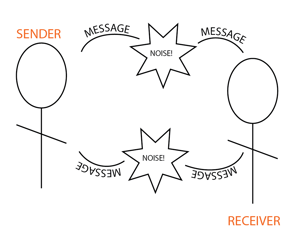
    Communication noise refers to influences (outside and internal) on communication that effect the interpretation of the conversation. Often over looked, communication noise can have a profound impact on both perception of interactions, and analysis of our own communication proficiency.

    Noise can be many factors ranging from psychological (stereotypes, biases), Physical (loud music, incessant background noise), physiological (preoccupied during conversation), or semantic (sender mumbles or uses jargon). In order to follow our best practices for team communication, we recommend identifying any potential noise before, during, and after a conversation, and addressing it immediately!
     
  3. Haste makes waste. Rarely are our first ideas, our best ideas. Often times in the business world we will spend hours upon hours forming our thoughts and opinions about a subject, and then turn around and expect our peers to provide the same insight, only on the spot.

    In all fairness to your project team, you must provide your team with an environment that fosters thinking, collaboration, and open ideas. Failure to do so will cause even the most extroverted of individuals to crawl in to a shell, making their ability to interpret your message more difficult. Lack of creating an environment that fosters collaboration will lead to team members more worried about why you are asking a question, rather than what you are asking.
     
  4. Listen, listen, listen! Did you know that we listen at a rate of 12-250 words per minute, but think at a rate of 1,000-3,000 words per minute? While impressive, this statistic is very scary! One of the biggest breakdowns in communication comes from lack of listening, both from the side of the sender, and the side of the receiver. If you, or your team, are too busy forming your opinion about what is being said, rather than listening to what is being said, you are doing your entire team a disservice. We have two ears and one mouth for a reason!

    Tip for better listening: If you are working behind a computer while having a conversation, do not ever open up your emails mid meeting. We all want to check that fresh email that just popped up in the corner of our screen, however by doing so you have effectively checked out of the conversation at hand.

We hope that you can apply these best practices for team communication, and improve the effectiveness of your team’s communication efforts. Agree or disagree with anything in this blog? Make sure to comment below and let us know your thoughts! 

Interested in improving team communication? Check out Deltek Kona, a new social collaboration tool. Deltek Kona is revolutionizing the way teams communicate!


The Project Performance Equation: Firm Metrics + Client Metrics = Success

Posted by Ryan Suydam on Jan 14, 2014

PROJECT PERFORMANCE

As the New Year begins, most businesses, including ours, look for ways to drive even greater success than last year. If you are like most professional services firms, you evaluate project performance based largely on the efficiency with which the project is completed.  Unfortunately for most firms, they only look at half of the equation.

Evaluate Client Feedback for the Full Picture

Client feedback should focus on helping clients achieve the long-term success they desire by measuring all the metrics important to project performance. As the title suggests, this includes measuring both financial metrics and client metrics. Client metrics measure how well your process is meeting your client’s expectations at each stage of the project. If your team is not asking whether their client’s expectations are being met, they are making three dangerous assumptions:

  1. An existing project delivery process will meet a new client's expectations (or a new project manager will meet an existing client’s expectation)
  2. A client’s expectations of the project manager they have worked with before is not influenced by external factors
  3. You and the client have the same understanding of project communication, deliverables, etc.

Benefits of Client Feedback

When your firm uses real-time, project-based feedback, you give your clients the opportunity to share their changing preferences and priorities with you throughout the project. You eliminate the assumptions that can result in poor project performance and unmet expectations. You strengthen your relationships with your clients as they realize that you really care about their goals. Ultimately, because the feedback you request is designed to benefit your client, you also give them the ability to help you help them achieve the success they desire.

Some of the benefits of improving your project performance and creating success for your firm include:

  • Establishing a reputation as experts, elite players with a premium brand.
  • Reducing or eliminating re-work and scope creep
  • Becoming the ‘go-to’ firm
  • Impacting the bottom line by providing a steady stream of profitable work

As 2014 gets underway, let’s challenge ourselves. Instead of measuring the same things you have in the past and expecting different results, take the strategic step of tracking the metrics that matter. Just like, Peter Drucker says, “what is measured improves”.  So the question to ask yourself is: Are you measuring the metrics needed to create the success you desire? Click below to learn more about measuring client metrics to create firm success. 


Project Survey - Just Click the Dot for Details!

Posted by Ryan Suydam on Dec 4, 2013

CFT ButtonAs a project manager you have more to do in any given day than you can possibly get done. Sound about right? And, as if you don’t have enough to do, you sit through team meetings, office meetings, and visits from the top leadership where they remind you how important it is to ensure your clients are your top priority while also achieving strong profits. Okay. Now for the big question – how do you balance both priorities?
Do you remember the EASY button? Well I think Staples© was really onto something with that. I can’t tell you how many times I’ve wished I had one of those to handle tasks that I knew were important but that I struggled to get completed. Have you ever wished you had one to measure how things were going with your clients? Wouldn’t it be great to have a one button solution when your supervisor asks you how things are going with your clients?

Well, now you do. The answer – send your clients project surveys!

Client Feedback Tool grew out of an architectural firm so I definitely get it! As strongly as I believe that getting feedback from your clients is essential to building strong and lasting relationships, I am well aware that time is the one thing project managers in the A&E industry have in limited supply!

So you may be wondering, he just acknowledged that project managers have no time for extra steps in the project management process and yet he is suggesting that we send project surveys to our clients? Fair enough. The truth is that it takes less than 2 minutes to send your clients a survey. And, the information you get will save you so much time!

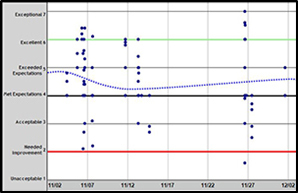
cft plotterEvery time one of our clients sends a survey, their clients’ responses are logged onto a scatter plot like the one in this figure. One of several reporting options, the scatter plot analyzes how well client expectations are being met. It takes less than a minute to run and you can schedule it as a weekly or monthly recurring report. Our clients see a snapshot of what their clients are saying. Are you starting to see how this will give you the information you need?

Each of our surveys consists of about 6 – 8 questions asking how well client expectations in different categories are being met. The blue dots represent individual pieces of feedback from one of those surveys. With a 4.0 indicating that the client’s expectations are being met, this one chart can be your very own EASY button!

With one quick glance you can see that overall you and your team are meeting, or exceeding, your clients’ expectations. But there’s more.

When you click on any of the blue dots, you immediately see:

  • What project that piece of feedback is associated with
  • What question was being asked
  • Who answered the question
  • Any specific comments by the respondent

It’s important to note that using project surveys does not replace the ongoing conversations you have with your clients.  However, with a strong feedback process you can, in about 5 minutes a day, get the details you need and get back to managing your projects. If there are ever any challenging responses, a simple click on the blue dot gives you the information you need to begin finding a resolution before their concerns become problems.

In addition to seeing the results for the clients you manage overall, you will have the ability to see a scatter plot for each individual client as well. Now, with your very own EASY button, the next time you are asked ‘how are things going’, you will have the information at your fingertips!

Interested in learning more about using project surveys?


Most Recent News Mentions

We’re changing the way project-based firms operate.

People can’t help but notice.
Who will be next?

Check out our latest newsworthy work: