
In the News


We’re devoted to revolutionizing the way our clients do business. Sometimes that gets us noticed.

No big deal.

Difference Between Project Backlog and Project Forecasting?

Posted by Scott Seal on Nov 6, 2013

Project Backlog, Project ForecastingProject Backlog and Project Forecasting are two of the major components that predict current and future profitability of a firm. As firms begin to put together financial budgets for future years they are often looking at these two in conjunction between project backlog and project forecasting. Typically there are two different processes for forecasting future revenue:

  1. Project Managers forecast work-under-contract, as part of backlog. This contracted work not performed is the most accurate indicator of short-term revenue. Additionally a firm’s backlog (the difference between contracted work and the work completed to date) reflects past marketing success and current project managers’ ability to balance resources against project workload. How successful a firm is in managing this backlog often determines whether profits are either realized or squandered.
  2. The Marketing group forecasts less-probable opportunities as part of our Project Forecast. Unlike the project backlog, the Project Forecasting discounts project opportunities to reflect uncertainty the project will be put under contract. When reviewed together, these two provide a very good picture of future revenues and upcoming workload.

Benefits of Project Backlog and Project Forecasting

A solid Project Backlog and Project Forecasting process helps manage this balance in the following ways:

    • Provides project managers tools for resource planning, scheduling, and deliverable management.
    • Provides a solid basis for marketing decisions. If your backlog forecast is lower than anticipated then increase your marketing campaigns engine. If your backlog forecast is higher than anticipated then add resources or become more selective about your marketing campaigns.
    • Provides validation of firms’ revenue projections to confirm the accuracy of your corporate financial planning efforts.

The project backlog and project forecasting process need not be complicated; it needs only to provide a standard tool for company-wide project planning and review. Use the following three steps to initiate a project backlog and project forecasting process.

1. Prepare a weekly ‘bottom-up’ forecast by project manager.

    • Each project manager compile a project backlog forecast that identifies active projects under backlog and opportunity forecast that exceed say a 60% probability.
    • Assign team member resources, and then resource loads (using an hours forecast) each project for the next six-to-eight weeks.

There are several benefits of these project manager forecasts which include:

    • Provides the project manager an opportunity to balance resources, identify gaps in workload, and plan for downtime (i.e. vacation, holiday, training, etc.).
    • Provides structure for reviewing project milestones, progress, and budgets.
    • Provides revenue forecast by pairing the forecasted hours with billing rates.

2. Management aggregate review

Once weekly project backlog forecasts are completed, management then can compile and review these aggregated forecasts. This step often provides insight into the following areas:

    • Possibilities of resource sharing between teams or service areas.
    • Provides glimpse at future  revenue projections
    • Identify potential budget problems.
    • Comparison of projected backlog revenues against corporate revenue goals.

3. Comparison to actual utilization.

Finally, we review weekly utilization from timesheets to ensure that forecasting matches reality. These reviews provide a critical feedback loop to improve your project forecasting process.

By following a sound process of project backlog and project forecasting tracking your firm can increase project management effectiveness, make better decisions about marketing expenditures, and improve and validate your corporate revenue planning efforts. These benefits will drastically improve profitability. 

Project Conflict - Cause for Stress, or a Path to New Ideas?

Posted by Ryan Suydam on Nov 5, 2013

project ConflictIf you ask friends or colleagues how they feel about conflict, you will likely know their answer even before they speak. Their body language will tell you immediately. That is because most people view conflict as having to do with arguments, agitation, and to an extreme extent, hostility. But what if we reframe the way we look at conflict? Is there a way to see conflict as an opportunity if we accept the fact that conflict is essentially about the gaps in expectations that happen when individuals interact?

Project teams work hard to match their deliverables to their clients’ expectations. However, we all know there are, at times, bumps in the road and that project conflict can occur when your team’s understanding of deliverables, communication, or schedule is different than your client’s. There is certainly no magic to ensuring this doesn’t happen but there are three actions you can take to minimize the frequency and to actually turn these gaps in expectations into an opportunity to learn more about your clients.

Don’t avoid it or ignore it. Just because you are not aware of the gap between your clients’ expectations and what your team is delivering does not mean that the gap doesn’t exist. Both you and your client make assumptions related to their project every day. You assume that the way you have done 50 projects in the past that are just like this one is the way to progress on this one. Your client may have expectations (or a vision) about what the deliverable will look like that is different than what you are planning. It happens. However, if throughout the project you ask questions, you will catch these gaps in expectations as soon as they occur. And, the sooner you and your client have a conversation about the difference in your expectations, the sooner your project gets back on a healthy track.

Don’t blame anyone. I have heard many A/E/C firms speak of having difficult clients. Their (clients) expectations are unrealistic, they are inconsistent, they just expect you to read their minds and know exactly how they want things done. This may be true. But beyond the obvious problem with telling your clients they are wrong, playing the blame game may create an attitude on your team that your clients will pick up on. By looking at project conflict as nothing more than a gap in expectations, you and your team will have the opportunity to learn more about each client. As you solicit feedback from your clients, you will close any gaps in expectations and be recognized as their expert.

Communication – the great conflict alleviator. You can avoid having conflict escalate or go unresolved, by communicating regularly with your clients. Asking for feedback on a regular basis lets you keep a pulse on whether or not there are any expectation gaps. You will quickly see if there any issues that need to come to the surface? By asking for feedback and following up, you will keep the channels of communication open. And, you will give your clients the opportunity to share with you their ideas and thoughts about how they would like you to serve them.

Getting regular feedback lets you build an easy rapport with clients. The Client Feedback Tool process is easy and comfortable for both you and your clients. Integrated into your existing project management system, the feedback you receive provides you with new ideas about your clients’ preferences. We hear a lot about being your client’s trusted advisor. In addition to being their trusted advisor, you will also become the expert at how each individual client prefers to be served.

Learn more about using feedback as an opportunity to turn conflict into client loyalty and trust.

Why Cash Flow Planning is Essential for Growth

Posted by Scott Seal on Oct 30, 2013

cash flow planning, cash flow planFor most professional services firms, planning for growth is a natural part of business. There are different strategies for doing so, and choosing the best one depends on your ultimate growth objectives. But whatever your goals, understanding how your growth plan affects your cash flow plan is essential to achieving the results you seek.


The way you grow affects cash flow planning.

Organic growth. There are a number of ways to grow one’s business organically. For example, in a generally healthy economy, your firm could continue doing “business as usual” (i.e., not increase your marketing or business development activity) and still experience significant growth from the improving economy. This type of growth is typically slow-paced; you can keep up with the increased demand either by using existing staff or gradually “ramping up” your staffing to meet the growth curve.

A somewhat more aggressive growth plan might be to expand your client base in the same market niche and geographic area where you’re already doing business. In such a scenario, you are typically increasing your marketing and business development outreach to generate business. As this outreach occurs, you may experience rapid growth that requires you to have staff immediately available to meet the increased client demands.

Strategic growth. Alternatively, you might be planning to significantly expand your service offerings or target market. For example, an engineering firm might add a new service line, or expand into another geographic market. In such cases, you could expect to take on additional marketing and staffing expenses, along with expenses for market research (please do not skip this step), software and equipment and possibly even new office space. These added expenses occur up front, well before you bring dollar one through the door. 

Expect a time lag before reaching ROI.

The fundamental point to keep in mind is that your cash flow will take a hit, probably at least for 90 days for increased staffing costs, and longer for marketing costs. The reason for this is the unavoidable lag between when you begin investing in expansion, and when you actually start reaping the benefit.

Here’s the general reason for the time lag. Once you decide to expand, there are several types of expenses you’ll incur at the beginning of your growth effort — investments that will not bear fruit immediately. For example, there are costs to hire and train new employees, with probably 60 days before they’re doing billable work. Even if you’re very efficient and bill on day 61, then the earliest you should expect payment for their work will be another 30 days, making it a minimum total of 90 days where cash is going out, but no additional revenue is coming in.  

How to meet the demand: sub-consultants vs. salaried staff.

In general, hiring consultants requires less of a cash investment than full- or part-time staff, as they typically will not get paid until you get paid (Paid When Paid, or PWP). This advantage may be offset, however, by the fact that consultants can also be more challenging to manage and they have their own clients (and potentially conflicting commitments as well). Additionally, you still have to invest manager time to assign and manage the sub-consultants’ performance.

On the other hand, while full- or part-time staff may be more costly to hire, they will likely gain institutional and process knowledge as they work, which should make them increasingly valuable to your company. Additionally, they are typically focused on the company’s needs and requirements; you can control their priorities.

Tracking cash flow and return.

The other part of cash flow planning during a growth period (or at any time, for that matter) is monitoring your expenditures and results (hopefully in the form of additional revenue). As with any plan, it’s essential to have an idea of the effort you need to expend, and what results you expect from that effort. Even if your plan is “business as usual” because of an improving market, you should understand what results you expect from the improving market. If you are increasing your marketing effort in your existing market, you should know what you expect from that effort in the form of additional leads, opportunities, clients and, of course, revenue. Without the increased revenue, what is the justification of the increased marketing effort (and assumed increased cost)?

There are a number of approaches for tracking results, ranging from one-off spreadsheets to purpose-built ERP solutions.

In our experience, one of the most effective strategies is to find a solution that accomplishes several key functions at once. Deltek Vision, for example, is a purpose-built ERP solution that provides a unified platform for connecting the front and back office functions — providing up-to-the-minute insight into cash flow planning, as well as accounts receivable, billability and utilization statistics, and much more. It even includes integrated solutions for automating major parts of your processes for customer relationship management, proposal development and tracking.

Watch the details, but don’t neglect the big picture.

Keep in mind that the timeframes for generating ROI mentioned in this article are generalizations. In fact, they’re based on an ideal scenario that assumes making good hires, efficiently training and integrating them, finding a receptive market … and getting paid on time.

Naturally, as the fine print often says, actual results may vary. This makes it even more important to build-in expectations that cash flow will take a significant hit for at least a few months before you start reaping the rewards of you investment.

Growth is rarely painless or easy — but knowing what to expect is far better than wading into a growth plan without knowing when it will start paying off.


Professional Services Marketing: A Changing Landscape

Posted by Lee Frederiksen on Oct 23, 2013

changinglandscape

Guest blog written by Lee W. Frederiksen, Ph.D.

It’s old news that technology has changed the way we interact – and that includes the way we purchase goods and services. But the professional services industry has largely lagged behind other sectors in reacting to this change, continuing to rely on traditional forms of marketing that are both more expensive and less effective. The small percentage of firms that have embraced online marketing, however, have seen marked success. In our recent study on online marketing, we learned that professional services firms employing online marketing techniques grow 4X faster, and are 2X more profitable than other firms. Why is this so? What is it about online marketing that is so effective? To understand why online marketing works, we need to understand today’s buyers. 

How Buyers Choose Professional Services Firms 

Technology has changed the way that buyers search for and evaluate professional services firms. Based on our research, we know that 71% of buyers still ask their friends and colleagues first when they search for a new professional services firm. At first glance, this seems like the old way of doing business. What’s changed is that, after receiving the referral, these buyers can now go online to do their own research on the firms that were recommended. 

The Internet has allowed buyers to take much more control of their purchasing process. In fact, in their recent study of over 1,400 B2B consumers, the Corporate Executive Board found that 57% of a typical purchasing decision occurs before the buyer ever has a conversation with a service provider. This represents a drastic break from the past. 

Even more notable, the third largest group in our study—11% of professional service buyers—said they skip the referral process altogether, going directly online to search for firms. Combined with the first group of buyers who use the Internet to check up on firms referred from their network, this means that altogether 82% of professional services buyers go online at some point in their buying process to evaluate a firm. 

The Digital Generation 

The Internet has drastically changed the marketing landscape for professional services firms, and we expect that landscape to continue changing. Consider that most workers under the age of 35 have never worked in an office without Internet access. Research shows that for this rising category of leaders, using online resources to evaluate and communicate with firms is second nature. And, as this digital generation ages and takes on increasingly senior leadership positions, they will give technology an expanding role in their buying and decision-making process. 

Putting It All Together 

Technology has forever changed the way that consumers interact with, and purchase, professional services. Those firms that learn to embrace the advantages offered by these new technologies will continue to grow and profit, widening the gap that already exists between technology adopters and non-adopters. For professional services firms, ignoring online marketing means living in the past. 

Read more about the way professional services marketing is changing in Hinge’s new coauthored book, Professional Services Marketing 

About the Author:

Lee W. Frederiksen, Ph.D., is Managing Partner at Hinge, a marketing firm that specializes in branding and marketing for professional services. Hinge is a leader in rebranding firms to help them grow faster and maximize value. Lee can be reached at LFrederiksen@hingemarketing.com or 703-391-8870. 

Interested in implementing an holistic solution to help your marketing team better manage your efforts? Check out Deltek Vision CRM and get a leg up on your competition.

What is Forecasting and How Can it Benefit Professional Services Firms

Posted by Full Sail Partners on Oct 9, 2013

forecastingWhat is forecasting? Forecasting is a tool that many professional services firms use to help management make decisions based on past and current data trends. 
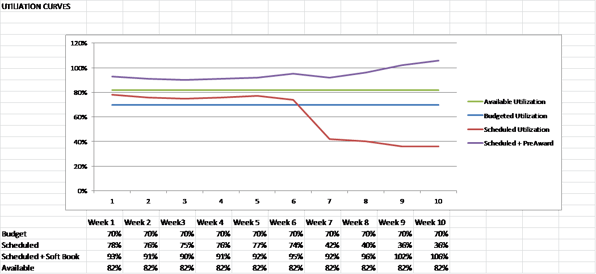
There are two types of forecasting we will focus on in this article: 

  1. Utilization forecasting
  2. Cash flow forecasting

For professional services firms, forecasting starts with the analysis of the work that is yet to be performed and equating that to overall firm revenue. The revenue then becomes the basis for the accountant to project cash flows coming in, considering average day’s receivables, to drive what cash is available versus the cash required to cover current expenses.

Without these forecasts, it makes it much more difficult for management to schedule, staff, plan or perform the work in production that is necessary without them sitting up in bed at night on a regular basis. 

So let’s break the process down into steps and then focus on the key benefits of what is forecasting. 

  1. To properly track utilizations, it is important to establish two budgeted figures, target utilization and available utilization. Both should be established for every staff person and documented by employee in your system.
    Definitions:
  • Target Utilization is a function of the targeted billable hours over the standard hours in the work week.
  • Available Utilization is a function of all available hours minus just the benefit hours.
  • Next establish tracking of scheduled hours by employee, by week or whatever reporting interval provides management enough lead time to make good decisions about staffing and scheduling – this usually being about six to eight weeks out from the current date.
  • Consider hours that are in your current proposals to clients.  This is another reason to do pro-forma timelines with estimated start dates for the project pre-award.  In addition, you will want to weight these proposals for likelihood of award.  This will allow you a weighting of the hours to the overall scheduled time.
  • On a weekly basis look at utilizations against the target, available, and awarded plus some weighted factor of pre-awarded after say 70% probability.  
  • One engineering firm we are working with used to post the labor utilization “curves” on their message board in their lunch room and it was measured against budgeted utilization for the year as a constant.  This singular graph showed what the firm was projecting for scheduled utilization against target and available which kept staff cognizant of both the need to schedule fully.  The graph also served as a tool for staff to promote billable hours against project deadlines.


    kpo 

    From this data, management was able to see the most important single factor for the firm, how far out they were scheduled, and if they needed to adjust staff or move project timelines to increase project throughput.  Since labor costs against labor revenue is the single most influential impact on a firm’s bottom line, forecasting in this way had this firm’s management sleeping better, while it also empowered the firm’s staff to keep an eye on utilization. 

    Since this level of tracking was in place at this particular firm, it also allowed their senior financial person to produce informative forecasts of revenue, which in turn, promoted the morale of everyone in the firm. 

    To note, when the firm had many proposals out with the results tracking per the graph above, and the firm had the ability to look at un-scheduled but awarded professional service hours as well, they knew when staffing could not meet the demand of the impending work and were able to stage clients expectation with delivery dates or let HR know that hiring was needed on the horizon. 

    So, is your firm enabling forecasting to better win work and deploy resources? If not, after reading this blog do you recognize the importance of implementing forecasting at your firm? I would forecast that the answer is “yes”!  


    Using Project Feedback to Increase Profitability

    Posted by Admin on Oct 8, 2013

    feedback profitsAchieving consistent project profitability while maintaining strong client relationships is at the top of most firms’ goals and objectives. And, while there are certainly a number of variables that must be integrated to make this happen, asking your clients for feedback during the project plays a valuable role. I’ve identified two scenarios that are common in the A/E industry. Incorporating feedback into your project management process has been demonstrated to have a positive impact on both.

    Reduce (or eliminate) Re-work

    Streamlining the project delivery process is essential to creating project efficiencies that lead to increased profit on your job. But there are pitfalls to this approach unless you are getting regular project feedback from your clients. Let’s look at a scenario:

    You have done projects for one of your best clients for more than 10 years. You have developed a delivery process that seems to be working for them and it eliminates the need for your team to reinvent the wheel each time. Enter the new client project manager. This individual has their own set of expectations regarding how this project will proceed. And, although you all believe you were aligned when you left the kick-off meeting, suddenly there are 10 pages of comments to your first major submittal. They don’t like the format, they feel you have left out critical information, and generally they are looking for you to fix the problem which will require some significant re-work on your team’s part.

    How could project feedback have avoided this outcome? Firms that have integrated gathering feedback into their project management process understand the importance of requesting feedback after each milestone meeting or deliverable. In this scenario, a feedback request would have been sent after the initial meeting perhaps after the submission of the meeting minutes. This would give the project manager the opportunity to uncover gaps in expectations with this new project manager. Before his team began to move forward on the project, these gaps can be closed. In this scenario this would have meant deviating from the streamlined process at least a little, but that knowledge and flexibility would save many hours of re-work that kills a project budget.

    Avoid Scope Creep

    Scope creep is something most A/E firms understand all too well. You know what is needed to complete the project but the client is extremely cost conscious and asks you to remove several items to lower your fee. Depending upon the experience of the project manager involved, they may be able to complete the project to the client’s satisfaction. However, doing so will quite likely result in a lower profitability for your project. Let’s look at a scenario:

    You have been asked to design a renovation for a commercial building for a new client. This type of work is your specialty. You know all of the elements that will be needed to meet your client’s expectations for a successful project. However, when the client asks you to remove about 5% – 10% of the scope so that your fee will fit into their budget, you agree because this is a client that you really want to work with and your staff is a little light on work at the moment as well. As the project progresses, you run into problems because of the scope you removed and the client ‘forgets’ they asked you to remove these items and asks you to do what is needed to complete the project. Rather than ask your client for an increase in fee, you just finish the project with the fee you have been given. This involves both you and your team working extra hours and your profit still takes a hit.

    How could project feedback have avoided this outcome? Because this is a new client let’s assume that the opportunities to use feedback to avoid the fee reduction in the first place are limited. Requesting feedback from your client throughout the lifecycle of the project however, can play a significant role when the scope items you removed come back into play. Each time you send a feedback request to this client you are giving them the opportunity to let you know how well you efforts are matching their expectations. You are building the relationship with them that lets them know that you value your relationship with them and it is your goal to ensure the project outcome meets or exceeds their expectations. When the moment comes that the scope items you agreed to remove become essential to the project, this relationship will make the conversation to request additional fees more comfortable for both of you.

    Interested in learning more about using project feedback to increase profits?


    Is Your Budgeting and Forecasting Process Doomed?

    Posted by Sarah Gonnella on Oct 2, 2013

    budgetingandforecastingBudgeting and forecasting is part art, part science. For too many firms, however, it is also a frustrating process that takes a lot of effort to produce less than optimal results.


    All too often, the budgeting and forecasting process breaks down because the two parties involved — the executive management team and the operations side — see the challenge from opposite ends of the same telescope. It may be a gross generalization, but from what I’ve seen, management often tends to be more aggressive and optimistic about goals and forecasts. On the other hand, the operational side sees the nuts-and-bolts challenges and logistics required to meet management’s goals, and tends to be more conservative in terms of what they think can be achieved with a given budget. 

    In addition to this fundamental dynamic, another challenge related to budgeting and forecasting is that unless it’s handled well, it can lead to a lack of buy-in on the part of various parties. Even worse, it can result in a budget that ends up sitting on a shelf for the rest of the year, which is not in anyone’s best interest. 

    Key strategies for success

    Fortunately, there are several strategies that can help an organization improve its chances of a successful budgeting and forecasting process. 

    1. Start early. Think about the budget process as one of dialogue and compromise — so allow time for both management and operations to develop their budgets and plans, and then to negotiate an acceptable compromise. If you’re aiming to complete your budget by December 31, for example, consider asking management to commit to establishing and publishing their corporate goals no later than October 31. 

    2. Be transparent and clear about the process. If you let everyone know up front that the budgeting process is a dialogue and compromise, there may be more chance that all parties will embrace it and comply with expectations. 

    3. Have the management team kick off the process. After all, their vision for the corporate goals and general forecasts should be what drives the organization. In general, it’s a good strategy to use previous years’ results as a baseline, incorporating any relevant data about changing market and economic conditions, new products in development, and so on. Once the management team has published its goals, the operational managers develop budgets for reaching those goals. This is not the order in which it’s always done, but in my experience, it’s a more effective approach and leads to better results. 

    4. Have a meeting of the minds. Last but not least, block off some time to bring the two sides together around the budget documents and negotiate a compromise. As in any compromise, it’s critical that both sides understand that they are not going to get everything they want. But by finding an agreeable compromise, the organization can develop a budget and forecast that’s both aspirational and achievable. 

    Budgeting and forecasting succeeds when it brings together two very different perspectives of the organization and finds an effective meeting point. Obviously, it needs to help the organization move forward in a strategic direction; but to become a plan that staff can buy into and implement; it also needs to be realistic and achievable. Above all, don’t forget that a realistic, well-thought-out budget is essential to the firm’s financial success. 

    CTA Webinar GrowingStronger

    "I just love working with you.." Client Evaluation Fallacies.

    Posted by Ryan Suydam on Sep 18, 2013

    100 percent2Your firm is committed to using client evaluation surveys to ensure project success. So what do you do when your client gives you all high marks and you just know it isn’t true?

    Recently one of our clients shared a story with me in which she was faced with this situation. Megan had been working on a project for Dee for several months. During this time there were a lot of times – certainly more than typical – when Dee came back with comments like, ‘well, that is fine but…’ Megan continued to feel that as hard as she tried to meet Dee’s expectations, there was something that was just not adding up.

    For a number of years, Megan’s firm had elected to use client evaluation surveys. As a result, and because Megan really wanted to create a successful project for Dee, she decided to send her a survey. The survey asked Dee to consider specific points in the project process. It gave her a chance to share her thoughts on how things were going. The goal of the survey was to hear what Dee felt was important and to allow Megan to uncover what processes Dee felt were working well and which ones might be adjusted to work a little more smoothly.

    Much to her surprise, the survey came back with all top scores and the comment, “I just love working with Megan!”  

    Since her purpose was not to receive accolades but to serve her client more successfully, Megan gave Dee a call. She told her she really appreciated her taking the time to complete the client evaluation survey but she was a little concerned with the high scores. She told Dee, “I really enjoy working with you as well but I just feel that there is some way in which I could be serving you better.” Dee told her that she gave her the high marks because she knew other people would be looking at the scores. She said she really did like working with Megan and didn’t want her to get into any trouble.

    Megan thanked Dee and told her she really appreciated her thinking of her. She was quick to add, however, that she (and her firm) actually appreciate knowing what their clients are thinking even if the survey comes back saying that the client is not completely happy with something. She pointed out that the reason her firm uses client evaluation surveys is because they are committed to providing their clients with the best possible experience.

    So how does the story end? Megan and Dee had an excellent conversation. They talked about the processes Megan was using on the project and agreed on a few minor adjustments that Dee felt would really work a little better for her. In the end, the client evaluation survey actually worked just as intended. Even though the high scores did not accurately reflect what was going on in the project at that time, it opened the door to an excellent conversation.
     

    Lessons Learned: Business Performance Metrics

    Posted by Brian McNamara on Sep 11, 2013
    Business Performance MetricsYou might be tempted to think that the hardest part of using business performance metrics to guide your business is gathering and analyzing the metrics. 

    But equally important — maybe even more so — is selecting the right metrics to begin with. Of course, there are some people who observe that there are no “bad metrics.” The argument goes that a metric itself is neither good nor bad; it could be just as likely that your data is wrong, or possibly that the metric is simply not a good fit for your needs or your organization. 

    But even though the metric itself is neither good nor bad, there are other ways that business performance metrics can be failing you. Let me describe three of the most common problems. 

    1. Inconsistency. One of the most common ways a metric can go south is inconsistency. Granted, some people think consistency is overrated: the philosopher Ralph Waldo Emerson once railed in his classic essay, Self-Reliance, that “A foolish consistency is the hobgoblin of little minds.” (It’s good stuff — look it up!)

    2. Unintended consequences. Another problem is if your metrics are somehow incentivizing your employees to do the wrong thing. For example, imagine your firm has put a recent focus on customer service. Unfortunately, last year you notified all employees that their pay raises will be based on employee utilization rates. The longer your employees spend keeping your clients happy (non-billable work), the lower their utilization rate. You are telling your employees one thing, but your actions are saying the complete opposite.

    Although it should go without saying, it’s absolutely critical to make sure that the math and logic that feed into your business performance metrics remain consistent, regardless of the timeframe or operating unit being analyzed. 

    So in this example, a better metric would be to incentivize your employees on a combination of utilization rate and customer satisfaction — more complicated to gather, but ultimately closer to what you want to reward and encourage. What’s more, a great reason to plan your metrics with care! 

    3. Understanding Lagging vs. Leading Indicators. To be most effective, you need business performance metrics in as close to real-time as possible. Understanding the difference between lagging vs leading indicators can often be the defining factor for setting your firm on the correct course. Lagging indicators help your firm indentify historical trend information, while leading indicators provide predictive information that can allow you to make data-driven decisions to change future outcomes.

    QuickBooks, Excel and other office applications can help in collecting and analyzing data, but lacks the sophistication to provide real-time insight. A purpose built ERP, like Deltek Vision, provides front and back office functions insight into historical and predictive information. Whatever tools you use to gather your metrics, be sure to automate the process as much as possible to provide your team with the ability to make the best data-driven decisions.

    Start measuring!

    So how does one avoid the pitfalls of metric management? A great starting point is to understand your business and what your version of success looks like. For example, is it total revenue, net profits, other measures, or a weighted combination? 

    At Full Sail Partners, we work with a large number of professional services firms — especially those that are project-based. As a result, we have a lot of insight and experience into the metrics that are most telling for them. To learn more, keep exploring our blogs, or contact us.


    Project KPI, Project Management KPI

    Stacey Ho Joins Full Sail Partners as Deltek Vision CRM Consultant

    Posted by Full Sail Partners on Sep 6, 2013

    describe the imageFull Sail Partners, a Deltek Premier Partner, is pleased to announce its recent hire of Stacey Ho, CPSM who will join the Full Sail team as a CRM Consultant. Within this role, Stacey will provide CRM consulting to Deltek Vision users. Her proven background supporting firms through CRM implementations and understanding of firm-wide marketing processes and procedures will ensure Full Sail Partners continues to provide clients with the most knowledgeable professionals the industry offers.

    "I am excited to join the team and further support services marketers looking to connect and grow their firms,” said Stacey Ho, CPSM. “I love seeing my peers grow with firms by working smarter and loving their jobs more because they finally have more time to truly strategize and win good work. With Full Sail Partners well-rounded team it will allow me to take my knowledge and capabilities even further.”

    Stacey Ho comes to Full Sail Partners with more than 15 years of experience in the A/E/C industry. Most recently, as the owner of Stacey Ho Marketing, LLC, she worked with clients as their Marketing Information Systems Strategist. In this role, Stacey was able to assist project-based firms elevate the role of the marketing team by helping them with processes and procedures to help achieve the firm-wide marketing plan. Further, she helped marketers to develop and implement internal systems and tools that can capture, store, and retrieve information useful in preparing sales proposals. Stacey has worked in various marketing positions in firms including Kennedy/Jenks Consultants, David Evans and Associates, and Century West Engineering.

    Stacey Ho’s appointment comes shortly after the one year anniversary of Full Sail Partners. "As the economy rebounds, Full Sail Partners looks to assist our clients in the process of efficiently expanding their businesses," said Sarah Gonnella, Vice President at Full Sail Partners. "Stacey's depth of experience, leadership acumen, and track record of success are exactly what the company needs for its next major phase of growth."

    For more information, please contact Full Sail Partners’ Marketing Communications Department at or leave a comment below.


    Most Recent News Mentions

    We’re changing the way project-based firms operate.

    People can’t help but notice.
    Who will be next?

    Check out our latest newsworthy work:

    Recent Posts