
In the News


We’re devoted to revolutionizing the way our clients do business. Sometimes that gets us noticed.

No big deal.

Posts about Professional Services (11):

Measuring Marketing ROI: Building a Better Relationship with Accounting

Posted by Sarah Gonnella on Dec 11, 2013

When it comes to proving the value of marketing efforts, often professional services marketers have to prove their worth to the financial department through a language that they understand – Marketing Metrics! This often means a series of pre-determined metrics for measuring marketing ROI (return on investment). 

describe the imageMarketers are often challenged with measuring marketing ROI. Many times it’s because we are don’t have access to the right type of data or in some cases it’s because we don’t know what to measure. This is where having a good relationship with finance can help you be a better marketer. To better develop the relationship and expectations between marketing and finance, we suggest fostering a relationship of understanding and sharing. 

Having the financial department on your side is one of the greatest feats any marketer can accomplish – If finance buys in, you can be assured that it is only a matter of time until everyone else falls in place! 

No matter how copasetic our relationship is with our financial department, we have to be ready to report on marketing ROI at a moment’s notice so here are some steps to take to gain a better relationship. 

Talking the Talk 

If you are looking at building a better relationship with accounting, in my experience the first bridge to cross is to put yourself in their shoes. When you think about what functions accounting is responsible for, you can easily understand their hesitancy to buy in to the marketing plan without cold hard data to evaluate. Instead of running from this hurdle, attack it straight on! Schedule a kick-off meeting with finance to address the plan, and allow them to voice any concerns. 

The goal during the kick-off session is to ease accounting’s anxiety.  Allow the finance department a chance to express their suggestions and concerns. Continue to reassure the finance team that through the marketing metrics established by your firm, you will be consistently measuring marketing ROI throughout the year to ensure that the marketing team’s plans and efforts stay on track.

Walking the Walk 

The quickest way to gain buy in is to lead by example. You know your job better than finance knows your job. Identify areas that your marketing efforts affect that might not be easily identified.  One way a Marketer can begin to do this on their own is to think about the data that you need to do their job better. Come to the kick off meeting ready to show your finance team that you understand their concerns, by identifying previously overlooked metrics for measuring marketing ROI. This will demonstrate to finance that you are looking at metrics that can help impact the growth of the company and further prove your value to the firm. 

If you are interested in learning more, review this blog article that discusses evaluating your business growth plan with metrics. This introduction can be applied to developing marketing metrics that help identify how your efforts are helping the firm grow. 

Here are important questions marketers can ask accounting to start the conversation on how the firm can start measuring marketing ROI:

  1. Retaining & Gaining Clients: I’m looking to understand our total customer growth. Do we have a way to determine by percentage and revenue the amount of our work we’ve received is new vs. existing clients throughout the year?
  2. Pursuing the Right Client: I’m been looking at how we can be more strategic in our pursuit of clients. Would it be beneficial to advise you when I see we are pursuing more work with clients that we are having AR issues with?
  3. Forecasting and Backlog: Can you help me understand what our break-even is and do we have a way to see what our current backlog is? I’d like to help make sure we have enough business coming in the pipeline for each market or division.
  4. Effectiveness: Can you help me better understand how I affect the bottom line? Developing metrics that help you understand the financials behind your results can help you fine tune your approach. 

Often times your finance team is not questioning the value of the marketing team -- they are however questioning the tactics (and results!) being used. Often times as marketers we can get lost down in the weeds and lose sight of the overall firm goals. By proving efforts through metrics and marketing ROI, we start speaking a language that our financial team can understand. 

As professional services marketers, start showing your finance team that you care by measuring marketing ROI, and building better relationships between marketing and finance to demonstrate the value of promotional efforts.

For more information, view the below webinar: 

3 Core Strategies for Financial Forecasting

Posted by Wendy Gustafson on Nov 20, 2013

Business leaders have any number of sophisticated computer programs and models to help them predict future business results. Despite these resources, however, in its essence financial forecasting is still a guessing game. 

That being said, there are several fundamental strategies that can improve one’s chances of making accurate forecasts.

Strategies for Financial Forecasting1. Understand how and where you’ve succeeded.

The first strategy is to look at historical data to gain insight into exactly where past successes and challenges have come from. This inquiry includes reviewing the various sources of your leads, how your sales team manages them, and where you tend to have the greatest success. For example, you might try to determine:

  • Whether your sales most often result from calling into existing clients to find additional work, from cold calling to purchased lists, or alternate sources.
  • The extent to which your success has depended on the person doing the calling, the script used for the call, the number of contacts made, or other factors.
  • The lasting impact of sales — i.e., which sales turned into continuing relationships and additional work. Of course, there are many factors that affect this statistic, but it can still provide useful insight for your financial forecasting. 

The key is investing the time and energy needed to gain fact-based insights into what has worked — and not worked — in the past.

2. Take a cold, hard look around you.

A second essential strategy of financial forecasting is to look closely at your current operating environment, and conduct a brutally honest analysis of your strengths, weaknesses, threats and opportunities (SWOT). 

Your SWOT analysis should begin with a realistic exploration of the many factors that could increase, or decrease, the likelihood of your success. Some questions you might want to answer:

  • What is your reputation in the marketplace — what are you known for doing well, and where should you try to improve?
  • Is the local or regional economy growing, stagnant, or shrinking? More specifically, what is the condition of the economy as it affects your clients?
  • Are there factors that could encourage your clients to maintain or even expand the services they are buying from you? Are there conditions that might threaten projects that they have planned with you but not yet started, or that could prevent them from engaging with you in the future?
  • What is your competition doing to take advantage of the current market? Where are they weak, and how can you exploit that weakness? 

The underlying strategy in doing your SWOT analysis is to be totally honest and realistic about where you excel and where you come up short — and determine what you can realistically achieve in your competitive environment. 

3. Test your assumptions and adjust as necessary. 

A third essential strategy in effective financial forecasting is to track and monitor your results. There is a range of ways to do so, but based on our experience working with professional services firms, one of the best is to invest in a purpose-built ERP such as Deltek Vision. This solution can provide a firm with up-to-the minute, comprehensive visibility into all of the assumptions and results related to its financial forecasting. Just as importantly, it connects and organizes data from both the front office (i.e., project) function as well as the back office (accounting), and automates a wide variety of essentially manual processes — including Customer Relationship Management (CRM), business development and more. Not only will the insight you gain help you tweak your assumptions to improve future forecasting efforts, but more importantly, you can make midcourse corrections to keep your firm on course. 

Keep your eye on the prize.

Whether you use one-off spreadsheets, software programs for specific functions, or a comprehensive solution like Deltek Vision, the key is to collect metrics that matter to you on an ongoing basis, measure results against your financial forecast, and make adjustments as necessary. 

You’ll never be able to see a completely accurate view of your company’s future. However, through financial forecasting, you will gain enough of a realistic sense of what’s coming that you’ll be able to stick to a plan and outmaneuver the competition. 


Difference Between Project Backlog and Project Forecasting?

Posted by Scott Seal on Nov 6, 2013

Project Backlog, Project ForecastingProject Backlog and Project Forecasting are two of the major components that predict current and future profitability of a firm. As firms begin to put together financial budgets for future years they are often looking at these two in conjunction between project backlog and project forecasting. Typically there are two different processes for forecasting future revenue:

  1. Project Managers forecast work-under-contract, as part of backlog. This contracted work not performed is the most accurate indicator of short-term revenue. Additionally a firm’s backlog (the difference between contracted work and the work completed to date) reflects past marketing success and current project managers’ ability to balance resources against project workload. How successful a firm is in managing this backlog often determines whether profits are either realized or squandered.
  2. The Marketing group forecasts less-probable opportunities as part of our Project Forecast. Unlike the project backlog, the Project Forecasting discounts project opportunities to reflect uncertainty the project will be put under contract. When reviewed together, these two provide a very good picture of future revenues and upcoming workload.

Benefits of Project Backlog and Project Forecasting

A solid Project Backlog and Project Forecasting process helps manage this balance in the following ways:

    • Provides project managers tools for resource planning, scheduling, and deliverable management.
    • Provides a solid basis for marketing decisions. If your backlog forecast is lower than anticipated then increase your marketing campaigns engine. If your backlog forecast is higher than anticipated then add resources or become more selective about your marketing campaigns.
    • Provides validation of firms’ revenue projections to confirm the accuracy of your corporate financial planning efforts.

The project backlog and project forecasting process need not be complicated; it needs only to provide a standard tool for company-wide project planning and review. Use the following three steps to initiate a project backlog and project forecasting process.

1. Prepare a weekly ‘bottom-up’ forecast by project manager.

    • Each project manager compile a project backlog forecast that identifies active projects under backlog and opportunity forecast that exceed say a 60% probability.
    • Assign team member resources, and then resource loads (using an hours forecast) each project for the next six-to-eight weeks.

There are several benefits of these project manager forecasts which include:

    • Provides the project manager an opportunity to balance resources, identify gaps in workload, and plan for downtime (i.e. vacation, holiday, training, etc.).
    • Provides structure for reviewing project milestones, progress, and budgets.
    • Provides revenue forecast by pairing the forecasted hours with billing rates.

2. Management aggregate review

Once weekly project backlog forecasts are completed, management then can compile and review these aggregated forecasts. This step often provides insight into the following areas:

    • Possibilities of resource sharing between teams or service areas.
    • Provides glimpse at future  revenue projections
    • Identify potential budget problems.
    • Comparison of projected backlog revenues against corporate revenue goals.

3. Comparison to actual utilization.

Finally, we review weekly utilization from timesheets to ensure that forecasting matches reality. These reviews provide a critical feedback loop to improve your project forecasting process.

By following a sound process of project backlog and project forecasting tracking your firm can increase project management effectiveness, make better decisions about marketing expenditures, and improve and validate your corporate revenue planning efforts. These benefits will drastically improve profitability. 

Why Cash Flow Planning is Essential for Growth

Posted by Scott Seal on Oct 30, 2013

cash flow planning, cash flow planFor most professional services firms, planning for growth is a natural part of business. There are different strategies for doing so, and choosing the best one depends on your ultimate growth objectives. But whatever your goals, understanding how your growth plan affects your cash flow plan is essential to achieving the results you seek.


The way you grow affects cash flow planning.

Organic growth. There are a number of ways to grow one’s business organically. For example, in a generally healthy economy, your firm could continue doing “business as usual” (i.e., not increase your marketing or business development activity) and still experience significant growth from the improving economy. This type of growth is typically slow-paced; you can keep up with the increased demand either by using existing staff or gradually “ramping up” your staffing to meet the growth curve.

A somewhat more aggressive growth plan might be to expand your client base in the same market niche and geographic area where you’re already doing business. In such a scenario, you are typically increasing your marketing and business development outreach to generate business. As this outreach occurs, you may experience rapid growth that requires you to have staff immediately available to meet the increased client demands.

Strategic growth. Alternatively, you might be planning to significantly expand your service offerings or target market. For example, an engineering firm might add a new service line, or expand into another geographic market. In such cases, you could expect to take on additional marketing and staffing expenses, along with expenses for market research (please do not skip this step), software and equipment and possibly even new office space. These added expenses occur up front, well before you bring dollar one through the door. 

Expect a time lag before reaching ROI.

The fundamental point to keep in mind is that your cash flow will take a hit, probably at least for 90 days for increased staffing costs, and longer for marketing costs. The reason for this is the unavoidable lag between when you begin investing in expansion, and when you actually start reaping the benefit.

Here’s the general reason for the time lag. Once you decide to expand, there are several types of expenses you’ll incur at the beginning of your growth effort — investments that will not bear fruit immediately. For example, there are costs to hire and train new employees, with probably 60 days before they’re doing billable work. Even if you’re very efficient and bill on day 61, then the earliest you should expect payment for their work will be another 30 days, making it a minimum total of 90 days where cash is going out, but no additional revenue is coming in.  

How to meet the demand: sub-consultants vs. salaried staff.

In general, hiring consultants requires less of a cash investment than full- or part-time staff, as they typically will not get paid until you get paid (Paid When Paid, or PWP). This advantage may be offset, however, by the fact that consultants can also be more challenging to manage and they have their own clients (and potentially conflicting commitments as well). Additionally, you still have to invest manager time to assign and manage the sub-consultants’ performance.

On the other hand, while full- or part-time staff may be more costly to hire, they will likely gain institutional and process knowledge as they work, which should make them increasingly valuable to your company. Additionally, they are typically focused on the company’s needs and requirements; you can control their priorities.

Tracking cash flow and return.

The other part of cash flow planning during a growth period (or at any time, for that matter) is monitoring your expenditures and results (hopefully in the form of additional revenue). As with any plan, it’s essential to have an idea of the effort you need to expend, and what results you expect from that effort. Even if your plan is “business as usual” because of an improving market, you should understand what results you expect from the improving market. If you are increasing your marketing effort in your existing market, you should know what you expect from that effort in the form of additional leads, opportunities, clients and, of course, revenue. Without the increased revenue, what is the justification of the increased marketing effort (and assumed increased cost)?

There are a number of approaches for tracking results, ranging from one-off spreadsheets to purpose-built ERP solutions.

In our experience, one of the most effective strategies is to find a solution that accomplishes several key functions at once. Deltek Vision, for example, is a purpose-built ERP solution that provides a unified platform for connecting the front and back office functions — providing up-to-the-minute insight into cash flow planning, as well as accounts receivable, billability and utilization statistics, and much more. It even includes integrated solutions for automating major parts of your processes for customer relationship management, proposal development and tracking.

Watch the details, but don’t neglect the big picture.

Keep in mind that the timeframes for generating ROI mentioned in this article are generalizations. In fact, they’re based on an ideal scenario that assumes making good hires, efficiently training and integrating them, finding a receptive market … and getting paid on time.

Naturally, as the fine print often says, actual results may vary. This makes it even more important to build-in expectations that cash flow will take a significant hit for at least a few months before you start reaping the rewards of you investment.

Growth is rarely painless or easy — but knowing what to expect is far better than wading into a growth plan without knowing when it will start paying off.


Professional Services Marketing: A Changing Landscape

Posted by Lee Frederiksen on Oct 23, 2013

changinglandscape

Guest blog written by Lee W. Frederiksen, Ph.D.

It’s old news that technology has changed the way we interact – and that includes the way we purchase goods and services. But the professional services industry has largely lagged behind other sectors in reacting to this change, continuing to rely on traditional forms of marketing that are both more expensive and less effective. The small percentage of firms that have embraced online marketing, however, have seen marked success. In our recent study on online marketing, we learned that professional services firms employing online marketing techniques grow 4X faster, and are 2X more profitable than other firms. Why is this so? What is it about online marketing that is so effective? To understand why online marketing works, we need to understand today’s buyers. 

How Buyers Choose Professional Services Firms 

Technology has changed the way that buyers search for and evaluate professional services firms. Based on our research, we know that 71% of buyers still ask their friends and colleagues first when they search for a new professional services firm. At first glance, this seems like the old way of doing business. What’s changed is that, after receiving the referral, these buyers can now go online to do their own research on the firms that were recommended. 

The Internet has allowed buyers to take much more control of their purchasing process. In fact, in their recent study of over 1,400 B2B consumers, the Corporate Executive Board found that 57% of a typical purchasing decision occurs before the buyer ever has a conversation with a service provider. This represents a drastic break from the past. 

Even more notable, the third largest group in our study—11% of professional service buyers—said they skip the referral process altogether, going directly online to search for firms. Combined with the first group of buyers who use the Internet to check up on firms referred from their network, this means that altogether 82% of professional services buyers go online at some point in their buying process to evaluate a firm. 

The Digital Generation 

The Internet has drastically changed the marketing landscape for professional services firms, and we expect that landscape to continue changing. Consider that most workers under the age of 35 have never worked in an office without Internet access. Research shows that for this rising category of leaders, using online resources to evaluate and communicate with firms is second nature. And, as this digital generation ages and takes on increasingly senior leadership positions, they will give technology an expanding role in their buying and decision-making process. 

Putting It All Together 

Technology has forever changed the way that consumers interact with, and purchase, professional services. Those firms that learn to embrace the advantages offered by these new technologies will continue to grow and profit, widening the gap that already exists between technology adopters and non-adopters. For professional services firms, ignoring online marketing means living in the past. 

Read more about the way professional services marketing is changing in Hinge’s new coauthored book, Professional Services Marketing 

About the Author:

Lee W. Frederiksen, Ph.D., is Managing Partner at Hinge, a marketing firm that specializes in branding and marketing for professional services. Hinge is a leader in rebranding firms to help them grow faster and maximize value. Lee can be reached at LFrederiksen@hingemarketing.com or 703-391-8870. 

Interested in implementing an holistic solution to help your marketing team better manage your efforts? Check out Deltek Vision CRM and get a leg up on your competition.

What is Forecasting and How Can it Benefit Professional Services Firms

Posted by Full Sail Partners on Oct 9, 2013

forecastingWhat is forecasting? Forecasting is a tool that many professional services firms use to help management make decisions based on past and current data trends. 
There are two types of forecasting we will focus on in this article: 

  1. Utilization forecasting
  2. Cash flow forecasting

For professional services firms, forecasting starts with the analysis of the work that is yet to be performed and equating that to overall firm revenue. The revenue then becomes the basis for the accountant to project cash flows coming in, considering average day’s receivables, to drive what cash is available versus the cash required to cover current expenses.

Without these forecasts, it makes it much more difficult for management to schedule, staff, plan or perform the work in production that is necessary without them sitting up in bed at night on a regular basis. 

So let’s break the process down into steps and then focus on the key benefits of what is forecasting. 

  1. To properly track utilizations, it is important to establish two budgeted figures, target utilization and available utilization. Both should be established for every staff person and documented by employee in your system.
    Definitions:
  • Target Utilization is a function of the targeted billable hours over the standard hours in the work week.
  • Available Utilization is a function of all available hours minus just the benefit hours.
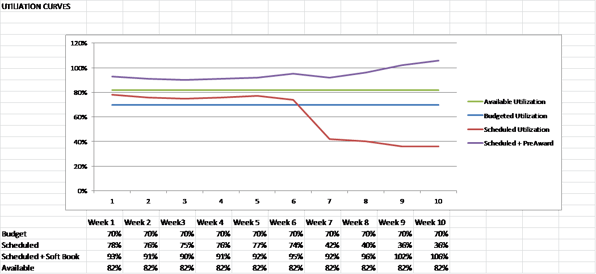
  • Next establish tracking of scheduled hours by employee, by week or whatever reporting interval provides management enough lead time to make good decisions about staffing and scheduling – this usually being about six to eight weeks out from the current date.
  • Consider hours that are in your current proposals to clients.  This is another reason to do pro-forma timelines with estimated start dates for the project pre-award.  In addition, you will want to weight these proposals for likelihood of award.  This will allow you a weighting of the hours to the overall scheduled time.
  • On a weekly basis look at utilizations against the target, available, and awarded plus some weighted factor of pre-awarded after say 70% probability.  
  • One engineering firm we are working with used to post the labor utilization “curves” on their message board in their lunch room and it was measured against budgeted utilization for the year as a constant.  This singular graph showed what the firm was projecting for scheduled utilization against target and available which kept staff cognizant of both the need to schedule fully.  The graph also served as a tool for staff to promote billable hours against project deadlines.


    kpo 

    From this data, management was able to see the most important single factor for the firm, how far out they were scheduled, and if they needed to adjust staff or move project timelines to increase project throughput.  Since labor costs against labor revenue is the single most influential impact on a firm’s bottom line, forecasting in this way had this firm’s management sleeping better, while it also empowered the firm’s staff to keep an eye on utilization. 

    Since this level of tracking was in place at this particular firm, it also allowed their senior financial person to produce informative forecasts of revenue, which in turn, promoted the morale of everyone in the firm. 

    To note, when the firm had many proposals out with the results tracking per the graph above, and the firm had the ability to look at un-scheduled but awarded professional service hours as well, they knew when staffing could not meet the demand of the impending work and were able to stage clients expectation with delivery dates or let HR know that hiring was needed on the horizon. 

    So, is your firm enabling forecasting to better win work and deploy resources? If not, after reading this blog do you recognize the importance of implementing forecasting at your firm? I would forecast that the answer is “yes”!  


    Is Your Budgeting and Forecasting Process Doomed?

    Posted by Sarah Gonnella on Oct 2, 2013

    budgetingandforecastingBudgeting and forecasting is part art, part science. For too many firms, however, it is also a frustrating process that takes a lot of effort to produce less than optimal results.


    All too often, the budgeting and forecasting process breaks down because the two parties involved — the executive management team and the operations side — see the challenge from opposite ends of the same telescope. It may be a gross generalization, but from what I’ve seen, management often tends to be more aggressive and optimistic about goals and forecasts. On the other hand, the operational side sees the nuts-and-bolts challenges and logistics required to meet management’s goals, and tends to be more conservative in terms of what they think can be achieved with a given budget. 

    In addition to this fundamental dynamic, another challenge related to budgeting and forecasting is that unless it’s handled well, it can lead to a lack of buy-in on the part of various parties. Even worse, it can result in a budget that ends up sitting on a shelf for the rest of the year, which is not in anyone’s best interest. 

    Key strategies for success

    Fortunately, there are several strategies that can help an organization improve its chances of a successful budgeting and forecasting process. 

    1. Start early. Think about the budget process as one of dialogue and compromise — so allow time for both management and operations to develop their budgets and plans, and then to negotiate an acceptable compromise. If you’re aiming to complete your budget by December 31, for example, consider asking management to commit to establishing and publishing their corporate goals no later than October 31. 

    2. Be transparent and clear about the process. If you let everyone know up front that the budgeting process is a dialogue and compromise, there may be more chance that all parties will embrace it and comply with expectations. 

    3. Have the management team kick off the process. After all, their vision for the corporate goals and general forecasts should be what drives the organization. In general, it’s a good strategy to use previous years’ results as a baseline, incorporating any relevant data about changing market and economic conditions, new products in development, and so on. Once the management team has published its goals, the operational managers develop budgets for reaching those goals. This is not the order in which it’s always done, but in my experience, it’s a more effective approach and leads to better results. 

    4. Have a meeting of the minds. Last but not least, block off some time to bring the two sides together around the budget documents and negotiate a compromise. As in any compromise, it’s critical that both sides understand that they are not going to get everything they want. But by finding an agreeable compromise, the organization can develop a budget and forecast that’s both aspirational and achievable. 

    Budgeting and forecasting succeeds when it brings together two very different perspectives of the organization and finds an effective meeting point. Obviously, it needs to help the organization move forward in a strategic direction; but to become a plan that staff can buy into and implement; it also needs to be realistic and achievable. Above all, don’t forget that a realistic, well-thought-out budget is essential to the firm’s financial success. 

    CTA Webinar GrowingStronger

    "I just love working with you.." Client Evaluation Fallacies.

    Posted by Ryan Suydam on Sep 18, 2013

    100 percent2Your firm is committed to using client evaluation surveys to ensure project success. So what do you do when your client gives you all high marks and you just know it isn’t true?

    Recently one of our clients shared a story with me in which she was faced with this situation. Megan had been working on a project for Dee for several months. During this time there were a lot of times – certainly more than typical – when Dee came back with comments like, ‘well, that is fine but…’ Megan continued to feel that as hard as she tried to meet Dee’s expectations, there was something that was just not adding up.

    For a number of years, Megan’s firm had elected to use client evaluation surveys. As a result, and because Megan really wanted to create a successful project for Dee, she decided to send her a survey. The survey asked Dee to consider specific points in the project process. It gave her a chance to share her thoughts on how things were going. The goal of the survey was to hear what Dee felt was important and to allow Megan to uncover what processes Dee felt were working well and which ones might be adjusted to work a little more smoothly.

    Much to her surprise, the survey came back with all top scores and the comment, “I just love working with Megan!”  

    Since her purpose was not to receive accolades but to serve her client more successfully, Megan gave Dee a call. She told her she really appreciated her taking the time to complete the client evaluation survey but she was a little concerned with the high scores. She told Dee, “I really enjoy working with you as well but I just feel that there is some way in which I could be serving you better.” Dee told her that she gave her the high marks because she knew other people would be looking at the scores. She said she really did like working with Megan and didn’t want her to get into any trouble.

    Megan thanked Dee and told her she really appreciated her thinking of her. She was quick to add, however, that she (and her firm) actually appreciate knowing what their clients are thinking even if the survey comes back saying that the client is not completely happy with something. She pointed out that the reason her firm uses client evaluation surveys is because they are committed to providing their clients with the best possible experience.

    So how does the story end? Megan and Dee had an excellent conversation. They talked about the processes Megan was using on the project and agreed on a few minor adjustments that Dee felt would really work a little better for her. In the end, the client evaluation survey actually worked just as intended. Even though the high scores did not accurately reflect what was going on in the project at that time, it opened the door to an excellent conversation.
     

    Evaluating Your Business Growth Plan With Metrics: An Introduction

    Posted by Sarah Gonnella on Aug 28, 2013

    business growth planYou may find it helpful to know that there is no ”right” way to go about evaluating your business growth plan (or knowing that might actually make you even more anxious!). There are however, several reliable tips for getting the most out of the effort. 
    Tip # 1. Choose the right metrics

    Using metrics to evaluate your business growth plan is a powerful strategy that can bring you greater focus. The key is knowing which key performance indicators (KPIs) to measure — and to do so, you need to really understand your business and what your version of success looks like. Start by considering such basic questions as:

    • What are the three or four market forces or trends that will have the largest impact on your organization in over the coming year?
    • What are your specific revenue objectives for the year, and for each quarter?
    • What are the “soft” (that is, non-financial) criteria for success over the coming year?

    Your answers to such questions will provide insights into what matters the most to your business. They’re also a springboard for choosing the metrics that will be most effective at measuring success. 

    Small wonder that the use of metrics differs from firm to firm. For example, Full Sail Partners recently conducted a survey of client organizations and asked about which specific metrics they considered to be reliable growth indicators. Almost 9 in 10 (88%) identified revenue, while slightly less (70%) identified profit margin; a much smaller portion pointed to headcount or retention as indicators of growth. 

    Tip # 2. Establish yearly and quarterly goals, and measure accordingly.

    Create a business growth plan with goals not only for the company, but for each department as well. Ideally, you should measure every component of your business in terms of its performance against goals — your marketing staff, your project managers and teams, support and operations, sales, finance, and so on. 

    Tip # 3. Keep your data fresh and reliable.

    To be most effective, you need data in as close to real-time as possible. QuickBooks, Excel and other office applications can help in collecting and analyzing current data. Even more effective is a purpose built ERP, like Deltek Vision, that allows front and back office functions to share and collaborate on relevant data. Whatever tools you use to gather your metrics, be sure to automate the process as much as possible — that way, you and your people won’t spend all your time on number-gathering. 

    Tip # 4. Get people involved and interested.

    In our survey, we also asked firms which functional areas within their organizations took part in the development of KPIs to measure. More than half (58%) said that their finance and operations functions contributed to the establishment of KPIs, while another 17% said that HR also played a role. Don't forget to include marketing so they have visibility on how they can impact KPIs. It’s also a good policy to share metrics and results as you receive them — not only with management, but with all employees. Doing so helps to maintain transparency and leads to a culture where everyone is on the same page and motivated toward unified goals. 

    Tip # 5. Keep tweaking.

    For best results, you should plan on reevaluating and adjusting your metrics as your business priorities change. Every month, quarter, and fiscal year offers a new chance to refine your metrics and your business growth plan in order to drive growth. 

    The power of metrics is within your reach!

    When you invest time and thought into establishing, measuring, sharing, and refining your metrics, incredible things can happen. You’ll be pleased at how much more in sync you are with the state of your business, and how much more confident you’ll feel in making the critical decisions that can help you take your business to the next level.


    Using Project Management Metrics to Drive Firm Growth

    Posted by Full Sail Partners on Aug 21, 2013

    Project Management Metrics - TRACQSFor firms in the project-driven Professional Services industry, managing a defined set of tactical project management metrics is key to meeting strategic objectives.

    Although it might seem efficient to have a single indicator of project success that measures the firm’s profit growth — for example, project profitability — there are pitfalls with such an approach. A better solution is to measure across a finite and efficient set of indicators that together track whether the firm is meeting its objectives, whether the specific goal relates to market penetration, service offering penetration or key account growth.

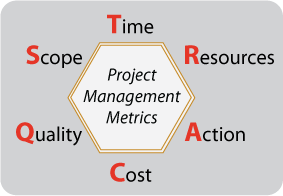
    Project Management Metrics — collectively known as the Project Management KPI — fall into six major categories. One way to remember these categories is to use the acronym TRACQS. 

    Is your project on TRACQS?

    Time - How is the project tracking against schedule plans?

    Keeping projects on schedule increases profit growth by lowering overhead and increasing labor margins. For example, when a project is off schedule and staff is reallocated it increases overhead to readjust the schedule may reduce realized utilization.

    Metric calculation: Schedule Performance Index (SPI) = Earned Value of the work performed ÷ Planned Value of the work performed (to date).

    Resources – Are we within anticipated limits of staff-hours spent?

    Using staff and labor multipliers as budgeted is essential to maintaining project margins. When evaluating which resources to use, it is sometimes argued to use a more skilled person that will use fewer hours than a less experienced person. The thought is the margin will ended up the same. However, when this decision is made business development and client relations to do the production work can result in the firm’s backlog and pipeline suffering.

    Metric calculation: Total Hours variance for budget vs. spent AND Labor Multiplier
    Budgeted versus Labor Multiplier Attained.

    Actions – Do we have action items outstanding or past due?

    It may seem obvious, but without a metric tracking action items (completed, missed, and planned), project performance cannot be corrected. Maintaining visibility and monitoring deliverables can increase client satisfaction and reduce inefficient cycles of “catching the project up”.

    Metric calculation: Number of project collaboration tasks that are past due.

    Cost – How are we doing against the budget?

    Monitoring this project performance metric provides direct insight into a firm’s profit growth.

    Metric calculation: Cost Performance Index (CPI) = Budgeted Cost of the work performed ÷ Actual Cost of the work performed.  

    Quality – Does client feedback indicate project success, or the need for correction?

    On a regular basis, survey clients about results and milestones, based on meeting the client’s expectations to the deliverables.  There is little to no change that can affect the project, if you wait until the end of the project to conduct a survey, there is little to no change that can affect the project. A satisfied client results in more work (client retention), reference-ability (more clients) which are essential to firm growth.  

    Metric calculation: A rating greater than X means quality, and anything less requires attention.

    Scope – Is the scope staying within budget? If not, do we have authorization for variances
    of planned from baseline?

    Clearly define an agreed upon scope, the client’s role or responsibilities, and qualifying what constitutes a change in scope is an essential first step. When the scope has changed, documenting “why” will allow for margins to remain intact for
    client requested change orders and allow management to take corrective action when the scope creep is due to the firm’s lack of performance to the initial scope.

    Metric calculation: Comparing where planned exceeds baseline, and ensuring that original scope plus authorizations equal or exceed the estimate at completion.

    Clearly, a firm needs to have mechanisms in place to measure these project management metrics. Almost as important, however, is finding a way to indicate variance from expected (budgeted) results in an easy-to-reference graphical format — e.g., blue for good, red for bad. Doing so will ensure that staff, project managers, and executives are all on the same page for tracking firm growth and responding to any obstacles or problems that may appear.


    Most Recent News Mentions

    We’re changing the way project-based firms operate.

    People can’t help but notice.
    Who will be next?

    Check out our latest newsworthy work: