
In the News


We’re devoted to revolutionizing the way our clients do business. Sometimes that gets us noticed.

No big deal.

Posts about Professional Services (10):

Marketing Analytics: Understanding the Value of Marketing Efforts

Posted by Full Sail Partners on Apr 29, 2015

marketing analyticsMarketing is tough. Marketers are expected to be jacks of all trades:  Brand manager, technology expert,social butterfly and head collaborator. Yet at the end of the day marketing is often a thankless job. However, the fruits of our labors are often six degrees of separation removed from our actual efforts. We do not directly sell and there is no physical doo-dad at the end of the day that we can point to in order to justify our existence. Enter the world of ‘marketing analytics.’

What the heck are marketing analytics? Marketing analytics are the lifeblood of your efforts. You spend countless hours working on integrated marketing content – blogs, newsletters, infographics, proposals and much more! Yet at the end of the day can you honestly claim to understand the impact of these efforts? Marketing analytics are not only the indicators of our successes but the learning blocks of our mistakes.

Don’t fool yourself! Know what marketing analytics are worth tracking.

Like many things in life, we can often get caught focusing too much on the nice-pretty red herring rather than digging deep and identifying what truly matters. Metrics are no different! Marketers often get caught looking at superficial statistics rather than focusing in on metrics strengthen our business case. To better understand what kind of metrics you should focus on let’s identify the two main data types:

Vanity Metrics | these metrics often look good – and make you feel good – at first glance. Unfortunately, vanity metrics focus on pumping up our ego – not our business. I often equate these metrics to a high school popularity contest: All that matters is how many people sign my yearbook. But don’t be fooled, these metrics are not your friends. So what are some examples of these metrics?

  • Total website visits
  • Page views
  • Number of subscribers or followers

As you can see, these metrics look good at first. But do they actually provide actionable data that allows you to drive your business case forward? The ambiguity of these analytics leaves your marketing efforts reactive rather than proactive.

Action Metrics | meaningful metrics are the bread and butter of your efforts. To be able to leverage marketing analytics to improve your marketing campaigns you must be able to understand the customer behavior represented by these metrics. Using the above high school analogy, these action metrics are representative of the number of people that invite you to their party. These metrics do not only want to know you – they want to hang out with you! Examples include:

  • Site behaviors – what are people actually viewing and consuming on your website
  • Who is converting; is there a common buyer persona?
  • Customer acquisition costs

These metrics actually mean something to your business. They are not only indicative of your efforts, but reflective of your results.

How do we track marketing analytics?

So now that we understand what we want to track we must figure out how to track our desired marketing analytics. Luckily for you, there are hundreds of tools out there. Highlighted below are examples of each type of tool you will want to add to your marketing arsenal.

Content Management System (CMS) | a content management system will allow you to seamlessly optimize all of your integrated marketing efforts within your website. Gone are the days of fumbling with html and css codes. While in the day-to-day trenches of marketing you need the ability to quickly and easily access the living data regarding your marketing campaigns – and this is precisely what a CMS allows you to do.

Examples of CMS include:

  • Act-On
  • Hubspot
  • Marketo

Whatever CMS you decide is right for you, make sure that it integrated with all of your other business systems and processes to provide you with maximum visibility.

Web Analytics Platform | integrating your website with a Web analytics platform is essential for taking the step from analytics-shmoe to analytics-pro. Yes, you already get analytics from your CMS. However, think of a CMS as fast food and a full Web analytics platform as a five-course meal. Your Web analytics platform is your go-to asset when you need the full meat and potatoes of reporting.

Examples of Web analytics platforms include:

  • Google analytics
  • Mixpanel
  • Webtrends

Understanding a full Web analytics platform can be intimidating. Luckily you can often find free training. For example, Google offers a free analytics certification course that you can complete at your own leisure!

Customer Relationship Management (CRM) System | what good are all of these marketing analytics if you can’t actually do anything with them? A CRM system will allow you to better understand your leads, holistically track your marketing campaigns and most importantly provide you with the tools needed to build meaningful relationships. Our CRM recommendation for professional services firms is Deltek Vision.

Go forth and spread your analytical marketing wings!

Gone are the days where you fear that your marketing efforts will be glossed over. You now have the tools and knowledge needed to go out and make something of your marketing campaigns! We hope that you take this new found knowledge and prove your resolve by becoming an analytical marketing guru!


The Future of Marketing for Professional Services Firms

Posted by Sarah Gonnella on Apr 23, 2015

building marketing1 300x249 (1)Have you ever thought about all the information a firm collects on a daily basis? Think about it, every department is collecting information all the time. More importantly, information collected impacts your firm’s strategy and directly correlates to how successful you are at winning and retaining business. So what should your firm be doing with all of this information? The following five concepts answer this question and are the future of marketing for professional services firms. 

1.    Multiple Marketer Personality (MMP) I disagree with the philosophy that being a jack of all trades is a bad thing. In today's world of marketing, your career depends on the fact that you must juggle multiple tasks at one time and that you can quickly grasp concepts that you may know nothing about. This complex role of the marketer requires us to have a disease called Multiple Marketer Personality (MMP).

How can you tell if you have MMP? One way to tell is your role requires you to understand, decipher and extract data. One of our past articles talks more about this specific requirement that identifies someone who is equally passionate about marketing and savvy with technology to become the Marketing Technologist. Other key symptoms indicative of MMP are understanding how HR, finance and operations impact marketing. Understanding strength and weakness of employee talents, how communication occurs between client and employee, and the ROI of marketing are critical to establishing a firm’s growth plan. A marketing strategy becomes a pipe dream, instead of a realistic strategy, without a good grasp of these areas.

2.    ‘Necessity is the Mother of Invention’ Says Your iPhoneMobile is no longer what will happen, it is happening. Having mobile access will no longer be a nice to have, but a necessity. We actually collect and share an infinite amount of information on mobile devices and the cloud is changing the way we conduct business. Can you submit expense receipts or document a new opportunity with a client in real-time on your phone? More and more of our life is on a mobile device and computers are not always available. If your firm is not able to access information on-the-go, you will fall behind your competition. To learn more about mobile CRM, read “Mobile CRM: A Day in the Life of a Business Developer.

3.    Fusion of Data ToolsWhat do you get when you have visibility into your entire organization? Inquiring professional service minds would wish to know. Marketing data is so spread out between Client Relationship Management (CRM) systems, website forms, email systems, accounting systems, project management system, etc. that having one place to report is nearly impossible. Moving into the future, firms need to make a conscious effort to connect these autonomous information systems. Marketing automation + ERP integration is the future. Marketing automation tools connect inbound marketing, outbound marketing emails, social scheduling, SEO and lead nurturing. Where ERP connects all business functions, from your Finance, Management Accounting, Project Management, Client Relationship Management (CRM), Human Resources, Inventory and Purchasing. Each can be very powerful alone, but together they become a powerhouse.

4.    Gathering Feedback that Impact Your Client 65% of a company's business is from existing customers. This means that a happy client equals future revenue, but do you really know what your clients think of your firm? You should and you can. Client feedback tools are changing the way professional services firms manage their clients. Other industries have called them, Voice of the Customer (VOC), Client Experience Management (CEM), and Enterprise Feedback Management (EFM). But professional services firms have different needs and research has found that only 5% of them utilize a customer/client feedback system. Firms no longer have to wait until the end of a project to know that their client is unsatisfied. With client feedback tools, quick two-minute surveys are sent to clients during the life-cycle of the project. This allows your firm to proactively manage your client's expectations by knowing what makes the client happy and also identify things they would like to see changed. As addressed in this blog, “Using Project Feedback to Increase Profitability,” feedback is the key to stopping profitability loss during a project. 

5.    Sharing Firm Knowledge with Social Collaboration ToolsAre you working with a team and still sending out group emails? Stop! Social media changed how we communicate in our private life and it has changed how we communicate in business. Business collaboration tools are designed to ensure that teams work more effectively. No longer do you need to send a group email and worry that you left someone off. Business collaboration tools allow team members to share project related information on one site. They can also be integrated with other business tools, such as ERP and CRM systems, and Outlook. Since business collaboration tools are designed to be user-friendly, they are easy to implement and people are more likely use them. Additionally, business collaboration tools are not just for internal communication, but can also be shared with the client. Interested in how your firm can start utilizing social collaboration, this blog further highlighting the “5 Key Reasons Why Business Collaboration Tools are the Future.
 

The future of marketing for professional services firms is based on the way we collect, share and use information. Is your firm taking the right steps to get ahead of the competition? Connect with us to discuss more about the future of your firm. 
 
*photo credit: http://www.business2community.com/ 


Top 5 Fears Keeping You From an ERP Implementation

Posted by Full Sail Partners on Jan 28, 2015

describe the imageMy momma was always full of advice. Some I took with great results, but others … well let’s just say I had to learn the lesson the hard way. At this stage in our lives, we’ve all moved on from those tender years where momma was our greatest guide, but we are all still attuned to receiving advice from those more experienced. Or at least we should be. Take for example, the ERP Implementation process:

Most savvy business professionals know the ERP acronym, but not all have taken the advice.  But why?  What’s keeping some companies from “pulling the trigger” and bringing this all important piece to their success puzzle – especially when their competitors are?  In my years talking and working with a variety of firms, I have gathered the top five fears why companies, like yours, haven’t completed an ERP Implementation. 

1)      You say: “It’s going to cost too much.”

We hear:  Fear of Being Out of Control

We solve: An ERP system will address this fear by managing costs and stopping       financial leaks.

Problem:  The industry says that ERP implementation can be expensive and many companies wonder where the money is coming from. Many function under the notion that it’s easier to just do the quick fix and move on.

Solution:  The right ERP system, implemented correctly with the aid of the right consultants, will fix those expensive leaks in processes. Furthermore, with a detailed IT growth plan and the information from the new ERP, the initial costs will be recouped and you’ll be well on your way to a better financial and technologically focused picture.

2)      You say: “I don’t have the time to research an ERP.”

We hear:  Fear of Where to Start

We solve:  Taking the first step with an ERP and controlling your future will eliminate this fear.

Problem:  It can be daunting to think about the work it will require to research and discover the right consulting firm who will help find and implement the right ERP. But, in this scenario, consumers are being reactive rather than proactive - spending days living those old clichés “with your head in the sand putting out fires.” 

Solution:  It’s time to take action - focus on goals and the future. An ERP is a planning, forward-looking mechanism designed to give control over an organization’s future. If the research and work is done at the beginning of the ERP implementation, energy will be focused on the future. 

3)      You say:  “It’s going to take too long to implement.”

We hear:  Fear of Failure

We solve:  An ERP system helps you succeed by pulling together all your information for a clear picture of your newly improved organization.

Problem:  When you run a lean organization, all internal resources are at full capacity unable to see the big picture which makes for silo’d company data inhibiting the ability to see the big picture. Not having a clear picture serves only to stunt a firm’s growth:  it’s this lack of encompassing visibility which keeps a firm from being able to make intelligent decisions or to understand trends, because they are lacking departments and systems that are connected to each other.

Solution:  A good ERP system will pull together all this disparate data giving users the clear picture they need to move forward and giving everyone the gift of time. Yes, ERP implementations require some work and time to evaluate and establish new processes, establish goals, and get everything running smoothly, but the more attention is focused on the consultants and the implementation, the faster you will reap the benefits and feel the relief.

4)      You say:  “It’s going to require too much change in my current processes.”

We hear:  Fear of Change

We solve:  An ERP consultant will guide you through change.

Problem:  Even a bad process can feel comfortable, familiar. And in the fast-paced business world, we all have to find comfort where we can. It’s understandable to want to avoid the work, unfamiliarity, and making changes to numerous business processes. But what’s more important is that your competitors are already using their ERP systems. They will be on “the latest and greatest” while you are still floundering with “this is the way we’ve always done it.”

Solution:  Here’s where the right consultant can really help. Someone who knows their way through the maze of settings; who knows the latest and most relevant business processes; and who, most of all, knows YOUR business and YOUR industry. Once the consultant tailors the ERP implementation to what are now highly efficient business processes, you’ll be able to appreciate the value of the phrase, “change is good.”

5)      You say:  “No one will use the system, anyway.”

We hear:  Fear of Unknown

We solve:  An ERP is such a supportive tool, it will quickly become a familiar part of your world.

Problem:  So after all the trouble of researching and implementing and ERP; the real fear is, “Will I really use it or just revert back to our old ways?”  Once the shine wears off of a new ERP system, there will be some effort every person will have to make to make the changes permanent. HuffPost Healthy article, “How Long Does It Actually Take to Form a New Habit? (Backed by Science)” tells us that, “On average, it takes more than two months before a new behavior becomes automatic -- 66 days to be exact.” 

Solution:  That’s great news, because in a little over two months, with a focused effort, everyone, including you, will have turned these new processes into automatic actions. What’s more, the new processes will have included regular reviews of data giving a clear picture of the entire organization allowing responsible action for your future. We also recommend understanding more about the 8 key ways to make your implementation a success

ERP Implementation Fears Laid To Rest!

Some (or all) of these fears may have indeed been on your mind as you contemplated your company’s future success. To learn more about ERP implementation, the benefits and the return on the financial and time investment, check out Full Sail Partners’ whitepaper, “Could Your Firm Benefit from an Enterprise Resource Planning System?”

In the end, while momma’s advice may not have included an ERP implementation, her wise words still resonate and are perfectly applicable to this journey “Nothing tried, nothing gained!” Obstacles are just opportunities waiting to be discovered!


5 Practical Tips to Preparing Your 2015 Marketing Budget

Posted by Sarah Gonnella on Dec 17, 2014

describe the imageIt’s that time again: year end.  No, not year-end resolutions, but the time of the year finance is stressing about year-end close and emphasizing that a 2015 marketing budget is needed.

So how many of you look at last year’s numbers and slap on an increase and submit? Be honest! However, how many things have changed since your last budget? The competitive landscape has completely changed for us and many of our clients. So we thought we might do a review to remind firms to get back to the basics when planning your marketing budget. 

Marketing Budget Methods

There are several budgeting methods when putting together your marketing budget. The Society for Marketing Professional Services (SMPS) Marketing Handbook for the Construction and Design Professional, 3rd Edition by BNi Building News, 2014 highlights 4 different methods: 

  1. Projection Method – is for steady businesses with well-established marketing approaches and which relies on costs from prior years separated into soft or hard costs.
  2. Percentage Method – allocates a fixed amount of resources dedicated to acquisition and total net service revenue to fund activities that support getting work
  3. Goal-based Method – bases “bottom up” budget based on revenue goals and the implementation tasks that need to be accomplished to meet them. 
  4. Ratio Method – is a more complex method incorporating ROI mentality with a strong ability to meet revenue goals and with every dollar spent being tied to a return.  This is for more mature market segments and fairly large projects.

5 Practical Tips

Developing a marketing plan is more than what conferences will you attend and what cool promotional items can we buy this year. When planning your marketing budget for the year it’s important to think about the long-term financial success of the firm.  Below are 5 practical tips for professional services firms to help guide you as you develop this year’s marketing budget: 

  1. Analyze the current state of affairs – Internal and external research should be conducted. This includes doing a SWOT analysis. The SWOT should be conducted with all leaders within your firm and is a great starting place to start your strategic marketing plan.
  2. Tie your marketing budget to you marketing plan – The most basic mistake is not understanding what your goals are. Your budget will come from the tactics you plan to take to accomplish your goals. Be sure to translate goals into day-to-day actions. Here is more on how to establish goals or Key Performance Indicators and establish goals based on the SMART guidelines.
  3. Budget for nurturing existing clients – Firms are always thinking about how to catch the next big fish and commonly overlook where most of their revenue comes from. At the end of the year evaluate where most of your business came from. What would happen if you lost that business? Firm should budget for client nurturing not only throughout the year, but on a daily basis as they execute their projects. It costs a firm 5-7 times more to gain a new client then to keep an existing one. One way of nurturing clients is to be proactive and institute a client feedback process.  
  4. Execution is key – Communicating what is expected and following up monthly and quarterly helps you change course when something isn’t working. It takes everyone understanding what is expected and then executing on their part. This includes billing your time to the right code and evaluating your goals versus actuals. If it doesn’t line up then what needs to change? A budget isn’t set in stone, you can make modifications throughout the year when something isn’t working. Knowing it isn’t working is what is critical.
  5. More is not necessarily better – Spending more does not equate to achieving more success. To prove this, Deltek conducted their annual clarity report among its clients and found that high achieving firms did not spend more on their marketing budget then those of their counterparts contrary to belief.  They found that high achieving firms however are able to differentiate themselves by focusing on executing more efficiently.

In planning for the upcoming year, we hope these five tips help you develop your marketing budget. Be sure to check out our past webinar crafting a marketing plan and be sure to add a comment to share your tips! 


Project Based ERP: It’s Time to Tackle This

Posted by Full Sail Partners on Sep 17, 2014

Project Based ERP TackleProject based ERP.  You’re probably wondering to yourself, “what is this anyway?”  We’ve all heard of Enterprise Resource Planning (ERP) systems, but now the industry added the words “project based.”  It probably feels like they are just layering more words … and difficulty.  So let me make some sense out of this for you. 
Project Based ERP Straight Talk

Traditionally, ERP’s have primarily been associated with companies manufacturing products: a key factor in ERP is the merging of IT, HR, Finance, and Marketing data with product operations and inventory management. 

In services firms and consulting businesses like yours, however, some alterations must be made for the ERP system to show the data they need to achieve their goal – high profit and high revenue in a skills based environment – hence the addition of “project based” to our discussion about ERP systems.  Your services business deals with a model where intellectual property is what you produce.  You don’t have the evils of shelf life, production lines, or parts departments.  Instead, your lives are geared toward a consistent evaluation of process, of skill, and of running the perfect project.   

Get Down to Business

Project based firms are exceedingly good at running projects.  They can create a GANNT chart that’s a thing of beauty, they can set achievable deliverables, and they meet or exceed every deadline.  But finding an ERP system that’s attuned especially to services and not manufacturing – now that’s tougher.  It takes dedication, knowledge and the focused energy of the right team to get it all together.  

  • An ERP Consultant whose job is to master-mind all the necessary pieces to banish redundant, useless old processes and make your project’s business goals a realty.

  • A Project Manager focused solely on gathering and maneuvering all the professionals to make achieving your project goals a success.

  • Your IT, HR, Marketing/Sales, Finance as the true heroes to making things happen.

So What Are You Going To Get Out Of It?

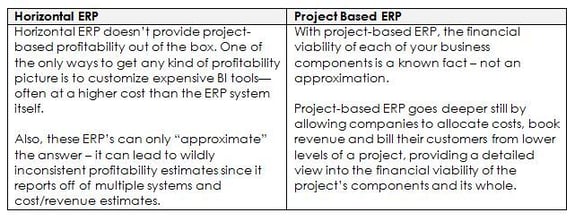
I know, I know.  “It’s expensive to add new software.”  “It’s a lot of work and we’re already pretty busy.”  I’ve heard this and more.  But let me tell you – you can’t afford NOT to add a project based ERP system!  The table below details those differences:

blog2

Brass Tacks

Still need more?  Here’s the slam-dunk.  According to “Managing Your Consulting Firm for Growth,” an IDC Info-doc, ERP systems built from the ground up with projects as a core process give firms the tools to make the most effective decisions in these critical areas:

Lifecycle process across customers, projects and employees.

Details on projects that help optimize profitability and lower risks.

• Manage and optimize an integrated portfolio of services – using data to learn how to do more of what “works” and eliminate what isn’t “working” (i.e. what’s not profitable).

• Find the “right” customers and have the data to eliminate unprofitable customers.

• Manage the future by understanding the past and using data to make fast, accurate course corrections.

A project based ERP system will combine the
strengths of 
Marketing/Sales, IT, HR, Finance together with
project management software 
to help eliminate project waste.

Bottom Line

Your dedicated employees joined with the support of organizations like Full Sail Partners, Inc.  will make your project based firm as successful as possible by using your greatest resource – a specifically designed project based ERP system.  And while it’s rad here in California to just “ride the waves,” when it comes to running your project based firm, using a project based ERP is your best choice.  Dude. 


Putting Yourself on a Shelf: Marketing Services Based Businesses

Posted by Admin on Aug 28, 2014

Consumers. Buyers. Clients. Users. Customers. You want ‘em, you need ‘em! and it doesn’t matter what kind of business you own.  Or does it? Marketing services based businesses can be a tricky task. 

Identifying and marketing to your consumers

is both formulaic and highly individual,

because what you’re marketing makes all the difference.

In other words, if you’re a product based firm or a services based firm, your marketing efforts will certainly have some similarities but marketing to each of these audiences will also have their own needs.

Let’s first start with definitions.  

marketing services based businesses

Product based firm – you’re an organization with a solid, tangible product to offer its customers:  you can package it and put it on a “shelf.” Marketing is pretty easy – you might even say it’s “textbook” (taught in every marketing class across the country).

Services based firm – an organization that has people as its primary offering, i.e. a process or an expertise.  And since you can’t package people or put a process on a shelf, you have to market differently. 

A bit of both – Sometimes you’re some sort of hybrid between a products business and services firm.  Maybe you sell a product and offer services to back up that product.  Maybe you offer services with some ancillary products.  Whatever your mix of products and services, your marketing efforts will have to vary depending on your target market for each.

Who says it best?

So let’s get down to business and start marketing.   

When you’re marketing a product, you let your product speak for itself, tell its own story of how buying the product will solve the customers’ problems.  You can do things like show your product in action - think cars careening down the highway or a newly cleaned floor.

With marketing services based businesses, it’s a bit different.  Yet still much the same.

Like products, services solve problems.  Marketing your services business will still show problems being solved but as told by the current clients of your services: as the old adage says, people buy from people.  Think of a company like “Angie’s List” which sells services of professionals as told by the users of those services.  With services, your biggest marketing tool is your clients.  In services, you can’t parade your product for your potential customers, but you can show those who have successfully used your services. 

Client Feedback Tool. The key to marketing services based businesses.

But how do you know the stories of your clients?  You ask them.  And in the services world, your best friend is client surveys, specifically, a Client Feedback Tool which companies like Full Sail Partners use to periodically and regularly gather information from clients about engagements.

Sometimes customers need a voice (other than just talking with a project manager) through which to offer their feedback.  A Client Feedback Tool offers survey questions which your clients can use to offer their thoughts on the engagement:  these can either be constructive points as to areas for improvement or compliments on the engagement which are really helping their work lives.  And, with the right marketing professional, both can be used to your services business’ advantage, because once you know how your customers are feeling, you can take action.  In marketing, no news is not necessarily good news; the more information you are armed with, the better marketing can do its job.

Never underestimate the value of retention

Marketing your services business is a bit different but can be better once you find your audience because of one word – RETENTION.  If you have happy customers, not only can they contribute to your marketing efforts, but keeping these same happy customers is the real boon to your bottom line.  According to Forbes.com “Five Customer Retention Tips for Entrepreneurs” 

For those who feel that customer retention plays a relatively minor role in helping a company grow a healthy bottom line, here are a few statistics you might be interested in. According to Bain and Co., a 5% increase in customer retention can increase a company’s profitability by 75%. And if those numbers don’t impress you, Gartner Group statistics tell us that 80% of your company’s future revenue will come from just 20% of your existing customers. Still not sold on customer retention? One final statistic provided by Lee Resource Inc. should give you plenty to think about: Attracting new customers will cost your company 5 times more than keeping an existing customer.   

When it comes to marketing services based businesses, happy clients are your secret weapon

Marketing your services business requires some tweaks to your marketing that differ slightly from product businesses.  Your chief marketing tool is your current customers as they proselytize your message.  Not only are they reaching new customers, but if they are happy enough to share your good work, it looks like you will have a long-term relationship making your bottom line even that much happier. 

Yes, it may be a bit daunting to come up with different marketing styles for your potentially varied target audiences. To accomplish this, check out the Client Feedback Tool - a tool designed to help you target your marketing efforts.


Is Your Project Evaluation Plan Measuring all the Metrics You Need?

Posted by Ryan Suydam on Apr 9, 2014

clientsatisfactionAdding client feedback results to your project evaluation plan provides an incredible return on investment. Conversely, by failing to identify key satisfaction metrics, your projects are less efficient, and you have less insight in to the mindset of your clients. Ask yourself, in the modern competitive business environment, can your firm afford to overlook anything -- let alone the satisfaction of your clients?
Our easy to use client satisfaction solution, The Client Feedback Tool, allows clients to quickly and easily provide insightful data that will ensure that projects stay on course, and meet or exceed expectations. Utilizing our tool, asking your clients how your processes work takes them only two minutes to complete - but the information provided gives both parties valuable data to assure effective, successful projects.

Based on our research, including 100K pieces of data from our clients, we've listed 4 ways that feedback will add to your bottom line.

  • Identify your top 10% most loyal clients. Do you have a way to identify which clients value you most?  Using the information provided using the Client Feedback Tool, our clients have identified their top 10% most loyal clients and converted this knowledge into increased billings, increasing fees by 3% to their top-rating clients.  For a $10 million firm, this translates into roughly $30k in additional profit each year.
     
  • Retain one client on the "bubble." One-third of our subscribers came to us after losing a major client.  In every case, these firms were surprised by the defection and realized they were blind to a pattern of problems the client never brought to light.  Frequent feedback greatly reduces the chances of this happening.

    According to PSMJ Resources: 

    • AEC firms spend four times more money replacing a client than the costs of retaining one.  
    • Even if you replace the lost revenue of a departed client, the added cost of winning a new client typically exceeds $22k.
     
  • Increase marketing efficiency by 3%. The average AEC firm spends 11% of their revenue marketing, while seeing only 25% of pursued work turns into billable work.  Adding client feedback informs you of your market successes and identifies where your firm’s strengths are.  By marketing your strengths to your best market sectors, you’ll not only target the markets that are most satisfying (and profitable), you will also reduce wasted effort pursuing work that doesn't match your firm's core services.  Even a 3% increase in efficiency will save a $10 million firm over $33k a year.
  • Reduce key staff departure by 5%. PSMJ Resources again reports that replacing your best staff costs in excess of $100k per departure.  Most key staff don’t leave for better salary. They leave because they feel unappreciated, unvalued, and because they feel their growth is not supported.  Quantitative feedback gives you the tools and information to recognize performance.  In fact, your clients will be directly recognizing your staff’s efforts as they provide feedback.  Research based on nearly 10 years of helping our clients collect feedback indicates that their clients rate staff performance as "Exceptional" 22% of the time.  This satisfying work environment will help retain (and identify) your best people, saving an average of $67k each year.

It’s simple, regardless of firm size, incorporating feedback in to your project evaluation plan can increase profits 13% or more just by applying these tools and strategies.

Garnering the client feedback metrics needed for your project evaluation plan is easy with a simple and powerful system like The Client Feedback Tool.  

Why Team Collaboration Tools are Essential for Productivity

Posted by Sarah Gonnella on Mar 12, 2014

Team Collaboration ToolsWhat are the major productivity killers for firms in the Professional Services? For most firms, some of the biggest ones revolve around information overload, duplicated effort and other inefficiencies. 

Fortunately, team collaboration tools can address each of these areas — and thus have a positive impact on the productivity of individuals and teams throughout an organization. 

First, let’s consider the element of information overload — which for many people is exemplified in the form of an overflowing email inbox. We all know the frustration of seeing fifteen different emails with the same subject line, where people are actually commenting each other’s earlier messages — and then trying to untangle the sequence of the discussion to make some sense of it. Not only does this type of information overload take time to sort through, but the reality is that with so many emails piling up, important messages can get lost or go unread. 

Another major factor that negatively affects productivity is duplication of effort. It’s common for multiple people in a firm to be working on the same problem — but is some cases, rather than working as a team, they’re operating in unconnected silos. Even if the whole team was in the same meeting, subsets of the group may have informal follow-up meetings, or even chance encounters in a hallway. Any one of these can result in parallel (and duplicated) efforts. 

Inefficiencies come in a variety of flavors, ranging from the annoying to the scary. One of my favorites is the issue of document versioning. This is especially likely when multiple people are working separately on the same document. Unless a firm has a solid solution in place, it’s all too likely for multiple versions of a document to spring to life, each with its own edits and authors. Sorting through the different versions to create one final document can be a time-consuming source of frustration. 

Real team collaboration is a beautiful thing

Now let’s switch gears and talk about some of the productivity gains a firm can realize by implementing effective team collaboration tools. 

One of the most essential functions that collaboration tools perform is organizing team members’ communications into a centralized repository of conversations around specific tasks and issues within the project. In the Kona tool, for example, individuals can have conversations with one colleague, a small group within the team, or the entire team. They can also see the various subtasks, view a centralized project calendar and share information with the entire team. 

Team collaboration tools can enable project managers to set up their groups so that certain members are able to see all conversations, while others have a more limited view. This capability can be especially critical when collaborating with clients. 

Kona in particular has found an effective way to address the problem of sharing documents among members of a team – one that ensures that everyone is working off the latest version. Instead of sending colleagues the actual document as an email attachment, users can send links to where the master files are stored (including such online services as Dropbox, Box or Google Drive). 

Last but not least, when collaboration tools are web-enabled, like Kona, they’re ideal for optimizing the way people work in the real world. After all, not all of our productive time is spent at work; we can also be productive when we’re in between doing other tasks, whether at home, on business trips or elsewhere. Team collaboration tools allow individuals to continue being productive, wherever and whenever inspiration hits. 

Summing up

Until a firm finds an effective way to address factors like information overload, duplication of effort, and inefficiencies, its productivity will probably suffer. Team collaboration solutions may hold the key to making the most of your team’s collective abilities — and at the same time, minimizing the overlaps, dropped balls and other issues that may be limiting your productivity.


How to Use Social Collaboration Tools in a Professional Services Firm

Posted by Rana Blair on Mar 5, 2014

SOCIAL COLLABORATION TOOLSLet’s be clear: people are not squirrels. That being said, when you’re trying to get your firm’s employees to interact with each other effectively, it may seem like trying to herd the little woodland creatures.

Most firms’ leaders already know that the most effective answers to this challenge involve improving collaboration, communication and teamwork. Easier said than done, right?

Fortunately, social collaboration tools can improve the effectiveness of not only your individual employees themselves, but also the separate functions within the firm and also the organization as a whole. Here are some of the ways a firm can use these innovative tools to add value throughout the organization.

Executives

From the CEO or partner’s perspective, social collaboration tools have the potential to improve productivity at every level within the organization. Here’s how:

  • Individual employees are empowered to share information and collaborate on projects more efficiently and keep their managers and colleagues up-to-date in real time.
  • Functional units can collaborate more effectively, because managers have better insight into the status of all ongoing projects. Managers also have a central location for all project communication that doesn’t disappear when an employee leaves.
  • Differentiating your firm from the competition by providing a collaborative environment for not only your internal team members, but outside consultants and clients. 

As an example, collaboration tools such as Kona make it far easier to include clients as team members throughout the process. Compared to other firms that simply use emails and phone calls to keep clients in the loop, a firm using these tools can enable more integrated and up-to-date communication with clients, and at the same time, create a more enjoyable customer experience. 

Project Managers

On each project, project managers can get better visibility into milestones and issues, improving project efficiency as well as the client’s experience in several ways:

  • Improves team members’ communication and accountability, while reducing time wasted in status meetings.
  • Strengthens the project manager’s relationship with the client, and also differentiates the firm.
  • Brings new staff up-to-speed more rapidly, shortening the time required before they can contribute.
  • Creates a centralized record of working issues, tagged and easily searchable. 

Marketing/Business Development

Professionals in a firm’s marketing/BD function, like its executives, stand to benefit in the long term from the differentiation that can result from effectively managed social collaboration tools. They also benefit in more tactical ways:

  • Improves communication and accountability in proposal planning, development, and review, including go/no-go decisions.
  • Streamlines event planning and tradeshow preparation.
  • Provides unified view of specific tasks across multiple BD proposal efforts happening simultaneously.
  • Enables greater consistency and knowledge transfer across multiple groups working on proposals and other repeatable processes. 

Information Technology

IT departments can use these tools to address a range of technical needs and, at the same time, change the culture to one that is more collaborative. Among its impacts, a social collaboration tool:

  • Enhances internal and external collaboration while protecting network information.
  • Is less expensive than traditional collaboration solutions such as SharePoint.
  • Improves management of complex IT projects and saves time by enabling peer support.
  • Allows the CIO and other leaders to be more aware and experience the “pulse” of individual projects and issues.

Human Resources

For the HR function, these tools can help in ways that are both strategic and logistical. Social collaboration tools:

  • Streamline and expedite recruiting and on-boarding processes.
  • Use two-way internal communication about tasks, events, and topics to create a more collaborative environment and improve employee engagement.
  • Allow HR employees to be more productive in planning and implementing internal events and initiatives.

Accounting

For the accounting function, social collaboration tools bring new efficiencies to a variety of ongoing processes in multiple ways:

  • Rather than having to dig through email chains and contact multiple individuals for updates and answers, accounting professionals can streamline the month-end close process by generating repeatable steps to organize and capture financial information.
  • Contract management can be improved by creating templates with specific steps and forms to guide each project.
  • Accounting staff can create a private but accessible space to capture progress and follow-up on A/R issues, assign individual responsibilities and maintain a centralized log of progress toward resolution.

The Collaborative Edge

In a sense, your most important asset could also be a liability:  If your staff cannot collaborate effectively, you’re not optimizing your firm’s capabilities. Social collaboration tools have the potential to improve collaborative capabilities at every level and in every area of your organization, bringing about measurable improvements. At the same time, they can help you create a better client experience and differentiate your firm from others — critical factors in attracting and retaining clients and employees.  

Do You Have the Correct Project Collaboration Tools in Place?

Posted by Scott Seal on Feb 26, 2014

Project Collaboration ToolsThe weather this winter has played havoc with the daily lives of millions of individuals, as well as countless businesses. 

One industry that has felt the impact in a unique way is that of professional services firms. These firms rely heavily on collaboration among their team members to manage and work on their projects. Unless they were already prepared to allow employees to work remotely, when the bad weather hit, many of them had to simply shut down until employees could once again manage to get to the office. 

Fortunately, technology is offering better and better project collaboration tools that allow team members to work together no matter where they’re located. But that’s just the tip of the snowdrift, so to speak. These solutions also make life easier for individual project managers and team members, increase the amount of creative collaboration among members of the team, and ultimately result in better projects. What’s more, they allow firms to easily include clients based in other locations, helping to maintain and build communication when meeting face-to-face isn’t an option. 

Let’s look at some of the key capabilities that effective project collaboration tools enable within a firm.

  • Communicate with anyone, anywhere, anytime. The most essential capability is making sure all the people involved on a project are able to effectively communicate and collaborate with each other. Any given project can include various employees and teams within the firm, as well as assorted external individuals, such as client representatives, consultants, and attorneys. A group this diverse often presents challenges in terms of finding communication channels and applications software that everyone can access and use — whether from their desktops, laptops, tablets, or smartphones.
  • Organizing the work. A second major function of effective project collaboration tools is to manage the tasks that are involved in each particular project. This function allows the project manager to use a central, intuitive resource to manage the many individual deadlines that are typically managed through email and Excel spreadsheets to complete milestones.
  • Streamlining document management. A third major function that effective collaboration tools address is that of document-sharing. Using a tool such as Kona, for example, allows you to share documents that your entire team (including external members) can view. As a result, instead of searching through dozens of emails to find the documents you need, you and your team have a centralized location. In addition, users have the option of uploading files directly to Kona or using other file-sharing solutions, like Dropbox, Google Docs, or SharePoint.
  • A better view across projects. An effective project collaboration tool allows project managers to have a view across all the projects they are managing. As a result, they not only have insight into the specific tasks, conversations and files for the current project, but can also view upcoming tasks and new conversations and files in one widely-accessible environment. 

Better collaboration, better results

For firms in the professional services space, project collaboration tools offer a wide array of functionalities that can help improve not only the interactions of a given project’s team, but ultimately, the quality of the ideas and solutions the firm delivers to the client. An added benefit of technology-enabled collaboration is that it can help create a better experience for the clients involved — and that can help a firm differentiate itself from its competition.

Most Recent News Mentions

We’re changing the way project-based firms operate.

People can’t help but notice.
Who will be next?

Check out our latest newsworthy work: