

5 Fundamentals for Success When Approaching Software Customization
 When implementing or seeking a new software system, our philosophy is that the solution should get you at least 80% of the way. Of course the goal is to have a solution that completely matches all of your needs, but that sometimes just isn’t possible. Luckily Deltek Vision’s open architecture allows you to quickly add fields with a click of the button. Sometimes firms need to take it a bit further and with the addition of User Defined Info Centers (UDICs) firms can do even more. One thing to keep in mind is before any revisions are made it’s important your project is built on a foundation for success. Let’s take a look at the five critical elements when approaching software customization that will enable you to go beyond with your Deltek Vision system!
The Five Fundamental Tips for Successful Customizations:
Gather Key Stakeholders | Making a software customization change for your business needs can often feel like being lost in the land of the unknown. Your key project stakeholders are your ultimate end users – identify, cultivate and leverage their needs and expectations. Identify priorities early in the project to develop an actionable game plan that enables your development team to make the most impact on the organization.
Assign a Project Owner | Identifying a primary project owner will allow you to have the eyes and ears on the ground needed to guide your project to success. Be a “Leader of Change” in your organization by identifying the right captain to steer your ship on the correct course. Although the project owner is a stakeholder by definition, this person generally acts as a representative for the overall stakeholders; giving the group visibility in to day-to-day developments. Increased visibility helps impediments to be identified & solved quickly. It also helps developers and stakeholders to understand each other's constraints & expectations. The Project Owner is a vital link between the needs of the stakeholders and the development team.
Document User Stories | For many software customization projects, the subject matter experts do not know what information technology could and should do for them, yet the IT team needs to know what to deliver. One of the biggest challenges development efforts face is overcoming the IT - subject matter communications gap. How can you deal with these difficulties early, and not waste valuable development time and effort? A user story complements business analysis techniques that you are using and will make identifying project requirements easier and more complete without adding an extra burden of effort.
Focus on stakeholder requirements, needs, and goals for the solution. Avoid the trap of trying to get the users to define technical specifications. Start with an approach to capture, in business language, the goals, objectives, or wants for the business system in the form of very short stories. You can then add details over time as needed to document each story. Business-driven test scenarios foster a common understanding of each requirement.
Rough It Up | Don’t be afraid to rough things up a little bit – your end users certainly won’t be afraid to take the shine off of the new toy. Try to think outside of the box and attack your solution from every angle possible. End users do crazy things – you’ll thank yourself later for being one step ahead!
4 Type of Tests | Before releasing development efforts, your software customization should undergo a thorough testing process to ensure that the solution is working as intended. There are four main stages of testing that need to be completed before a solution can be cleared for use: unit testing, integration testing, system testing, and acceptance testing. The breadth of these tests is just another reason why keeping your key stakeholders active and engaged is important. When a program is more thoroughly tested, a greater number of bugs will be detected; this ultimately results in higher quality software. Test it once, test it twice… and then test it some more! Eat your own dog food. Allow internal testing, on your own system, to ensure that bugs and system flaws are identified as early as possible from real-world testing.
Is your firm considering utilizing Deltek Vision's UDICs? See how real Deltek Vision users are creating richer and more connected business environments in this on-demand webinar:
 As white-collar professionals, our individual skillsets are built upon our cognitive abilities. We spend years adding new skills and competencies to our wheelhouse by absorbing tidbits of information from every facet of our daily lives. Think hard enough and I am sure you can identify personal, professional and communal experiences that have factored in to your eventual expertise. So how do we capture this intellectual information and pass it on to our coworkers? This knowledge sharing conundrum stumps many firms.
 In June Deltek announced iAccess. So what is iAccess? Deltek’s iAccess is a new, user-friendly interface that gives front office employees access to Deltek Vision information on-the-go. Users can access information from anywhere, anytime and the new interface is specifically built for tablets and mobile devices.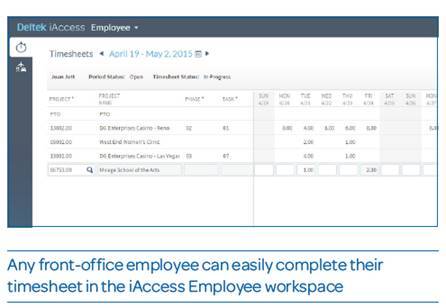

 Sometimes life’s not fair. We’ve all been told this before, and if you are part of the human resources (HR) department, I’m sure you hear about fairness all the time. But what about you - the HR professional performing manual processes and navigating through a sea of paper work. Why do the accounting and operations departments have sophisticated software to make their lives easier? It’s just another one of life’s injustices, but it doesn’t have to be. That’s right, talent management systems are now being integrated into those awesome Enterprise Resource Planning (ERP) solutions your counterparts in other departments are using and are changing the way companies manage their human capital.
 As a virtual employee I often have a computer within arm’s reach. The need to access Deltek Vision on a mobile device has largely been non-existent for my work situation. However, recently I attended back-to-back conferences and I quickly found myself behind on my timesheets and desperately needing to submit an expense report. So one afternoon, as traffic died down while manning a tradeshow booth, I decided to install the Deltek Touch Time and Expense app on my phone.
 Among many things, today’s professional service firm managers are constantly striving for the most effective and efficient way to operate their business. They are inundated with data and, while reviewing latest financial results, finding the right business indicators for planning, understanding modern marketing trends and, of course, keep up with technology – simply managing the business can fall through the cracks. If your business is thriving, then it is evolving, and you need technology that can keep up with it and keep your business moving ahead. Enter open architecture (OA).
 "The road to hell is paved with good intentions."