In the News


We’re devoted to revolutionizing the way our clients do business. Sometimes that gets us noticed.

No big deal.

Posts about Technology Solutions (11):

What Do Soccer and ERP Consulting Have in Common?

Posted by Scott Seal on Aug 14, 2014

Here in the United States, our sports zealots perform crazy antics like going shirtless in freezing weather or painting their faces in support of their teams.  But it’s more than the individual antics; the real difference is in the scale of extremism that soccer fans exhibit – a literal global exuberance all in support of their beloved sport.  But wait, isn’t this an article on ERP Consulting? 

Well, believe it or not, soccer and ERP consulting have quite a lot in common: 

  • They both strive to achieve a very specific GOAL.
  • They require coordination among the various efforts of serious talent to make it all happen.
  • True fans are enthusiastic about the team winning.

Breaking it down: Are Soccer and ERP Consulting that Similar?

ERP

First, let’s talk about and define ERP.  Enterprise Resource Planning (ERP) is the name given to the compilation of software products and/or modules.  According to “Could Your Firm Benefit From an Enterprise Resource Planning Solution

The original Enterprise Resource Planning (ERP) solutions, introduced in the 1990s, were primarily designed for and used by manufacturers. Today , ERP solutions have evolved and serve as a tool to manage the project life cycle for professional services firms. These include firms involved in IT services, architectural and engineering, design and planning, system integration, and management consulting, to name a few.
 
Furthermore, according to CIO.com’s “ ERP Definition and Solutions
 
ERP’s must serve “the needs of people in finance as well as it does the people in human resources [and other departments which typically have their] own computer system optimized for the particular ways that the department does its work. But ERP combines them all together into a single, integrated software program that runs off a single database so that the various departments can more easily share information and communicate with each other .” 
 

This sharing and communicating of information is all geared toward one, single purpose – achieving business goals. 

Putting them together

Next, let’s get back to one of my favorite subjects, soccer.  Soccer is a game requiring the coordination of individual players, each with their own proficiency; sometimes it involves players from different nationalities, or differences in a position focus like a goalie or halfback or a variations in specific skillsets like juggling or dribbling the ball. The players rely on the communicating and sharing of information during a game to one single, purpose – putting the ball into the net for a GOAL, a win.

So, like the soccer team with different players, ERP consulting requires synchronization of dissimilar needs, processes, and indeed functions of the software of different departments, so that the business can achieve its business GOALS, its win.

It takes the right coach to win

ERP ConsultingIn soccer, while the right players, good equipment, and positive fan support are unquestionably important parts of the team’s success, the keystone to an effective soccer team is, in fact, the coach.  The coach’s job is to balance each player’s strengths against the combined team’s goal of winning.

The coach in ERP is the ERP Consultant.  Having the right individual department software is important, but the keystone to implementing a system, evaluating business processes, and bringing all that information together in a meaningful way is the ERP Consultant.  This person, like the coach, has to balance all the individual parts, i.e. departmental needs, in order to reach the business GOALS of the entire organization. 

How to find the right ERP Consultant

Choosing the right ERP Coach, er, Consultant is your important first step.  This person can help you determine the scope of your ERP project – including costs, size, structure, business process evaluation, and ERP goals as well as help you research and find the right ERP solution for your business.  Full Sail Partners, Inc., for example, specializes in identifying the critical resources to create a faster, more efficient, and cohesive business infrastructure for professional services firms looking at ERP solutions.  Ultimately, you need a consultant who

  • listens to you
  • knows your industry
  • understands needs beyond the tool
  • understands your company culture, and
  • knows the ERP industry.

Don’t get a red card

redcardChoosing the wrong ERP consultant or software solution can lead to significant issues penalizing you in dollars, time and public relations.  Following are only two examples of many instances of what happens when ERP implementations fail:

… Knight Capital, [a financial services firm,] recently lost over $400 million in a matter of minutes because of a glitch in its trading software — trading software that wasn’t fully tested and properly deployed prior to production. In addition to the immediate impact of lost cash and profits, the software failure also caused the company’s stock to drop 68-percent the day following the glitch. 

SAP and AxonCity of San DiegoThe city of San Diego, CA terminated its software implementation contract with services provider, Axon, citing “systematically deficient project management practices” and a project that was running $11 million over budget.

But be aware, an ERP Consultant cannot entirely save you from these “red card” losses.  Like the soccer coach, their real purpose is more about setting realistic expectations and sound goals, as well as offering their expertise for avoiding potential issues before they occur.   

In the end

Although analogous in many ways, the reality is that soccer is purely a game to most of us while ERP consultants help you achieve your GOAL – a more efficiently run business resulting in greater success for all your employees.  Calling Full Sail Partners as your ERP consulting expert is your first step in achieving your WIN.  

And while going shirtless in below freezing weather or being painted the colors of your favorite ERP vendor is one way to show your support, it’s not necessary.  But then again…a Full Sail Partners logo on my chest would make me stand out in the crowd. 
 

Get Mobile with Touch Time & Expense and Touch CRM 1.3!

Posted by Full Sail Partners on Aug 6, 2014

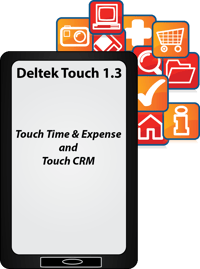
mobile deltek touchIt’s time to break away from the chains of your desk, and get mobile with Deltek Touch Time & Expense, and Touch CRM 1.3. With these apps, both available in iTunes and in the Play Store, it is now easier than ever to research (and update) contact records, as well as capture expenses and track time on the go. Take advantage of the following features, and provide your staff with the most powerful remote tools and utilities to do their jobs to the fullest:

Deltek Touch Time & Expense 1.3:

  • New Name, New Features, Same Reliability | In this release, expenses were added to the Touch Time application, and the application name has officially changed to ‘Touch Time and Expense’. No more waiting to manage timesheets and create expense reports. Avoid forgetting the details or losing receipts by entering as you go. Wherever your mobile device is, Touch Time & Expense follows.

  • A Picture is Worth a Thousand Words | Touch Time and Expense allows you to create a new report, and then associate expense with that report. Take pictures of receipts, and upload them directly!

  • Numerous User Experience and User Interface Upgrades | A number of improvements have been made to the application to improve your experience. Upgrades include:

    • A sliding menu to replace all tabs and provide quick access to Help and Log Out.
       
    • A menu button to allow you to perform specific tasks for timesheets and expense reports.

  • Math is Hard, Let Your Apps Figure it Out | Touch Time & Expense allows you to select or update default transaction currency and exchange rate for an expense report. This screen, however, only displays if Multicurrency is enabled in Vision core.

Deltek Touch CRM 1.3:

  • Touch Knows How to Push Your Buttons | Touch CRM now has buttons, with icons, to replace labels on certain screens. Examples of new buttons include:

    • ‘List Button’ - Tap this button to display options specific for the contacts, clients, and opportunities screens.
       
    • ‘Pen Button’ – Tapping this button allows you to edit contact, client, and opportunity information.

  • No Mobile Limitations | Touch CRM allows you to search, edit, and add clients on the go. In addition, add or update Opportunities with the touch of a button.
     
  • Syncing Made Easy | Touch CRM automatically syncs up with your Deltek Vision system, and allows you to create activities and calendar events on the desktop, and access them on your mobile device.
     
  • Full Visibility | See user defined fields in contacts, clients, and opportunities. Additionally, Touch CRM 1.3 gives you the ability to view activities!
     
  • It’s All One Touch Away | Make a phone call, send an email, or map an address with the touch of a button.

  • And more | Interested in learning more about the features and functionality included in Touch 1.3? Reach out to us today for a demo, and start operating better!

Are you currently using the Touch applications? If so, respond below and let us know what your experience has been like so far.


Have you Seen Vision Lately? Check out Deltek Vision 7.3!

Posted by Full Sail Partners on Jul 15, 2014

vision 7.3The newest version of Deltek Vision (7.3) has been released, and along with it comes a new slew of powerful features and functionality. As always, operating on the newest version of Vision gives your firm the ability to manage better, achieve more, and improve your ability to better track your projects and efforts. Let’s take an overview glance of the new benefits.

Vision 7.3 Product Enhancement Synopsis

  • Manage company paid credit cards | 7.3’s new credit card functionality streamlines cost accounting. Features include the ability to setup credit cards, import credit card charges, and reconcile credit cards.
  • Expanded internationalization and localization features | New globalization functionality included in 7.3 gives your firm the tools needed to expand into new markets, and win more work!
  • Improved compensation break out | Gain additional insights into fee structures with detailed compensation breakouts.
  • Dashpart enhancements | Users can now choose which columns to include in info center dashparts; including user defined info center dashparts. Additionally, the dashpart can be populated with work breakdown structure level two or three record data.  Lastly, users can create an Invoice Review dashpart; providing a quick summary of outstanding receivables for chosen projects.
  • Core CRM | Users can now edit activities directly in the grid. Many new text editor features have been improved; including highlighting misspelled words and the ability to add words to the spelling dictionary.  Enhancements to the Opportunity Forecast Report; including revenue allocation for fiscal years.
  • And more | Interested in learning more about the features and functionality included in 7.3? Reach out to us today for a demo, and start operating better!

Is Your Firm Prepared for Deltek Vision 7.3?

Because of Microsoft’s de-support of Windows XP in April 2014, Deltek can no longer support the Windows XP client operating system beginning with Vision 7.3 and extending to future releases.

The following client operating systems will be supported for Vision 7.3:

  • Windows 8 or 8.1
  • Windows 7
  • Windows Vista

Additionally, to use this new version you must ensure that .NET Framework 4.5 or 4.5.1 is installed. For more information on the .NET Framework and to determine how best to deploy the 4.5 or 4.5.1 release within your organization, please refer to the Microsoft web site at http://www.microsoft.com/net.

Project Accounting: One, one deliverable met … ah, ah, ah! (Lightening flash)

Posted by Admin on Apr 30, 2014

Project AccountingLike the beloved Sesame Street Count Von Count character, your project accounting should be just as obsessive about tracking numbers – project management numbers that is.  Many companies are very good about ensuring that their general accounting functions (things like their A/P and A/R balances, for example) are consistently maintained and reported to those who need this data.  But when it comes to project accounting, too many companies fall short.  

But first – what is project accounting?

Let’s start by comparing it to standard accounting, which most of us know.  Standard accounting manages the financials using a company’s organizational structure – how divisions or departments are tracking (like their G&A, labor, etc.) compared to their budgeted amounts on a periodic basis.  For those who embrace their arithmomania (a compulsive love of counting) and for those companies where growth is a key component of their future, there is another layer which is a must.  Project accounting looks closely at the projects a company has undertaken most of which regularly cross departments and might last months or even years. 

Let’s say, for example, company X wants to undergo a new green initiative in their office.  Our standard accounting will keep good track of costs for things like the smart electronics to manage lighting and HVAC or the newly hired “Green Officer.”  What standard accounting doesn’t do is manage the costs for the actual project, i.e. how much did it cost you to achieve your final goal.  Things like:

  • The project manager’s time to create and manage the project plan: the work breakdown structure and project hierarchies.
  • Were deadlines met?  If not, what the cost of missing those deadlines?  If so, how did meeting those deadlines translate into cost savings?
  • How is percentage of completion managed and tracked to budget?
  • What long or short-term investments will need to be managed on an on-going basis once this project is complete? 

But let’s take this a step further.  Let’s say you need to perform a customer project – you’re going to implement that same green initiative in your customer’s office.  You probably have access to someone who is really good at estimating the costs of a project, so you have this first step covered.  You may not, though, have a good system for tracking those project costs to the actual costs which means for the entire project, you’re working with blinders and hoping that at end of the project, you’re not bankrupt.  That’s where a good project accounting system will save you.  Forbes.com contributor, Bill Connerly’s piece, “Businesses Lose Money From Bad Accounting,” says he’s surprised at “how many businesses do not know the profitability of each customer or project or order they have. For instance, a sign company could not tell … how much it cost them for a particular job they undertook. Their financial statements told them whether the entire business made money in the month” or not but there was no accounting in place to determine to which project the gain or loss was attributed.

Now, SOLUTIONS, please.

When you’re a small company doing your best to manage your business day-to-day, a smaller accounting solution, like Quick Books, serves your needs … for a while.  J. Carlton Collins, CPA details those limitations in his piece “Practical Advice for Companies That Have Outgrown QuickBooks” (http://www.iyoungland.com/_pdfs/outgrown_quickbooks.pdf)

QuickBooks has two basic limitations:

• Limited accounting system features

• Limited database performance 

If you run a smaller operation, these product characteristics are actually appealing … If your organization is rapidly expanding, however, you will eventually outgrow the QuickBooks feature set and database performance … growing companies often find they need more sophisticated features that aren’t offered by QuickBooks.

And therein lies the rub.  Growth.

For companies who have “growth” as part of their future – and “growth” can be defined any number of ways like increase in revenues, employees or customers, higher profits, greater market share, etc. – they will outgrow these types of small accounting solutions and have to take the leap to accounting sophistication by finding a solution that manages both their standard accounting as well as their project accounting.  

But before you take that leap alone, let’s get you a partner.  As much as we all love Count Von Count, you should look to a partner who is just as obsessive about numbers, but without the funny accent.  Your friends at Full Sail Partners are just what the Count ordered.  Take, for example, this piece by Mark Lovstrom with Full Sail.  He writes that growth is a KPI which should be analyzed with “a project KPI dashboard [that] can examine some simple indicators [to] allow a project manager to gauge which project(s) need more attention.”  He goes on to list those items which should be closely examined in order to manage your project costs.  Things like:

  • Accounts Receivable
  • Unbilled Labor
  • Estimated to Complete (ETC) and/or Estimate at Completion (EAC) 

In the end, we are all working toward success for our business.  And to most of us, success means growth which then means managing every minute and every dollar – through project accounting – to achieve your success.  Click to view this webinar by Full Sail Partners to learn more about how your particular style of growth can be achieved. 

Count Von Count and all his Sesame Street friends will be proud of how much your project accounting has allowed your business to grow!

IT Consultant, Cloud Solution, Cost Savings … Oh My!

Posted by Wes Renfroe on Apr 16, 2014

Cloud Solution, IT ConsultantJust like Dorothy in the Land of Oz, we are all searching for the great and powerful wizard to handle our problems, like computing.  Instead of the brave lion, the full-of-heart tin man, or the intelligent scarecrow, our companions to this all-powerful place are IT Consultants who lead us to today’s version of the Land of Oz … the Cloud Solution. 

What is a Cloud Solution?

First, let’s talk about this land that, to many people, seems amorphous and far away – the Cloud Solution for your IT problems.  The cloud is really a symbol for an ever available electronic network that relieves you of managing your IT infrastructure.  To bring it closer to earth … the cloud is really a partnership where another company manages all of your IT needs including securely storing your computer data, handling all hardware and software needs, and allowing you continuous access to your computing.  

The cloud takes the IT infrastructure burden off you

and allows you to focus your energies on what you do best.

Here’s an example … let’s say you’re a small construction engineering firm.  Your engineers can create CAD designs that are a thing of beauty.  But managing an internal network, updating software and hardware, and troubleshooting issues are just not in their skill set.  Furthermore, researching and buying all those computers and other technical devices is a massive non-revenue generating responsibility.  You need someone to take care of all this – you need a Cloud Solution that will eliminate headaches, and provide benefits: 

  • Reduce costs – managing your entire IT hardware and software structure and all labor with people whose first skill and interest is taking care of your computing.  
  • Be disaster safe – with disasters like hurricanes and wildfires, it’s nice to know that your data is housed in a facility specifically designed to protect the hardware and software from these types of occurrences.  Is your building that safe?
  • Be green – these days, we’re all trying to do our part in taking care of our planet; the less energy we use and the fewer old computers that end up in a landfill is a big part of that.  Cloud computing manages this far more effectively than many businesses are designed to do.
  • But most importantly, allow secure access to your data from anywhere, at any time on any device.  

Yes, literally.  Access.  Anywhere.  Anytime.  Anything.

What does a good IT Consultant do?

“Sounds good,” you say, “But who will get me started?”  That’s where you work with an IT Consultant from Full Sail Partners.  According to Forbes.com, “Be the Best Consultant Ever:  6 Things That Will Make You Great” (11/05/13), a successful consultant will:

  • Do exactly what they say they are going to do
  • Pay attention to details which produce error-free deliverables
  • Truly be the “expert”
  • Think critically through all possible solutions
  • Be resourceful
  • Probe effectively and listen critically

In short, a good IT Consultant is there for YOU. 

So when we pulled back those drapes and learned the great and powerful Oz is, in fact, Full Sail Partners, all fears vanished.  Full Sail offers the consulting expertise and a free webinar to further help solidify the benefits of cloud consulting.  And, luckily, there is no need to click our heels three times to find that consultant – one click of a mouse and you’re on your way.  

And, yes, you can keep the ruby red slippers … you’re welcome!


Is Your Project Evaluation Plan Measuring all the Metrics You Need?

Posted by Ryan Suydam on Apr 9, 2014

clientsatisfactionAdding client feedback results to your project evaluation plan provides an incredible return on investment. Conversely, by failing to identify key satisfaction metrics, your projects are less efficient, and you have less insight in to the mindset of your clients. Ask yourself, in the modern competitive business environment, can your firm afford to overlook anything -- let alone the satisfaction of your clients?
Our easy to use client satisfaction solution, The Client Feedback Tool, allows clients to quickly and easily provide insightful data that will ensure that projects stay on course, and meet or exceed expectations. Utilizing our tool, asking your clients how your processes work takes them only two minutes to complete - but the information provided gives both parties valuable data to assure effective, successful projects.

Based on our research, including 100K pieces of data from our clients, we've listed 4 ways that feedback will add to your bottom line.

  • Identify your top 10% most loyal clients. Do you have a way to identify which clients value you most?  Using the information provided using the Client Feedback Tool, our clients have identified their top 10% most loyal clients and converted this knowledge into increased billings, increasing fees by 3% to their top-rating clients.  For a $10 million firm, this translates into roughly $30k in additional profit each year.
     
  • Retain one client on the "bubble." One-third of our subscribers came to us after losing a major client.  In every case, these firms were surprised by the defection and realized they were blind to a pattern of problems the client never brought to light.  Frequent feedback greatly reduces the chances of this happening.

    According to PSMJ Resources: 

    • AEC firms spend four times more money replacing a client than the costs of retaining one.  
    • Even if you replace the lost revenue of a departed client, the added cost of winning a new client typically exceeds $22k.
     
  • Increase marketing efficiency by 3%. The average AEC firm spends 11% of their revenue marketing, while seeing only 25% of pursued work turns into billable work.  Adding client feedback informs you of your market successes and identifies where your firm’s strengths are.  By marketing your strengths to your best market sectors, you’ll not only target the markets that are most satisfying (and profitable), you will also reduce wasted effort pursuing work that doesn't match your firm's core services.  Even a 3% increase in efficiency will save a $10 million firm over $33k a year.
  • Reduce key staff departure by 5%. PSMJ Resources again reports that replacing your best staff costs in excess of $100k per departure.  Most key staff don’t leave for better salary. They leave because they feel unappreciated, unvalued, and because they feel their growth is not supported.  Quantitative feedback gives you the tools and information to recognize performance.  In fact, your clients will be directly recognizing your staff’s efforts as they provide feedback.  Research based on nearly 10 years of helping our clients collect feedback indicates that their clients rate staff performance as "Exceptional" 22% of the time.  This satisfying work environment will help retain (and identify) your best people, saving an average of $67k each year.

It’s simple, regardless of firm size, incorporating feedback in to your project evaluation plan can increase profits 13% or more just by applying these tools and strategies.

Garnering the client feedback metrics needed for your project evaluation plan is easy with a simple and powerful system like The Client Feedback Tool.  

5 Key Reasons Why Business Collaboration Tools are the Future

Posted by Sarah Gonnella on Apr 3, 2014

business collaboration, collaboration toolsBusiness communication continues to change with each generation. The quantity and speed of information has exploded and firms are seeking new ways to handle the pressure of information overload. Are business collaboration tools the answer? We predict that these 5 reasons demonstrate why collaboration tools are the way of the future.   

  1. Reduce Dependency on Email | Imagine a world of no email. I know it sounds crazy, right? However, if you had a designated space that colleagues, sub-consultants, vendors, and clients used to collaborate about specific initiatives, projects, or marketing efforts, wouldn’t it be nice to capture all of those thoughts in an organized fashion in one area? When you think about some of the biggest challenges with email and the fact that colleagues are not always down the hall anymore, it makes sense that businesses are looking beyond email. Here are some of the things that can be improved through business collaboration tools where email consistently fails:

      • Eliminate forgotten or missed requests
      • Categorizing comments, notes, files, tasks, and requests
      • Capturing ideas, competitive intelligence, or ways to improve your business that are easily searchable
  2. Personal Meets Business | The line of business and personal continues to blur. When was the last time you worked 9-5? People are working at all times of the night and answering questions while watching their favorite TV show. Business colleagues and clients are now connected to us on Facebook and personal activities and responsibilities need to be accomplished sometimes during the work day. Social collaboration and business collaboration tend to have the same needs: to share files, ideas, assignments, calendar of events, etc. Wouldn’t it be nice to organize both business and personal in one tool? Collaboration tools like Kona are making this possible.

  3. Make Life Easier | Employees are looking at ways to balance their work and personal life, as well as, have more flexibility with their schedule. Not all tasks need to be done during work hours or even at their desk. Virtualization is becoming more common, requested, and needed in corporate America. Disasters or state emergencies have made that even more apparent. Collaboration tools are designed with mobility and accessibility in mind. Additionally, they allow people to access information and other individuals anywhere and anytime with the comfort that the information is readily available in the cloud.
     
  4. Instant Access | Business collaboration is not just for internal communication, but is also being requested by clients. Clients are looking for a better way to communicate and a better client experience. No more excuses of lost emails. Clients can instantly ping you with a question and you can immediately respond with an answer through the use of collaboration tools. What client wouldn’t like to immediately IM or video chat with their consultant to resolve issues? Setting expectations of this instant access is important. Alternatively, you could set a schedule that you are available for client questions at a particular time each day and quickly answer those pending questions in one collaboration tool.
     
  5. Integration | Collaboration tools are becoming more and more integrated with other business tools. Not only are they now integrated with our ERP, CRM and Outlook, but collaboration tools integrate with other sharing tools like Dropbox, Box, Google docs, Skype, and the list goes on. The ease of use and social familiarity increases the likelihood of usability. Integration makes it even easier for users to access data in one place through connectors.  

Business collaboration tools are all about working more effectively as a team. Let us know what you think. Has your firm been contemplating collaboration tools? See what others are saying: 

Why Your SMB Firm Should Consider Taking Your ERP Online

Posted by Jennifer Renfroe on Mar 27, 2014
ERP Online, Cloud

It is common nowadays for firms to have some kind of database or system in place. Unfortunately, not all firms are benefiting from an Online ERP (Enterprise Resource Planning) system. So what is meant by taking an ERP Online? This term is also known as the “cloud” because information is loaded, stored and accessible from the internet.

If your firm hasn’t evaluated taking your ERP Online, as well as, other software and systems, it is worth investigating. Gartner reported in January 2014 that 2% of firms are already on the cloud and within the next 5 years, almost half of those surveyed will be in the cloud. We are finding that SMBs are benefiting the most from the taking their ERP Online as it is keeping them competitive.

So, why are SMBs taking their ERP online or to the cloud?

Can your professional services firm ignore the advantages of the cloud? Put yourself on an even playing field with organizations much larger, and with greater resources. Engage a partner that will work with you to understand your firm, and is familiar with the ins and outs of your current setup to ensure that a proper implementation takes place.

  1. Access your data on the go! Enable your business development team to access all of the pertinent information about leads and clients through mobile applications such as Vision Navigator and Deltek Touch. This invaluable access to data will become the Swiss Army Knife of your business development team’s tool box.
     
  2. Stay current with the latest technology advancements (not only with your Cloud ERP, but with other technology include Microsoft.) Enjoy the latest and great advancements without being the guinea pig.
     
  3. Focus on what you do best and let the experts worry about IT. Utilize experts to reduce time sinks and headaches, and let your people do what they do best – their job!
     
  4. Low entry point - save money. Avoid upfront investments and eliminate the need to manage slow and outdated infrastructure.
     
  5. Compete with the big dogs. With all of the cost advantages of taking your ERP online to the cloud, your firm will gain the needed firepower to compete with larger firms and stay competitive at all stages of the project.


Deltek Vision and Adobe InDesign Integration

Posted by Full Sail Partners on Feb 28, 2014

Vision InDesignFor years marketing professionals have been clamoring for a way to directly merge information from their Deltek Vision system to an InDesign template. For firms with Deltek Vision version 7.1 and higher, the wait is over! Creating InDesign Templates and merging information directly from Deltek Vision is simple, and is very similar to merging from Word, with some usability enhancement.  

Before we begin, you might be asking yourself, ‘What kind of functionality will InDesign merging include?’ To answer your question, we have highlighted some of the major areas below:

  • Add fields and grids (including user defined!) to an InDesign template
  • Format number, currency (projects only), and date fields in a template
  • Merge data directly from an info center record into InDesign
  • New ‘Select Projects’ function for Employee Resumes allows for more precise formatting of project examples on resumes within InDesign

So as you can see by the functionality, the ability to merge data directly from your Deltek Vision system to Adobe InDesign is going to allow your firm to easily deliver accurate, more consistent proposals through the industry standard desktop publishing software.

What exactly will we be able to merge?

If your information is in Vision, you can now export it out allowing your firm to merge the following documents from Deltek Vision to Adobe InDesign:

  • Resumes
  • Cover letters
  • Project cut sheets
  • References
  • and much more from your Vision system 

Merge functionality includes the ability to pull information from tables, grids, custom Info Centers, and user defined fields.

What technical requirements are required?

In order to run a Deltek Vision merge to Adobe InDesign, you will need to be running a copy of Adobe InDesign CS5.5 or newer, installed on your local user directory. You will also need to be running a copy of Deltek Vision 7.1 or newer, with TDM enabled.

So what are the steps?

Setting up Deltek Vision to Adobe InDesign merge capabilities is surprisingly easy! The process requires five major steps, highlighted below.

  1. Access the ‘Merge Templates’ section in Deltek Vision (Configuration>General>Merge Templates), this step may require you requesting additional privileges from your Vision administrator
  2. Select the Info Center you would like this template to be associated to
  3. Create or upload a new template. If creating a new template, please be aware that you will need to insert merge codes from the Vision Merge Code window
  4. Open the ‘Custom Proposals’ Info Center, select the proposal you want to merge information out of, and link the new template to the merge function
  5. Merge your information out of Vision!

So now that you know the basics of what Deltek Vision Adobe InDesign merge integration offers, we encourage you to get started. Should you or your team need further information, reach out to our team of CRM experts to assist. 

5 Best Collaboration Tools in 2014

Posted by Wes Renfroe on Jan 15, 2014

collaboration toolsNot all business buzzwords are created equal. For example, “collaboration” is red-hot among buzzwords today — but unlike other momentarily popular topics, the concept has been around a long time, but is now being addressed via technology designed to leverage the Internet. Collaboration apps and platforms typically take advantage of the Internet to enable the sharing of documents, ideas, calendars and more with colleagues. In fact, the more one embraces collaboration, the more implications one can find for teamwork, innovation and growth.

Here’s a quick look at the 5 best collaboration tools available today.

Kona

Kona is a cloud-based social collaboration/productivity platform for individuals and groups that enables file sharing, task/event management, and comments and conversations via Skype and instant messaging. It also integrates easily with other collaboration platforms and products, including Dropbox, iCloud, Google Docs and even SharePoint (if that’s your collaborative bag). 

In addition, Kona includes templates to expedite repeatable projects and processes, and can function as a company’s Private Social Network and shared calendar. Even better, Kona’s mobile app compliments its desktop functionalities, letting users track work from anywhere. Take it for a test drive by checking out the free trial version.

join.me

JoinMe is an elegantly simple (at least, simple to the end user) solution that allows you to share screens with anyone anywhere over an Internet connection. JoinMe can accommodate up to 10 meeting participants, and allows the meeting initiator to choose which items to share with whom, and enables chatting with one participant at a time or all at once. Keep in mind that these features are all in the free version — a fact that helped it land on our list of the 5 best collaboration tools.

Doodle

Doodle is a handy meeting scheduling/tracking tool for Android device users. Designed to integrate seamlessly with Google Calendar, Doodle makes it easy to find the right date and time for a group of people to meet. You can use the basic service for free at doodle.com, without the need to register or install software. With easy-to-use polling capabilities and real-time commenting tools, it’s also available as a low cost app for Android devices.

Dropbox

Currently in use by over 200 million people, Dropbox is a cloud-based platform for file sharing and accessing. Users designate a special folder on their computer that Dropbox synchronizes with similar folders the user creates on their other computers and devices. Any files that the user places in the Dropbox folder also are accessible through a website and mobile phone applications. Available for Windows, Macintosh and Linux desktop operating systems, Dropbox also offers apps for iPhone, iPad, Android, and BlackBerry devices. Options range from a free version to DropBox for Business ($15/user/month).

Skype

Skype enables free video and voice calling to anyone else using Skype, as well as instant messaging and file sharing. Alternatively, a modestly-priced version of Skype includes low rates on calls to mobile devices and landlines worldwide, text messaging and group video calls for up to 10 people. Users can take part in Skype calls using a wide variety of devices, from desktop computers and mobile devices to home phones, certain TVs, and even devices you might not think of as collaboration tools, such as PlayStations Vitas and iPod Touches.

Join the collaborative world

As you can see from the 5 best collaboration tools mentioned above, the world of collaboration choices and tools is exploding. But before you jump in and start rubbing virtual elbows with colleagues on the other side of the world, keep in mind two bits of advice:

  1. As attractive as their price tags may be, the free versions of all of these apps and platforms have limitations. For example, you may be limited in the number of participants you can accommodate and the amount of data you can share — and you may have to endure the occasional advertisement as well.
  2. Remember that integration with your existing apps (especially your calendar) as well as other collaboration apps is critical. Some of these apps, such as Kona, play well with almost all of the apps mentioned above; others, not so much. The more seamless the integration between your various collaboration apps, the bigger the impact on productivity and ease of use.

Despite those caveats, each of these tools can truly transform aspects of the way you work with colleagues. The result could be better ideas, more effective teams, and possibly even a better quality of life. Just imagine how nice it would be to cut down the time you spend setting up, going to and from, and sitting in meetings — not to mention, take part in them from the comfort of your own home, cubicle, or coffee shop! 


Most Recent News Mentions

We’re changing the way project-based firms operate.

People can’t help but notice.
Who will be next?

Check out our latest newsworthy work: