

Advantages of ERP Systems... and Their Bottom Line Impact
 I was talking recently with a prospective client who observed that his firm had outgrown QuickBooks (QB). The conversation eventually led to a discussion of the advantages of ERP systems over back office accounting systems — which include not only efficiency gains, but strategic improvements as well.
Being in the ERP implementation business, we hear a lot of customers express frustration over outgrowing QB, so I asked my prospect what it meant specifically for his firm. Off the top of his head, he named several pain points:
- First, their QB systems were disconnected, so there was no particular place where management could view financial performance overall, let alone broken out by project manager or client.
- QB could display AR for a specific client, but offered little in the way of project information regarding specific services or deliverables.
- Last but not least, correspondence for each client was buried in various public folders on the firm’s file server. To make matters worse, the correspondence trail was incomplete due to users’ not following the correspondence logging protocol.
After hearing these insights, plenty of examples came to mind of ways that even a small- to mid-size firm like his could benefit from an ERP system. I mentioned a few of the most basic advantages of ERP systems over back office accounting: the value of integrated data, open architecture and user customizations.
I also pointed out that thanks to the evolution of niche ERP systems, small firms CAN get the type of functionality that used to be available only to firms with deep pockets. In fact, it’s now quite easy to implement an ERP system that not only addresses the accounting function, but also facilitates the firm’s core processes and way of doing business.
The Need For Visibility
My colleague next mentioned how his firm actually had strong AR, and good visibility into its cash and cash management. The problem, he said, was that the organization lacked the visibility needed to help back office management play a more significant role in decisions affecting the firm as a whole. By the same token, it was difficult to get project managers more involved in the fiscal responsibility that goes with managing client expectations.
I pointed out that there were several other major advantages of ERP systems over basic accounting packages. The ERP concept excels at addressing the front end of the project life cycle, by facilitating tracking of projects and providing visibility. Specific examples include:
- Managing data obtained through the business development process
- Generating opportunity notifications and creating process flow through workflows and alerts to improve efficiencies and win rate
- Forecasting for opportunities and already-awarded projects regarding not only revenue, but staffing requirements as well
- Providing for audit trails of communication with clients, contacts and opportunities and supporting technical staff in the delivery of services under specific projects
- Facilitating communication with accounting early in the business development phase regarding terms, rates, related documents and specific contract requirements
- Integrating with desktop tools like Outlook, Word and PowerPoint to facilitate email communication and automate creation of proposal, estimating and contracting documents
I then suggested we establish a value proposition for the level of investment that would be needed at this critical juncture in the firm’s transition from QuickBooks. This is where my prospect’s eyes started to get big, as he saw how much time, factored by associated hourly costs, was being spent on efforts that an ERP system could automate.
We assessed values for each of the existing manual processes, and compared them with the reduced time and effort involved using the ERP approach. The resulting savings would go right to the firm’s bottom line. But as significant as those savings would be, I added, the real impact would come from the improved quality of the work environment, better communication with clients, and most importantly, increased opportunities for success.
See how today’s success-minded firms require a laser-like focus on strong project and financial management practices by downloading the whitepaper on Growth and Transition Strategies.
 Of all the metrics that professional services firms can track, two of the most important are utilization and realization. These are different, but related ways of measuring employee productivity and profitability. Both can be measured with a high degree of accuracy — and made visible to management — using software.
 1. Make it Comfortable.
 In this situation, I observed people giving advice as opposed to just sharing experiences. I found it curious that contributors to the forum assumed many of the variables the person inquiring had not provided and further, the person making the inquiry hoped to find solutions without providing any background or specifics.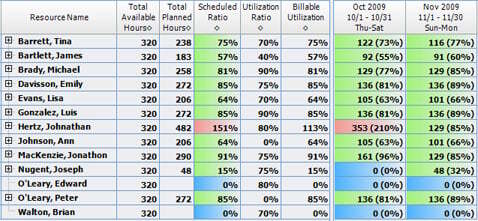
 The conversations module on Kona is my favorite internet based tool that I have found since I discovered Google Docs. Kona allows users to hold separate conversations on each task of the project. Notice that an important detail was left off of the calendar for tomorrow’s meeting? No need to open up your email to contact the event host, simply update the event, and you are free to comment on the conversation to let others know of the change. This condensing of communication in to one multi-faceted medium allows for a clear and effective message, enabling project staff to focus on completing the project, and not talking about it.
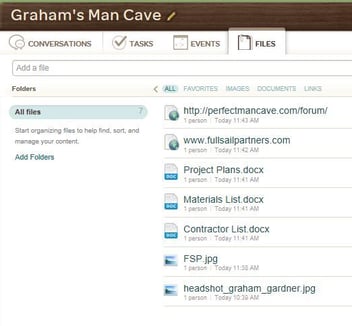 The files module. How many times have you emailed someone a file, only to be told later that they never received it? Many people cannot receive emails larger than 2mb – a data size that is nothing in today’s media rich web. While programs like Outlook have made it easier to manage attachments, email was create in the late 80’s and was never intended to be a storage database for large, detailed files.
  Good customer service is a rare commodity in this day and age of virtual customer support agents. Business is done in an ultra-competitive arena where your direct competition is only a Google search away. As a result, firms are developing customer relations management plans to help better serve their client base. Has your firm ignored developing a plan to manage your customers?
 Anyone that knows me, knows I love music and sing karaoke. I was learning one of Adele’s songs and listening to the lyrics: “Should I just keep chasing pavements, even if it leads nowhere?” I started thinking about the things we chase in our own life that lead nowhere. Even though this song by Adele is referring to love, it really can apply to pursuing business or ways to grow business. Does your firm have a way to analyze if the business you chase is leading anywhere? Better yet, do you know what efforts are paying off? Below are things to consider when evaluating the effectiveness of your business building strategies:
 Full Sail's Director of Marketing and Business Development,