In the News


We’re devoted to revolutionizing the way our clients do business. Sometimes that gets us noticed.

No big deal.

Value of the Deltek Vantagepoint Readiness Report
Posted by Amanda McClain on Jan 16, 2025

01-016-25 Readiness Report - Banner rev

The Full Sail Partners’ Vantagepoint Readiness Report remains the essential launchpad for any firm transitioning to Deltek Vantagepoint. This comprehensive tool is your guide to cleanup efforts and strategic planning as you consider the upgrade from Deltek Vision to Vantagepoint. It’s the perfect starting point for firms aiming to navigate the complexities of this process with confidence and clarity. 

Where to Begin 

Architecture, Engineering, and Construction (AEC) and professional services firms increasingly focus on Deltek Vantagepoint. The mix of excitement and hesitation surrounding the upgrade is palpable. At Full Sail Partners, we’ve developed solutions to help ease the transition. Our clients frequently address questions like: 

  • “What do I need to do before the upgrade?”
  • “When should we plan the upgrade?” 
  • “How will the upgrade impact our business operations?” 

The answers vary based on your Deltek environment and the state of your data. That’s where the Vantagepoint Readiness Report comes in. 

Start with a High-Impact Tool 

As a Deltek Partner with over two decades of experience, Full Sail Partners has guided countless firms through upgrades, implementations, conversions, and migrations. Many firms begin their journey by exploring resources like our Preparing for Deltek Vantagepoint webinar series, the Deltek Readiness Portal, or the Client Assistance Program (CAP). While these are helpful, the Vantagepoint Readiness Report offers unique insights into your specific database. The report provides clear insights, identifies potential issues, and offers a detailed plan to address data cleanup and strategic planning before the upgrade. Here’s why this tool is invaluable: 

  • Alleviate anxiety: Gain a clear plan for areas that need cleanup and attention, allowing you to start with confidence while managing other responsibilities.  
  • Quick and easy database inventory: In just 30 minutes, the report highlights potential duplicates and irrelevant records, saving countless hours of manual effort.  
  • Consulting time included: A Full Sail Partners’ consultant will spend an hour reviewing the report with your upgrade team, helping you digest findings and plan the next steps. 
  • Eliminate manual steps: Save time with an automated inventory script, allowing your team to focus on preparing data and preview environments.   
  • Tailored insights: Get a detailed view of your specific Deltek environment, going beyond generic resources. Your Full Sail Partners’ consultant will develop a customized plan based on your goals.  We will discuss what items are crucial to address before the upgrade, while other topics can be completed at any time, and sometimes helpful to revisit after the upgrade. We will also discuss opportunities to save the work created in your test environment and apply it to your live database. 
  • Uncover hidden data: Identify data from unused modules that may require cleanup before upgrading.  
  • Customized next steps: Every firm’s use of Deltek is unique; our consultants help prioritize actions specific to your needs. Learn what modules are included and those that are no longer available in Vantagepoint, and how to best move forward. Discuss the merging of several Vision info centers into Vantagepoint Hubs. For example, the merging of Vision clients and vendors into Vantagepoint firms. We provide best practices combining these info centers.  
  • Trusted expertise: Count on Full Sail Partners to guide you through your Deltek journey with proven strategies and support. 

Maximize the Results 

The Vantagepoint Readiness Report identifies key areas that need attention or discussion before upgrading, ideally before obtaining a preview environment. The simple process involves running a script to generate a detailed Excel report. Here are some of the insights it provides: 

  • Identifies potential duplicate vendors and clients
  • Produces a list of workflows
  • Compiles user-defined fields and grids
  • Highlights custom report files in use 
  • Flags duplicate columns across vendors, clients, leads, and contacts 
  • Displays key formats for various info centers 
  • Details labor cross charge, overhead allocation, and revenue generation settings 
  • Shows database table sizes 
  • Identifies unposted transactions, including timesheets and expense reports 
  • Highlights plans non-compliant with Vantagepoint (iAccess) requirements 
  • Flags info center numbering inconsistencies

Leverage Your Resources 

Investing in the right resources can transform a daunting project into a manageable task. The Vantagepoint Readiness Report is a prime example. With a typical turnaround time of about two weeks, depending on schedules, this tool provides clarity and direction. By rolling up your sleeves and letting the report do its magic, you can confidently identify and prioritize the next steps for your Vantagepoint upgrade. 

Let’s Get Started 

The Vantagepoint Readiness Report is just the beginning. Full Sail Partners offers a suite of additional resources to assist with your transition to Vantagepoint. Ready to take the next step? Let us know how we can help you make this year one of seamless upgrades and enhanced efficiency! 


Should I Migrate? 6 ERP Data Migration Considerations

Posted by Sparsha Muppidi on Nov 25, 2024

11-14-24 Should You Migrate_Banner rev

When evaluating a CRM or ERP system, a critical component of the decision-making process is assessing the data migration effort. Beyond the software and consulting costs, data migration presents its own set of challenges and expenses. As organizations move to the latest ERP systems, such as Deltek or similar ones, understanding the migration process becomes key to ensuring a smooth transition.

So, when you're asking yourself, "Should I migrate my existing data to a new ERP system?", here are the 6 essential questions you should ask:

#1 How Valuable is the Data?

One of the first steps in the data migration process is to understand how valuable the data is to your current and future business operations. In today’s world of data-driven decision-making, your data is likely more valuable than ever.

With the rise of the latest software development, high-quality, accurate data has become a business asset. Data that isn’t frequently updated or no longer relevant might not be worth migrating. However, real-time data on sales, finance, and customer interactions should be prioritized. In some cases, you may need to archive historical data rather than fully migrate it.

When considering whether to bring data to the new system, consider these four questions:

  1. Is the data frequently updated and is it accurate? 
  2. How often is the data accessed/needed? 
  3. Do you use the data in reports? 
  4. Do you need the data to make business decisions?
  5. If your answer to these questions is rare or never, then the data is probably not worth migrating to the new system.

#2 How Organized is the Data? 

Organized data is essential for smooth ERP migration. Data that isn’t structured properly or with inaccuracies will cause significant roadblocks during migration. ERP migrations should be focused on data cleanliness and consistency.

Some existing data that is being considered for migration may not be consistent across a given data field in a database record. For instance, inconsistencies in key fields (e.g., a phone number field containing text instead of numbers) will need to be corrected before data is moved. Migrating to any latest ERP system requires standardizing data fields to ensure compatibility.

So, evaluating the amount of manual clean-up required can help determine if the information is worth migrating. 

#3 How Long Would It Take Someone to Manually Enter the Data? 

One of the main concerns in an ERP migration is the sheer volume of data that needs to be transferred. As mentioned earlier, certain data is more efficiently entered manually into the new system. It is crucial to evaluate the effort versus the cost. Small data sets or data fields with only a few records may be better handled manually, but large-scale migrations benefit significantly from automation.

If a particular field contains only 50 data records, is it worth the cost of migrating it programmatically to the new system? On the flip side, underestimating the time and effort required for manual data entry can significantly extend the implementation timeline. Our experience has shown that when a firm opts out of a recommended data migration based on analysis, the success rate of the overall implementation tends to decrease substantially.

#4 Is A Conversion Utility Available for my Data?

In today’s ERP landscape, conversion utilities are often available to help automate and simplify the data migration process. These tools can significantly reduce costs and time, especially when migrating to popular ERP systems like Deltek. If a conversion utility is not available, working with a data migration expert who can create custom scripts may be necessary. Be sure you evaluate the cost of these custom tools before starting your migration process. 

#5 What is the Data Migration Vendor’s Migration Process? 

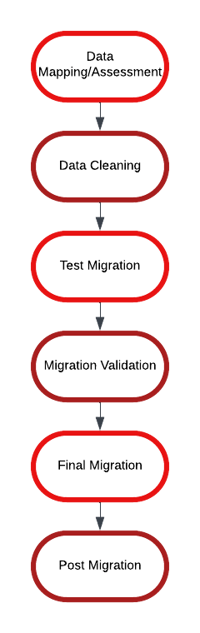
Selecting a vendor with a well-defined and proven migration methodology that addresses the preservation, security, and speed of migrating your business data is key to a successful ERP migration. As an example, below is Full Sail Partners’ migration methodology: 

  1. Data Mapping/Assessment – This step involves defining the scope, outlining the migration strategy and approach, and establishing the desired timeline. A proposal will be provided, detailing the costs involved.
  2. Data Cleansing – During the mapping phase, data that needs cleansing will be identified. The necessary data will be cleaned and organized in the current system to prepare it for migration. The data migration expert will also analyze the existing data and ask relevant questions to assess its quality. Improving the quality of source data in the current system enhances the success of automated data conversion.
  3. Test Migration – Once the migration scripts are created and the data is verified with the client, a test database will be set up for review.
  4. Migration Validation – After receiving the test database, the client will examine the data in the new system to confirm it has migrated as expected.
  5. Final Migration – After the data is validated, a final migration date is scheduled. Typically, all data is backed up based on the timing of a firm's billing cycle or payroll cycle. The final migration is performed over a couple-day period. Once the final migration is complete and reconciled the system is ready for use, minimizing downtime between the old and new systems.
  6. Post Migration – If any issues with the data are discovered after the final migration, occasional post-migration updates may be required to address those issues.

#6 How Experienced is the Migration Expert? 

ERP migrations are complex projects, and the expertise of the migration team can make or break the process. Experienced ERP consultants and migration specialists focus on data strategy and digital transformation.

Most data migrations require a mapping document. This defines the scope and ensures that the data will be imported correctly. An experienced data migration consultant provides this mapping document as well as valuable insight on potential issues that might occur during the data migration process. Before proceeding with data migration, it's important to understand the role and expertise of the data migration specialist within the firm.

Is their primary responsibility focused on data migration, or are they handling multiple tasks? Do they have experience migrating data like yours? A seasoned migration expert typically specializes in this area, dedicating most of their time to migration. Selecting the right expert is crucial, as it can minimize post-migration cleanup and ensure the data is accurately and efficiently transferred to the new system. be necessary. Be sure you evaluate the cost of these custom tools before starting your migration process. 

Data Migration Success Involves a Well-Thought-Out Plan

In many cases, migrating data is a must when implementing a new ERP system. However, by considering these 6 critical factors—data value, organization, manual entry requirements, available conversion utilities, vendor process, and expert experience—you can ensure a smoother transition and get the most out of your new system.

Data migration has evolved significantly over the years. Still, the key to success lies in a well-thought-out plan, comprehensive data assessments, and collaboration with experienced vendors and experts. If you're still unsure about your data migration process, then see how Full Sail Partners can help you with personalized migration strategies tailored to your specific needs by clicking the image below.

What You Need to Know About OCR and ICR Technologies

Posted by Evan Creech-Pritchett on Apr 25, 2024

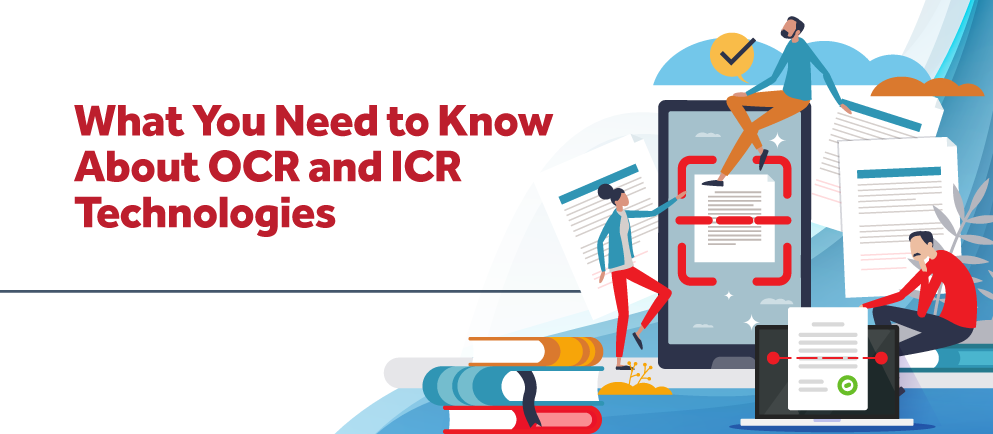
04-25-24 OCR and ICR Technologies - Banner

Without efficient document management, project-based firms would fall to pieces. The advent of advanced technologies, particularly in scanning and document processing, helped firms streamline this crucial aspect of their operations. Traditional scanning methods often fall short, only capturing document images without extracting crucial metadata such as client names, dates, or invoice amounts, unless manually inputted by associates.

What is OCR?

Optical Character Recognition (OCR) technology, also referred to as optical character reader, plays a pivotal role in modern document management systems. It involves the conversion of images containing typed, handwritten, or printed text into machine-encoded text. Various sources can be converted such as scanned documents, photographs of documents, scene photos capturing text on signs or billboards, or even subtitled text overlaid on images from television broadcasts.

OCR technology was developed by Emanuel Goldberg, making its debut in 1914. Initially, it was developed to aid the visually impaired in reading characters. Over time, OCR capabilities have evolved significantly, becoming useful in various everyday applications such as airport processes, mail handling, and banking.

Early iterations of OCR systems required training with images of individual characters and were limited to working with one font at a time. However, advancements in technology, and most notably in AI, have led to the development of sophisticated systems capable of achieving high accuracy across a wide range of fonts. Modern OCR systems can support various image file formats as inputs, enhancing their versatility and applicability.

Some OCR systems can even reproduce formatted output closely resembling the original document layout, including images, columns, and other non-textual components. This capability ensures that the digitized documents retain their visual integrity and readability, further enhancing the utility of OCR in document management and data processing tasks.

OCR engines have evolved into specialized software applications tailored to specific subjects such as receipts, invoices, checks, and legal billing documents. These applications offer a multitude of functionalities, including:

  • Entering data for business documents like checks, invoices, and receipts
  • Extracting business card information and integrating it into contact lists
  • Creating digital versions of printed documents
  • Enhancing document searchability by converting scanned documents into searchable PDFs

These applications show off the versatility and significance of OCR technology in modern-day document management. The adoption of OCR solutions is poised to become increasingly integral to firms’ operational workflows, driving efficiency, accuracy, and overall productivity.

What is ICR?

Intelligent Character Recognition (ICR) software goes a step further than OCR, recognizing various fonts and handwriting styles. This distinction is crucial for grasping the nuances of modern document processing. ICR swiftly extracts information from scanned paper documents, digitally storing it for analytical reporting and seamless integration into business processes. Its self-learning systems continuously update recognition databases, achieving accuracy rates exceeding 97% for structured forms.

An important application is Automated Forms Processing, pioneered in 1993, streamlining data extraction from real-world forms. While OCR focuses on machine-printed text, ICR excels in deciphering hand-printed characters, though it faces some challenges with cursive handwriting. As businesses embrace digital transformation, ICR's adoption promises enhanced efficiency and accuracy in document management, revolutionizing data processing workflows.

Benefits of ICR

While OCR remains a cost-effective solution for basic document management needs, ICR offers advanced features tailored to the requirements of project-based firms. Not only does the ability to decipher handwritten notes and diverse fonts expand its utility beyond OCR, but the automatic retrieval of relevant data mitigates the risk of human input errors, a common challenge with manual data entry processes.

ICR in Accounting

In the realm of accounting, ICR proves particularly invaluable, streamlining the processing of various financial documents such as accounts payable, invoices, purchase orders, and payroll forms. For larger firms handling a high volume of documents monthly, ICR significantly reduces the time and effort expended on manual data entry tasks, thereby enhancing operational efficiency.

Mobile Expense Retrieval with Deltek Vantagepoint

Leading ERP systems provider Deltek has embraced ICR technology within its flagship solution, Deltek Vantagepoint. Leveraging ICR capabilities, Vantagepoint's mobile expense feature enables users to capture receipts via photographs, with the software automatically extracting relevant text and populating fields. This eliminates the need for manual data entry, empowering accounting teams to track project budgets seamlessly throughout the project lifecycle.

Looking Ahead

As technology continues to evolve, Deltek remains at the forefront of innovation, exploring additional applications of ICR to further streamline business operations. Stay updated as Deltek continues to test and integrate ICR capabilities into various facets of its ERP system, promising even greater efficiency gains for project-based firms.


5 Mistakes Made During an ERP Search

Posted by Bryce Crosby on Apr 4, 2024

04-04-24 ERP Search - Banner

Selecting and implementing an Enterprise Resource Planning (ERP) system is a complex and critical process for any size professional services firm. Those investing in an ERP need to understand it can take significant time and is a decision that will impact your firm for many years if not decades. Here are five common mistakes made during an ERP search and our advice on avoiding them.

#1 Insufficient Needs Assessment

Mistake: Failing to thoroughly understand and document the professional services firm's specific business requirements and needs. It’s important to keep the “end in mind.” What are your long-term goals? How will you know if this project is successful or not? “Easier” isn’t a real goal. Easy is subjective. Business requirements should be Specific, Measurable, Achievable, Relevant, and Time-Bound (SMART GOALS AND OBJECTIVE SETTING).

Consequence: Choosing an ERP system that doesn't align with the organization's unique processes both current and future needs, leading to inefficiencies and potential failed implementations. It is very important to be on the same page across the entire firm. The firm needs to come together as one, and not have fragmented processes for an ERP implementation to be successful.

Our Advice: Make sure that every department (from business development to project tracking to forecasting to billing) has their needs documented. Understand where there are inefficiencies and where you need improvement. What measurable results are you looking for from those improvements?

#2 Lack of Executive Involvement

Mistake: Not having strong executive sponsorship and involvement throughout the entire ERP process. This includes the evaluation process, selection, kick-off, key milestones, and ongoing commitment to improvement. Change Management really starts with the leaders of the company. As we all know, change is not always easy. Having leadership be an advocate and having strong communication downstream will ensure you reach the “end in mind.”

Consequence: Lack of commitment from top management may result in inadequate resources, funding, and overall support for the ERP project, increasing the risk of failure. Executive involvement can ensure that all departments are aligned and that everyone can see the bigger picture.

Our Advice: Ensure C-Suite is involved throughout the evaluation process, so they can be an advocate during the implementation, and they share the strategic vision and benefits this will bring to your professional services firm.

#3 Inadequate Vendor Evaluation

Mistake: Rushing the vendor selection process or not thoroughly evaluating potential ERP vendors. Many vendors can seem similar on the surface. Taking the time to dive into specific differentiators and finding the vendor that is best suited for your needs is important.

Consequence: Choosing a vendor without considering factors such as financial stability, support capabilities, industry expertise, and long-term viability, can lead to problems during implementation and ongoing use.

Our Advice: Make sure to consider your ERP vendor as a long-term partner. Make sure the ERP can grow with your professional services firm and that you have established strong relationships with the organization and consultants that will implement your software. Some questions to ask yourself:

  • Do the vendor and the consultants understand your business?
  • How long has this ERP provider been in business? Is ERP their primary focus?
  • Are there user groups and other references of similar companies?

#4 Overlooking Change Management

Mistake: Underestimating the importance of change management and employee training. This can mean different things to different departments. Some employees or departments may be affected more than others, and it is important to understand the micro level of the impact that any change may have.

Consequence: Resistance from employees, lack of user adoption, and increased likelihood of project delays or failure due to insufficient preparation for the organizational changes associated with ERP implementation. If users do not see the benefits of change, they might look at it as additional or unnecessary work.

Our Advice: Making sure to have executive involvement throughout the evaluation and implementation will help with change management a ton. Consistent reminders of the benefits this will bring both to your professional services firm and to each specific role are critical for the full adoption of a new ERP.

#5 Not Understanding the Time and Resource Commitment

Mistake: Focusing solely on upfront costs and not considering the long-term expenses associated with ERP implementation and maintenance. ERP is not a “one-and-done” investment. Consistent monitoring and evaluation of your internal processes is critical to stay on track with your long-term goals.

Consequence: Unexpected costs, and challenges in maintaining the ERP system over time, impacting the overall return on investment. Depending on how the software is deployed (SaaS vs. On-Premise), there are different ongoing costs to consider.

Our Advice: Have in mind who will be the champions of the implementation. Having a strong Project Coordinator will ensure things go smoothly. Training doesn’t end when you go live. You need to anticipate some ongoing training, periodic refreshing, and of course, new hire training. Think about questions like will there be an internal “power user” to conduct these, or will you be looking to hire consulting for this?

Carefully Tread When Doing the ERP Search

The choice you make for an ERP for your professional services firm is a decision that will greatly affect your firm down the road and must be done thoughtfully. To avoid these common mistakes when searching, organizations should invest time in comprehensive planning, involve key stakeholders, conduct thorough vendor evaluations, prioritize change management, and carefully assess the total cost of ownership throughout the ERP search and implementation process. Need help figuring out which ERP you should use? Let us give you a hand!

Bridging Product Excellence with Customer Insight: New Leadership Announced for Informer Advisory Council (IAC)

Posted by Lindsay Diven on Oct 10, 2023
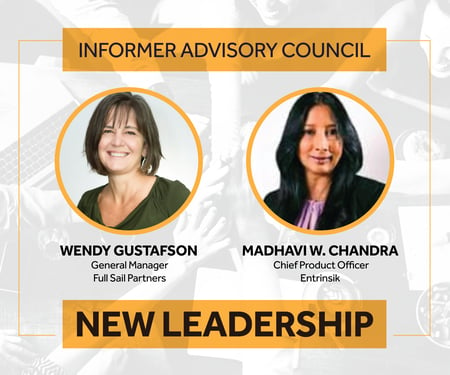
IAC_Social Post-05In a move highlighting the symbiotic nature of their collaboration, Full Sail Partners and Entrinsik jointly unveil the appointment of Wendy Gustafson, General Manager at Full Sail Partners, and Madhavi W. Chandra, Chief Product Officer at Entrinsik, as co-chairs of the Informer Advisory Council (IAC). This partnership will enable Entrinsik to gain a richer insight into the customer voice and needs through Gustafson's expertise. Simultaneously, Chandra's leadership will facilitate the infusion of Entrinsik's vision and best practice workflows directly into the Council's initiatives.

About the IAC

The IAC is a collaborative platform where a small group of selected customers and partners work closely with Entrinsik to guide the future of the Informer platform. Council members receive exclusive early access to new features and enhancements, enabling them to provide direct feedback and influence the product's development.

Chandra explained, “The IAC was established more than four years ago with a mission to create a mutually beneficial platform between us and our clients. The IAC is an intimate and exclusive community, and we are thrilled to progress to the next stage by appointing an external co-chair to collaborate alongside me. Wendy, who has been a dedicated IAC member for years and possesses comprehensive knowledge of Informer, is the ideal candidate. I am looking forward to working alongside her!”

Driving Competitive Advantage Through Early Access

The collaborative leadership in the IAC, uniting Full Sail Partners and Entrinsik, represents a landmark progression not only for project-based businesses and professional services firms but for the entire Entrinsik customer base. By blending the product voice of Entrinsik with the customer voice of Full Sail Partners, we are creating a synergistic avenue for product enhancement. 

Gustafson’s co-chair position epitomizes this synergy, allowing Full Sail Partners to mold the direction and capabilities of Entrinsik's Informer platform in alignment with the broader needs of all stakeholders. This partnership offers clients—across all sectors—the privilege to preview, test, and shape features prior to their widespread launch, granting them an analytical edge in their decision-making processes.

Gustafson remarked, "I am honored to take on the co-chair role for the IAC. This allows for close collaboration with fellow council members to foster strategic relationships and facilitate domain-specific expertise. We aim to complement Entrinsik's ongoing efforts in delivering systems that meet diverse user needs."

Accelerating Client-Driven Innovation

This partnership represents a symbiotic union, leveraging the collective expertise of both Full Sail Partners and Entrinsik. In this relationship, Entrinsik gains unparalleled access to the authentic customer voice through joint leadership, enriching its understanding of user needs and aspirations. Conversely, Full Sail Partners benefits from Entrinsik's vision, absorbing best practices and advanced workflow methodologies that can be integrated into the field via the Council. 

The Informer platform thus evolves at a faster pace, with new client-driven features being informed by real-world feedback. Early access to these features by the IAC members offers a practical advantage: Entrinsik can observe these functionalities in action, refine them based on actual use, and ensure optimal performance and relevance before a wider rollout. In this dynamic ecosystem, every insight, feedback, and innovation contributes to a product that's both technologically advanced and deeply aligned with user requirements.

Tailoring Technology Strategies for Professional Services

The participation in IAC’s activities allows for an in-depth interaction with the new features, ensuring that they are tailored to meet the specific demands of professional services firms. With direct insight to Informer’s development priorities and roadmaps, Full Sail Partners can help clients plan their technology strategies more effectively. This will lead to better integrated systems that not only meet but exceed the diverse requirements of project management, financial reporting, and other critical business processes.

About Full Sail Partners

Connecting thousands of project-based firms, Full Sail Partners identifies critical resources to create fast, efficient, and cohesive companies. As a Deltek Premier Partner and creator of the Blackbox Connector, our team helps professional services firms fully integrate their business processes by connecting their front end and back end systems. We provide technology consulting, business solutions, and application hosting for both Vision and Vantagepoint. Full Sail Partners has received the Deltek Partner of the Year and the Marketing Excellence Award multiple times throughout our firm’s history. Keep Your Business on Course.

For more information, please email Full Sail Partners’ Marketing Communications Department. 

About Entrinsik

Founded in 1984, Entrinsik is a global leader in data analytics and business intelligence solutions. Its flagship product, Informer, empowers organizations to make data-driven decisions by providing self-service data discovery, visualization, and reporting capabilities. Entrinsik serves thousands of clients in various industries, including higher education, manufacturing, healthcare, insurance, and financial services.

For more information visit: https://entrinsik.com/.


Topics:  

Key Performance Metrics for Architecture and Engineering Firms

Posted by Sarah Gonnella on Aug 17, 2023

08-17-23 Key Performance Metrics for AE Firms Banner

How does your firm measure up? That is the vital question many architectural and engineering (AE) firms should be asking themselves. It is challenging to manage what you are unable to measure! There are several key performance metrics that an AE firm should use to determine its current status. These measurements are important to not only keep you abreast of the condition of your company, but they also allow you to examine the past, so you can plan for the future. Let’s look at a few of the significant performance metrics. 

Proposal Win Rate

When we talk about Proposal Win Rate, we're essentially looking at how effective your business development efforts are at turning potential leads into actual projects. It's like keeping score on how well you're playing the business game! By tracking this rate, you gain valuable insights into what strategies are paying off and which ones might need a little tweaking. 

Even the tiniest improvement in your win rate can have a huge impact on your bottom line. Think about it – landing just a few more projects out of every ten proposals can make a significant difference in your profitability.  

In the fiercely competitive world of AE firms, the ability to gain new business is like having a superpower. It's what sets successful firms apart from the rest. So, honing your business development skills and consistently improving your win rate is critical to your success. 

Here's a pro tip: When analyzing your Proposal Win Rate, pay attention to the reasons behind both your wins and losses. Learning from both successes and setbacks is the secret sauce to continuous improvement. You might discover patterns that can help you replicate your victories or identify areas that need some extra attention. 

Profit

Profit is a crucial metric for any AE firm’s success. It tells you how well your firm is doing financially. It's the money left over after deducting all expenses from your gross income. Profitability metrics help AE firms figure out which projects are worth pursuing. It shows you if you're making enough money to keep your operations going and growing. 

Analyzing your profit helps you make smart decisions about where to focus your efforts and resources. It's like a report card for your financial performance. Being profitable is essential for your firm's sustainability and growth. It allows you to invest in your business and attract top talent. 

But don't get too fixated on profit alone. Keep in mind that different projects may have different profit margins and timelines. 

By keeping a close eye on your profit over time and comparing it to your goals, you can spot areas for improvement and make informed decisions for a prosperous future. 

Labor Utilization

Labor utilization is a metric that helps you measure your team's efficiency. It ensures you have the right number of employees for optimal performance. By analyzing labor utilization, you can identify both high and low performers, enabling you to take targeted actions for improvement. 

To maintain an effective labor utilization rate, review both billable (direct) and non-billable (indirect) hours. Monitoring this metric allows you to make data-driven decisions and allocate resources wisely for maximum productivity. 

A well-utilized team leads to a happy and productive work environment, driving your firm's success. Keep an eye on labor utilization for a thriving team and business! 

Net Revenue/Operating Income

Net revenue and operating income are like a dynamic duo that keeps your business running smoothly and efficiently. Let's take a closer look at these essential metrics and understand why they're crucial for your AE firm's financial success. 

First up, net revenue is the lifeblood of your business. It's the total revenue your firm generates after deducting any discounts, returns, or allowances. Think of it as the fuel that keeps your business engine roaring. Without sufficient net revenue, your firm's growth and sustainability could hit a roadblock. 

Operating income, on the other hand, measures your business's capacity to take on new projects while covering all operating expenses. It's like a litmus test of your firm's operational efficiency. By subtracting your operating expenses from your net revenue, you get a clear picture of how much profit you're generating from your core operations. 

Now, here comes the interesting part: net revenue also sheds light on your firm's relationship with subcontractors. It shows how much of your revenue goes to paying them for their services, leaving you with the revenue that your firm retains for its own services. Understanding this breakdown helps you gauge the impact of subcontracting on your profitability. 

By carefully tracking net revenue and operating income, you can make informed decisions about pricing, resource allocation, and investment opportunities. It's like having a compass that points you in the direction of profitability and growth. 

For example, if you notice that your net revenue is high, but your operating income is lagging, it could signal inefficiencies in your operations or excessive costs that need addressing. On the other hand, if your operating income is strong, but net revenue is low, it might be time to revisit your pricing strategies or explore new revenue streams. 

In a nutshell, net revenue and operating income are two sides of the same coin. Together, they provide valuable insights into your business's financial health, helping you steer it toward prosperity. 

So, pay close attention to this financial power duo. Regularly monitor their performance, set targets, and use the insights gained to fine-tune your business strategies. With net revenue and operating income on your side, you'll be well-equipped to navigate the waters of profitability and keep your AE firm thriving! 

Backlog

The backlog metric is your firm's project navigator, keeping you on course within your budget. By tracking both ongoing projects and potential wins, it provides a clear picture of your workload and budget needs. This insight helps you plan ahead, allocate resources effectively, and deliver top-notch results to your clients. Regularly keeping an eye on your backlog ensures you stay on track and sail smoothly toward success! 

Client Loyalty

For any AE firm to grow and continue to be successful, client loyalty is a necessity. It is important for both word-of-mouth referrals and repeat business. Meeting client expectations, proactively engaging in client feedback, and acting on areas that need improvement are all essential to keeping loyalty. 

Cost of New Business

When it comes to growing your AE firm, new business opportunities can lead the way. But expanding also means there are costs involved. Measuring these costs helps you choose which opportunities are worth pursuing and if the potential gains are worth the investment. Remember, calculated risks can lead to profitable growth. So, keep an eye on the cost of new business and set your company on a path of strategic expansion! 

Measuring Up the Firm

Keeping a close eye on key performance metrics is the secret sauce to your AE firm's ongoing success. We've explored some noteworthy metrics today, but there's a whole world of data waiting to be discovered. It's up to you to decide which metrics align best with your firm's goals. 

To see how your firm measures up with these KPIs and gain valuable insights into the A&E industry, we encourage you to download the latest Annual Deltek Clarity A&E Industry Study by clicking the image below. This study contains valuable information to aid your decision-making and stay ahead of the competition. 

Remember, the path to prosperity starts with data-driven decision-making. Equip your firm with the right metrics, ensure your team understands the goals, and set sail toward a brighter, more successful future! 🚀 

Accounting Today Recognizes Full Sail Partners on the 2023 VAR 100 List for Another Year

Posted by Jennifer Renfroe on Aug 15, 2023
Full Sail Partners is ranked among the Top 100 VARs again according to Accounting Today. 

It is official. Once again, Full Sail Partners is listed among Accounting Today’s Top 100 Value-Added Resellers (VARs). This means that Full Sail Partners continues its ranking as one of the leading value-added resellers in the accounting industry and even moved up in rank for 2023. 

Each year, Accounting Today chooses the top 100 VARs which are selected from firms focused on sales and implementation of accounting and enterprise resources planning (ERP) software. Being on the list for another year acknowledges the accomplishments of these firms in the accounting software space. Full Sail Partners’ ranking again for 2023 shows that Accounting Today continues to be confident in its services and accounting knowledge incorporating inclusive software.  

As always, in utilizing its resources, Full Sail Partners remains focused on recognizing the specific needs of the clients it serves. The sales and consulting teams strive to really partner with clients to find the best solution based on individual needs. Moreover, as a VAR, Full Sail Partners stays future focused carefully considering how client needs evolve over time and what the key trends are resonating across the professional services industry. 

“Recognizing the crucial role knowledgeable VARs play in understanding client-specific business needs, our clients seek to collaborate with such experts,” noted Sarah Gonnella, VP of Marketing and Sales. “At Full Sail Partners, we were early to acknowledge a shift towards succinct content, offering concise coverage on pertinent topics to engage more effectively with clients and prospects alike.” 

As to noteworthy trends for this year, according to the 2023 report, leading VARs continue to be greatly impacted by the ever-evolving state of technology. The migration to cloud computing continues to accelerate and top VAR firms are consistently working with clients to capitalize on opportunities provided by the cloud. The unique nature of the cloud enables firms to manage in ways that on-premise computing does not provide. Post pandemic, with many clients still operating remotely or using a hybrid model, tools to help with communication, document sharing, and collaboration are needed and most commonly cloud based.  

Additionally, based on the 2023 VAR 100 report, firms are intrigued by artificial intelligence (AI), particularly models like ChatGPT which is cloud-based. There is a lot of client interest in the topic of AI and a willingness to explore available applications. Also, with cloud investments being remote, there has been the need to pay even more attention to cybersecurity. There have been rising numbers of cyber-attacks and scams targeting businesses. Furthermore, the report reflects that, in the face of economic pressure, firms have been embracing automation to shore up operations for more efficiency. 

For more information about the 2023 Top 100 VARs, download the ranking here The VAR 100 | Accounting Today. Accounting Today is a leading provider of online business news for the accounting community, offering breaking news, in-depth features, and a host of resources and services.  

For more information, please contact Full Sail Partners’ Marketing and Communications Department or visit the Full Sail Partners’ website at http://www.fullsailpartners.com.    


Topics:  

Erin Haver Joins Outsourced Accounting Team at Full Sail Partners

Posted by Jennifer Renfroe on Jul 11, 2023
Erin’s extensive experience in both client and account services with professional services firms makes her a great addition to the Outsourced Accounting team 
Erin_Haver_01

Due to increased demand, the Outsourced Accounting team has added Erin Haver as Staff Outsourced Accountant. In this role, she will assist clients who need outside resources to keep up with bookkeeping and financial reporting for their project-based firms. With this new addition, Full Sail Partners now has the capacity to service even more clients who are in need of accounting support. 

“I am so very happy to have Erin on board with us,” noted Wendy Gustafson, General Manager. “Her accounting knowledge and great attitude will allow us to assist more clients with their outsourced accounting.” 

Erin comes to Full Sail Partners with over fifteen years of experience in professional services. In her previous roles, she focused on both client and account services. Over her tenure in account services with professional services firms, she has managed accounts receivable including processing and recording of payments as well as handling banking procedures and reconciliation of ledgers. Additionally, Erin has been involved with the customization of daily and month-end reports. 

With her belief in excellent customer service and desire to learn, Erin will be an amazing asset to the Outsourced Accounting team. Erin foremost understands the importance of actively listening to the specific needs of each client with solution options in mind. She also excels at providing one-on-one support to clients and believes strongly that communication is vital for superior client service. Her new position will ensure that Full Sail Partners continues to provide the best available outsourced accounting services. 

“I am really looking forward to working with the Outsourced Accounting team at Full Sail Partners,” stated Erin Haver. “I cannot wait to assist clients and can assure them that I have a proven history of reliability and exceptional skill in regard to bookkeeping and accounting.” 

For more information, please contact Full Sail Partners’ Marketing and Communications Department or visit the Full Sail Partners’ website at http://www.fullsailpartners.com.    


Topics:  

The Business Benchmarking Process: 4 Key Steps

Posted by Wendy Gustafson on Jun 29, 2023

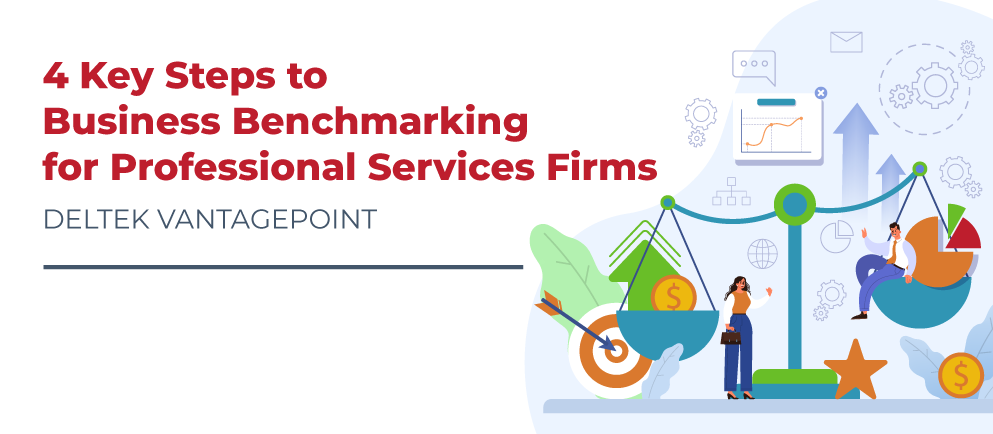
06-29-23 Benchmarking_BannerAt Full Sail Partners, we firmly believe in the transformative power of the business benchmarking process. It serves as a vital tool that empowers professional services firms like yours to make well-informed decisions, streamline operations, and gain a competitive edge in the marketplace. To achieve optimal results, we advocate adopting an approach that encompasses four essential steps. These steps lay the foundation for a comprehensive and effective benchmarking strategy, allowing you to unlock the full potential of your business. 

#1 Look for Benchmarking Resources

If you're just getting started in the world of benchmarking, it's always beneficial to get a glimpse of how other professional services firms handle this process and measure up against your own company. There's an abundance of industry experts and organizations out there who generously share valuable insights into their benchmarking practices.

By taking advantage of these resources, you'll gain valuable knowledge and a broader perspective on benchmarking strategies. You'll be able to see firsthand how successful companies approach this process and uncover valuable tips and tricks to apply within your own professional services firm. So, don't hesitate to tap into this wealth of information and discover the key to benchmarking excellence.

Here are a few of our personal favorite resources that you'll want to check out:


There are countless other companies and organizations out there who are also avid benchmarkers, so don't hesitate to explore further and discover even more insightful resources.

#2 Choose Your KPIs to Measure Success 

This is where we get to choose the meaningful measurements that will serve as your benchmarks or standards. Don't worry, we've got an array of exciting key performance indicators (KPIs) to explore—financial and project-related statistics that provide valuable insights into your professional services firm's performance. It’s like finding the perfect recipe for success! 

In the world of professional services firms, there's a whole bunch of KPIs that can help you gauge your organization's financial and operational health. Here are some of the widely used favorites: 

  • Accounts Receivable
  • Average Collection Period
  • Chargeable Ratio
  • Chargeable Ratio times Net Multiplier
  • Current Ratio
  • Debt to Equity Ratio
  • Employee Realization
  • Employee Utilization
  • Estimate at Completion (EAC)
  • Estimated to Complete (ETC)
  • Net Multiplier
  • Net Revenue per Technical Staff
  • Net Revenue per Total Staff
  • Overhead before Discretionary Distributions
  • Profit on Net Revenues before Taxes and Distributions
  • Return on Owners’ Equity

Now, it's time to do some soul-searching and consider which of these metrics truly encapsulates success for your unique organization. Establish corresponding benchmarks that align with your firm's historical performance, industry surveys, specialized standards, your company's philosophy, or even a delightful combination of factors. The goal is to create a tailored measuring tape that fits your organization like a glove.

When selecting professional services firms to benchmark against, think about factors like industry, geography, and size. The more similarities they share with your firm, the more relevant and valid their metrics will be. It's all about finding those perfect benchmarking buddies who can inspire and guide you toward greatness.

#3 Diligently Track Your Data

With the metrics identified and the benchmarks set to evaluate your professional services firm's performance, it's time to engage in diligent data tracking. Fortunately, there are various options available to streamline this process. 

While traditional methods like one-off spreadsheets and makeshift workarounds may seem tempting, we highly recommend exploring sophisticated software packages tailored to your specific needs. These solutions range from advanced accounting software that effectively monitors financial statistics to specialized project management tools designed to meticulously track individual projects. 

However, allow me to introduce an even more compelling alternative: a purpose-built Enterprise Resource Planning (ERP) system such as Deltek Vantagepoint. This comprehensive solution seamlessly integrates data from both the front office (project-related activities) and the back office (accounting operations). Imagine having a reliable sidekick that offers real-time, comprehensive visibility into all the aforementioned metrics. But it doesn't stop there—Deltek Vantagepoint also optimizes project and staff oversight, automates manual processes (including Customer Relationship Management and business development), and significantly enhances operational efficiency. 

Whether you opt for a combination of software programs or embrace the unified power of Deltek Vantagepoint, it is essential to utilize consistent and continuous data collection. This is an ongoing endeavor that ensures you stay well-informed and propels your professional services firm towards remarkable achievements. So, let's implement robust systems, leverage cutting-edge technology, and diligently track that data to stay ahead of the curve as accomplished benchmarkers. 

#4 Use Your Benchmarks to Make Data-Driven Decisions 

This is where we close the loop and ensure that the right data reaches the right people in a timely manner. It's all about fostering a management commitment to utilizing data for decision making and trust me, it's a game-changer. 

Imagine this scenario: You have schedule-based metrics at your disposal. Not only do they help you determine if a project is currently on budget, but they also shed light on whether it will ultimately stay within the overall budget. If the Estimate at Completion (EAC) surpasses the overall budget, management faces a pivotal choice. They might decide to reduce future expenditures or accept that the project will go over budget, while also identifying where the slippage occurred (perhaps those additional services contracts slipped through the cracks). Mind you, this is just one example. Depending on the specific underperforming metric and the degree of deviation from the desired benchmark, management will have an array of options and decisions to make. 

Now, let's uncover the secret to success in this phase of the benchmarking process: granting management access to all the vital metrics at any given moment. While manual methods can be employed to gather and present this information, there's a far more efficient way to do it—automated KPI dashboards. These customizable features, available in Deltek Vantagepoint, serve as your trusty sidekick, delivering essential data to management in a snap. 

By embracing this data-driven decision-making approach, you unlock the power to steer your professional services firm with precision and confidence. So, let's ensure the flow of valuable insights reaches decision-makers in a timely manner, empowering them to make informed choices that propel your company to new heights of success. 

Don’t Wait, Start Now! 

Regardless of the approach you choose to identify and track your professional services firm's benchmarking information, rest assured that the process yields substantial dividends. It grants your firm a more relevant and up-to-date understanding of its performance, positioning you for success. Equally important, it enables proactive measures to address underlying issues before they escalate into significant challenges, thereby increasing the likelihood of achieving both project and financial success.   

The future of a professional services firm's success begins with benchmarking. Embrace it, harness it, and let it guide us towards a prosperous tomorrow.  


10 Most Common Resource Management Problems

Posted by Rana Blair on May 18, 2023

05-18-23 10 Most Common Mistakes Resource Management_Banner rev

Hey there, professional services firms! We need to talk about something important. No, it's not about who has the best coffee in the office (although that's important too). We need to address the top ten resource management problems that could make or break your success. Don't worry, I'm here to give you the low-down.  

Problem #1: Missed Project Deliverables and Deadlines 

Picture this: a client is eagerly waiting for their project to be completed, but the deadline passes, and there's no sight of the deliverables. Chaos ensues as the client starts breathing down your neck, and you realize you don't have sound processes in place. Good luck getting out of that one! 

Getting the work done on time sounds simple, but it’s not. It’s a complex balancing act involving creativity, quality control, resource management, and much more. If you don’t have sound processes in place, all the best thinking in the world won’t mean a thing. 

Problem #2: Ineffective Documentation on Billable Hours 

So, you've been working tirelessly on a project, but when it's time to bill the client, you realize you don't have accurate documentation of the billable hours. Cue the client disputing your bill and leaving you with an empty wallet.  

What creative person wants to hear that their success might rely in part on basic accounting skills? For professional services firms, effectively managing billable hours is one of the biggest factors in profitability, and thus, lasting success. Need help with billing effectively? Watch our mini demo now! 

Problem #3: Lack of Project Resource Visibility 

Now, let's talk about visibility. Your firm’s management needs to quickly understand which projects are underway for which clients. This means having visibility of progress on milestones, technical issues, and how, when, and where resources have been allocated. It's time to get your head out of the clouds and start paying attention to the details. 

Problem #4: Assigning the Wrong People to Teams 

You've got a project that requires specialized knowledge, but instead of assigning the right people to the team, you just throw some random folks in there. The project turns into a hot mess, and the client is none too pleased. Looks like you just lost a customer, honey! 

Each project requires a team with the right insights, talents, and other qualities. Assigning the wrong people to a project can have a negative impact on profitability and success. So, let's stop playing musical chairs and put the right people in the right seats! 

Problem #5: Accounting and Project Management Disconnect 

Let's address the accounting and project management disconnect. Using multiple tracking systems for financial and project data can lead to errors and make it difficult to respond to issues. Consolidate your tracking systems, and make it rain with those profits. 

Problem #6: Inefficient Cash Forecasting 

You've got a project that requires a lot of resources, and you're not sure how much cash you'll need. You don't allocate resources to a timeline, and now you're in a cash flow crisis. Better start penny-pinching, sugar! 

Cash forecasting can be a complicated process, but it's essential for successful resource management. Allocate resources to a timeline for efficient cash forecasting. Your wallet will thank you later. 

Problem #7: One-off Spreadsheets and Workarounds 

Spreadsheets and workarounds are so 2005. Silos across a firm can lead to duplicated efforts, incomplete solutions, missed opportunities, and unprofitable projects.  

Picture this: you've got a project that requires a lot of data, and you decide to use a spreadsheet to keep track of everything. But then, someone else on the team creates their own spreadsheet to keep track of something else, and before you know it, there are spreadsheets and workarounds all over the place. 

Now, you've got a mess on your hands. Data is duplicated, incomplete solutions are everywhere, and you're constantly missing opportunities. You're wasting valuable time on duplicated efforts, and you're not making the profits you should be. 

So, what's the solution? It's simple, really. You need to get everyone on the same page. You need a centralized system that everyone can use to track data, projects, and resources. No more one-off spreadsheets or workarounds - it's time to get serious about your business. Read our article on The Best BI Tool for Deltek Vantagepoint Users and find out what application is right for you! 

Problem #8: Under-Informed Decision-Making 

It's all about the information, baby. Resource management problems involve information regarding projects, teams, or human and other resources. Management must have a large dataset at their fingertips before making big decisions. Failing to do so can result in under-informed decision-making, and ain't nobody got time for that. 

Problem #9: Failure to Meet Financial Reporting Standards 

We're getting close to the end, but we can't forget about compliance. Professional services firms often need to comply with various reporting regulations such as Earned Value Management (EVM). So, let's make sure we're crossing our T's and dotting our I's, and getting paid for our hard work. 

Problem #10: Missed Business Opportunities 

You've got a business development team that's not managed effectively, and you're missing out on potential opportunities. Your ROI and profitability suffer, and you're left wondering why you're not making any money. Time to start taking business development seriously, sweetie! 

Organizing and managing the work of business development teams is complex and high-stakes. Effective management can optimize ROI and profitability and ensure just-in-time hiring or business development. Let's do this! 

In conclusion, don't let these resource management problems drag you down. Get your head in the game and address these issues head-on. Whether you manage them in-house using ERP software and other solutions or outsource them all together, make sure to handle them properly. And remember, nothing screams success like a firm that's got its resource management problems in check! 


Most Recent News Mentions

We’re changing the way project-based firms operate.

People can’t help but notice.
Who will be next?

Check out our latest newsworthy work:

Recent Posts