Full Sail Partners Blog | Full Sail Partners (28)

Posts by Full Sail Partners:

8 Reasons an ERP System Implementation Succeeds

Posted by Full Sail Partners on Apr 10, 2013, 12:00:00 AM

Significant investment is required to purchase an ERP software package and so it’s important that firms go into the purchase with eyes wide-open. Many studies have been done on why an ERP system implementation fails, so what should your company know before purchasing an ERP system?  Through our own success and failures, we’d like to share with you eight (8) key areas that impact an ERP system implementation: 

  1. Executive Support – In order to get buy-in from employees on the importance of using any system or adopting any process you implement, you first MUST have executive support.  Your firm is investing a lot of time ERP System Implementationand money into this decision.  The message must come from the top.  If the executives of your firm don’t see the importance, then others will probably feel the same way.  As with any new process or change, it’s important to demonstrate a ROI and the key areas that will be improved within your company.   

  2. Establish Goals/Objectives – Make a list of the items that need to be improved within your company.  With that list, apply Pareto’s 80/20 rule to your business.  Focus on the 20% that matters and the other 80% of issues will fall into place.  What information do you need to grow your company?  What processes do you need in place to make things better, faster, and easier?  Be specific.  These goals should drive the functionality of your solution.  
  3. Invest in Training – A vital part, commonly overlooked in an implementation, is training.  Training enables and empowers your users.  Taking the “they’ll figure it out” approach is a quick way to discourage users from using the system.  Learning from experts on how to do it quicker, more efficiently, and correctly from the beginning can keep you from feeling you’ve wasted money on a system. The system doesn’t run the process; people do!  The system will only be as good as the information put into it so make sure to support the people within your firm that will help keep the process running smoothly.
  4. Choose a Champion – You’ve heard the saying about too many cooks in the kitchen, right?  Designate a consensus-building champion for the implementation.  We recommend identifying three main roles with distinct purposes: Project Coordinator (PC), Executive Sponsor (ES) and Application Administrator (AA).  The PC is involved with every phase of your firm’s implementation. This role will be involved with making key decisions and consider the global impacts of those decisions.  They are also responsible for the schedule, progress, and team communication.  The AA is an individual that develops a thorough understanding of the application throughout the implementation process, later performing the ongoing day-to-day administration, and leads the internal training effort. The ES is responsible for securing commitment from executive management, department/office management, accounting, marketing and project management and should be an individual within senior management.  They are to stay in contact with the PC and consultant to convey any expectations or concerns.
  5. Think About the Future – Make sure all areas of your company are talking to one another. Consider your growth plans, customer communications needs, and internal knowledge sharing.  Integration and streamlining processes impact profitability and obtaining/maintaining clients.  Most firms think about the finance side first; an essential part of any business since they handle the money. However, what about the side that brings in those customers or work with them on a day-to-day basis?  Is finance sharing information with them?  Integration can help breakdown the silos and build true customer interaction.  Keep in mind you don’t have to do everything at once, but make sure you think about the next steps.
  6. Gain Consensus from End Users – Gaining consensus within the company requires work upfront during the planning process.  Consider the needs of end users and how the process will impact all areas of the company.  Check back with them periodically to demonstrate solution designs to confirm you aren’t missing anything.
  7. Demonstrate Key Wins – Identify quick wins that can demonstrate progress with the system and track your results.  The goals established at the beginning should be checked periodically to ensure you are making progress.
  8. Take a Phased Approach – By taking a phased approach, the Project Coordinator isn’t burdened thinking about everything all at once.  Remember, this is a job upon a job.  On top of doing their daily duties, the implementation team is taking on a project that requires significant time and dedication.  In addition to spreading out the implementation, training should be incremental. This keeps employees from experiencing information overload.   

A successful ERP system implementation require a collaborative effort amongst your firm’s implementation team. Empower your employees and establish a good relationship with your consultant. Overall, strive to constantly evolve and improve your company in order to ensure you are ready for tomorrow’s challenges. 

Did any of these steps ring a bell during your past implementation? Do you have any suggestions to share? 

Be sure to check out other articles written by Sarah Gonnella

Deltek Vision Customization: Past Trends Provide Insight into the Future

Posted by Full Sail Partners on Mar 11, 2013, 12:00:00 AM

When evaluating your professional services firm, understanding your past trends can provide valuable insight into the future.

It is important to know where you are going, as well as, where you have been. Understanding mistakes and achievements is paramount to truly understanding how to progress your firm. The old adage by George Santayana remains true, “Those who cannot remember the past, are condemned to repeat it.”

Luckily, firms don’t have to rely on people’s memory. There are all kinds of ways to track information. However, having the tools set-up to extract, dissect, and analyze the data is a different story. When it comes to proposals, it is essential to know the Win to Loss Ratio (Hit Rate).


In a recent 2012 survey, SMPS Technology Committee reported firms are tracking the following marketing metrics:

56% | Win to Loss Ratio
50% | Client Satisfaction
46% | Marketing Expenditures
39% | Revenue
30% | Sales Funnel/Pipeline
27% | Sales Potential Forecast
26% | Proposal Cost vs. Revenue         Generated
24% | Referrals

In a recent, SMPS Technology Committee survey, only 56% of firms stated they tracked this information, which is surprising. This type of report allows you to evaluate the overall hit rate by the firm, a division, the pursuit lead, or other criteria.  You can also evaluate it by percentage or by revenue.  Knowing both provides you a different story.

Take William Apple, who has a 50% hit rate for the number of projects he has pursued.  He pursued 10 and won 5.  Ann Johnson on the other hand only has a 33% hit rate. She pursued 3 and won 1.  Seems like William is doing better, right?  However, if you evaluate them on revenue, William only has a 24% while Ann has a 73% hit rate.  Why the difference? 

Well, the one project Ann won, was a large project worth millions of dollars.  William however, won a lot of smaller projects and lost out on the bigger project. Both are important to the business.  However, if you start to see that William is constantly losing out on the large projects or maybe particular project types, this type of analysis would be valuable information that could be acted upon.

Key metrics like the Win to Loss Ratio allow a quick snap shot to determine if you need to dig deeper.  The historical progress of an opportunity sometimes provides further clues. 

  • Were you realistic with your expectations?

  • What stage did you lose the opportunity?

  • Did you have an established relationship and effective pursuit strategy?

Is your firm able to answer these questions or are you repeating the same mistakes? Let us know how your firm learns from your success and failures and how your firm is improving your hit rate by leaving a comment. Interested in more historical trends information?

Deltek Vision Tips: Workflow for Modified User

Posted by Full Sail Partners on Dec 21, 2012, 12:00:00 AM

It looks like the world will not come to an end! So back at it campers. Let's learn some quick tips about Deltek Vision.

As the first of our Deltek Vision Tips & Tricks Series we would love to hear if you find the information helpful. Recently I came across a question about how to know who modified a record. Of course the audit reports can provide this information, but there are two easier ways to get this information.

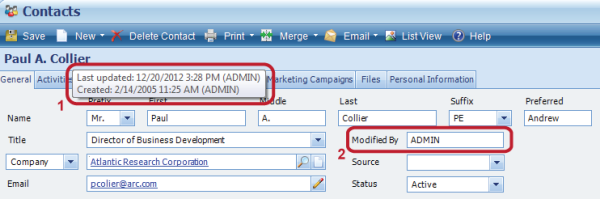
In every info center you can hover over the name of the record at the top of the record. It will tell you who created the record and on what date. Additionally, it will tell you who last modified the record and on what date. So in the image below for item #1, the mouse is hovering over the word Paul A. Collier in blue. If you need to know what field was modified then you would need to run an audit report.  

Deltek Vision Record Audit Trail


Additionally, you could set-up a field that displays who modified the record. This is accomplished through a workflow. First create a new character field. (Note: An employee field will not work.)  In this example it is named Modified By.  See image item #2 above. 

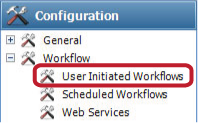
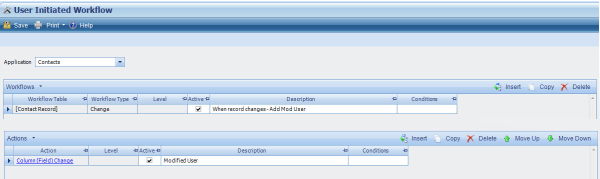
Then set-up a User Initiated Workflow. Choose the Application, which in this instance will be the Contacts. Click Insert on the Workflows grid. The Workflow Table will be Contact Record and the Workflow Type will be Change. This simply means every time the contact record is changed, the workflow will trigger.

User Initiated Workflow


User Initiated Workflow Contacts


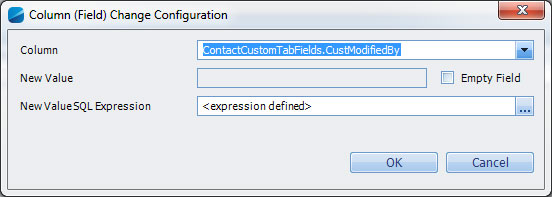
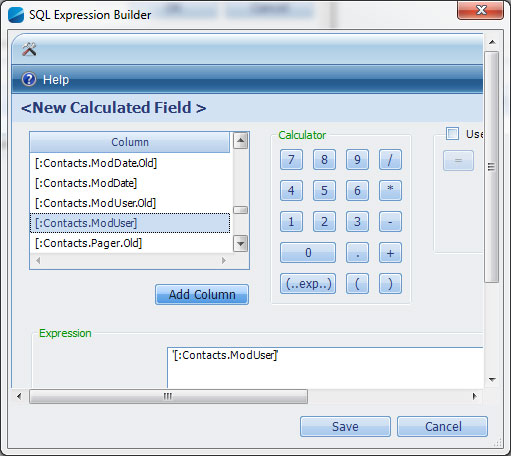
Now on the Actions grid click Insert to add an action. Choose Column (Field) Change for the Actions column. Next, choose the field to update. In this case it is ContactCustomTabFields.CustModifiedBy.  Then set-up a SQL Expression. The expression is simply, a field that already exists: [:Contacts.ModUser]. Find that code and click Add Column. Then click Save. Be sure to add descriptions so you know what the workflow is related to and then Save the workflow. To test it, change something on a Contact record. You should see the users login name filter in.

Column Field Change


Column Field Change SQL Expression


Check back in 2013 for new blog entries related to Deltek Vision tips. Let us know if you learned something new by leaving a comment. Wishing you a wonderful 2013!


Deltek Vision Customization: Knowing the Right Questions to Ask

Posted by Full Sail Partners on Dec 14, 2012, 12:00:00 AM

When a request for a custom solution is received, be it a report, workflow, or external data automation, many clients are surprised the first items we review are the standard functions available in the particular system they are looking to customize.  “Are you trying to talk us out of having you perform the programming work?” I had one client ask me incredulously, after I had shown her a way to accomplish getting the information she had wanted in a custom report within the native Vision Reporting system. 

My response is always the same.  We would love to work with your firm on a custom initiative; however our top priority as your Consultant is to ensure that you receive the best value for any work we perform.  There are times where custom programming is going to be the best path forward, but if we can accomplish the same (or relatively the same) results natively, in less time – you’re going to be happier as our client, and we may have an opportunity to work with you on a customization effort that will truly be valuable for your organization in the future.  As your consultant, we are ultimately advocates and partners in helping you be successful and getting the most out of your system. 

Sometimes the native functionality is not quite enough for an organization and so customization is the right step to make. In some circumstances, it’s natural to start to look at custom programming to help overcome those hurdles. Those might include:

  • Cultural requirements in the organization to have data represented a certain way
  • Manual processes require a tremendous amount of repetitive effort
  • It takes two or more reports to get one set of information the organization requires
  • Additional systems that are used in the organization may require a duplication of effort
  • Information is stored in house and in the cloud, and you wish to simplify the effort of keeping these separate silos of data up to date
  • Aesthetics of a particular report or information set may not match with the firms brand or be overly complex for the information needed 

checkbox, Deltek Vision CustomizationWhen evaluating if engaging a consultant on a custom programming effort makes sense for your firm, here are some key questions to ask your internal team:

  • Have we identified the motivating factors for requiring the custom programming effort?  
  • How much time is spent manually today to get our desired result?
  • How much of this time will be saved by incorporating the custom programming?
  • Have we explored the native Vision system capabilities and found we cannot reproduce what we need?
  • Have we considered how close we can get using the native capabilities in Vision and can we operate within those parameters, or is this a definitive organization need?

As you embark on asking a colleague or consultant to customize your system, here are some questions to ask prior to having them moving forward:

  • Do you have advanced knowledge of Transact SQL?
  • Have you worked with the structure of the Vision database and functionality of the Vision application?  (I can’t emphasize this point enough!)
  • In developing this report, will we be able to reconcile the custom work to native Vision reports? (Whether through a single report or a combination of multiple reports)
  • Is there a way to already accomplish something similar with the native functionality of Vision?
  • Do you have experience writing web services for Deltek Vision and ?
  • I have an example of what I’m looking for, do you see any issues with providing it in this format or with this information and do you have any suggestions for how we may be able to do this more effectively.  

Our library of custom solutions continues to grow every day. Some of these solutions can be purchased at a flat fee and utilized as is or further customized.  This is a great way to minimize costs and get results quickly.  We welcome you to reach out and find out if something similar has already been created. We are committed to helping you find the right solution to fit your unique needs.

Full Sail Partners and WJE Receive Deltek Project Excellence Partner Award

Posted by Full Sail Partners on Nov 8, 2012, 12:00:00 AM

Deltek, Inc. recently announced at the Deltek Insight 2012 Conference that Full Sail Partners and its client, Wiss, Janney, Elstner Associates, Inc. (WJE), have been selected for the Partner Award for Deltek’s 2012 Project Excellence Awards Program.  The Partner Award recognizes a Deltek partner, and customer, that together have delivered an exceptional Deltek solution implementation.

2012 Deltek Project Excellence Partner AwardFull Sail Partners assisted Wiss, Janney, Elstner Associates, Inc., a prominent A/E/C firm ranked on Engineering News-Record's list of the Top 500 Design Firms in America, with the implementation of Deltek Vision across its business.  Full Sail Partners built numerous workflows in Deltek Vision such as conflict checking, project initiation, billing, and project status report.  As a result, WJE realized an annual savings of about $1.8 million and a reduction in DSOs of 45 days.  The cost to purchase and implement Deltek Vision paid for itself over 30 times in just one year. 

“As the leader in solving the world’s most challenging construction-related problems, WJE works on more than 7,000 projects a year. Our project management, time, and accounting systems must not let us down,” said WJE Associate Director of Finance and Controller, Steven Schmit.  “We are honored to receive this award recognizing the partnership between WJE and Full Sail Partners, whose expert guidance and support has been so critical to the successful implementation and ongoing operation of Deltek Vision within our firm.”

Since the awards program started in 2008, Deltek has recognized some of the most innovative, market-leading companies in the world. The Project Excellence Awards program, a key component of the annual Deltek Insight User Conference, was designed to highlight and honor unique achievement among Deltek's more than 14,500 customers worldwide.  The goal of this award program is to recognize outstanding Deltek customer and partner success in improving business processes and performance, increasing profitability and winning new business.

“We are very proud to be honored with the Project Excellence Partner Award with WJE.  We loved the challenge as presented by Steve and WJE” said Kevin O’Connor, President of Full Sail Partners. “The automation created by WJE and the FSP team brought forward a game changing level of efficiency. The implementation provided increased functionality, reduction of manual processes through automation, and timelier reporting and distribution which resulted in significant time savings. WJE has been a true partner with our firm and the close integration of the work we did is a testament to both or team’s commitment to excellence.” 


Are You Playing Poker with Your Customer Relations?

Posted by Full Sail Partners on Oct 8, 2012, 12:00:00 AM

Customer Relations Management Policy, ACESGood customer service is a rare commodity in this day and age of virtual customer support agents.   Business is done in an ultra-competitive arena where your direct competition is only a Google search away.  As a result, firms are developing customer relations management plans to help better serve their client base.  Has your firm ignored developing a plan to manage your customers?


A good customer relations management plan will act as a guideline for your firm when dealing with clients.  However, it is important to remember that there is no end-all-be-all remedy for customer support.  Some battles cannot be won, no matter how diligent and worthy your efforts.  This is why I compare having a strong plan, to a game of poker!

Much like in a game of poker, the typical customer service interaction involves some 'hidden cards' that you are not always privileged to see.  These hidden cards can be anything from possible prior negative history with your company, temperament, and maybe even personal issues that the customer is dealing with in their life.  It is because of these cards that we as customer service representatives, much like a seasoned poker player, must approach every hand as though we are playing with pocket ACES.

Pocket ACES are a poker player’s best friend.  The ACES acronym also happens to be easiest to remember four step processes for dealing with every day client interactions.

ACES stands for:

Accountability:

Take responsibility for fixing the problem.  This is the first and foremost job for any professional when dealing with clients.  We cannot change the past, so we must concentrate on moving forward and fixing the situation.  The best way to do this is by taking accountability over the situation. 

Communications:

Clearly communicate the process.  Let your client or customers know how you are going to assist them, and then keep them updated throughout the process.  This breeds confidence and sets a level of expectation. 

Empathy:

Acknowledge the impact that the situation has on the customer.  Letting the customer know that you understand their inconvenience can go a long way in building a personal connection.

Solution:

At the end of the day, make sure to solve the problem.  None of the above steps matter if you do not solve the problem at hand.  You owe it to your customers to provide a prompt and convenient solution.

As a professional, it is your responsibility to play like poker legend Phil Hellmuth and go ’all in’ for your customers with pocket ACES!


Full Sail Partners, Providing Cloud Database Solutions, Named on Top VAR 100 List by AccountingToday

Posted by Full Sail Partners on Sep 7, 2012, 12:00:00 AM

AccountingToday.com selects Full Sail Partners to join the 2012 Top VAR 100 List. Several Deltek Partners were named to the list, but Full Sail Partners was the highest ranking VAR dedicated to only Deltek products.


Var 100 AccountingToday, cloud crm solutions, cloud accounting solutions, cloud database solution, cloud based service

Each year a select group of 100 organizations are honored for their accomplishments as Value-Added Resellers (VAR). The top VARs are selected from organizations focused on sales and implementation of accounting and Enterprise Resource Planning (ERP) software. Criteria used to determine the winners include 2011 revenue, number of offices, and staff.  Full Sail Partners, offering business consulting, technology solutions, and application hosting for Deltek Vision, is honored by AccountingToday as a 2012 Top Value Added Reseller (VAR). The firm provides on-premise and cloud-based solutions for architects and engineers, energy and environmental consultants, and professional service firms across the country. Full Sail Partners' team, collectively, brings more than 200 years of experience with Deltek products. 

"We are honored to have Full Sail Partners named a 2012 VAR," stated Kevin O'Connor, President of Full Sail Partners. "We focus on the 'value-added' part of being a VAR. We embrace Deltek's SaaS solution and are finding clients like the flexibility of knowing they have the option of both a cloud and on-premise solution. The cloud is not new to our firm. For almost 5 years, we've offered firm's the ability to host their application instead of investing in IT infrastructure. Our firm continues to differentiate ourselves by providing unique technology solutions and most importantly working with them through the sales process to solve business issues," added Mr. O'Connor. 

"We are proud to have Full Sail Partners represent Deltek. The award is a well-deserved recognition. As one of Deltek's most successful Vision Partners, Full Sail Partners is a major player in Deltek's overall strategy and has a long track record of providing outstanding software solutions and client services. They have earned a reputation as industry leaders and this recognition is a reflection of their hard work." Claus Thorsgaard, Deltek Executive Vice President and General Manager, Professional Services. 

About Full Sail Partners
Full Sail Partners specializes in client-focused technology solutions for architects and engineers, energy and environmental consultants, and professional service firms across the country. Full Sail Partners offers business consulting, technology solutions, and application hosting for Deltek Vision. Partnering with more than 1000 clients nationwide, Full Sail Partners builds long-term relationships and seeks to identify the critical resources to create a faster, more efficient, and cohesive business infrastructure.

Full Sail Partners – Keep Your Business on Course. | For more on Full Sail Partners profile and background on the Full Sail Partners crew, visit us at http://www.fullsailpartners.com. 

About Deltek
Deltek (Nasdaq: PROJ) is the leading global provider of enterprise software and information solutions for professional services firms and government contractors. For decades, we have delivered actionable insight that empowers our customers to unlock their business potential. 15,000 organizations and 2 million users in over 80 countries around the world rely on Deltek to research and identify opportunities, win new business, optimize resources, streamline operations, and deliver more profitable projects. Deltek – Know more. Do more.® www.deltek.com. 

About Accounting Today
AccountingToday.com is a leading provider of online business news for the tax and accounting community, offering breaking news, in-depth features, insightful editorial analysis, and a host of web-related resources and services.

What Singer Adele and Business Building Strategies Have in Common

Posted by Full Sail Partners on Sep 7, 2012, 12:00:00 AM

marketing campaigns, Business Building Strategies, Measuring Return on InvestmentAnyone that knows me, knows I love music and sing karaoke.  I was learning one of Adele’s songs and listening to the lyrics: “Should I just keep chasing pavements, even if it leads nowhere?” I started thinking about the things we chase in our own life that lead nowhere. Even though this song by Adele is referring to love, it really can apply to pursuing business or ways to grow business.  Does your firm have a way to analyze if the business you chase is leading anywhere?  Better yet, do you know what efforts are paying off?  Below are things to consider when evaluating the effectiveness of your business building strategies:

Are You Chasing the Flavor?
A recent client described that each week they discuss the potential business everyone is pursuing.  However, each sequential week everyone was chasing the flavor of the week.  She had no idea what happened to the previous week’s pursuits and if anyone was even following up until she received a proposal request.  To avoid chasing the flavor and ensure your firm is following-up on all opportunities, consider these steps:

  1. Document All Stages with Action Items: You don’t need a proposal to document the opportunities you are pursuing.  Even if business is in a discovery or assessment phase, documenting these efforts with actions items can remind you to follow-up. 
  2. Identify Trends and Outstanding Items: Using an integrated system allows marketing and executives to track the progress of the entire company through reports to identify if there are trends or items that are outstanding.
  3. Administrator and Automation: Identifying someone to administer and review your pursuits is critical to ensuring progress. Also look at ways to automate alerts to remind you when you should follow-up.
  4. Win/Loss Report: It’s important to know how successful you are. Knowing the history of past pursuits can help future go/no-go decisions and improve your win rate. By developing a win/loss report and evaluating how successful you are by department, opportunity champion, and the type of project can help you make better decisions in the future.

Are You the Nurturing Type?

Many of us attend events, are a part of an organization, and are involved in business development efforts in hopes to nurture business.  However, most individuals and firms don’t know the effectiveness of their efforts.  To ensure your firm is making good use of your time, consider these steps: 

  1. Network vs. Attend: Not every event you attend will result in business.  There are many reasons to network.  However, showing up to an event doesn’t equate to networking. After attending an event log who you talked with. What did you discover about the individual and what was important to them?  Think about how you might follow-up with that individual. Maybe there is a subject they are interested in, someone they want to meet, a project they are working on, or you found out something about their personal life. How can you use your knowledge or connections to follow-up?  Social media is making it easier to connect with people and stay up-to-date with their changes. Be sure to personalize your request.
  2. Get Involved: If you are a member of an organization, take the plunge and be active.  Think about your audience when you chose an organization and then get involved in a committee, the board, or become a speaker. Volunteering can help you gain exposure, connect you with decision makers, and allow you to demonstrate your expertise. Joining SMPS was one of the best decisions I could have made for my company and career.
  3. Return on Investment: We all tend to hear the phrase, measuring Return on Investment related to effectiveness of business efforts.  Another way to look at ROI is ask yourself, if you had to pay for the marketing or business effort out of your own money, do you think it would be worth the effort?  A great way of looking at the marketing effectiveness is to track the time you spend toward business development efforts and compare it to the business you obtained from those efforts.  When you compare the expense vs. the business you received, was it worth the effort? Sometimes efforts take months or even years to pay off. So to determine trade show ROI or events that happen on a yearly basis, allow two years to determine the effectiveness. 
  4. Building Business: Most people look at clients as Existing or New.  I would challenge you to look at them as one of three categories: Prospective, Nurturing, and Maintenance. Prospective clients are those you want to do business with, maintenance clients are those you continue to do business with, while nurturing clients are those you’ve done business with or have recently received business from.  Your message and how your firm will gain business from all categories will vary. Keeping in mind that it is seven times easier to maintain an existing client than is to go out and get a new client; moving clients to the maintenance category is the goal.  So where should you spend your time and how do you know when you are effective?  First you need to define what justifies a maintenance client.  Is it the number of projects or dollar amount over a period of time?  With an integrated database system, your data can trigger when the criteria is met and send out an automated report.  This information informs “Client Champions” and executives when client business increases or decreases and provides marketing with insight for nurture campaigns.

I hope my inspiration from Adele will help your firm build business and avoid chasing pavements. Let us know what inspires you and what your firm does to ensure growth. View our webinar: Get the Most from Your Conference.

Full Sail Partners and Deltek Take Action with SMPS

Posted by Full Sail Partners on Aug 14, 2012, 12:00:00 AM

While much of the country endured 100+ temperatures, the attendees at the annual Society for Marketing Professional Services (SMPS) Build Business Conference in San Francisco experienced daily highs of 72 degrees. Although the temperatures were low, the event was burning with energy as attendee's embraced this year's theme of "Take Action".  

At the conference, Deltek announced a strategic alliance with SMPS. The partnership will include identifying best practices and trends to advance technology's role in the architectural, engineering, and construction (AEC) industry. Additionally, mySMPS added a collaborative space for Deltek Users and SMPS members to interact, ask questions, and provide feedback on improvements.

SMPS National President Kevin Hebblethwaite

Full Sail Partners is a proud supporter of SMPS as demonstrated through active involvement of its employees and consultants. Full Sail Partners’ CRM Consultant Kevin Hebblethwaite officially took on the role of SMPS National President and announced the board’s plans for the upcoming year. A “scan” of the marketplace through a survey has been deployed to the SMPS membership. The purpose of the survey is to incorporate the feedback into the society’s long-term plans. The survey currently has a 24% response rate and is expected to continue to increase. Expected key initiatives, supported by survey responses, include marketing integration, expansion of SMPS’ education offerings, and the development of operational standards and toolkits for local chapters.

At the event, Kevin brought a chuckle to the audience as he officially announced he's "weird" and encouraged others to embody a spirit of thinking that is not limited by sticking with the norm.  Kevin explains further that “politely shaking things up a bit can often short-circuit the path to success in areas such as relationship development, process improvement and differentiation.”

SMPS Atlanta Wins Striving For ExcellenceFull Sail's Director of Marketing and Business Development, Sarah Gonnella, also attended the event and is entering her second year term on the SMPS National board's Technology Committee and contributes to SMPS Connection and the Marketer. At the end of August, Sarah rolls off of the SMPS Atlanta Board and joins Kevin Hebblethwaite as a Past President of the Chapter. Both are proud to be part of such a strong chapter, which received 1st place Striving for Excellence Awards for website and large chapter. “SMPS is one of the best organizations in the AEC industry. I encourage those involved in business development, marketing and strategic planning at their company to actively get involved. The organization really does advocate, educate, and connect members,” remarked Sarah Gonnella.  To find out more about the a, e, and c of SMPS view this video: http://www.youtube.com/watch?v=syHFDKAxsW4.

Scott Seal, Director of Service Development, is a new comer to the SMPS network and joins the host chapter, San Francisco.  “I’ve heard a lot of great things about the organization and I look forward to getting involved on a local level. The conference was a great way to kick-off my experience. As demonstrated by the awards, I’m excited to be associated with such a great chapter,” commented Scott Seal.   The San Francisco Chapter's President, Alethea O'Dell, was recognized as the President of the Year. Her gracious acceptance speech brought laughs and tears to the audience as she thanked her "Big, Bold, Bad A$$" board and committee members.

Full Sail Partners looks forward to “Dreaming Big” in Orlando, Florida at next year’s conference and encourages you to share your story about SMPS or your conference experience.

KPI Insight for Project Managers

Posted by Full Sail Partners on Jul 17, 2012, 12:00:00 AM

A Cautionary Example of Using KPIs

If a Project Manager Falls Down in the Forest and No One is Around to See It, Does the Project Manger Still Get the Quarterly Bonus?

I have been giving a great deal of thought to KPIs (Key Performance Indicators) lately.  One thought was about the idea of the unintended consequences of putting a “suite” of KPIs (KPIs are like potato chips, you can’t have just one. . .) in place, specifically for Project Managers.

How will their behavior change?  Will measuring chargeability for their project teams cause the employees to be more utilized or cause billable project to become less profitable?

Let me throw out an example.  This example is based upon a real client and provides KPI insight. The Names have been changed to protect the innocent.

Company A wanted to incentivize their project managers to produce more revenue.  So, after months of discussion and planning, the partners setup revenue targets for each PM based upon past performance and a generously favorable potential revenue prediction for the next year.  The Project Managers would be paid a bonus at the end of each Quarter for any Revenue they brought in over the projected target.  This was very generous, and all the partners agreed that this would drive business revenues higher.

Except it didn’t happen exactly the way they wanted it to.

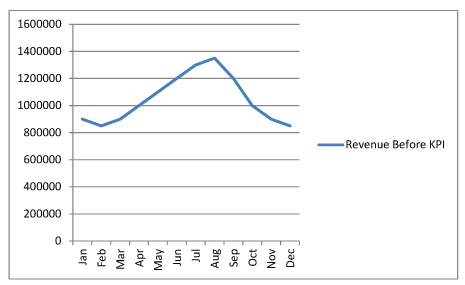
Here is a graph showing how their revenue was before this particular KPI was put in place:

KPI Key Performance Indicator Before


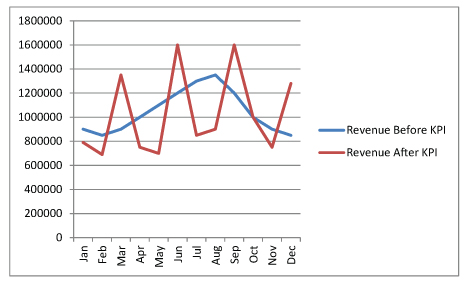
And here is the before and after picture:

KPI Key Performance Indicator After


Ouch!

This of course caused their accounting team to load up on antacids for most of the year.  Their KPI (and bonus program based on that KPI) had encouraged some behavior that was not necessarily good.  The Project Managers did not care about recognizing any revenue (and by extension, billing the client) until the end of the quarter, and when they did, they typically over-recognized and over-billed.

This problem caused a cascade through-out the organization.  Clients noticed and started to question why this month’s bill was so much larger that last month’s.  Average AR started to go up.  Cash flow went down.  Lines of credit had to be accessed to make payroll (and pay the quarterly bonus).

How could this have been prevented?  Looking back, it is obvious right?  But at the time, this sounded like a great idea and everyone was committed to making it successful.

  1. Too much focus on one KPI is not a good thing.  They should have used several measurements that touched upon AR, Chargeability, and (Project Managers cover your ears!), Client Satisfaction.
  2. Quantitative measurements are great, but we also need some Qualitative measurements in the mix.
  3. Involve many different types of people in your KPI development.  Someone might have pointed out this scenario at the beginning if the partners had not developed this on their own.

Which brings me to my final point... KPIs only help if you review them frequently and action is taken based upon them.  A well designed KPI exists to measure performance and if adjustments are not made based upon them...then no one saw the Project Manager fall in the forest.

View webinar on KPI Insight for Project Managers.

Latest Posts