
Full Sail Partners Blog | Michael Kessler, PMP

Posts by Michael Kessler, PMP:

What’s Trending in Mergers and Acquisitions

Posted by Michael Kessler, PMP on Jan 9, 2019 12:00:00 AM

Mergers and Acquisitions2018 was a banner year for mergers and acquisitions (M&As) across the A&E industry. If trends continue, 2019 should be even better. So, what is the driving force behind this increase in deals? Let’s check out why firms want to make these big changes.

Buying for Geography

Firms are wanting to expand their footprints. In many cases, a firm entrenched in a state or region has a desire to expand its services and brand to new territories. In some instances, this is driven by their clients who insist on a physical presence in order to win work. Additionally, there is an advantage to acquiring a firm in a desired territory since it comes with a backlog to help in absorbing the cost of becoming established and selling new work.

Buying New Disciplines

Often in tandem with geography there is a desire to grow a firm’s offerings and skill sets. This can be addressed in one of two ways:

  1. Acquiring a firm with parallel disciplines that are in different market sectors
  2. Acquiring a firm with a completely different discipline base

Both instances provide the opportunity for cross selling and talent development.

Acquiring the Competition

Another common occurrence in the M&A world is acquiring competitors. Simply, it’s a great way to see immediate market growth. When acquiring the competition, there is the option to absorb staff into your firm’s current workforce. Therefore, the need for acquiring resources can lead to buying the competition.

Selling to Private Equity

Another trend is selling to private equity.  This allows the firm being acquired to continue operating as is and use the infused capital to hire new talent or purchase assets, or to buy out members of the existing ownership looking for an exit strategy. Selling to a private equity group doesn’t come without its challenges though. These purchases often require a material change in accounting practices and reporting, and new ownership doesn’t always understand the operation or industry. In addition, follow on sales between equity firms are always looming.

What’s Your Firm’s Reason to Go Down the M&A Road?

Each firm has its own reasons for choosing to go down the M&A road. Is 2019 going to be the year your firm makes a move to gain a better hold in the A&E industry? If so, remember that it is always recommended to seek outside parties to help with the technical aspects of the M&A process.

 

Travel and Expense Tips from a Road Warrior

Posted by Michael Kessler, PMP on Jun 21, 2017 12:00:00 AM

AirplaneSo many people have suggested that I write a book about my travel experiences. After all, I average about 125,000 domestic miles each year and truly believe that, if I decorated my home with cheap hotel art and bolted down my television, my “layover” in Bakersfield, CA would be quite comfortable. Not to mention the miles and miles of test driving countless models of white cars you see in most hotel parking lots. Seriously though, I do love my job, and because it does require me to travel a lot, I have learned much and will now pass some tips on to you.
Complaining Gets You Nowhere 

I always try to remember to say “please” and “thank you” while mostly keeping my composure when the inevitable stressful situation arises. Gate agents, flight attendants and front desk clerks are simply messengers often delivering news that no one wants to hear. As a result, I make an effort to: 

  • Collect a business card of a manager to let him know how wonderful his team was and how well they handled even the most frustrating of situations
  • Send a note to corporate acknowledging the people that delivered great customer service 

These gestures usually ensure even better real-time service. In addition, knowing the management team at the properties you frequent establishes a good rapport and allows for them to proactively prepare for your next arrival being already aware of your preferences. 

Indirect Routes May Be More Direct 

I always consider different airports and frequently know the routes better than the airline representatives. Selecting an alternate airport can often be both cost and time saving provided you don’t mind a road trip. Also, choosing to drive between two clients within 250-300 miles is a good option which gives you the opportunity to stop and see new places. 

If you find yourself with an early flight on your return trip home, staying at an airport hotel is not only convenient but can be a cost savings. You can go ahead and turn in your rental car early and use a complimentary hotel shuttle. Most rental car companies will also drive you to your hotel if you just ask. 

Make Sure to Get Reimbursed for Expenses 

I have used many different expense report tools over the years beginning with the failsafe Excel and remember the days of sending my receipts via FedEx. Fortunately, I now use Concur Expense which is integrated into the Full Sail Partners’ Vision database using the Blackbox Connector. Concur makes filing expenses easy and streamlined. Using only my smart phone, I can take a picture, upload to Concur and complete my line item in seconds. 

Enjoy Your Travels! 

I hope that these tips will make your business travel a pleasure. I do strongly suggest you monitor your rewards programs to ensure you always receive what is due. Got to go, doors are closing, and it’s time for me to fly. 

Why Your Firm Should Be Using Earned Value Management

Posted by Michael Kessler, PMP on Nov 10, 2016 12:00:00 AM

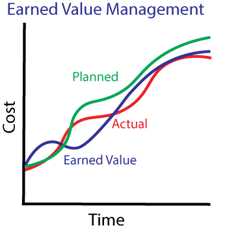
Earned Value Management For project-based firms, measuring current firm performance is the most significant indicator of future firm performance. Furthermore, by using trend data, firms can forecast cost and schedule variances in the early stage of a project. A preferred method by project managers to factor this trend data is the earned value management technique.     

Using Earned Value Management

Earned value management allows firms to evaluate cost and schedule variances in both dollars and percentages on projects. These factors are derived by considering planned value, actual cost and earned value over time.

A common way of looking at earned value is by using both the financial percent complete job to date (JTD) and the estimate too complete (ETC) by using the formula, JTD/(JTD + ETC) and the project managers reported physical percent complete. These two factors when equated provide a quick and easy comparison. For example, the financial percent complete on construction documents may be at 75% when the reported percent complete on construction documents is 50%. There are several possible explanations for these variances, such as:

  • There were many revisions that were client driven and not in scope
  • The complexity of the work was under estimated
  • We have just been very inefficient

Keep in mind, there are a number of other scenarios that can also explain these factors as well.

Factoring Earned Value Management

Getting the information above is actually simple. It requires holding project managers to a high level of accountability. Project managers need to evaluate the amount of hours budgeted, hours burned (JTD), and the effort required to finish the scope of work (ETC).

As a result, this will produce the financial percent complete. Project managers then need to record where the project is from a physical percent complete, which should tie to progress on the project schedule.

Much like a crossover episode of two TV shows, this is where EVM crosses over with a previous blog about FASB 606. EVM will ultimately meet the requirements that in turn will keep the accounting team compliant with FASB 606.

Enter Deltek Vision

The Resource Planning module in Deltek Vision addresses EVM by:

  • Allowing the financial percent complete to be calculated
  • Providing a physical percent complete plan in the form of an EV%
  • A default report in the Resource Planning module known as the Earned Value Chart, which represents the S Curve

By maintaining a project plan in the Resource Planning module, firms can be successful in developing a project report that shows cost and schedule variances in both the dollars and percent (CV, SV, CPI and SPI). If your firm has a benchmark or standard range, you can then compare the actual to that standard to identify anomalies in your projects performance.

The title of this blog is, “Why Your Firm Should Use Earned Value Management” and the answers are:

  1. It’s an industry standard and proven method for project management and project accounting
  2. It’s a common language among project managers across industries
  3. It provides quick visibility into a projects performance
  4. It brings firms closer to compliance with FASB 606

Learn more about Michael Kessler and his more than 30 years of experience of working in and around project-based accounting here.


How Does the FASB 606 Impact AE Firms and How Can Deltek Vision Revenue Generation Help?

Posted by Michael Kessler, PMP on Sep 14, 2016 12:00:00 AM

FASB 606Our first inclination when the new FASB 606 was announced was this wouldn’t impact many of our Deltek Vision clients. But after more insight, we recognize this has a tremendous impact on our clients. The rule states applicability to ALL entities that deliver goods or services. Though many believe that GAAP, FASB, SOX and other guidelines are good rules to follow regardless of any statutory relevance, the reality is if we are not being overseen we tend to be somewhat lax in compliance.

On May 2014, FASB issued Accounting Standards Update (ASU) 2014-09, Revenue from Contracts with Customers. As a result, nonpublic entities will be required to apply the revenue recognition standard. In the case of FASB 606, if you are subject to any audit oversight, whether it be the bank or a taxing agency, FASB 606 now becomes relevant. This is also relevant if revenue is used and or needed for verification. Lending institutions and those requiring financial statements for qualification have been requiring GAAP compliant financial statements and will likely begin to demand conformance to the new standards. Finally, CPAs offering attestation services will now give increased scrutiny to how firms recognize revenues on their contracts.

“Revenue is recognized when a company satisfies a performance obligation by transferring a promised good or service to a customer (which is when the customer obtains control of that good or service).”

Architects, Engineers, and Professional Service Firms that “sell” labor and drawings fall under this definition and will be subject to FASB 606.

Enter Deltek Vision Revenue Generation

Using Deltek Vision Revenue Generation was always a good idea for Project Management as it allows us to begin recognizing what we have earned as compared to what has been spent. This is done by using basic revenue generation factors such as: 

  • Job to Date Spent (or as I refer to it “earn as you burn”)
  • Percentage of Complete
  • Milestones or Deliverables

Using Vision’s User Defined Revenue capabilities, these and other potential methods and formulas can also be developed.

Preparing Deltek Vision for FASB 606

All firms need to understand how this measure requirement relates to them and seek advice from CPAs and Tax Professionals to ensure they will meet the requirements. Our role is to work with you and your CPA to configure Deltek Vision appropriately to accommodate the methods. In advance of your discussion with your advisors, we will assist in the creation of commonly understood measures. 

To learn more about overall revenue recognition concepts in Deltek Vision, check out this past blog. For further information on how to set-up revenue generation methods related to FASB 606 in Deltek Vision, please reach out to us and a consultant will be in contact.

* Rana Blair contributed to this blog.


Latest Posts