Full Sail Partners Blog | Communication

Posts about Communication:

Architecture & Engineering Firms’ Top Trends from the 43rd Annual Deltek Clarity Study

Posted by Lindsay Diven on Jun 29, 2022 12:00:00 AM

2022-ClarityReport_Banner-01

The Deltek Clarity report is the longest running, most comprehensive study in the architecture and engineering (A&E) industry for North America. The report digs into benchmarks, market outlook, and industry trends to help A&E firms identify where they are and how they compare to other firms in the industry. The 43rd Annual Report provides both surprising and not so surprising findings, as well as positive firm indicators for financial strength and project management excellence.  

Deltek Clarity has participation from more than 540 companies and delivers more than 100 benchmarks and industry insights across the business. The study focuses specifically on architecture and engineering firms and other firms who support the design firms. The 43rd Annual Deltek Clarity Study collected responses from A&E firms of all sizes in North America based on 2021 fiscal data. Here is an overall look at what was reported this year, but for more detail, the 43rd Clarity Study can be reviewed in its entirety. 

Consistent Challenges Across Departments 

This was one of the report findings that was not surprising. The two biggest challenges across company departments were related to staffing and time. Business development is challenged to find the time to nurture client relationships while technology departments have a lack of time to invest in learning. Moreover, project management, human resources, and finance departments all cited staff shortages, finding, and retaining qualified staff as their top challenge.  

In fact, 78% of the financial leaders identified that finding and retaining qualified staff is the number one financial challenge. This has been very different than what previous Clarity reports have shown in the past few years. In addition to staffing challenges, other consistent themes included business process automation and managing strong backlog and pipeline. All of these have an underlying theme of technology and how best to leverage technology to address some of the challenges companies are facing. 

Purposeful Investment in Technology 

This begins by measuring the digital transformation and maturity levels now and in the next five years, and how this aligns with the goals of the business. Then aligning business goals and IT goals to have that culture of efficiency and culture of innovation. According to the report, most firms identify themselves in that early or exploratory phase of maturity but nearly 70% of firms expect to be mature or advanced within the next five years. This is less optimistic than the previous year’s study. Some factors attributing to this may be that the pace of technology is moving so fast that the ultimate end goal seems to be constantly changing and/or not attainable.  

The top three challenges related to technology were lack of time to invest in learning, cost of technology, and prioritizing which trends are most applicable. Companies are struggling to understand not only what the new technologies are, but how to apply them in projects and business improvements. Top emerging technology cited by the firms were geolocation, augmented reality, and Internet of Things.  

These are often externally focused and can be leveraged in managing and executing projects. Not far behind in the cited top technology was big data and data science. Both can help firms to provide greater visibility and insight into what’s happening inside the firm.  

What this all leads to is purposeful investment into technology. Firms are looking to invest in the right technology to meet firm goals, not necessarily the newest technology. Deltek calls this purposeful investment. It’s critical, with the challenges of lack of time and resources, to look at the firm’s current systems with the technology in place and make sure it’s using them to their maximum capacity.  

Strong Market Forecast 

As noted earlier, the report indicates a really strong market forecast for the North American A&E industry. However, there are limited resources to both pursue and perform work. With these issues in mind, firms are going to have to be more strategic about how best to capitalize.  

Fortunately, the report does show a net revenue growth forecast of 17.6%. This is the highest that growth has been in the last ten years, and this is very optimistic over last year at an increase of 13.4 percentage points. Small firms were drivers for a lot of this positive push. In last year’s report, small firms had a negative forecast but now are rebounding back to a 14.6% net revenue growth forecast.  

The overall percentage of firm revenue from the top three clients has decreased slightly from the previous year to 35%. This could show good or harmful trends. Firms may be strategically and purposefully diversifying their client base or competition may be winning work away from the top clients. This is a great time to lead these types of discussions internally to see how the firm compares. 

Thus, while the forecast remains optimistic, it doesn’t come without challenges. About half of the firms said they are struggling to find the time to nurture client relationships. Combined with increased competition, firm leaders are trying to keep existing client relationships healthy and strong while looking for new prospects and revenue sources.  

Project Delivery Keeps Improving 

Projects are the core of what architecture and engineering firms do. The 43rd Annual Deltek Clarity Study indicates that, overall, A&E firms are becoming more confident in their project performance. 67.8% of projects are on or under budget, more companies (59%) are doing internal performance evaluations based on projects not waiting for an annual review, and 15% of firms are sharing their best practices through either a center of excellence or a project management office. Firms are focusing on project management as a discipline.  

While more projects are staying on track or ahead when it comes to budget (67.8% of projects), they aren’t performing as well from a scheduling perspective. Just over half (58.5%) of projects are on or ahead of schedule according to the report. This number decreased by 6 percentage points from the previous year. These are areas that both firm leaders and project managers should evaluate to strategize, understand, and determine what is happening. Does the firm need additional training for project managers or is the schedule being driven by the clients but at the cost of the firm’s profitability? 

One challenge could be access to timely data around projects. When asked about visibility around schedule variance, half the firms report low or very low visibility for project managers and principals. It’s challenging for project managers to proactively manage and keep the project schedule on track if there is a lack of visibility. This is a good opportunity to ask the firm’s project managers how visible their project schedule variance is and how better to improve that visibility.  

Similar to other firm departments, top project management challenges include staff shortages, competing priorities, inexperienced project managers, and accurate project cost and timeline forecasting. When it comes to project management, how is the firm handling project schedules, are the schedule changes internally or client driven, how quickly can the firm train new project managers, how can technology improve the project delivery gaps, and do the project managers need more visibility and access to project data? Discussing these internally will help to continue to improve the firm’s project performance. 

A&E Talent Staying, but Not Enough 

While the talent shortage is not new news, the Deltek Clarity Study digs in a little deeper to see what’s exactly happening in the North American A&E Industry. One surprise finding was the employee turnover rate. This was expected to be high, but it’s 13.6% which is low compared to the 18-19% that is shown in the Deltek Clarity Global report. Additionally, the findings show that talent isn’t necessarily leaving the industry but rather moving to other A&E firms. This might be good for the industry, but maybe not for the firms struggling to refill the positions. 

Medium-sized firms experience the highest turnover at 14.7%. Large firms are just below at 14.4% with small firms even lower at 11.9%. This lower turnover might be because smaller firms could have better employee engagement or be able to give different opportunities to grow.  

Nonetheless, with the high turnover, firms are experiencing the biggest challenge with filling open positions. The majority of firms are seeing more open positions than they had last year (65% of firms) while a third (30%) have about the same number of open positions. For nearly half of the firms, it’s taking 60 to 90 days to fill a position.  

With this talent challenge, it might be a good time for the firm to look at external factors such as candidates available in the market. Firms could also look internally to make sure their processes are as efficient as possible. This would include leveraging technology to streamline the recruiting process.  

The top talent acquisition challenges noted in the study were the availability of good candidates in the marketplace, ability to offer competitive compensation to candidates, and matching qualified candidates to open positions. This is even trickling over to the finance department. Finance leaders are feeling the increase in labor costs, higher salary demands for candidates, and additional costs to keep employees engaged. These higher labor costs could affect the future profitability of projects.  

In last year’s Deltek Clarity Study, succession planning and performance management were the top human resources’ challenges. This year, the challenges and priorities have changed. Now the top challenges for managing human resources are retaining employees, employee engagement/experience, and workforce capacity and planning.  

Relatively Stable Financial Statements 

The financial management section of the Deltek Clarity report is the longest running section of the report, with many findings showing a 10-year trend line. Firm financial leaders should review this section and analyze the trends and changes. For this year’s report, the financials are relatively stable but there are a few noticeable declines to note.  

Operating profit on net revenue declined after a decade of growth to 12.8% from 19.0% from the previous year. Deltek Clarity sets a threshold of 15% operating profit on net revenue for its high performing firms. In this year’s study, high performing firms had 23.9% operating profit on net revenue and large firms were near that threshold at 14.6%.  

Net labor multiplier is another key financial metric of the Deltek Clarity Study. This year’s multiplier increased just slightly to 2.99. The high performer firms had an average of 3.41 net labor multiplier. Something also to note is the top quartile net labor multiplier of 3.36. 

Overall, the utilization rate has decreased but is hovering close to 60% at 58.5%. This is not a surprising finding because of the increased labor costs, number of open positions, and maybe the increase in business development or other non-billable activities. Small firms saw the biggest decrease from 63.9% last year to 60.9% this year.  

Firms are seeing a strong backlog of nearly nine months. Large firms saw the biggest increase last year from 8.3 months to 9.94 months, and the top quartile is nearly 12 months of backlog. So, this is positive news for firms, if they are making sure that they can actually deliver on the work with the right resources.  

44% of the reported top financial challenges listed finding and retaining qualified staff as the top challenge. This was a big jump from the prior year’s report. Other challenges for financial leaders were managing firm growth and increasing profitability. These top challenges are interdependent. Finding qualified staff and having to compensate for that top talent will affect the firm’s ability to increase profitability and grow the firm.  

Diving Deeper 

This has just been a glimpse of some of the findings in the 43rd Annual Deltek Clarity Study. Firms should download the report (click the image below) and dig into it to understand what’s happening in their business, how they are leveraging technology, and where there are opportunities for additional training and awareness. This will allow these firms to better educate their teams, make sure they understand what their process is, and how they contribute to the overall success of the firm. 

 

Human Capital Management Remotely – No Office Required!

Posted by Sarah Gonnella on Feb 10, 2021 12:00:00 AM

Since the spring of 2020, many firms have had to transition to a remote only working environment. Learning to deal with this new operating style was certainly a challenge at first, but hopefully, these same firms are embracing the changes which could help to streamline the whole Human Capital Management (HCM) process. Let’s check out how HCM can be successfully done remotely with no office required based on our own experience at Full Sail Partners.

Human Capital Management

Pre-Hire

First off is the interview process which can still be done face to face, just virtually. Searching for talent is different when you work remotely. The location of potential new hires doesn’t really matter. It is more about skillsets and the fit of the person with the company.

You will also want to ask different types of questions about working from home such as questions towards working autonomously and communication skills. You need to see signs of motivation and the ability to self-motivate with any candidates you interview. Some key questions are “Why would you want to work from home?” and “Can you handle IT issues on your own?”, “Do you have internet?”, and “Do you have a quiet place to work from”. These types of questions will help you determine whether a particular candidate can handle a remote only position.

Onboarding

Once you’ve found the talent that seems to fit your remote work environment and the offer letter has been accepted, it is time to prepare for this new hire. Working remotely, a very important place to start is with the IT aspect. Having a standard online checklist of items that IT should prepare for is super helpful. Deltek Collaboration and Microsoft Teams are great solutions that allow you to copy a template that includes a list of standard tasks or assignments. Don’t reinvent the wheel each time you have a new hire. Everyone needs a computer and login info for different types of software. Send that info ahead of time so new hires can be ready day one to start learning more about the company. Also be sure new employees are provided with contacts within the company that can be approached for different needs. Working remotely puts the onus on the new hire to seek out the answers, but they should have a list of resources.

Another significant way to start on good footing remotely involves setting goals. These goals will have details about expectations to accomplish. The goals should focus on steps that are required to be successful. We find establishing 45-day, 3-month, 6-month, and 9-month goals can ensure the employee knows exactly their priorities and allows them to proceed forward with confidence. A supervisor should meet with the employee at the end of each of these time increments to discuss where they are in meeting their goals and determine if further mentoring or training is required.

Retention

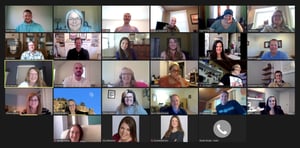
Full Sail Partners Team Fun Meeting CallNow that you have the right people for remote work up to speed, think about ways to engage employees and offer professional development. Since you can’t just walk down the hall to see what is happening, you have to trust them and their desire to perform their duties. Continuous feedback and performance discussions are key. It is a good idea to check in to see how things are going in frequent intervals.

Finally, day to day is different in the remote world with no monthly team lunches or birthday cake. However, time can be taken to meet virtually over Zoom, have phone conversations or even text. Just recently, Full Sail Partners had a virtual happy hour to get the gang together with a little bingo time. Being comfortable in a new position at the outset also promotes retention. New hires can learn about the roles of the various company positions through shadowing them. Once employees have shadowed certain firm members, they can then take the lead knowing that there is a built-in safety net still shadowing them. Offering professional development opportunities and trainings is another means to ensure retention. There are plenty of online resources available.

Learn More From Full Sail Partners' Sarah Gonnella

Sarah is interviewed by another Full Sail Partners' Crew Member about the onboarding process at our firm. Watch the video below.

Remote Going Forward?

Full Sail Partners has been a virtual company for more than two decades and has proven that HCM can be done remotely with success. For those firms who have seen the benefits of working remotely, there may not be a return to the way before. Let Full Sail Partners’ experience guide you going forward. If your firm is interested in learning more about remote working, feel free to reach out to an employee to learn more about their experience.


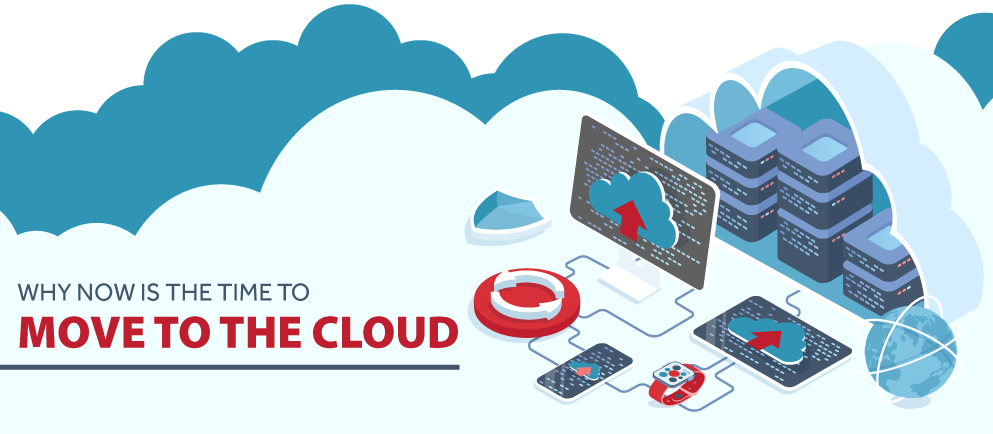
Why NOW is the Time to Move to the Cloud

Posted by Amanda Roussel on May 13, 2020 12:00:00 AM

MovetotheCloud_Banner


Leadership teams and firm owners have countless business elements to focus on and decisions to make. Some decisions are no-brainers, others are hard, and some just need to wait for the “right time.” There are often firm improvements pitched for consideration that may not make it to the priority list, or that are labeled as a luxury rather than a need. The word “value” can often determine where an initiative may fall on that labeling scale. One initiative that is proving to be a need is moving your firm’s ERP solution like Deltek Vantagepoint or Vision to the cloud. Now is the time, and it should be an easy decision. Let us identify some of the many advantages of moving your ERP solution to the cloud.

Make it Easy for Your Teams

Professional services firms have data… lots of data. Much of this data is centered around your people and projects and should be safely stored and easily accessible. With a device and an internet connection, teams can securely access their solution from anywhere. This allows for great flexibility with office, remote, and field team members. The cloud is not only flexible with location, but it is also flexible with firm size. Growth is a leading driver for many firms, and it is important that systems put in place now allow for scaling up when the time is right. The cloud offering makes it easy for teams to get their work done, providing value for the firm.

Reduce IT Burdens

Another benefit the cloud offers is removing the burden on your IT team, whether internal or external. On-premise hardware requires system maintenance and server upgrades which take time and money. Moving to the cloud, IT resources can be reallocated, and your firm will have confidence knowing that your ERP system is running on enhanced security, using updated hardware and software, and requiring zero maintenance from your IT team. You can also rest assured that a disaster recovery plan has been established and is ready to be deployed, if needed. The value of the cloud ultimately improves firm efficiency because you can now focus on what you do best, providing value to your own clients.

Fixed Costs vs Unexpected Costs

Planning for and managing expenses is a significant part of a firm’s financial health. Opting for a subscription-based fee for cloud services, firms can have confidence in budgeting a fixed cost. Otherwise, a best-guess amount would be budgeted for on-premise hardware needs. Another factor that should be considered is potential downtime. On average, downtime with a traditional IT system can be four times longer than the cloud alternative. Unexpected expenses and downtime can put an unfortunate burden on a firm. Choosing to be in the cloud ensures value with increasing reliability and reducing operating expenses.

Everyone is Invited to the Cloud

Small and large businesses alike have the same access to the cloud. The cloud can give businesses a competitive edge as they use the latest ERP solution like Deltek Vantagepoint for project management, financial management, and other streamlined processes. With proven tools accessed easily from the cloud, project managers, accounting teams, marketing groups, and executives can stay integrated and informed, no matter the firm size. The cloud does not discriminate on who gets value.

Continuity is a Necessity

Now is the time to make the move. Firms should be proactive in protecting their valuable data and seamlessly move it to a safe place. Do not wait until something goes amiss with your traditional IT system. Because cloud solutions are reached via the internet, users have greater flexibility with computer upgrades and mobile devices, too. The cloud is the leading choice for data storage because it is secure, reliable, and always available. With all these benefits, it should be an easy decision that NOW is the time to move to the cloud.

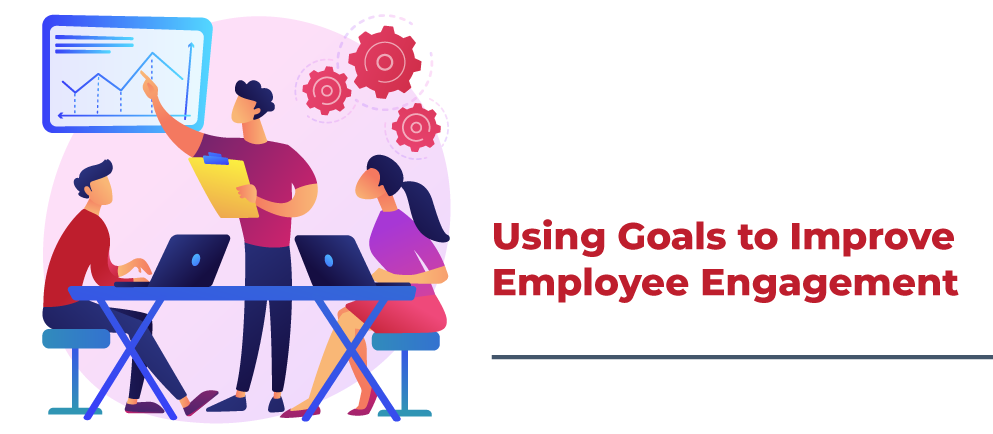
Using Goals to Improve Employee Engagement

Posted by Jennifer Renfroe on May 6, 2020 12:00:00 AM

05-04-23 Using Goals to Improve Employee Engagement_Banner

While many consider satisfied clients to be the most important factor for a business to be successful, they often overlook the significant contribution that satisfied employees make to the bottom line. Employees need to feel that they are not only a part of the process but see their efforts result in positive results. If employees are left in the dark regarding firm strategies and outcomes, they are more likely to just go through the motions in their jobs rather than be engaged. The best way to make sure your staff is engaged and therefore motivated towards firm success is to set goals. Let’s see what this entails.

Set Clear Expectations

If employees know what they are expected to achieve in their roles, they will be more inclined to work hard. When you clearly state goals and explain the strategic direction your team will be taking, you provide needed guidance which forms a connection. The individual employee goals established should be aligned with the overall firm goals whether short-term or long-term. Short-term goals work particularly well as the results can be more quickly seen by both employees and managers and provide a way to offer more continuous feedback ensuring employee engagement.

Stay SMART

In identifying particular objectives, it is best to be SMART about them. The guidelines for setting goals should be specific, measurable, attainable, relevant and time bound. A specific goal should address what is to be accomplished and what resources are involved. A measurable goal looks at when it will be accomplished while achievable focuses on how realistic the goal is. A relevant goal decides if it is timed correctly and if it meets a firm’s current needs. Finally, time bound establishes when the goal should be met. Goal milestones should be set to hold employees and teams accountable, and there should be a way to track the goals using a talent management system like Deltek Talent.

Recognize Employee Impact

Employees want to see how their contributions impact their team and their firm overall, and it is easy to become disillusioned when they cannot see the end result of their actions. With a tracking system in place, managers can show employees what they have accomplished, and employees can understand how their meeting of goals benefits the company at present and down the line. When you recognize the efforts of employees, they feel like they are part of firm success and will be motivated to continue these efforts.

Put a Goal System in Place

Employee engagement is necessary for the success of your firm and setting of goals is the best pathway to ensure such engagement. This way, employees will be informed of their expectations and given an opportunity to show what they can accomplish. Tracking these goals with a talent management system like Deltek Talent will keep employee goals aligned with firm goals and provide a way for employees to see their contributions to firm growth. Put a goal system in place today.

Continuous Performance Management

Posted by Hubspot System on Apr 15, 2020 12:00:00 AM

Continuous feedback

For years, annual performance reviews have been the standard way to evaluate employees. Usually, these evaluations take place at approximately the same time each year. They often discuss issues from the distant past then try to address future goals which are not brought up again until the following annual review. This dated process is static and useless when motivating and engaging staff. With the competitive talent market in the project-based world, firms need to actively nurture and develop their staff using continuous performance management. Here are some key components of a continuous performance management program.

More Than Just a Check-In

Continuous performance management involves more than just an occasional manager “check-in” with employees. It goes much further by incorporating input from other team members such as project leaders, human resources and other co-workers. With continuous feedback, employees can be kept abreast of how project milestones are being met while also examining outcomes that don’t go exactly the anticipated way. Furthermore, using technology, these frequent conversations between team members become an easy occurrence.

Goal Management that Flows

Another part of continuous performance management entails the fluid management of employee goals. Hiccups and successes should not be stagnant but should be evaluated as they occur during an employee’s tenure at your firm. Growth occurs constantly and employees meet their goals in various time increments so managing these goals should be just as fluid. This adaptable management of goals benefits the firm since project requirements change as well. Therefore, goals should be altered as needed rather than absolutely set in stone.

Clear Development Plans

Continuous performance management also incorporates career development plans for employees. From getting new hires productive at onboarding to upskilling or reskilling them several years down the road, development plans should be authentic and intentional. When employees have the opportunity to drive their careers, they become more engaged with their firms. As a result, this engagement leads to more productive projects which will benefit the firm in the end.

Transform Your Performance Management Process

Based on a SHRM/Globoforce Survey, a whopping 89% of HR leaders agreed that continuous feedback had a positive impact on their businesses. However, a Gallup study showed that only 19% of millennials surveyed said they got routine feedback with only 17% revealing that it was meaningful. The project-based workforce of the present and future wants authenticity and autonomy from its employer. Yet, the same workforce desires a way to showcase its skills and advance. Continuous Performance Management offers firms the ability to fully utilize the best talent, adapt to changing needs and ensure they grow with the firm.

Improving the Employee Experience

Posted by Ryan Felkel on Mar 25, 2020 12:00:00 AM

Employee Experience

We’ve heard a lot about the customer experience (CX) and its impact upon professional services firms. However, another experience that is just as significant to firm success is the employee experience (EX). The employee experience involves not only firm culture, but also the means used by firms to encourage employee success. Let’s take a look at what can be used to ensure an exceptional employee experience.

Exceptional Onboarding

It is important to set the stage for a positive new hire experience. Therefore, the onboarding process needs to be effective and efficient in getting employees to the point of being productive as soon as possible. In order to avoid overwhelming orientation paperwork, there should be an online onboarding portal which can capture all relevant new hire information. For example, solutions like Deltek Talent Management offer such a portal. Additionally, there should be a person assigned to each new hire to provide guidance and resources needed for a smooth transition into the workplace.

Performance Management and Career Development

Employees need not only independence to do their jobs, but also room for growth. Another key feature offered by a solution like Deltek Talent Management is continuous performance management. Employee goals should be managed constantly giving them a chance to meet goals in realistic time frames. Both employees and managers can then see when those goals are met and what the next steps to take would be. For the future, employees need to see what upskills or reskills are needed for a transition into a higher or different level position within the firm.

Frequent Internal Communication

Internal communication within a firm not only disseminates significant information, but also helps develop a culture. Employees should feel a sense of community with their firm and be connected to the corporate brand. Providing frequent updates keeps employees in the loop which encourages engagement and productivity. This is particularly true for remote workers. Frequent internal communication will additionally earn employee trust which ensures longevity.

Follow Through on Employee Feedback

Employee feedback can be gleaned in a variety of ways. It could come from a routine feedback survey or even discussions during goal review. No matter where or how employee feedback is obtained, it must be reviewed and acted upon to ensure an exceptional employee experience. Generally, feedback is given because employees want to see changes that will positively impact the firm. Following through on employee feedback thus benefits everyone.

Share Positive Client Feedback

One sure fire way to keep employees motivated is to show how they have positively contributed to their firm. After hours of dedicated work, employees want to see how their projects came to fruition or how the product they sold solved their client’s problems. When employees hear compliments, it boosts confidence and proves that hard work does pay off in the end. Positive client feedback should be shared not only with the employee but across the organization as well.

Employee Experience Affects Employee Engagement

It is a fact that employee engagement directly impacts firm revenue. With an exceptional employee experience, many more employees will stay engaged meaning more success for your firm. Furthermore, those same employees will continue to grow with your firm eventually moving into higher level positions. This will avoid the cost of future top talent recruitment and save your firm money. Start working on improving your employee experience today and let Full Sail Partners know how we can help.

A How to Guide for Working Remotely

Posted by Hubspot System on Mar 18, 2020 12:00:00 AM

Covid 19

With the recent health crisis of COVID-19 and the need for social distancing, we’ve noticed an uptick in companies’ interest in working from home. Therefore, important questions remain: What departments are feasible to work remotely? What services should be made available? How do you secure such an environment?

Setting up a Home Environment

The first thing you need to consider is if your employees are prepared to work from home? Do they have the necessary resources? Critical gear such adequate hardware and peripherals like full-sized keyboards and local printers may need to be provisioned and adequate internet connectivity both at home sites and the office should be evaluated.

Connecting to Work from Home

How will employees connect to work resources? If you are already using Office 365 or other software as a service then a good bit of the heavy lifting for email, files (SharePoint) as well as availability and collaboration (Teams) is already in place. Deltek Vision is a web based application and making it available remotely is a straightforward evolution our IT consultants can assist with or it can be moved to our Hosting environment. A virtual private network solution whereby each employee creates a connection back to his home office may be required for accessing large CAD or Engineering projects.

A new approach that Full Sail Partners and some of our clients are now using is Server and Desktops as a Service provided by Desktops2go. In this scenario, local desktops and file/licensing servers are hosted in the cloud and remote users simply connect to their workstation from wherever they are, and all workload/file access behaves as if the entire company is working from the same office. This solution also removes a remarkable load from company IT by reducing the need for purchasing high end servers and workstations for staff and provides a predictable monthly IT cost.

Other Considerations

Wide format drawings from a plotter are unlikely to work well from home. However, for drafts, we’ve seen some clients print to PDF, then use Adobe Reader’s ability to print out posterboard tiles until access to the plotters or print shop become available again. Office phones should be forwarded to cellphones or voice mail messages should be checked frequently to stay in contact with critical clients.

Keep Communication Going

From a managerial standpoint, we recommend frequent team and individual staff stand up meetings. Working from home can be disconcerting and isolating for some so additional consideration and contact may help keep morale and productivity up during challenging times. Full Sail Partners has been a virtual company since its inception with everyone working remotely. Please feel free to reach out to us to assist with your work from home needs!

Ways to Improve Office Communication

Posted by Ryan Felkel on Oct 9, 2019 12:00:00 AM

Connections Employees

In the workplace, communication is vital to success. Leaders must make sure that their team knows what is happening on a constant basis and what is expected from them. Not only does communication keep everyone abreast of the goings on, it also encourages relationship building which leads to a more productive and engaged workforce. So, how can you improve your office communication to make it the most effective?

Have Open Meetings      

Having team meetings in a common, open venue is a great way to encourage communication. It is a receptive environment offering the opportunity to discuss issues that are on team member’s minds. The face to face dialogue of open team meetings allows for matters to be actively addressed and some problem solving to occur. Additionally, all team members can contribute their input which provides various points of view.

Listen and Encourage Feedback

For effective communication to happen, leaders must listen to what their team members have to say. They must keep an open mind and really hear what is being said before following up with the team. They should also encourage feedback from the team to make sure that what they are trying to convey is being accurately digested. With the give and take of all parties, communication will thrive.

Keep Humor

Another trick for improving office communication is making it light and relaxed. When dealing with subjects that can otherwise be intense, keeping humor in the conversation makes the message easier to pass along to the team. This does not mean you have to become a stand-up comedian but just insert some humor into the discussions.

Be Appreciative of Efforts

A necessity for business leaders who want to have improved communication with their teams is to show appreciation for their team efforts. When they attend a meeting and offer feedback, thank them for their time. Being respectful towards your team shows that you care, and in the end, will make them more engaged with your firm.

Update Frequently

Frequent updates are certainly required to improve communication. When communicating more boilerplate information, they can be done in one of two ways - either by email or via an internal newsletter. While emails are good for quick reminders, internal newsletters impart much larger amounts of general information to all team members.

Effective Office Communication Helps with Retention

When firm leaders use effective office communication, they are engaging their teams. Engagement is a big reason that employees choose to stay employed with a firm. So, by improving office communication, you are not only helping with productivity but ultimately staff retention as well.

Latest Posts