
Full Sail Partners Blog | Building Business (9)

Posts about Building Business (9):

Four Best Practices for Team Communication

Posted by Jennifer Renfroe on Feb 21, 2014 12:00:00 AM


Team CommunicationHave you ever tried to communicate a thought or idea to a group or team, and yet no matter how hard you try, you cannot get your point across? Like it or not, we have all been there. The cause for this breakdown in communication could be many different factors, but many times this breakdown is caused by a failure of fundamental best practices for team communication.

Let’s review four of the best practices for team communication that will get your team operating at full sail:

  1. Responsibility is on the sender of the message, not the receiver! We live in a complex world, and most of us are juggling what feels like a hundred different things. This can often lead to us jumping from task to task, often leaving a tornado-like path in our wake. Next time, before you start forming the message for your co-worker or teammate, stop for a minute and organize your thoughts. If you are having a hard time keeping up with your train of thought, how do you expect someone else to follow it? As the communicator, it is incumbent on you to develop a coherent, easy to decipher message that has been received the way you intended.

    Think > Organize > Disseminate > Confirm

  2. Cut out the noise. You may be sitting there saying “DUH!”, but honestly ask yourself, have you done this lately?

    Communication noise refers to influences (outside and internal) on communication that effect the interpretation of the conversation. Often over looked, communication noise can have a profound impact on both perception of interactions, and analysis of our own communication proficiency.

    Noise can be many factors ranging from psychological (stereotypes, biases), Physical (loud music, incessant background noise), physiological (preoccupied during conversation), or semantic (sender mumbles or uses jargon). In order to follow our best practices for team communication, we recommend identifying any potential noise before, during, and after a conversation, and addressing it immediately!
     
  3. Haste makes waste. Rarely are our first ideas, our best ideas. Often times in the business world we will spend hours upon hours forming our thoughts and opinions about a subject, and then turn around and expect our peers to provide the same insight, only on the spot.

    In all fairness to your project team, you must provide your team with an environment that fosters thinking, collaboration, and open ideas. Failure to do so will cause even the most extroverted of individuals to crawl in to a shell, making their ability to interpret your message more difficult. Lack of creating an environment that fosters collaboration will lead to team members more worried about why you are asking a question, rather than what you are asking.
     
  4. Listen, listen, listen! Did you know that we listen at a rate of 12-250 words per minute, but think at a rate of 1,000-3,000 words per minute? While impressive, this statistic is very scary! One of the biggest breakdowns in communication comes from lack of listening, both from the side of the sender, and the side of the receiver. If you, or your team, are too busy forming your opinion about what is being said, rather than listening to what is being said, you are doing your entire team a disservice. We have two ears and one mouth for a reason!

    Tip for better listening: If you are working behind a computer while having a conversation, do not ever open up your emails mid meeting. We all want to check that fresh email that just popped up in the corner of our screen, however by doing so you have effectively checked out of the conversation at hand.

We hope that you can apply these best practices for team communication, and improve the effectiveness of your team’s communication efforts. Agree or disagree with anything in this blog? Make sure to comment below and let us know your thoughts! 

Interested in improving team communication? Check out Deltek Kona, a new social collaboration tool. Deltek Kona is revolutionizing the way teams communicate!



7 Ways Your Team Can Improve Project Collaboration

Posted by Wendy Gustafson on Feb 12, 2014 12:00:00 AM

group collaboration, team collaboration, improve collaborationWhen you improve project collaboration, you improve your organization’s ability to develop innovative products and processes. What are some specific strategies you should employ to get to a more collaborative environment? 

1. Focus on goals. The most effective project collaboration tends to be aimed at a specific goal or goals. So a natural place to start the process is with a discussion of the pain points/problems for a given project that the team is trying to address. Starting in this way ensures that team members share a specific understanding of what success will look like, and also makes it easier to take periodic measurements of the team’s progress and compare it against the established goals. 

2. Create small, diverse, nimble teams. The best way to encourage collaboration on a team is to keep groups small and diverse. For inspiration, consider that one of history’s most prolific inventors, Thomas Edison, liked to organize his people into teams of 8 or less that included a variety of disciplines (his light bulb team, for example, included chemists, mathematicians, and glassblowers). Fortunately, collaboration tools on the market make it easier than ever to include team members not only from different parts of an organization, but from different parts of the world. 

3. Build trust. To improve project collaboration, it’s crucial for team members to trust and respect one other. In a similar vein, they must be sure that management is supporting them, providing the time needed for collaboration, and giving credit where it’s due. If you’re assembling a team with members who are working together for the first time, consider team-building exercises that allow the members to get to better know each other and their work/communication styles — building cohesion and trust in the process. 

4. Choose appropriate tools. We live and work in the age of the app — and that’s good news for organizations that are seeking to improve project collaboration. There are many software tools that empower collaboration — not only widely-known ones such as DropBox that facilitate file sharing, but also other, lower cost (and even free) tools for screen sharing, real-time chats and IMs, scheduling and more. Click here to read about our five favorite collaboration tools. 

5. Appreciate different approaches to technology. Ultimately, you’ll want your team members all using the specific collaboration tool or tools that you select, for ease of management and cost effectiveness, if nothing less. That being said, it’s helpful to keep in mind that not everyone may be ready to adapt to the new technology at the same time (“hey, what’s wrong with me just collaborating via e-mail?”). Be realistic, and build a process and schedule that allows time for bringing every member up to speed on the new technology. 

6. Allow sufficient time for success. Evolving to a more collaborative environment is not a simple or quick process. Rather, it requires changes in not only how group members work individually and together, but also in the level of trust that the individuals have in each other and in management. Try to manage expectations in such a way that you maintain enthusiasm for the new possibilities the process will enable, with the realism that success will not come overnight. 

7. Effectively capture information and ideas. Last but not least, make sure your have a system to capture and store the group’s collective work, as well as individual members’ contributions. Unlike using simple email for communication among team members, the leading collaboration tools create central repositories where communication and documents can be archived for later referral — a very useful capability to have throughout a project, but especially when a key team member leaves. 

Gentlemen (and ladies), start your collaboration engines!

Collaboration may seem like just another corporate buzzword … but for the most part, the strategies underlying it are not too different from your other tried-and-true business practices. By carefully establishing and guiding your project teams, equipping them with the most effective collaboration tools, and managing expectations appropriately, your organization can be on its way to far more innovative and responsive products and services. 

Ready to begin collaborating as a team? Read our below blog to learn how to work more cohesively:


4 Tips for More Cohesive Group Collaboration

Posted by Rana Blair on Feb 5, 2014 12:00:00 AM

From the treehouse, to the garage, to the conference room, and now to the web, we’ve been doing group collaboration all of our lives. We’ve done it so much that we rarely, if ever, think about the finer details that really make the difference between a pleasant journey and a treacherous adventure.  

Group CollaborationOver the years, I’ve managed or participated in dozens hundreds of projects. I am great with communicating with people, a whiz at technology, and even pretty savvy with interpreting human behavior. Doing all three, while trying to get something done, is a challenge. I’ve learned a few things about group collaboration and the lessons are equally applicable across tools and platforms. 

Be Captain Obvious.

Be careful not to assume that everyone knows why they are assembled and what the objective is. Often, team members find themselves gathered without a complete understanding of the purpose, goal, or constraints. Too often, leaders assume that all group members have (or remember) all the details they need. The first activity using your tool of choice is to lay the groundwork. Create an accessible communication that defines:  

  • The final objective and it’s priority relative to other objectives in the organization
  • The team members and their roles, including the leader
  • The stakeholders
  • The due date

Revisit the communication frequently and highlight changes to the originally stated information. 

Even anarchists use sign-up sheets for potlucks.

No group can function devoid of guidelines on structure and communication. Guiding the team’s administrative characteristics does not quash the creative spirit. Providing structure saves time and minimizes confusion, thus encouraging the collaboration. If you don’t want to appear as dictatorial, address the appropriate considerations during the first meeting and let the masses decide. 

  • Define acceptable means of communication
  • Explain how documents and collateral are to be managed
  • Detail how activities outside of the group collaboration tool will be memorialized inside of the tool
  • Choose a process for moving seemingly off-topic elements to the appropriate venue 

When members lose their way, communicate the guidelines again. AND be willing to change previously defined processes that don’t work. 

Hammers are used to hit nails, not fingers.

“It’s really uncomfortable telling people what to do. Peer pressure goes a really long way. Can’t the software produce a list for everyone to see?” 

Really?!  Seriously?! 

Frequently, we use tools to get us out of doing the things we don’t want to do. Group collaboration tools are meant to encourage the flow of ideas and communication. No collaboration tool creator has ever recommended that you use the tool to publicly shame non-performing members. Like alarm clocks, annoying reminders can be shut off (or even thrown across the room.). The alarm clock does nothing to get us out of bed, but the boss sure does. 

  • Communicate tasks and due dates clearly
  • Ensure that the responsible party understands the dependencies
  • Follow-up on at-risk tasks appropriately (read: personal phone call) 

Let the tool serve in its capacity and you serve in yours.  

If it quacks like a duck, it’s probably a frog.

When the group collaboration tool is not yielding the success you expect, don’t blame the tool. When we find ourselves ready to throw up our hands and go back to another tool or no tool at all, it’s best to investigate for root causes and make adjustments.

  • Audit the participation of team members.  Spend one-on-one time with those who are not engaged by reviewing the project while using the tool.
  • Review how the tool has been laid out for use in the project. It is possible that features have been overlooked or are being used improperly.
  • Solicit suggestions on improving the use of the group collaboration tool.  If someone speaks up, the ensuing discussion will uncover misunderstandings or create opportunities to collaborate on finding a solution.  Either way, collaboration has taken place and a connection made. Win-win.

None of us are new to working in groups. Each of us brings the baggage we’ve accumulated from previous collaborations to our newest venture. The best thing we can do is to zero the scales, define, communicate, and revise. Group collaboration only works if the group is spending its time collaborating and moving easily from task, to topic, to task. Take the guesswork out of how to function within the group and use the group collaboration platform to propel the group.


Improving Collaboration in the Workplace Starts by Avoiding These Common Mistakes

Posted by Sarah Gonnella on Jan 29, 2014 12:00:00 AM

Almost everyone has heard Thomas Edison’s famous quotation about genius being “one percent inspiration and ninety-nine percent perspiration.” Far fewer people stop to wonder exactly what Edison was sweating about. 

Improving Collaboration in the WorkplaceThe answer is, Edison was not only working on the various inventions for which he’s well-known, but also on the emerging discipline of R&D itself. Even as he and his team were cranking out one technological marvel after another, one of Edison’s ongoing areas of interest was in improving collaboration in the workplace. 

According to Sarah Miller Caldicott (who happens to be Edison’s great grandniece), the world’s most prolific inventor developed a methodical approach to nurturing teamwork and innovation among his workers. In her book on the subject, Midnight Lunch: The Four Phases of Team Collaboration Success From Thomas Edison’s Lab, she describes the little-known, behind-the-scenes processes that Edison pioneered to create and sustain high-performing teams. 

Caldicott does a great job of finding insights into Edison’s approach that have relevance for businesses today, so I highly recommend checking out her book. In case you don’t have time to read it yourself, I’ve synthesized some of Caldicott’s key observations with current best practices in collaboration. For starters, I’ve identified three major areas where organizations often make mistakes that prevent them from improving collaboration in the workplace. 

Mistake # 1: Keep doing business the old way.

It’s natural to keep using the same tools and processes that have worked for you in the past. However, your competition is probably hard at work trying to figure out a faster, cheaper way to put you out of business. So “sticking to what works” may put your organization in an increasingly vulnerable position. Fortunately, there’s a constantly expanding variety of tools that can help you maximize your ability to collaborate. 

One of Edison’s interesting approaches to fostering collaboration was the “midnight lunch.” These were regularly scheduled but informal get-togethers where his engineers got to know and trust one another better, increasing their ability to communicate and work as a team. In today’s business environment, technologies like Kona and Skype may make it easier for teams to exchange ideas, but many people who write about collaboration still point to the effectiveness of starting with face-to-face meetings and then evolving to virtual collaboration as time progresses. 

In Edison’s day, the products of collaboration were obviously analog — although many of their ideas existed only in their heads, a great deal existed on paper as well. If a team member left, much of their work and insights could literally be passed out among team members. In today’s world, we are meeting the need by creating central repositories of files and communication — so if a team member leaves, all their intellectual property doesn’t leave with them. 

Mistake # 2: Assemble the wrong type of team.

The ideal size team for collaboration depends on a variety of factors — including the complexity of the work, the products the group is expected to generate (and the timeframe for doing so), and how often, if ever, the team needs to convene in person. 

For what it’s worth, Edison preferred smaller, more cohesive teams of between two and eight members, according to Caldicott. In addition to hosting the “midnight lunches” mentioned above, Edison also tried to ensure a mix of disciplines and areas of expertise on each of his teams; Edison’s light bulb team, for example, included chemists, mathematicians, and glassblowers. To put it another way, Edison and his colleagues were focusing on diversity decades before the term was ever used in a business management context! 

Mistake # 3: Take your eye off the ball.

One other lesson to be learned from Edison is to take the long view on collaboration. Real impact is not a short-term gain or achievement, but rather an investment of energy and resources that will eventually bear fruit. 

Taking this perspective, it’s easier to realize that mistakes can be just as instructive as successes. When Edison was only 22, he had his first flop:  An electronic vote recorder that legislators declined to adopt. Following that experience, Edison changed his focus to the consumer instead, and never regretted the decision. 

Another lesson Edison teaches us is to keep an eye on the market, and be ready to make adjustments as necessary. For example, he and his team ushered in the era of electricity, and then continued to invent new applications that used the increasingly available power source; other inventors ignored electricity at their peril. (For a more recent example of how not to do things, look no further than Kodak, which failed to adapt to market changes and is playing catch-up with hundreds of more innovative, nimbler companies.) 

Has the light bulb over your head turned on yet?

Most companies would consider themselves to be phenomenally successful to have even one innovation on the level of the light bulb, the motion picture, the phonograph, or any of the hundreds of other inventions and patents credited to the Wizard of Menlo Park. But by making the most of the collaborative tools and strategies for improving collaboration in the workplace mentioned above, your company can at least maximize the chance that your teams will do their very best work. 


5 Best Collaboration Tools in 2014

Posted by Ryan Felkel on Jan 15, 2014 12:00:00 AM

collaboration toolsNot all business buzzwords are created equal. For example, “collaboration” is red-hot among buzzwords today — but unlike other momentarily popular topics, the concept has been around a long time, but is now being addressed via technology designed to leverage the Internet. Collaboration apps and platforms typically take advantage of the Internet to enable the sharing of documents, ideas, calendars and more with colleagues. In fact, the more one embraces collaboration, the more implications one can find for teamwork, innovation and growth.


Here’s a quick look at the 5 best collaboration tools available today.

Kona

Kona is a cloud-based social collaboration/productivity platform for individuals and groups that enables file sharing, task/event management, and comments and conversations via Skype and instant messaging. It also integrates easily with other collaboration platforms and products, including Dropbox, iCloud, Google Docs and even SharePoint (if that’s your collaborative bag). 

In addition, Kona includes templates to expedite repeatable projects and processes, and can function as a company’s Private Social Network and shared calendar. Even better, Kona’s mobile app compliments its desktop functionalities, letting users track work from anywhere. Take it for a test drive by checking out the free trial version.

join.me

JoinMe is an elegantly simple (at least, simple to the end user) solution that allows you to share screens with anyone anywhere over an Internet connection. JoinMe can accommodate up to 10 meeting participants, and allows the meeting initiator to choose which items to share with whom, and enables chatting with one participant at a time or all at once. Keep in mind that these features are all in the free version — a fact that helped it land on our list of the 5 best collaboration tools.

Doodle

Doodle is a handy meeting scheduling/tracking tool for Android device users. Designed to integrate seamlessly with Google Calendar, Doodle makes it easy to find the right date and time for a group of people to meet. You can use the basic service for free at doodle.com, without the need to register or install software. With easy-to-use polling capabilities and real-time commenting tools, it’s also available as a low cost app for Android devices.

Dropbox

Currently in use by over 200 million people, Dropbox is a cloud-based platform for file sharing and accessing. Users designate a special folder on their computer that Dropbox synchronizes with similar folders the user creates on their other computers and devices. Any files that the user places in the Dropbox folder also are accessible through a website and mobile phone applications. Available for Windows, Macintosh and Linux desktop operating systems, Dropbox also offers apps for iPhone, iPad, Android, and BlackBerry devices. Options range from a free version to DropBox for Business ($15/user/month).

Skype

Skype enables free video and voice calling to anyone else using Skype, as well as instant messaging and file sharing. Alternatively, a modestly-priced version of Skype includes low rates on calls to mobile devices and landlines worldwide, text messaging and group video calls for up to 10 people. Users can take part in Skype calls using a wide variety of devices, from desktop computers and mobile devices to home phones, certain TVs, and even devices you might not think of as collaboration tools, such as PlayStations Vitas and iPod Touches.

Join the collaborative world

As you can see from the 5 best collaboration tools mentioned above, the world of collaboration choices and tools is exploding. But before you jump in and start rubbing virtual elbows with colleagues on the other side of the world, keep in mind two bits of advice:

  1. As attractive as their price tags may be, the free versions of all of these apps and platforms have limitations. For example, you may be limited in the number of participants you can accommodate and the amount of data you can share — and you may have to endure the occasional advertisement as well.
  2. Remember that integration with your existing apps (especially your calendar) as well as other collaboration apps is critical. Some of these apps, such as Kona, play well with almost all of the apps mentioned above; others, not so much. The more seamless the integration between your various collaboration apps, the bigger the impact on productivity and ease of use.

Despite those caveats, each of these tools can truly transform aspects of the way you work with colleagues. The result could be better ideas, more effective teams, and possibly even a better quality of life. Just imagine how nice it would be to cut down the time you spend setting up, going to and from, and sitting in meetings — not to mention, take part in them from the comfort of your own home, cubicle, or coffee shop! 


The Project Performance Equation: Firm Metrics + Client Metrics = Success

Posted by Admin on Jan 14, 2014 12:00:00 AM

PROJECT PERFORMANCE

As the New Year begins, most businesses, including ours, look for ways to drive even greater success than last year. If you are like most professional services firms, you evaluate project performance based largely on the efficiency with which the project is completed.  Unfortunately for most firms, they only look at half of the equation.

Evaluate Client Feedback for the Full Picture

Client feedback should focus on helping clients achieve the long-term success they desire by measuring all the metrics important to project performance. As the title suggests, this includes measuring both financial metrics and client metrics. Client metrics measure how well your process is meeting your client’s expectations at each stage of the project. If your team is not asking whether their client’s expectations are being met, they are making three dangerous assumptions:

  1. An existing project delivery process will meet a new client's expectations (or a new project manager will meet an existing client’s expectation)
  2. A client’s expectations of the project manager they have worked with before is not influenced by external factors
  3. You and the client have the same understanding of project communication, deliverables, etc.

Benefits of Client Feedback

When your firm uses real-time, project-based feedback, you give your clients the opportunity to share their changing preferences and priorities with you throughout the project. You eliminate the assumptions that can result in poor project performance and unmet expectations. You strengthen your relationships with your clients as they realize that you really care about their goals. Ultimately, because the feedback you request is designed to benefit your client, you also give them the ability to help you help them achieve the success they desire.

Some of the benefits of improving your project performance and creating success for your firm include:

  • Establishing a reputation as experts, elite players with a premium brand.
  • Reducing or eliminating re-work and scope creep
  • Becoming the ‘go-to’ firm
  • Impacting the bottom line by providing a steady stream of profitable work

As 2014 gets underway, let’s challenge ourselves. Instead of measuring the same things you have in the past and expecting different results, take the strategic step of tracking the metrics that matter. Just like, Peter Drucker says, “what is measured improves”.  So the question to ask yourself is: Are you measuring the metrics needed to create the success you desire? Click below to learn more about measuring client metrics to create firm success. 


Measuring Marketing ROI: Building a Better Relationship with Accounting

Posted by Sarah Gonnella on Dec 11, 2013 12:00:00 AM

When it comes to proving the value of marketing efforts, often professional services marketers have to prove their worth to the financial department through a language that they understand – Marketing Metrics! This often means a series of pre-determined metrics for measuring marketing ROI (return on investment). 

describe the imageMarketers are often challenged with measuring marketing ROI. Many times it’s because we are don’t have access to the right type of data or in some cases it’s because we don’t know what to measure. This is where having a good relationship with finance can help you be a better marketer. To better develop the relationship and expectations between marketing and finance, we suggest fostering a relationship of understanding and sharing. 
Having the financial department on your side is one of the greatest feats any marketer can accomplish – If finance buys in, you can be assured that it is only a matter of time until everyone else falls in place! 

No matter how copasetic our relationship is with our financial department, we have to be ready to report on marketing ROI at a moment’s notice so here are some steps to take to gain a better relationship. 

Talking the Talk 

If you are looking at building a better relationship with accounting, in my experience the first bridge to cross is to put yourself in their shoes. When you think about what functions accounting is responsible for, you can easily understand their hesitancy to buy in to the marketing plan without cold hard data to evaluate. Instead of running from this hurdle, attack it straight on! Schedule a kick-off meeting with finance to address the plan, and allow them to voice any concerns. 

The goal during the kick-off session is to ease accounting’s anxiety.  Allow the finance department a chance to express their suggestions and concerns. Continue to reassure the finance team that through the marketing metrics established by your firm, you will be consistently measuring marketing ROI throughout the year to ensure that the marketing team’s plans and efforts stay on track.

Walking the Walk 

The quickest way to gain buy in is to lead by example. You know your job better than finance knows your job. Identify areas that your marketing efforts affect that might not be easily identified.  One way a Marketer can begin to do this on their own is to think about the data that you need to do their job better. Come to the kick off meeting ready to show your finance team that you understand their concerns, by identifying previously overlooked metrics for measuring marketing ROI. This will demonstrate to finance that you are looking at metrics that can help impact the growth of the company and further prove your value to the firm. 

If you are interested in learning more, review this blog article that discusses evaluating your business growth plan with metrics. This introduction can be applied to developing marketing metrics that help identify how your efforts are helping the firm grow. 

Here are important questions marketers can ask accounting to start the conversation on how the firm can start measuring marketing ROI:

  1. Retaining & Gaining Clients: I’m looking to understand our total customer growth. Do we have a way to determine by percentage and revenue the amount of our work we’ve received is new vs. existing clients throughout the year?
  2. Pursuing the Right Client: I’m been looking at how we can be more strategic in our pursuit of clients. Would it be beneficial to advise you when I see we are pursuing more work with clients that we are having AR issues with?
  3. Forecasting and Backlog: Can you help me understand what our break-even is and do we have a way to see what our current backlog is? I’d like to help make sure we have enough business coming in the pipeline for each market or division.
  4. Effectiveness: Can you help me better understand how I affect the bottom line? Developing metrics that help you understand the financials behind your results can help you fine tune your approach. 

Often times your finance team is not questioning the value of the marketing team -- they are however questioning the tactics (and results!) being used. Often times as marketers we can get lost down in the weeds and lose sight of the overall firm goals. By proving efforts through metrics and marketing ROI, we start speaking a language that our financial team can understand. 

As professional services marketers, start showing your finance team that you care by measuring marketing ROI, and building better relationships between marketing and finance to demonstrate the value of promotional efforts.

For more information, view the below webinar: 

3 Core Strategies for Financial Forecasting

Posted by Wendy Gustafson on Nov 20, 2013 12:00:00 AM

Business leaders have any number of sophisticated computer programs and models to help them predict future business results. Despite these resources, however, in its essence financial forecasting is still a guessing game. 

That being said, there are several fundamental strategies that can improve one’s chances of making accurate forecasts.

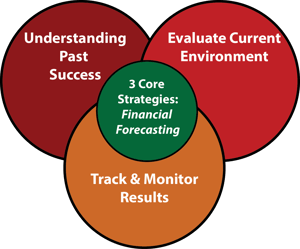
Strategies for Financial Forecasting1. Understand how and where you’ve succeeded.

The first strategy is to look at historical data to gain insight into exactly where past successes and challenges have come from. This inquiry includes reviewing the various sources of your leads, how your sales team manages them, and where you tend to have the greatest success. For example, you might try to determine:

  • Whether your sales most often result from calling into existing clients to find additional work, from cold calling to purchased lists, or alternate sources.
  • The extent to which your success has depended on the person doing the calling, the script used for the call, the number of contacts made, or other factors.
  • The lasting impact of sales — i.e., which sales turned into continuing relationships and additional work. Of course, there are many factors that affect this statistic, but it can still provide useful insight for your financial forecasting. 

The key is investing the time and energy needed to gain fact-based insights into what has worked — and not worked — in the past.

2. Take a cold, hard look around you.

A second essential strategy of financial forecasting is to look closely at your current operating environment, and conduct a brutally honest analysis of your strengths, weaknesses, threats and opportunities (SWOT). 

Your SWOT analysis should begin with a realistic exploration of the many factors that could increase, or decrease, the likelihood of your success. Some questions you might want to answer:

  • What is your reputation in the marketplace — what are you known for doing well, and where should you try to improve?
  • Is the local or regional economy growing, stagnant, or shrinking? More specifically, what is the condition of the economy as it affects your clients?
  • Are there factors that could encourage your clients to maintain or even expand the services they are buying from you? Are there conditions that might threaten projects that they have planned with you but not yet started, or that could prevent them from engaging with you in the future?
  • What is your competition doing to take advantage of the current market? Where are they weak, and how can you exploit that weakness? 

The underlying strategy in doing your SWOT analysis is to be totally honest and realistic about where you excel and where you come up short — and determine what you can realistically achieve in your competitive environment. 

3. Test your assumptions and adjust as necessary. 

A third essential strategy in effective financial forecasting is to track and monitor your results. There is a range of ways to do so, but based on our experience working with professional services firms, one of the best is to invest in a purpose-built ERP such as Deltek Vision. This solution can provide a firm with up-to-the minute, comprehensive visibility into all of the assumptions and results related to its financial forecasting. Just as importantly, it connects and organizes data from both the front office (i.e., project) function as well as the back office (accounting), and automates a wide variety of essentially manual processes — including Customer Relationship Management (CRM), business development and more. Not only will the insight you gain help you tweak your assumptions to improve future forecasting efforts, but more importantly, you can make midcourse corrections to keep your firm on course. 

Keep your eye on the prize.

Whether you use one-off spreadsheets, software programs for specific functions, or a comprehensive solution like Deltek Vision, the key is to collect metrics that matter to you on an ongoing basis, measure results against your financial forecast, and make adjustments as necessary. 

You’ll never be able to see a completely accurate view of your company’s future. However, through financial forecasting, you will gain enough of a realistic sense of what’s coming that you’ll be able to stick to a plan and outmaneuver the competition. 


Why Cash Flow Planning is Essential for Growth

Posted by Scott Seal on Oct 30, 2013 12:00:00 AM

cash flow planning, cash flow planFor most professional services firms, planning for growth is a natural part of business. There are different strategies for doing so, and choosing the best one depends on your ultimate growth objectives. But whatever your goals, understanding how your growth plan affects your cash flow plan is essential to achieving the results you seek.

The way you grow affects cash flow planning.

Organic growth. There are a number of ways to grow one’s business organically. For example, in a generally healthy economy, your firm could continue doing “business as usual” (i.e., not increase your marketing or business development activity) and still experience significant growth from the improving economy. This type of growth is typically slow-paced; you can keep up with the increased demand either by using existing staff or gradually “ramping up” your staffing to meet the growth curve.

A somewhat more aggressive growth plan might be to expand your client base in the same market niche and geographic area where you’re already doing business. In such a scenario, you are typically increasing your marketing and business development outreach to generate business. As this outreach occurs, you may experience rapid growth that requires you to have staff immediately available to meet the increased client demands.

Strategic growth. Alternatively, you might be planning to significantly expand your service offerings or target market. For example, an engineering firm might add a new service line, or expand into another geographic market. In such cases, you could expect to take on additional marketing and staffing expenses, along with expenses for market research (please do not skip this step), software and equipment and possibly even new office space. These added expenses occur up front, well before you bring dollar one through the door. 

Expect a time lag before reaching ROI.

The fundamental point to keep in mind is that your cash flow will take a hit, probably at least for 90 days for increased staffing costs, and longer for marketing costs. The reason for this is the unavoidable lag between when you begin investing in expansion, and when you actually start reaping the benefit.

Here’s the general reason for the time lag. Once you decide to expand, there are several types of expenses you’ll incur at the beginning of your growth effort — investments that will not bear fruit immediately. For example, there are costs to hire and train new employees, with probably 60 days before they’re doing billable work. Even if you’re very efficient and bill on day 61, then the earliest you should expect payment for their work will be another 30 days, making it a minimum total of 90 days where cash is going out, but no additional revenue is coming in.  

How to meet the demand: sub-consultants vs. salaried staff.

In general, hiring consultants requires less of a cash investment than full- or part-time staff, as they typically will not get paid until you get paid (Paid When Paid, or PWP). This advantage may be offset, however, by the fact that consultants can also be more challenging to manage and they have their own clients (and potentially conflicting commitments as well). Additionally, you still have to invest manager time to assign and manage the sub-consultants’ performance.

On the other hand, while full- or part-time staff may be more costly to hire, they will likely gain institutional and process knowledge as they work, which should make them increasingly valuable to your company. Additionally, they are typically focused on the company’s needs and requirements; you can control their priorities.

Tracking cash flow and return.

The other part of cash flow planning during a growth period (or at any time, for that matter) is monitoring your expenditures and results (hopefully in the form of additional revenue). As with any plan, it’s essential to have an idea of the effort you need to expend, and what results you expect from that effort. Even if your plan is “business as usual” because of an improving market, you should understand what results you expect from the improving market. If you are increasing your marketing effort in your existing market, you should know what you expect from that effort in the form of additional leads, opportunities, clients and, of course, revenue. Without the increased revenue, what is the justification of the increased marketing effort (and assumed increased cost)?

There are a number of approaches for tracking results, ranging from one-off spreadsheets to purpose-built ERP solutions.

In our experience, one of the most effective strategies is to find a solution that accomplishes several key functions at once. Deltek Vision, for example, is a purpose-built ERP solution that provides a unified platform for connecting the front and back office functions — providing up-to-the-minute insight into cash flow planning, as well as accounts receivable, billability and utilization statistics, and much more. It even includes integrated solutions for automating major parts of your processes for customer relationship management, proposal development and tracking.

Watch the details, but don’t neglect the big picture.

Keep in mind that the timeframes for generating ROI mentioned in this article are generalizations. In fact, they’re based on an ideal scenario that assumes making good hires, efficiently training and integrating them, finding a receptive market … and getting paid on time.

Naturally, as the fine print often says, actual results may vary. This makes it even more important to build-in expectations that cash flow will take a significant hit for at least a few months before you start reaping the rewards of you investment.

Growth is rarely painless or easy — but knowing what to expect is far better than wading into a growth plan without knowing when it will start paying off.


Professional Services Marketing: A Changing Landscape

Posted by Ryan Felkel on Oct 23, 2013 12:00:00 AM

changinglandscape

Guest blog written by Lee W. Frederiksen, Ph.D.

It’s old news that technology has changed the way we interact – and that includes the way we purchase goods and services. But the professional services industry has largely lagged behind other sectors in reacting to this change, continuing to rely on traditional forms of marketing that are both more expensive and less effective. The small percentage of firms that have embraced online marketing, however, have seen marked success. In our recent study on online marketing, we learned that professional services firms employing online marketing techniques grow 4X faster, and are 2X more profitable than other firms. Why is this so? What is it about online marketing that is so effective? To understand why online marketing works, we need to understand today’s buyers. 

How Buyers Choose Professional Services Firms 

Technology has changed the way that buyers search for and evaluate professional services firms. Based on our research, we know that 71% of buyers still ask their friends and colleagues first when they search for a new professional services firm. At first glance, this seems like the old way of doing business. What’s changed is that, after receiving the referral, these buyers can now go online to do their own research on the firms that were recommended. 

The Internet has allowed buyers to take much more control of their purchasing process. In fact, in their recent study of over 1,400 B2B consumers, the Corporate Executive Board found that 57% of a typical purchasing decision occurs before the buyer ever has a conversation with a service provider. This represents a drastic break from the past. 

Even more notable, the third largest group in our study—11% of professional service buyers—said they skip the referral process altogether, going directly online to search for firms. Combined with the first group of buyers who use the Internet to check up on firms referred from their network, this means that altogether 82% of professional services buyers go online at some point in their buying process to evaluate a firm. 

The Digital Generation 

The Internet has drastically changed the marketing landscape for professional services firms, and we expect that landscape to continue changing. Consider that most workers under the age of 35 have never worked in an office without Internet access. Research shows that for this rising category of leaders, using online resources to evaluate and communicate with firms is second nature. And, as this digital generation ages and takes on increasingly senior leadership positions, they will give technology an expanding role in their buying and decision-making process. 

Putting It All Together 

Technology has forever changed the way that consumers interact with, and purchase, professional services. Those firms that learn to embrace the advantages offered by these new technologies will continue to grow and profit, widening the gap that already exists between technology adopters and non-adopters. For professional services firms, ignoring online marketing means living in the past. 

Read more about the way professional services marketing is changing in Hinge’s new coauthored book, Professional Services Marketing 

About the Author:

Lee W. Frederiksen, Ph.D., is Managing Partner at Hinge, a marketing firm that specializes in branding and marketing for professional services. Hinge is a leader in rebranding firms to help them grow faster and maximize value. Lee can be reached at LFrederiksen@hingemarketing.com or 703-391-8870. 

Interested in implementing an holistic solution to help your marketing team better manage your efforts? Check out Deltek Vision CRM and get a leg up on your competition.

Latest Posts