
Full Sail Partners Blog | Building Business (8)

Posts about Building Business (8):

Management of Change: The Project Manager's Perspective

Posted by Rana Blair on Oct 29, 2014 12:00:00 AM

management of change pmThis series has been exploring how change management is viewed by a variety of perspectives: executives and finance to date with marketing, HR and IT yet to come.  We’ve advocated that change must be understood and handled differently from each department’s “normal” day to day activities.  However, for our focus on project management, this series will take a somewhat different turn.  Project Managers already have, in their very work DNA, the ability to see, to scope, and to manage change.  It’s what they do on a daily, weekly, and yearly basis: it’s what project management is all about.  

The specifics

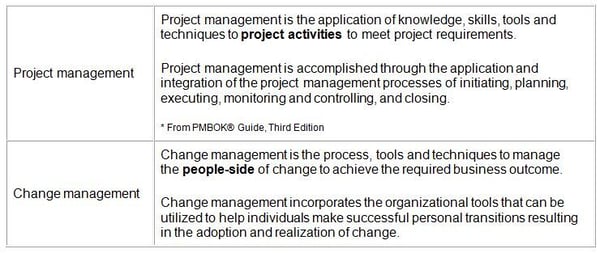
Let’s first take a closer look at our terms – project management and change management – in order to make the clear connection.  Tim Creasey, Director of Research and Development for Prosci Research takes us through this process.  
change management

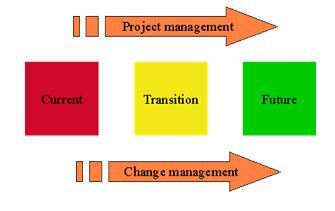
From these terms, he offers next the vital connecting visual and description.
change management2

“As shown in this image, both project management and change management support moving an organization from a current state (how things are done today), through a transition state to a desired future state (the new processes, systems, organization structures or job roles defined by 'the change'). Project management focuses on the tasks to achieve the project requirements. Change management focuses on the people impacted by the change.

Any change to processes, systems, organization structures and/or job roles will have a 'technical' side and a 'people' side that must be managed. Project management and change management have evolved as disciplines to provide both the structure and the tools needed to realize change successfully on [both] the technical and people side[s].” 

But there’s more

In our first piece, we offered a definitions of change management with user adoption as the important second step in the management of change.  Once again, project managers are well positioned to ensure that not only are the processes of change implemented correctly, but that the people involved in the change are empowered to take full advantage.   

As we’ve discussed, both project management and change management have as their leading characteristic, a specific focus on the people involved in the change.  Also we stated in beginning of our series, user adoption requires a clearly defined and financially measured goal with training, clear communication/marketing and leadership buy-in as necessary parts to be successful.  Each of these attributes is an important part of ensuring that the people part of change is not only smooth but wholly embraced:  there is, after all, good reason that the company utilized valuable energy scoping out the change that will take your company from its present state to its future, more desired, state.  And since a company is really the embodiment of the sum of its employees,   

The company will only change

 when the individuals fully and entirely

commit to the change.

Final phase

No project would be complete without this all-important final phase - project review.  We all well know that no project would be complete without really looking at those phases which were well executed and which were not:  it is here in the post-mortem where real learning occurs and where there is a final determination of success and of change. 



Management of Change Series – Finance

Posted by Ryan Felkel on Oct 24, 2014 12:00:00 AM

management of change financeYou are the authority on finance:  You speak in numbers using  words like “return on investment,” “profit,” “revenue,” and, of course “results.”  In this third installment of our Management of Change Series, we explore change management through the eyes of the financial experts who prove the attainment of goals with reliable, empirical evidence … bottom line numbers.  

But how?

Many professionals are capable of creating and clearly defining goals, not the least of whom are the executives in your company, as we explored in our Management of Change – Executive.  But as the financial wizard, your job is to establish clear, numerically defined, indicators of success which start with a distinct baseline.   After all, to know where you are on the journey, you need to know where you have been.

So, back to our initial question:  How do you prove goal attainment once goals have been clearly established?  It is best to use a defined, multi-step program.

  1. Establish a baseline – This is not about finding bottom line numbers, somewhere, as some sort of false starting point.  Your baseline must include the numbers which clearly support the defined objectives. 
     
  2. Define financial checkpoints – Change is a time intensive process and must therefore be managed as meticulously as the most important project, since implementing change is, in fact, a project.  Your firm’s success is dependent upon this project.  Financial objectives must be managed throughout the change process, through project status reports, so that there are no financial surprises at the end.
     
  3. Determine final success numbers – We certainly know that success isn’t always defined by dollars but also by numbers indicating things like percentage increases or decreases.  But, and this is important, don’t be tied to a specific number, instead determine a tolerance range as your indicator of success, your ROI.  Remember, that management of change is not just about processes but also about the people in your organization, and, as we all know, change in people is difficult.  This speaks to user adoption, i.e. how your employees adopt, accept and embrace the changes being proposed. According to “The ‘harder’ side of change.  The What, Why and Ho of change management’” The consequence of not managing the people side of change, i.e. employees and customers, has “tangible and real financial impact on the health of the organization and the project.” Therefore, set an acceptable level of success and celebrate when you’re within a good range of your numbers.
     
describe the image Here is your softare toolbox for managing the above steps.

Even more numbers

Management of change for “finance types” is unquestionably about the numbers.  But all good number crunchers know that numbers reflect all sorts of things:  More than just bottom line profit/loss, percentage increase, or improved customer satisfaction numbers. Financial repercussions also must be measured for change that doesn’t occur to account for potential adverse effect of not making a necessary change.  Therefore, numbers have to be analyzed reflecting the “opportunity and efficiency costs of NOT making the change both of which also directly impact ROI” as we discussed in our introductory piece to this series.   

Bottom line

The financial side of the management of change is really where cold numbers meet the warmth of the human ability to accept and adapt to change.  The purpose of this piece is not to immerse you in ROI calculations, number projections, or columns of dollars – all of which you’re thoroughly aware – but, instead, to ensure that all involved in the change management process are aware of the steps to proving the financial effect of change as well as to speak to the financial ramifications NOT making changes.  Those numeric bottom line steps are the solid evidence of change management success.  Our next installment features project managing your change.

Management of Change Series: The Executive Perspective

Posted by Scott Seal on Oct 16, 2014 12:00:00 AM
management of change exec

You are the leader of a company.  People look to you for establishing goals, creating direction and for driving the company’s success.  When looking at managing change, your perspective is from 5,000 feet … but with all the responsibility of the minutiae.   This second installment in our Management of Change series focuses on how you, the executive, must navigate your employees through the rough waters of change to the calm seas of success.  Here are the important steps.

1. Establishing goals

In order to effectively manage change, an important first exercise is a goal setting session with the entire leadership team.  Unfortunately, we hear too often, “I know it’s important, but we don’t have time for goal setting meetings with all the other meetings we already have.”

Without goals, though, here is what you’re doing.  Let’s say you want to take a vacation.  Great, now book your flight(s), reserve a hotel room, and schedule some activities.  But wait – where are you going?  Is your hotel room in the same place as where your flight landed?  How much is this trip going to cost?  Are the activities in the same area as your hotel?   In your personal life, of course you know all the answers to these questions, because you already had your goal, your destination in mind and your family buy-in before making decisions and actually spending money.  But do you lead your company with this same clarity of purpose?  Do you have clear and specific goals and the consensus of the management team before making decisions and sending money?  Too many, regrettably, do not. 

It is time consuming and difficult, but absolutely necessary to establish clear goals that also have the buy-in of every member of your leadership team

2. Creating direction

Now that you know where you’re going, how are you going to get there? As we discussed in our first piece, “change management requires a structured approach for lasting benefits”, that structured approach is the direction, the roadmap that the executives of companies need to create in order to reach company goals. 

Of course, you know all this already; you spend hours of your valuable time in seemingly endless business planning sessions.  But this is a bit different.  When looking at change, you are not just trying to reach a goal, like higher profitability or increased revenue, but you’re working to reach a goal of minimizing any negative impacts change might bring.  Change is usually required most often as a result of

  • External forces like politics, environment, or technology

     OR

  • Internal requirements like a major reorganization or change on offerings

Another thing you are already quite aware of … change is hard.  It effects not only your established company processes but, more importantly, the people in your organization. 

Process Changes

When change impacts your processes, every area in your organization is impacted:  Finance impacts HR which impacts Marketing which impacts IT which impacts … well, you get the picture:  Your company is an interrelated amalgamation of interactive expertise.  Although executives often speak in department silos – “Let’s work with Finance on that new report” – we all know that the report depends on information from every other department in the company which means that “new report” is not just Finance’s responsibility but every department’s responsibility.  And why?  Defined as a series of actions or steps taken in order to achieve a particular end, process is what drives your company’s every day activities which ultimately lead to the achievement of your company goals. 

People Changes

But there’s more.  While change impacts your processes, it’s the people in your organization who are actually running those processes, and it’s the people who struggle with change (yes, even you executives are people who struggle with change too).  Peter Drucker, Wikipedia tells us, “whose writings contributed to the philosophical and practical foundations of the modern business corporation, says that ‘We now accept the fact that learning is a lifelong process of keeping abreast of change.  And the most pressing task is to teach people how to learn.’” Change is indeed a hard and necessary evil but can be abated with training which is the next most important part of company-wide user adoption of change.

3. Drive Company Success through Powerful Tools

dashboardSo what are the tools to allow you to be an effective, involved leader of the management of change process?  Quite simply, an executive dashboard in a technology solution from a company like Full Sail Partners who can customize software for your change management project.  Dashboards, like the one pictured here, can allow executives to get a snapshot of activities taking place during the change process ensuring that you have a pulse on your project.  

Bottom line

As the executive, you have many roles – not the least of which is company change agent.  A tremendously important role necessary to allow your company to continue to flourish in the wake of ever-changing internal and external environs.  The leadership team must clearly define goals and create a clear plan for reaching those goals keeping in mind:

a) The impact of the changes in process and the people who are required to do them

b) The tools and the allies, like Full Sail Partners, Inc., that you have access to which will help manage your change. 

Now is the time for company executives, like you, to accept the challenge of change! 


Management of Change Series: Impacting User Adoption

Posted by Sarah Gonnella on Oct 8, 2014 12:00:00 AM

management of change 350x350

A friend comes to you and asks for your advice regarding a great investment they discovered with a huge money down initial investment but with – and here’s the kicker – no idea of the ROI. 

Your advice?  Never invest unless you know what you’ll get in return, right?

Yet, thousands of companies today are operating their business without knowing if there will be any return on the investments on initiatives or significant purchases each day.   

WHY do companies do this and HOW can they realize the necessary ROI?

They answer is right in front of us - effective management of change.

This article is the first in an exciting and informative series where we focus our attention on this invasive corporate conundrum and how an effectively run Management of Change Program can positively impact your bottom line.  What’s even more engaging about this series is that we will look at the benefits of change management from a variety of perspectives:  Executive, Finance, Project Management, Marketing, and HR. 

In this introduction piece, we will concentrate on two key definitions including change management and user adoption.

Change Management

Change Management is a term often bandied about as the vague yet intended scapegoat for why things don’t go well in an organization.  While many people certainly understand the concept, there is in fact a real definition.  Generally, change management is the process of moving an organization from its current status to a defined desired status.  However, few understand the importance or the specifics as to what makes an effective management of change program. 

According to mindtools.com’s article “Change Management Making Organization Change Happen Effectively,” “Change management is a structured approach for ensuring that changes are thoroughly and smoothly implemented, and that the lasting benefits of change are achieved.  The focus is on the wider impacts of change, particularly on people and how they, as individuals and teams, move from the current situation to the new one.”  I’ve added the boldface font to make two very important points:  1) that change management requires a structured approach for lasting benefits and 2) change management requires not only a change in process but a change in the people involved. 

User Adoption

Which brings us to our next definition regarding the people involved in the change, User Adoption.  Broadly, it means the people in the company using and taking full advantage of the changed environment.  We all know that getting people to change is always a difficult task:  people are naturally resistant to change - even if change means their work lives will be easier - because the initial adjustment to their lives seems too big a barrier.  Now, taking that broad definition into a more specific level, we can clarify it as the following:  successful user adoption requires a clearly defined and financially measured goal requiring training, clear communication/marketing and leadership buy-in in order to be successful. 

Management of Change and ROI

Now, let’s get back to ROI.

For a change to be considered advantageous, there has to be a compelling business case which will look at the cost of the project weighted against the benefits the company will gain. If the benefits outweigh the costs, the ROI is positive.  The formula for calculating Return on Investment (ROI)[2] is:

MOCblog


NATALIE PETOUHOFF, PHD, TAMRA CHANDLER and BETH MONTAG-SCHMALTZ, “The Business Impact of Change Management,” 2006 Volume 9 Issue 3.

In other words, the difficulties of change must be overcome by the positives, i.e. an ROI both financially and personally for those involved. 

Two other important items that many people forget when calculating ROI are a) the amount of resources and time change takes as well as b) the opportunity and efficiency costs of NOT making the change both of which also directly impact ROI

Looking forward …

We have established our key terms, change management and user adoption.  Now let’s look at management of change programs - which reap the benefits to your organization’s bottom line - from the different perspectives mentioned above through focusing on user adoption.  Next week, An Executive’s User Adoption Story. 


How My Life Teaching Moment Helped with Client Conflict Resolution

Posted by Sarah Gonnella on Oct 3, 2014 12:00:00 AM

conflict resolutionHave you ever had a moment in your life that stands out as a teaching moment that has made you who you are today? My moment transformed and prepared me as a Project Manager and Owner to tackle difficult conversations. Let’s face it, whether personal or in the workplace, we are constantly faced with resolving conflict.  At the same time, I have learned (or found) that not everyone is comfortable with expressing what needs to be said. So, it really resonated with me when a couple years ago I discovered a tool that has made conflict resolution easier. More about that in a minute. 

My Story

My teaching moment was when I was in sixth grade.  I had a teacher I felt was not being fair. I expressed to my mother my frustration to see if she could help. She told me that she could go to this teacher and have a conversation, but that the teacher would probably respond better if I addressed the issue head on. She coached me on how to have the conversation so I had the tools to handle the conversation on my own.

I was nervous as I entered her classroom. I asked the teacher if she had a moment that we could step outside of the class and talk. I told her how I felt and wanted to bring it to her attention to see how we could resolve the issue. The teacher was impressed and happy that I brought it to her attention. We came up with a solution and each day after I felt that I was respected and developed a better relationship with that teacher.  Each day I look back at that experience, I realize that was the moment I learned to speak up about concerns and not fear the hard conversation to resolve conflict.

Resolving Conflict

By no means am I an expert at resolving conflict. However, I have learned that avoiding the subject and hoping it goes away rarely works. Additionally, conflict doesn’t have to be looked at as negative. Sometimes opportunities flourish from conflict. The other person might be feeling the same way and because you took the time to say something your relationship improved.  A great resource for learning more about conflict resolution is Mindtools. Below are some tips I have learned throughout the years to help resolve client issues:

  1. Perception is Reality - The definition of conflict is to be incompatible. So in order to resolve conflict, the first step is to listen and understand the other person’s or group’s point of view.  We all come from different experiences that influence us and can lead us to make assumptions. So it’s important to understand that someone else’s views may have nothing to do with you, but be based on their past experience.  So with that, we must also realize that perception is the truth no matter if you think it’s true or not. Once you put your mind around that fact you can begin to focus on what can be done to resolve the issue.
     
  2. Managing Expectations Managing expectations with a client requires being proactive vs. reactive. Once a client is frustrated with multiple things that have built up over time, it takes a lot more work to resolve the issue and sometimes is too late. For professional services firms that need to manage clients, a great tool to help with this is the Client Feedback Tool. The only way you can really know what a client is thinking is to ask. This tool allows a firm to check-in with their clients using two minute surveys throughout the project. When you do this, you uncover things your firm has done that your clients love (so you can continue to do more of the same) as well as things that your client would like you to change if only slightly. This doesn’t remove the need for picking up the phone and calling, but it is great for letting you know there is an issue before it gets unmanageable. And, it is very comfortable for clients to let you know things you might not think to ask on the phone and that they might feel were perhaps not worth mentioning on a project call. However, knowing allows you to adjust your service delivery and make you even more valuable to them.
     
  3. Take Action – When a person does speak up about an issue, it’s important to follow-up, follow-up, follow-up and take action! Keep in mind that this doesn’t mean that you go against best practices or things you know are not in the best interest of the client or your firm. The feedback just brings out in the open something that matters to your client. It gives everybody a moment to collect their thoughts and then have a discussion. When you do, it’s important to communicate concerns you have and any consequences after fully understanding the client.  At the end of the discussion and meetings, a recap of action items, who is responsible and due dates can help you get back on track.

So the next time you encounter an issue with a client, I hope my story and tips help you think about ways you can deal with conflict resolution. Be sure to share your conflict resolution tips or stories. Should you want to provide your employees a way to manage expectations, we invite you to take a tour of the Client Feedback Tool. 


Deltek Kona: 'Spaces' for all Shapes and Sizes!

Posted by Rana Blair on Aug 26, 2014 12:00:00 AM

Deltek Kona Spaces"The road to hell is paved with good intentions." This saying could never be truer than when talking about collaboration. We as humans have an intrinsic need to work together. Unfortunately it seems that at times as humans we also have a  need to butt heads! More often than not in the business world, this butting of heads is a result of how we communicate. Luckily, Deltek has recognized these faults with collaboration and has introduced a solution that you may or may not of heard of by now – Deltek Kona!

Since the release of Kona there have been many upgrades to the platform. If you are a long time user, you have probably recognized some of these changes. Well, now it is time to identify some of the most important changes made to Kona spaces, and how these changes impact your professional services firm:

Organizing Deltek Kona Spaces

If you’re reading this, chances are you are using Deltek Kona frequently and have been added to a number of Kona spaces. 

The Deltek Kona team has developed some tools that allow you to categorize your spaces.  You can then use the classifications you’ve created just for you to adjust what you see and what content is emailed to you.

Space Categories

After assessing the types of spaces you are involved in, you may find that there are multiple spaces for different objectives such as Billable projects, Internal Work Groups, or Company Initiatives. Create a category for multiple spaces so they can be grouped together and used as filters.  The categories you create are just for you and can be changed any time.   

To create categories, go to Manage under the Spaces pane and then Add Category.  To assign spaces to the new category, simply enter the space and choose edit, then assign it to the desired category.

$5 Tip:  Don’t go make categories now.  Read on to find alternative thought processes on creating categories.

Space Favorites

With or without using Space Categories, you can also use the Favorite tool to mark one or more spaces as a Favorite.  This is helpful for spaces where there is a lot of activity or information that you refer to frequently.  Like categories, the list of Favorites can be used as a filter to narrow what you see in your Deltek Kona session.

To mark a Kona space as a favorite, go to the space in the list of spaces and click the down arrow to the right of the space name and choose Favorite.

$10 Tip:  You can also hide spaces.  The only way to find the hidden spaces is to use the filter drop-down.  (See below.)

Positioning Spaces

Spaces are natively organized first by Network, then Favorites, then everything else alphabetically.  Perhaps there is a space that you don’t want to mark as a favorite, but would like to see in your space view without scrolling or you have spaces that are at the top of the list but don’t need to be seen immediately.  This is often helpful for personal or reference spaces that don’t have a lot of new conversation content but need to be easily accessed

To reposition a space, simply click in the middle of the space name and drag it to its new position

Filtering Space Views

Once you’ve assigned spaces to categories or have marked them as favorites, you can begin to use the Space Filter tool in a more advanced way.  To access the filters, look for the down arrow just below the space search box and above the first space.  The dropdown will reveal the standard categories, favorites, and categories you’ve created. 

$25 Tip:  The filter selection remains even after you log out of Deltek Kona.  If upon logging in again, you cannot find the space you’re looking for, go to the filters and reset to All.

Using Categories and Favorites in Email Settings

Once you’ve organized your Deltek Kona spaces on a more granular level, you might want to revisit the Notifications area in your profile.  One of the most exciting features in Deltek Kona this summer, is the ability to turn on the Conversation Digest for only one category or only for Favorites.  Furthermore, you can choose to mark the conversations as read once they are emailed in the Digest.

$1,000 Tip:  If you are not inclined to choose just one category for your Deltek Kona spaces, considering creating a category for spaces that you just don’t care that much about.  Then, tell Kona that you’d like to receive a periodic Conversation Digest for that category and that you’d like to mark the conversations as read.  This will still let you know what you’ve missed in a compact format, but will also keep your Kona view cleaner for all that you do wish to digest from within the application. 

If the ability to filter your Deltek Kona spaces doesn’t seem useful to you, then you have not been properly introduced to the “Kona Life”, let us help you discover how Kona can make yours and the lives of your group members easier:
 

If you are intrigued by the mention of Billable Projects as a space filter, ask about Kona business and integration with Deltek Vision Projects and Opportunities, and with Project Navigator


What Do Soccer and ERP Consulting Have in Common?

Posted by Scott Seal on Aug 14, 2014 12:00:00 AM

crazysoccerHere in the United States, our sports zealots perform crazy antics like going shirtless in freezing weather or painting their faces in support of their teams.  But it’s more than the individual antics; the real difference is in the scale of extremism that soccer fans exhibit – a literal global exuberance all in support of their beloved sport.  But wait, isn’t this an article on ERP Consulting? 

Well, believe it or not, soccer and ERP consulting have quite a lot in common: 

  • They both strive to achieve a very specific GOAL.
  • They require coordination among the various efforts of serious talent to make it all happen.
  • True fans are enthusiastic about the team winning.

Breaking it down: Are Soccer and ERP Consulting that Similar?

ERP

First, let’s talk about and define ERP.  Enterprise Resource Planning (ERP) is the name given to the compilation of software products and/or modules.  According to “Could Your Firm Benefit From an Enterprise Resource Planning Solution

The original Enterprise Resource Planning (ERP) solutions, introduced in the 1990s, were primarily designed for and used by manufacturers. Today , ERP solutions have evolved and serve as a tool to manage the project life cycle for professional services firms. These include firms involved in IT services, architectural and engineering, design and planning, system integration, and management consulting, to name a few.
Furthermore, according to CIO.com’s “ ERP Definition and Solutions "
ERP’s must serve “the needs of people in finance as well as it does the people in human resources [and other departments which typically have their] own computer system optimized for the particular ways that the department does its work. But ERP combines them all together into a single, integrated software program that runs off a single database so that the various departments can more easily share information and communicate with each other .” 

This sharing and communicating of information is all geared toward one, single purpose – achieving business goals. 

Putting them together

Next, let’s get back to one of my favorite subjects, soccer.  Soccer is a game requiring the coordination of individual players, each with their own proficiency; sometimes it involves players from different nationalities, or differences in a position focus like a goalie or halfback or a variations in specific skillsets like juggling or dribbling the ball. The players rely on the communicating and sharing of information during a game to one single, purpose – putting the ball into the net for a GOAL, a win.

So, like the soccer team with different players, ERP consulting requires synchronization of dissimilar needs, processes, and indeed functions of the software of different departments, so that the business can achieve its business GOALS, its win.

It takes the right coach to win

ERP ConsultingIn soccer, while the right players, good equipment, and positive fan support are unquestionably important parts of the team’s success, the keystone to an effective soccer team is, in fact, the coach.  The coach’s job is to balance each player’s strengths against the combined team’s goal of winning.

The coach in ERP is the ERP Consultant.  Having the right individual department software is important, but the keystone to implementing a system, evaluating business processes, and bringing all that information together in a meaningful way is the ERP Consultant.  This person, like the coach, has to balance all the individual parts, i.e. departmental needs, in order to reach the business GOALS of the entire organization. 

How to find the right ERP Consultant

Choosing the right ERP Coach, er, Consultant is your important first step.  This person can help you determine the scope of your ERP project – including costs, size, structure, business process evaluation, and ERP goals as well as help you research and find the right ERP solution for your business.  Full Sail Partners, Inc., for example, specializes in identifying the critical resources to create a faster, more efficient, and cohesive business infrastructure for professional services firms looking at ERP solutions.  Ultimately, you need a consultant who

  • listens to you
  • knows your industry
  • understands needs beyond the tool
  • understands your company culture, and
  • knows the ERP industry.

Don’t get a red card

redcardChoosing the wrong ERP consultant or software solution can lead to significant issues penalizing you in dollars, time and public relations.  Following are only two examples of many instances of what happens when ERP implementations fail:

… Knight Capital, [a financial services firm,] recently lost over $400 million in a matter of minutes because of a glitch in its trading software — trading software that wasn’t fully tested and properly deployed prior to production. In addition to the immediate impact of lost cash and profits, the software failure also caused the company’s stock to drop 68-percent the day following the glitch. 

SAP and AxonCity of San DiegoThe city of San Diego, CA terminated its software implementation contract with services provider, Axon, citing “systematically deficient project management practices” and a project that was running $11 million over budget.

But be aware, an ERP Consultant cannot entirely save you from these “red card” losses.  Like the soccer coach, their real purpose is more about setting realistic expectations and sound goals, as well as offering their expertise for avoiding potential issues before they occur.   

In the end

Although analogous in many ways, the reality is that soccer is purely a game to most of us while ERP consultants help you achieve your GOAL – a more efficiently run business resulting in greater success for all your employees.  Calling Full Sail Partners as your ERP consulting expert is your first step in achieving your WIN.  

And while going shirtless in below freezing weather or being painted the colors of your favorite ERP vendor is one way to show your support, it’s not necessary.  But then again…a Full Sail Partners logo on my chest would make me stand out in the crowd. 


The Importance of Project KPIs for Project Based Firms

Posted by Sarah Gonnella on Jul 14, 2014 12:00:00 AM

Project KPIsBecoming a champion of project management is as easy as solving a puzzle. The puzzle is rather complex and requires specialized training with a very specific kind of expertise, but a puzzle nonetheless.  So what does it mean to be a project based firm? What do project managers do? What do project KPI’s have to do with project management?  As with all puzzles, the best way to solve is to take the puzzle apart, piece by piece, and decode it.


Puzzle One: Am I a project based firm?

Interestingly, business theorists debate as to what determines “a project based firm”.  There is not a hard-and-fast rule for defining whether or not you’re project based and would need the services of a project manager. So let’s just stick with the basics.  The most obvious way to decide is if you have a business model where you perform “projects,” “jobs,” or “services” for external clients.  Ultimately, you are offering your expertise – NOT your goods – to an external customer.

The Project Management Institute says that a project “is a temporary group activity designed to produce a unique product, service or result like building a bridge, relief after a natural disaster or expansion of sales into a new market.”  Examples of project based companies include:

  • Management Consulting Firms
  • Architecture, Engineering or Construction Companies
  • System Integrators
  • Advertising Agencies

If you’re goods oriented (you sell software or insurance) or operationally oriented (i.e. you manage clients’ IT structure), you are not naturally a project based firm.  We could expand our definition by looking at your business organizational structure – project based firms tend to organize around their projects or jobs.  In a non-project based firm, “a business may include separate departments for manufacturing, accounting, marketing, and human resources because the organization is based around functions, not projects, …” (Miranda Morley, Demand Media, “What Is the Difference Between Project Based & Non-Project Based Organizations?”)

Puzzle Two: Am I a Project Manager?           

Most of us have a general understanding of project management, but we can go to the Project Management Institute (pmi.org) for a good definition – “project management is the application of knowledge, skills and techniques to execute projects effectively and efficiently.  It’s a strategic competency for organizations, enabling them to tie project results to business goals – and thus, better compete in their markets. Project Managers Initiate, Plan, Execute, Monitor and Control, and Close their projects.”  

Many would argue that there is more to being a Project Manager. I would argue that communication and follow-up are key areas required to be a successful Project Manager. However, the basics of being a project manager revolve around the delivery of a project. 

Puzzle Three: What are Project KPI’s for Project Management?

KPI’s are Key Performance Indicators and they are quantifiable, measurable indicators of goal attainment.  They are the very backbone as to what makes projects succeed or fail – which is directly tied, in your project based firm, to your company’s success or failure.  When given a new project, Project Managers create KPI’s to:

  • Initiate the project and its deliverables
  • Plan project details
  • Execute those details
  • Monitor and control each step in the project
  • Close the project upon completion of the deliverable and the project post-mortem

Some subject examples of project management KPI’s are adherence/deviation of budgets, milestones, and task times.  Here are some sample KPI’s that might be part of a project plan: 

  • Determine percent of rework attributable to requirements definitions. 
  • Conclude deviation of planned ROI
  • Establish cost of managing processes

For more information on writing project KPI’s, refer to “KPIs | Writing, Establishing, and Measuring" by Full Sail Partners, Inc.

Bonus Round…

Although joining a game show is potentially a quick way to make some money, it’s the savvy business owner who aligns his project based firm with project KPI’s. This alignment helps ensure the firm’s bottom line is replete with positive cash flow and employees who are happy, because they know their jobs and how to be professionally successful.  No, we shouldn’t rely on a game show host to guide us to riches, but we can depend on consultants at Full Sail Partners to help guide us to metrics that matter.  And don’t worry about buying a vowel, just turn over your mouse to this webinar and see how achievable all your goals are.


Software Business Solutions: Features vs. Functionality

Posted by Brian McNamara on Jun 26, 2014 12:00:00 AM
Business solutions

This is the sort of adversarial match that goes on too often every day.  Buyers are overwhelmed by the sheer number of features when they watch a software demo.  What is often forgotten, though, is that elephant in the room – the function of the software and how the product solves your business problems. 

Business Solutions: Feature vs. Function

But first, what’s the difference between features and functions?

Features are all the cool things a software can do

Functions are all the cool things a software can do … FOR YOU

First Problem 

Here is usually how it goes.  An organization feels business pains – growing pains, direction or market pains, etc.  They decide that a new software will solve their problems and set about contacting vendors to see what their software will do.  What is sometimes not communicated, though, is exactly what the problems are.  Sometimes they keep their needs/wants to themselves preferring instead to see what the sales rep has to say, or sometimes they simply don’t know exactly what the problem is or how to solve it.  

Second Problem

The eager sales rep arrives and starts working with the company trying to understand their business issues, but there is often that aforementioned communication disconnect regarding the business issue that needs to be solved.  So the sales rep, having confidence in the quality of their product to solve a myriad of issues, launches a demo campaign perfectly designed and choreographed to show every remarkable thing their software does.  It works - the client is awestruck by all the impressive features.  

Third Problem 

After looking at several vendors’ presentations and RFP responses, the organization gathers together, compares notes, and ultimately chooses the most appealing and financially comfortable solution. 

I’m sure, as a savvy member of our business community, you spotted the increasing snowball of issues that all come down to one basic, yet seemingly elusive, concept – the lack of clear definition, well-defined communication, and effective partnering with the vendor on the business issue(s) itself.  We will explore this further … 

Solving the business issue … the function

Let’s replay that same scenario with a significant tweak to the beginning.  The organization is realizing some sort of business pain:  current market/direction pains or future growth and development pains, disparate and inefficient process and lack of relational data for business metrics.  Key organization members still convene to clearly identify what the issues are.  However – and here’s where it gets exciting – they reach out to a preferred vendor who, together with the key organization members

  • Clarify the business issues

  • Develop a plan to solve them

And only then do they …

  • Acquire the right software solution

Notice how we didn’t even mention the features.  Sure, it’s important to have cool things that your software business solution does which make every day work life easier or more interesting.  Yes, it’s great to have hot keys, special gui (graphical user interface) on pages, neat buttons and clicks.  But, in too many instances, those features are there mostly to sell but not to solve.   They are frosting, gravy, or special sauce – yummy to see and eat, but without the solid nutrients are not satisfying the functional need. 

And what’s more, those “bling” features almost always end up costing far more than going with what may seem like an initially expensive business solution.  The cliché, “you get what you pay for” is very true in the software industry.  Going with a less expensive solution can sometimes cost more in the long run, because if you haven’t solved your business problem, you end up with voluminous customization costs or just more disparate systems.  At some point in the future after choosing based solely on price,   bells and whistles, you will likely need to cut your losses and just go with a vendor who will work with you to solve your business problems.

It’s the partnering of organization and vendor which garners the real result.

In the Forbes.com article, “To Increase Revenue Stop Selling” by contributor, Mike Myatt, he states that organizations want to be treated like partners and not a software sales target.  Working with their vendor is the only way a successful solution will be realized resulting in a longstanding, productive business relationship.  He says,

Engage me, communicate with me, add value to my business, solve my problems, create opportunity for me, educate me, inform me, but don’t try and sell me – it won’t work … Think about it – do you establish trust by profiling and targeting prospects, or by attempting to understand the needs of a potential client? This is much more than a semantical argument – it’s a philosophical shift in thinking, and a practical shift in acting. Stop selling and start serving. 

To put this in terms of your organization, stop buying and start receiving this service. 

So where are these wonderful consultants who help ME?

They’re out there all right.  Yes, they’re tougher to identify among all those throwing the title around on their business cards or in their lingo.  Here are 4 tips to help you find the right business solution partner.

You’re looking for consultants who:

  • Talk more about you and less about themselves and their product features
  • Question and then listen
  • Work with you and don’t sell to you
  • Take the time to build trust and mutual respect
  • Provide solutions that function for your firm instead of features that “could” work. 

The win

Interested in learning more? Check out the below webinar about how best-in-class firms are operating better!  And while you’re at it, get rid of those boxing gloves.  You won’t need them now that you can win the match – because you know how to make the right choice between features vs. functionality in selecting your next business software solution.


5 Key Reasons Why Business Collaboration Tools are the Future

Posted by Sarah Gonnella on Apr 3, 2014 12:00:00 AM

business collaboration, collaboration toolsBusiness communication continues to change with each generation. The quantity and speed of information has exploded and firms are seeking new ways to handle the pressure of information overload. Are business collaboration tools the answer? We predict that these 5 reasons demonstrate why collaboration tools are the way of the future.   

  1. Reduce Dependency on Email | Imagine a world of no email. I know it sounds crazy, right? However, if you had a designated space that colleagues, sub-consultants, vendors, and clients used to collaborate about specific initiatives, projects, or marketing efforts, wouldn’t it be nice to capture all of those thoughts in an organized fashion in one area? When you think about some of the biggest challenges with email and the fact that colleagues are not always down the hall anymore, it makes sense that businesses are looking beyond email. Here are some of the things that can be improved through business collaboration tools where email consistently fails:

      • Eliminate forgotten or missed requests
      • Categorizing comments, notes, files, tasks, and requests
      • Capturing ideas, competitive intelligence, or ways to improve your business that are easily searchable
  2. Personal Meets Business | The line of business and personal continues to blur. When was the last time you worked 9-5? People are working at all times of the night and answering questions while watching their favorite TV show. Business colleagues and clients are now connected to us on Facebook and personal activities and responsibilities need to be accomplished sometimes during the work day. Social collaboration and business collaboration tend to have the same needs: to share files, ideas, assignments, calendar of events, etc. Wouldn’t it be nice to organize both business and personal in one tool? Collaboration tools like Kona are making this possible.

  3. Make Life Easier | Employees are looking at ways to balance their work and personal life, as well as, have more flexibility with their schedule. Not all tasks need to be done during work hours or even at their desk. Virtualization is becoming more common, requested, and needed in corporate America. Disasters or state emergencies have made that even more apparent. Collaboration tools are designed with mobility and accessibility in mind. Additionally, they allow people to access information and other individuals anywhere and anytime with the comfort that the information is readily available in the cloud.
     
  4. Instant Access | Business collaboration is not just for internal communication, but is also being requested by clients. Clients are looking for a better way to communicate and a better client experience. No more excuses of lost emails. Clients can instantly ping you with a question and you can immediately respond with an answer through the use of collaboration tools. What client wouldn’t like to immediately IM or video chat with their consultant to resolve issues? Setting expectations of this instant access is important. Alternatively, you could set a schedule that you are available for client questions at a particular time each day and quickly answer those pending questions in one collaboration tool.
     
  5. Integration | Collaboration tools are becoming more and more integrated with other business tools. Not only are they now integrated with our ERP, CRM and Outlook, but collaboration tools integrate with other sharing tools like Dropbox, Box, Google docs, Skype, and the list goes on. The ease of use and social familiarity increases the likelihood of usability. Integration makes it even easier for users to access data in one place through connectors.  

Business collaboration tools are all about working more effectively as a team. Let us know what you think. Has your firm been contemplating collaboration tools? See what others are saying: 

Latest Posts