
Full Sail Partners Blog | HR (5)

Posts about HR (5):

Four Strategies for Winning the Modern War for Talent

Posted by Jennifer Renfroe on Nov 30, 2016 12:00:00 AM

war 4 talent.pngThe war for talent acquisition has experienced a major shift in recent years. Historically, the employer held all of the power and candidates vied for the opportunity to prove their worth to the employer. However, in recent years, this dynamic has changed. Human Resources leaders and executives around the globe are faced with both talent shortages and a lack of candidates who possess the required skills to fill critical roles. Whether we like it or not, we are now operating in a candidate-led hiring market.

In a world where demand exceeds supply, we must manage the war for talent. HR must learn how to fight and win this desirable talent through innovative strategies to attract, recruit and retain the skill sets that our businesses require. It’s time to refocus, to get creative and analytical, and to win this war.

Four Proven Strategies to Win the War for Talent

1. Build a Better Brand

Branding is typically thought of as a marketing function. However, what happens when companies apply the same branding principles to their recruiting tactics? It is simple, these companies effectively manage the market perception of what it is like to work for their organizations.

Successful firms stay aware of the perceived image that current and past employees have about their employment experience. Making sure the perceived image is on target involves evaluating specific details such as the company culture, employee benefits and work environment.

Building a strong and strategic employment brand will:

  • Create a sense of excitement about working for your company
  • Highlight the company mission and product/service offerings
  • Provide clear and compelling reasons to work for your company
  • Evoke feelings of attaining prestige and professional reward with your company

A strategic approach to employer branding requires a non-partisan examination of how your company attracts, engages and retains talent. It would be beneficial to undertake an employer brand audit. The results will hopefully inspire your leaders to invest time and effort into building a brand strategy to expand your talent recruitment pool.

2. Refine Your Candidate Experience

Successful companies go above and beyond to create a great candidate experience during the talent acquisition process. Human Resources and Marketing can team up to create this great candidate experience by focusing on these tactics:

  • Improve Your Application ProcessWhen is the last time you reviewed your company’s application process? Most application forms are unnecessarily cumbersome and lead to a large portion of candidates not completing the process because of the time commitment involved. You can improve your candidate experience by keeping your application process to a minimum while meeting all of the firm’s essential requirements.
  • Write More Compelling Job AdvertisementsA marketing mindset can help improve one of the first touch points with a potential candidate, the job advertisement. When writing, focus on the job description and opportunity rather than stringing together a list of requirements and qualifications. The job description should be intriguing in order to elicit interest and make candidates want to take the next step in the recruitment process.

During the talent acquisition process, both Human Resources and Marketing should work together to emphasize the advantages of working for your company – the great company culture, the reasons your company is a great place to work and the benefits. Using these measures will ensure that those with the right cultural fit have a great candidate experience during recruitment.

3. Create a Culture of Developing Internal Talent

The offer of learning and development is vital for attracting new talent. So why don’t firms spend more time providing learning and development opportunities for their own internal talent? Current personnel can fill employment gaps fast if they are given the chance to pursue another direction in the firm. All internal staff should be given opportunities to learn new skills and develop alternate career paths within the firm. By providing development options to internal staff, the firm will have better longevity with its personnel and keep the skill sets internal.

4. Collect the Right Data to Support Talent Development

Relevant data is crucial to business leaders. Our financial metrics, KPIs and future growth reports are all dependent upon having access to quality data. Maintaining information on talent recruitment and retention are no different, and Human Resources Information Systems make this critical employee data much more accessible.

Just like the other areas of our businesses, we must first understand how to capture accurate information and then how to use this data within the context of our businesses. Before we concentrate on capturing this information, we must assess the accuracy of the data itself as well as find better ways of presenting the data.

Firms that remain competitive in the war for talent are able to contextually embed talent-related data within their business systems. For example, these firms are able to link their staff’s professional development and performance activities to project management and customer service goals and metrics. This data allows company leaders to see real results regarding talent development.

Learn More About the War for Talent

Want to learn more about staying competitive in the modern war for talent? Sign up for our upcoming webinar to learn how your firm can better attract and retain millennial talent for your professional services firm.
Topics:  
HR

Hiring Smarter in a Competitive Workforce Market

Posted by Ryan Felkel on Jun 17, 2016 12:00:00 AM

Hiring SmarterFinding and hiring the right talent is a lengthy and administratively burdensome process. The amount of time and money spent announcing job openings and qualifying applicants is barely quantifiable, but we all understand that the price is high. Add in the tasks created by legal requirements and corporate responsibility, and the process becomes crushing for even the most seasoned and organized recruiter. Therefore, hiring smarter in a competitive workforce market is critical to lowering costs of recruiting the top talent.
The Hiring Team

Businesses of all sizes use teams to conduct the hiring cycle. The decision makers on the teams are often professional staff whose primary role is to produce. The cost of time spent by these members can be massive and results in reduced attention to mentorship, production, or development. Having a portal that allows managers to see the progress of the hiring cycle and quickly identify their own action items is an integral to saving time.

The Job

Even if the job announcements are fully standardized, they must still be posted to each site of choice. Each site has its own format and requirements, forcing recruiters to take the same actions multiple times.

Using a tool that allows for automated posting to multiple sites and tracking of non-automated postings is an important time saving device. Having visibility into the applicant pipeline and notification alerts that action is needed helps streamline the requisition process.

The Applicants

There is a shortage of talent. There is no shortage of applicants.

Qualifying applicants and moving them through the hiring process is a time-intensive effort often plagued by manual processes. The mechanics of receiving an application, reviewing the data, and ranking the applicants are most often conducted via email or paper and creates risk legal risks without clear and objective criteria and measurement.

The ability to build a database of applicants who do, may, or do not meet the hiring criteria is highly valuable for this and the next hiring cycle. Hiring smarter requires retaining past applicants’ information so your firm has a deep pool of possible talent for future positions.

The Communications

The hiring process is full of action items for the recruiter. Traditional tools used to communicate with applicants and candidates often force recruiters to create a physical paper trail and allows important communications to slip through the cracks. Scheduling interviews and tracking the stage of candidates as well as memorializing the results, can become overwhelming in a multiple interview process. Leveraging the use of the database, automation, and tacking abilities, including bulk letter submissions, allows recruiters to save time and provides a reference for later use.

Hiring Smarter With the Right Tool

Every role in a firm is best served by having the right tools in place. Hiring smarter requires investing in a tool designed for the recruiting function that allows for not only time savings, but also optimization of the process, risk reduction, and increased satisfaction by hiring team members and applicants alike.


Topics:  
HR

9 Ways to Connect with Employees

Posted by Ryan Felkel on May 17, 2016 12:00:00 AM

Connect with EmployeesWhat is the lifeblood of your business? Some might say clients and others might say employees. I tend to agree with the latter. Every company needs employees that are enthusiastic about their job and care about the company. Additionally, employees need to bring excitement and drive every day they show up to work in order for companies to be competitive. But how can a boss or employer create driven workforce? Simply by connecting with their employees. Let’s take a look at ways to connect with employees so your company can thrive.

Nine Ways to Connect with Employees

  1. Create Dialogue – The act of conversation in itself is a way to stay connected with employees. Far too often though, bosses find themselves leading conversations and doing most of the talking. As a result, employees are not engaged and the conversation is one-way. This doesn’t have to be the case. Whenever you are engaged in conversation with employees, it’s important to ask open ended questions to encourage employees to express their ideas and opinions.
  2. Keep Your Ears Open – You have two ears and one mouth for a reason. This might sound cliché, but it’s still a good thought to keep in mind. In reality, many people don’t understand how to listen. A good listener remains patient, absorbs what other people are saying, and ask engaging questions for clarity. More importantly, some people express ideas better than others, but that doesn’t diminish the value of their ideas.
  3. Give Ownership to Employees – I’m not saying give them actual ownership, although that could be appropriate at times. What I mean is to allow employees to own responsibilities and tasks within the organization. Give them the power to make decisions that truly affect their job and performance.  
  4. Provide a Career Path – Words and actions are two different things. Telling an employee they are doing well and they have a promising career with the company sounds nice, but it lacks an actual roadmap or path to where they are going and how to get there. Instead, find out what the employee’s career goals are and figure out a way to get them there. Put this in writing, and include challenging responsibilities to drive their personal growth. Additionally, include clear milestones that allow the employee to see they are achieving their goals.
  5. Educate Employees – Education doesn’t stop when you leave school and start a career. Even more, the skills we learned in school might not be exactly applicable to where your career path is going. Any company can train their employees, but how many of you educate your employee beyond their job responsibilities? Spend time educating about soft skills and even topics that help employees grow as a person. Investing in employee education provides a path to connect with your workforce. It also shows you care.
  6. Provide Guidance to Employees – One of the best learning opportunities for employees come from their boss. Furthermore, bosses provide more than explicit knowledge; they also provide a great deal of tacit knowledge. Here’s the difference. Explicit knowledge is formalized and documented. Whereas, tacit knowledge is more situational based knowledge. This experienced based knowledge is hard to teach, but as a boss, you’re in the perfect place to teach this based on your past experiences by applying this knowledge to current situations. For more about knowledge sharing, check out this whitepaper.
  7. Be Flexible with Employees – Technology has changed the way we work. The good thing about this is that many professional jobs can be accomplished from nearly anywhere with an internet connection. Additionally, these roles are no longer working from to 8:00 to 5:00, Monday through Friday and some days are longer than others are. Value your employee’s time and recognize the need for positive work to personal life balance. This allows you to connect with employees through trust, and that you know they will manage their responsibilities.
  8. Honesty is the Best Policy – Honesty is a powerful personal characteristic to exemplify. In fact, honesty is a characteristic that most, if not all leadership guides list as a key characteristic of a good leader. The reason for this is employers that are honest build confidence and trust with employees.   
  9. Always Remain Calm – Keep calm and connect with your employees. In other words, overreacting to stressful situations builds a wall between bosses and employees. By remaining calm and not screaming, employees find bosses more approachable and open minded.

Make It about the Employee

What this all boils down to is that employees want to be seen as people and to know that the company is invested into them. So in order to connect with employees, your goal should be to create a culture that empowers employees and shows you value them. After all, you want them to value the company as well.  

5 Benefits of a Talent Management System

Posted by Ryan Felkel on Mar 2, 2016 12:00:00 AM

Employee engagement is currently a hot topic in the realm of Human Resources. As a result, the enterprise software industry has responded and created a plethora of solutions to address this growing demand. The era of Talent Management Systems is upon us, and these systems are becoming a vital role in supporting business growth and increasing employee productivity.

Talent Management Systems enable the automation of the recruitment process, performance monitoring, and implementing employee training and development. Additionally, they also enable the performance tracking of your Human Resources department. So how can your firm benefit by implementing a Talent Management System?

Click the infograph below to download the whitepaper on the "Top 10 Recruiting Metrics HR Should Care About." 

Managing Talent with ERP

Posted by Ryan Felkel on Jul 8, 2015 12:00:00 AM

iMac Monitor v2Sometimes life’s not fair. We’ve all been told this before, and if you are part of the human resources (HR) department, I’m sure you hear about fairness all the time. But what about you - the HR professional performing manual processes and navigating through a sea of paper work. Why do the accounting and operations departments have sophisticated software to make their lives easier? It’s just another one of life’s injustices, but it doesn’t have to be. That’s right, talent management systems are now being integrated into those awesome Enterprise Resource Planning (ERP) solutions your counterparts in other departments are using and are changing the way companies manage their human capital.



So how does managing talent with an ERP benefit your company? Let me explain. The purpose of a talent management system is to attract, retain, and develop a skilled workforce to ensure a company has the talent needed in order to grow in the future. More specifically, these systems are integrated software suites that address the three core areas of managing talent: recruitment, performance tracking, and employee development. Let’s look at how a talent management system can ease headaches for the HR department and can increase workforce engagement. 

Recruitment – Talent Acquisition

Admit it, the recruitment process is a daunting task and selecting the best candidate isn’t easy. One job posting can generate hundreds of responses from candidates with varying levels of skills, and reviewing all those resumes is a time consuming process. Why continue spending precious hours on the tedious recruitment process when a talent management system can reduce these headaches.

Talent management systems can eliminate several of the time consuming and tedious tasks related to the recruitment process. For starters, advertising new positions over multiple job board sites and social media sites happens with just one click, therefore reducing the time to advertise new positions. Speaking of saving time, the most time consuming component of the recruitment process is reviewing numerous cover letters and resumes. Quickly reduce the resume review time by eliminating underqualified candidates using pre-screening questions, and using standardized resume templates to enable an apples-to-apples comparison of qualified candidates.

Performance Tracking – Employee Acknowledgement and Engagement

When a company has an inconsistent appraisal processes, employees have a tendency to lose motivation. It’s human nature to desire to achieve goals and receive recognition for their accomplishments. Even worse, no one likes giving or receiving an unexpected poor review. Put an end to the inconsistent appraisal processes and create a process that motivates employee improvement.

By utilizing a talent management solution, the employee performance tracking program can increase accountability and the entire process is documented within one system, which ensures that the appraisal process is consistent across all departments. Talent management solutions are also designed to make sure the business goals align with employee goals and these individual impacts on the company bottom line are measured. Additionally, goals are tracked throughout the year enabling a multistage approach to the appraisal process so employees are aware their performance throughout the year.     

Employee Development – Succession Planning and Workforce Motivation

There’s nothing more demotivating at work than feeling pigeon-holed into a position. Sure, that recent raise was nice and even the bonus. But let’s get real, no one wants to be doing the same task day-in and day-out for an eternity and employees have aspirations of climbing the corporate ladder. Furthermore, employee development is a critical factor in succession planning. How does senior management identify the skills and talents of individual employees in rapidly growing organizations?  

The employee development component of a talent management system is critical for identifying top performing talent. For starters, these systems allow employees to build individual talent profiles where they add their skills and career goals to ensure alignment with their development plan. These profiles allow managers to create individual development plans based on the employee’s personal goals, strengths and weaknesses. As a result, employee learning and development are tracked within one centralized database where the employee and management can see their progress.  

Conclusion – Managing Talent by the Numbers

How important is it to have an effective talent management system in place? According to Josh Bersin, “Organizations with superior talent management practices generate 26% higher revenue per employee, 40% lower turnover among high potential employees and 29% higher employee engagement than their peers.” (Bersin by Deloitte 2013) Based on these stats, it only seems fair for HR to have a sophisticated ERP system. 


Learn Why SharedHR Selected a Project-based ERP for Human Resources Consulting

Posted by Ryan Felkel on Jun 17, 2015 12:00:00 AM


Full Sail Partners
' VP of Sales and Marketing, Sarah Gonnella, spoke with Cathy Cushing, Office Manager; Malcolm Whyte, Executive Vice President; and Saul Macias, Vice President of Professional Services from SharedHR to discuss the human resources consulting services they provide to small- to medium-sized business and how having a project-based ERP system is critical to their success. 

--------------------------------------------------------------------------------------------------------

SharedHR logo

--------------------------------------------------------------------------------------------------------

SharedHR is an experienced management consulting and human resource services firm. They believe the essence of an organization’s success rests with attracting, developing, and retaining the right talent. SharedHR takes the time to learn about your company and its culture in order to provide customized, service-orient- ed support to foster your success. SharedHR can supplement your payroll, benefits, and HR team or fully outsource your HR function. The SharedHR methodology streamlines your administrative processes using our cloud-based HR platform. Their approach offers flexible solutions to match the needs of your small to mid-sized business. They pair each client with a dedicated and experienced associate who offers access to the combined knowledge and resources of our entire knowledge base and senior team. SharedHR leverages paperless, cloud-based technology to integrate and optimize your HR and administrative processes so you can focus on high-value business priorities. 


The Evolution of the Marketing Technologist

Posted by Ryan Felkel on Apr 8, 2015 12:00:00 AM

MARKETING TECHNOLOGIST

The digital age has revolutionized every aspect of our lives. If you want to know something, simply search for the answer on the internet. Email and social media are now prevalent ways to communicate, and are becoming increasingly effective marketing channels. This revolution has changed how we conduct business. More importantly, the way we market our business evolves daily and has created a new role called the marketing technologist. 

The Impact of More Data

A Forrester Research study found that 96% of CMOs surveyed agreed that the pace of change in technology and marketing will continue to accelerate. As a result, firms cannot rely on mass marketing techniques that provide little return on investment. A wealth of information about your prospects and their level of interest is readily available with the right tools and knowledge. This modern marketing world is becoming more strategic and performance-driven. So with the rise of performance-driven marketing, marketing decisions are based on extremely accurate data. This new era of marketing has given birth to a new breed of marketing professionals known as marketing technologist.

What is Required of a Marketing Technologist?

A marketing technologist is a unique individual that is characterized as analytic and creative. They have a background that is a blend between information technology and marketing. Furthermore, a marketing technologist is the secret to staying ahead the technology curve and your competition. They know how to analyze the data collected from marketing campaigns to gain a deeper understanding of your customers. In fact, they can use this data to determine the level of interest of a potential lead to create a nurturing campaign that guides the lead through the business development process. In addition to creating content and evaluating campaign performance, marketing technologist are tech savvy and understand how new marketing technologies work. This increased ability to collect accurate data in near real-time is the direct result of the digital age and the advent of new technologies.

Why the Growing Demand of the Marketing Technologist

The marketing technology software industry is booming. International Data Corporation (IDC) recently reported that organizations worldwide will spend over $130 billion on software over the next five years for marketing departments alone. Today, having a website and a few social media accounts is the norm for business. Now there is a never ending sea of content management and marketing automation platforms that allows for all types of new creative ways to engage customers. More importantly, these platforms can be integrated with internal CRM solutions to increase marketing effectiveness by:

  • Enabling lead nurturing before the sales team gets involved in the sales process.
  • Gathering data about potential leads by tracking their web activities, browsing habits, and responses to marketing efforts.
  • Prioritizing leads by scoring them based on their recorded activities and recognizing when a lead is ready to be engaged by the sales team.

As more technologies enter the marketplace, the demand for marketing technologist will grow.

The Future of the Marketing Technologist

Even though SHRM, the leading organization for human resources professionals, does not recognize “Marketing Technologist” as a job title, there are job postings on employment websites with similar job descriptions across the country. According to a recent study by Gartner analyst Laura McLellan, CMOs will be spend more on information technology than their counterpart CIOs by 2017. Marketing departments are spending more on technology than information technology departments - that is saying a lot about the future of marketing and is indicative of the future growth of the marketing technologist role. As companies invest more into their marketing technology, having a qualified individuals will be a requirement.

A current trend in many organizations is to closely align the marketing and technology departments to work together as a team. Not because they do not want to hire a marketing technologist, but rather the result of having a limited amount of people to choose from with experience in both marketing and information technology. The title of a recent article posted on Forbes, “The Rise of the Unicorns – Why Marketing Technologists will Rule Modern Marketing” supports this assertion and supports the real growth in the marketing technologist role.


11 P’s for Peak Performance of a 'Perfect Employee'

Posted by Ryan Felkel on Mar 19, 2015 12:00:00 AM

PERFECTIONOur modern day culture is often obsessed with perfection. Magazine covers are graced by photoshopped professional models and our TV screens are filled with successful eclectics whose wealth is their biggest problem.
Fortunately, perfection is not an attainable goal; the real goal is the path we follow as we strive for peak performance which is the essence of a 'perfect employee'.

It was Vince Lombardi that said, “Perfection is not attainable, but if we chase perfection we can catch excellence.” Considering that the NFL Super Bowl trophy is named after Vince Lombardi, you could say he knew a thing or two about peak performance…

So, what qualities help us along this path to being the ‘perfect employee’? 

What are the 11 P's of Peak Performance?

If obtaining peak performance is our professional goal, then, what exactly are the attributes that we need to be the 'perfect employee'?  Following is the list of benchmark qualities you should strive for on your path:

1. Proficient. Sure, you can’t have all the answers but you know how to dive in or connect with the right people to figure them out. You come to the table with suggestions - not more problems. You are constantly looking at how to improve the process.

2. Proud. You are proud of your work because your efforts are always well thought out, tested and reviewed. You don't rely on others to finish your assignments but ask others to quality check your work to make sure it is always correct.

3. Persistent. We all know to learn from mistakes, but the 'perfect employee' personifies this concept. You admit when you are wrong sooner than later. If you don't know how to do something, you find out how … with no excuses.

4. Passionate. You LOVE what you do and radiate emotion when you talk about your work!  You learn on your own, offer improvements, and share with others what you know.

5. Productive. Your willingness to push up your sleeves and work overtime while not jeopardizing other commitments is renowned. While we all have parts of our jobs that are not favorable, 'perfect employees' realize the goal of those less desirable tasks and get them done.

6. Positive. You exemplify “Can Do!” by accepting that you can always improve, you see challenges as opportunities, and you think about how things can be done instead of complaining about what you can't change (including the past).

7. Professional. You understand that while comradery is important with co-workers and clients, there is a fine line between “fun” and unprofessional “fooling around.” You make sure your work is top notch and your comments will not ever be construed as childish or offensive.

8. Able to keep Promises. You are always thinking about priorities and when the job will be completed in order to deliver in order to keep your promise. You communicate when a conflict arises but still look to deliver on time. You are faithful about deadlines and rarely provide excuses.

9. Punctual. You understand the value of time, yours as well as others. People think “punctual” is your middle name.

10. Able to Promote … others and yourself. You promote great deeds and great work regardless of who completed it. You are always thinking and talking about ways to make the workplace a better environment for your colleagues and services better for clients.

11. Purposeful. Each day has a purpose. You take each day and every action seriously; constantly thinking about what needs to be accomplished and how to generate purposeful results.

HOW to be “perfect” (or close)?

Providing professional services, by nature, means that we are tasked to serve our clients. We often measure billings, schedule delivery and quality of deliverables, yet fail to objectively measure the real goal - driving client delight. Strive to be the 'perfect employee' to your clients by evaluating how to obtain your peak performance and implementing continuous improvement with feedback!


Deltek Vision Tips: Custom Info Center for Human Resources

Posted by Wendy Gustafson on Mar 11, 2013 12:00:00 AM

Many of us in Accounting have to wear a dual hat of the HR manager.  Somehow it is assumed that accounting experience qualifies you to manage the HR process.  Why?  Perhaps it is due to the portion of HR that involves risk (employment laws are everywhere) or perhaps it is the crossover between HR and payroll. 

Outside of payroll, there isn’t much crossover between the two jobs. Further blurring the issue, an increasing amount of firms are utilizing third party payroll services.

For the true HR part of the job, we create spreadsheets to track and review timelines and employment metrics.  We struggle to keep track of employee initiatives and job metrics.  Most employee reviews are a reflection of their performance over the last couple months at best as managers often forget successes or failures earlier in the year.  Job descriptions are vague and associated with metrics that are difficult, if not impossible, to measure objectively. Employees are often dissatisfied if they receive a positive or neutral review without an increase in compensation. 

So what is the answer?  We can use our Deltek Vision System to assist us.  

Some items are relatively simple.  Utilize user defined fields to track the next review date and have a scheduled workflow send a reminder to the manager and yourself.  You can set up a user defined grid to allow tracking of an employee’s pay/position history so that it is easy to track the changes through the years.  All of this is helpful, but it really doesn’t solve the full problem.

With the advent of Vision 7.0 and User Defined Info Centers, you can go many steps further.   Utilize a combination of User Defined Info Centers, User Defined fields, standard workflows and scheduled workflows, to set up HR, and review tracking system managed from within your existing Vision system. 

How would something like this work?

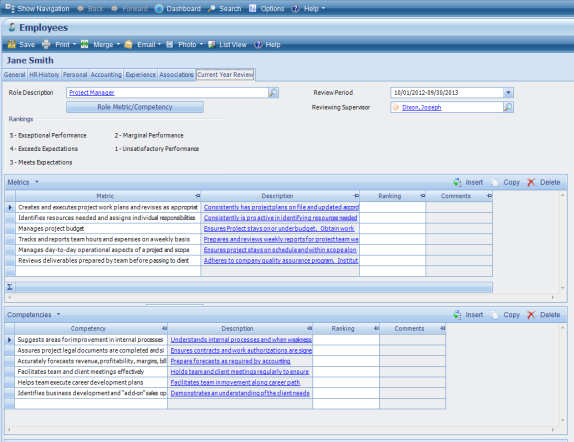
You can create a user defined info center to house your employee job descriptions.  These job descriptions can contain the measurable metrics for the job along with overall core competencies.

You then create a “review form” using user defined fields in the employee info center.   A stored procedure will allow you to pull the employee metrics and competencies into the employee review tab.

After the review is complete, results can be stored in Vision and reviewed later. 

Stored procedures can update a tracking grid for the employee so that historical review scores can be seen at a glance.  You can also use grids to provide places for managers to track employee’s progress throughout the year.

User defined fields, grids, workflows & stored procedures - Is all that really necessary?  Not really.  All this can continue to be managed in various worksheets, word documents and calendars. 

The system above simply allows all of the disparate parts of an employee review/compensation/current and long term history to be maintained in one place.  Also, the beauty of using Vision and User Defined elements is the ability to customize your HR procedures to your company needs.  I mean it IS by definition “User Defined”.

 Deltek Vision Custom Info Center for HR


So what are some tips for an effective HR process?

Whether you decide to automate your HR, or keep up the use of spreadsheets,  there are some things you can do to make your HR processes more effective:

  • Create well defined job descriptions and make them available to employees.
  • Within the job descriptions, define the metrics by which employees will be measured.  Ensure the metrics are specific. For example, the Project Managers will ensure work authorizations for every additional service provided to clients.
  • Have a well-defined review policy.
  • Separate the review schedule from the schedule for raises.  Raises are given, not only on performance, but on budgetary restrictions.  This removes one level of angst from the reviews.
  • Provide managers a place to keep track of employee successes and failures.  Allow employees to update their successes and failures also.  This allows the employees to be more active participants in the process.

Has your firm utilized the Custom Info Center? If so, in what ways? Leave us a comment.  Not on Deltek Vision 7.0 yet? See how our firm can help you transition to 7.0.


11 P’s for Peak Performance of a 'Perfect Employee' (Clone)

Posted by Ryan Felkel on Jan 1, 1970 12:00:00 AM

PERFECTIONOur modern day culture is often obsessed with perfection. Magazine covers are graced by photoshopped professional models and our TV screens are filled with successful eclectics whose wealth is their biggest problem.

Fortunately, perfection is not an attainable goal; the real goal is the path we follow as we strive for peak performance which is the essence of a 'perfect employee'.

It was Vince Lombardi that said, “Perfection is not attainable, but if we chase perfection we can catch excellence.” Considering that the NFL Super Bowl trophy is named after Vince Lombardi, you could say he knew a thing or two about peak performance…

So, what qualities help us along this path to being the ‘perfect employee’? 

What are the 11 P's of Peak Performance?

If obtaining peak performance is our professional goal, then, what exactly are the attributes that we need to be the 'perfect employee'?  Following is the list of benchmark qualities you should strive for on your path:

1. Proficient. Sure, you can’t have all the answers but you know how to dive in or connect with the right people to figure them out. You come to the table with suggestions - not more problems. You are constantly looking at how to improve the process.

2. Proud. You are proud of your work because your efforts are always well thought out, tested and reviewed. You don't rely on others to finish your assignments but ask others to quality check your work to make sure it is always correct.

3. Persistent. We all know to learn from mistakes, but the 'perfect employee' personifies this concept. You admit when you are wrong sooner than later. If you don't know how to do something, you find out how … with no excuses.

4. Passionate. You LOVE what you do and radiate emotion when you talk about your work!  You learn on your own, offer improvements, and share with others what you know.

5. Productive. Your willingness to push up your sleeves and work overtime while not jeopardizing other commitments is renowned. While we all have parts of our jobs that are not favorable, 'perfect employees' realize the goal of those less desirable tasks and get them done.

6. Positive. You exemplify “Can Do!” by accepting that you can always improve, you see challenges as opportunities, and you think about how things can be done instead of complaining about what you can't change (including the past).

7. Professional. You understand that while comradery is important with co-workers and clients, there is a fine line between “fun” and unprofessional “fooling around.” You make sure your work is top notch and your comments will not ever be construed as childish or offensive.

8. Able to keep Promises. You are always thinking about priorities and when the job will be completed in order to deliver in order to keep your promise. You communicate when a conflict arises but still look to deliver on time. You are faithful about deadlines and rarely provide excuses.

9. Punctual. You understand the value of time, yours as well as others. People think “punctual” is your middle name.

10. Able to Promote … others and yourself. You promote great deeds and great work regardless of who completed it. You are always thinking and talking about ways to make the workplace a better environment for your colleagues and services better for clients.

11. Purposeful. Each day has a purpose. You take each day and every action seriously; constantly thinking about what needs to be accomplished and how to generate purposeful results.

HOW to be “perfect” (or close)?

Providing professional services, by nature, means that we are tasked to serve our clients. We often measure billings, schedule delivery and quality of deliverables, yet fail to objectively measure the real goal - driving client delight. Strive to be the 'perfect employee' to your clients by evaluating how to obtain your peak performance and implementing continuous improvement with feedback!


Latest Posts