
Full Sail Partners Blog | Marketing (3)

Posts about Marketing (3):

Preview: Email Marketing Trends for Professional Services Firms Survey Results

Posted by Lindsay Diven on Jun 23, 2021 12:00:00 AM

In May 2021, Full Sail Partners conducted its first-ever email marketing trends survey. We wanted to gain insight as to how many firms have fully embraced email marketing as a proactive marketing strategy. And, if the effects of the worldwide pandemic, when many face-to-face meetings and conferences have been canceled, adjusted firms’ email marketing strategy and results.

Email Marketing

General B2B Statistics

Before the results from the Full Sail Partners’ survey are previewed, let’s take a look at some other statistics focused on email marketing and business to business (B2B) marketing strategies.

  • Billions of emails are sent every day. 306 billion to be exact. And, according to The Radicatti Group, that number is expected to reach 361 billion by the end of 2024.
  • Email helps you reach your clients as fast as possible. With the popularity of social media, you might think it has overtaken email as the fastest way to reach new and current clients. But the truth is that 21% of opened emails are opened within the very first hour of delivery.
  • In the annual research conducted by Content Marketing Institute in 2020:
    • 85% of B2B organizations use email marketing software to assist with content marketing
    • 81% of B2B organizations use email newsletters as part of their marketing strategy
    • 87% of B2B organizations use email to distribute their content
    • 90% of B2B organizations used email engagement as the top metric to measure content performance
  • That same research also found that email is the most reliable channel for nurturing leads to sales throughout the funnel.

Email Marketing Trends Survey Results Preview

So how do the responses from our email marketing trends survey compare to some of the national trends? Full Sail Partners invited our clients, prospects, and partners to complete the survey. The invitation was sent via email and shared on our social media channels.

Survey Demographics

The survey responses were from firms that provided mostly either engineering (41%) or construction (28%) services. Half of the responses were from firms that had either 1-50 (36%) or 51-100 (25%) employees. The other half of the responses broke down into the following: 101-500 (29%), 501-1000 (2%), and 1001+ (8%) employees.

Full Sail Partners is a Premier Partner for Deltek Vision and Vantagepoint. So, one of the questions asked if the firms responding were users of either software. Of the responses, 40% are either a Deltek Vision or Vantagepoint user, 58% were not users, and 2% said other. The one “other” response indicated that they are currently using another CRM software system.

Overall Firm Marketing Strategies

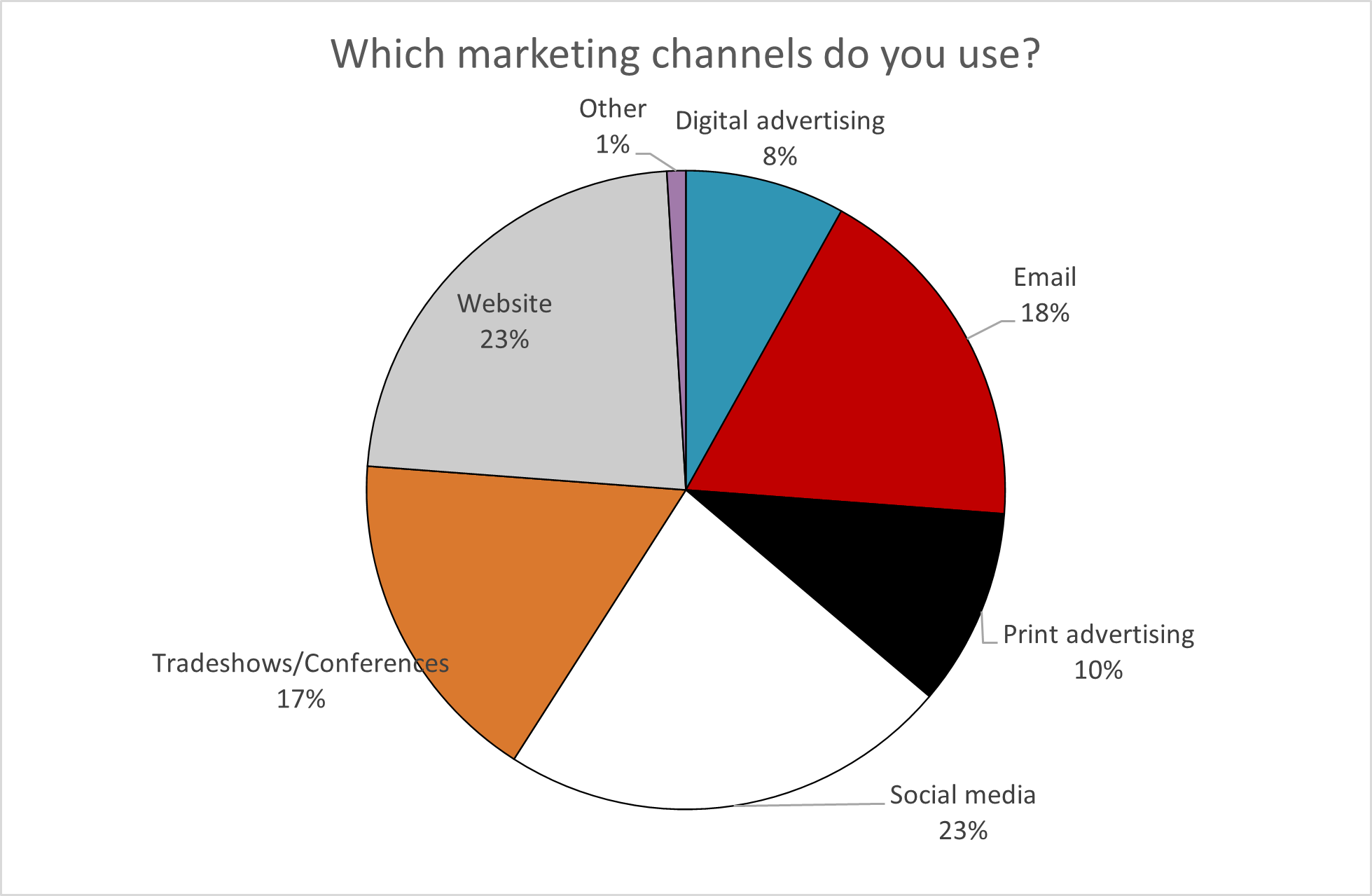
Before we asked about email marketing strategies, we asked respondents what marketing channels their firm currently uses. They could respond with multiple answers. The top three marketing channels included website, social media, and email. This seems to be consistent to the other independent research noted above.
Email Survey Image 1

Today’s Email Marketing Strategy

The survey also wanted to gauge how professional services firms are using email marketing today. We asked questions including goal/purpose for email marketing, frequency, type of email campaigns, and how the firms track success of their email marketing efforts. These were asked in a combination of quantitative and qualitative questions.

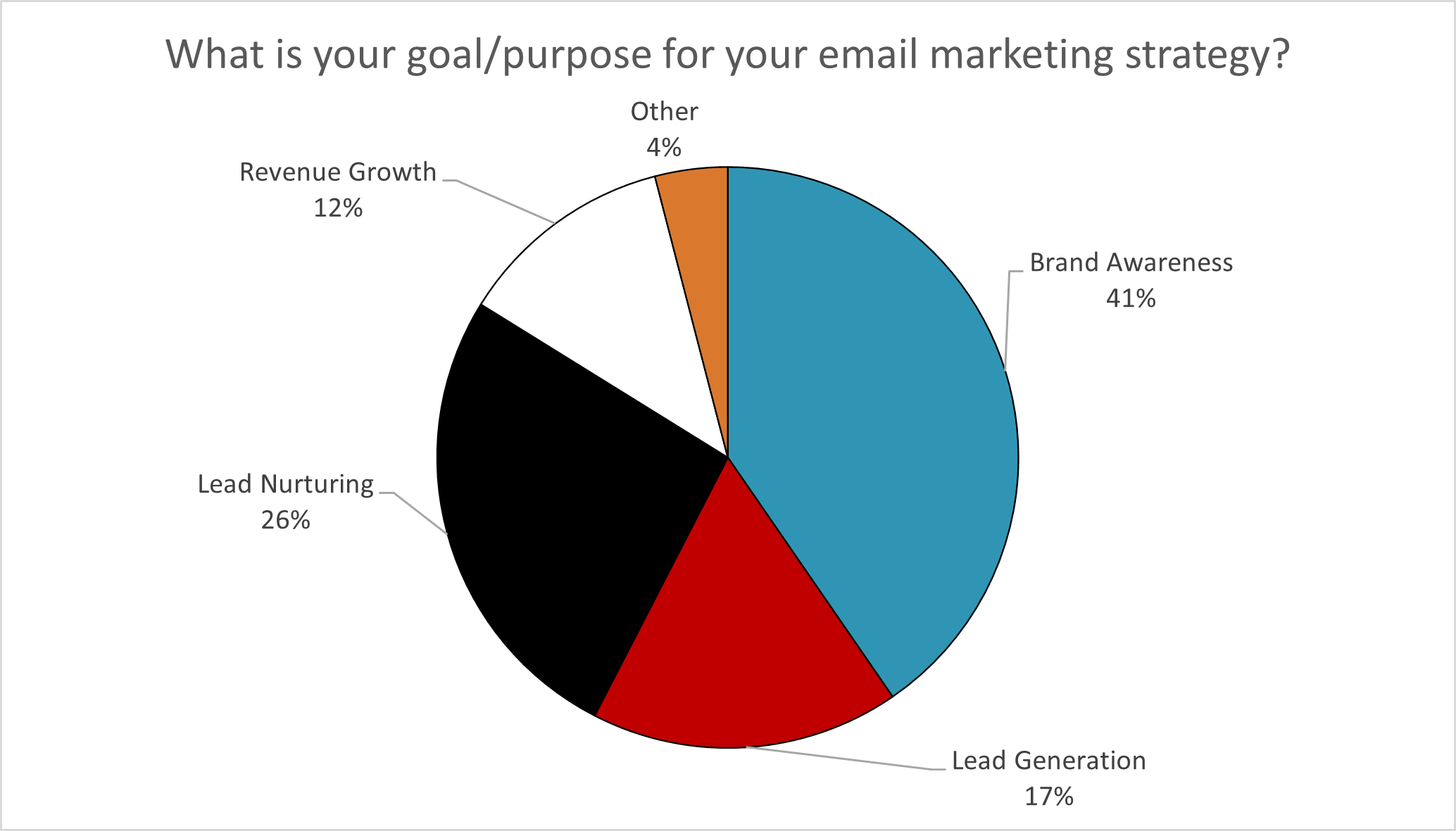
The biggest goal/purpose for email marketing is for brand awareness (41%) with lead nurturing well behind at 26% of the responses.
Email Survey Image 2

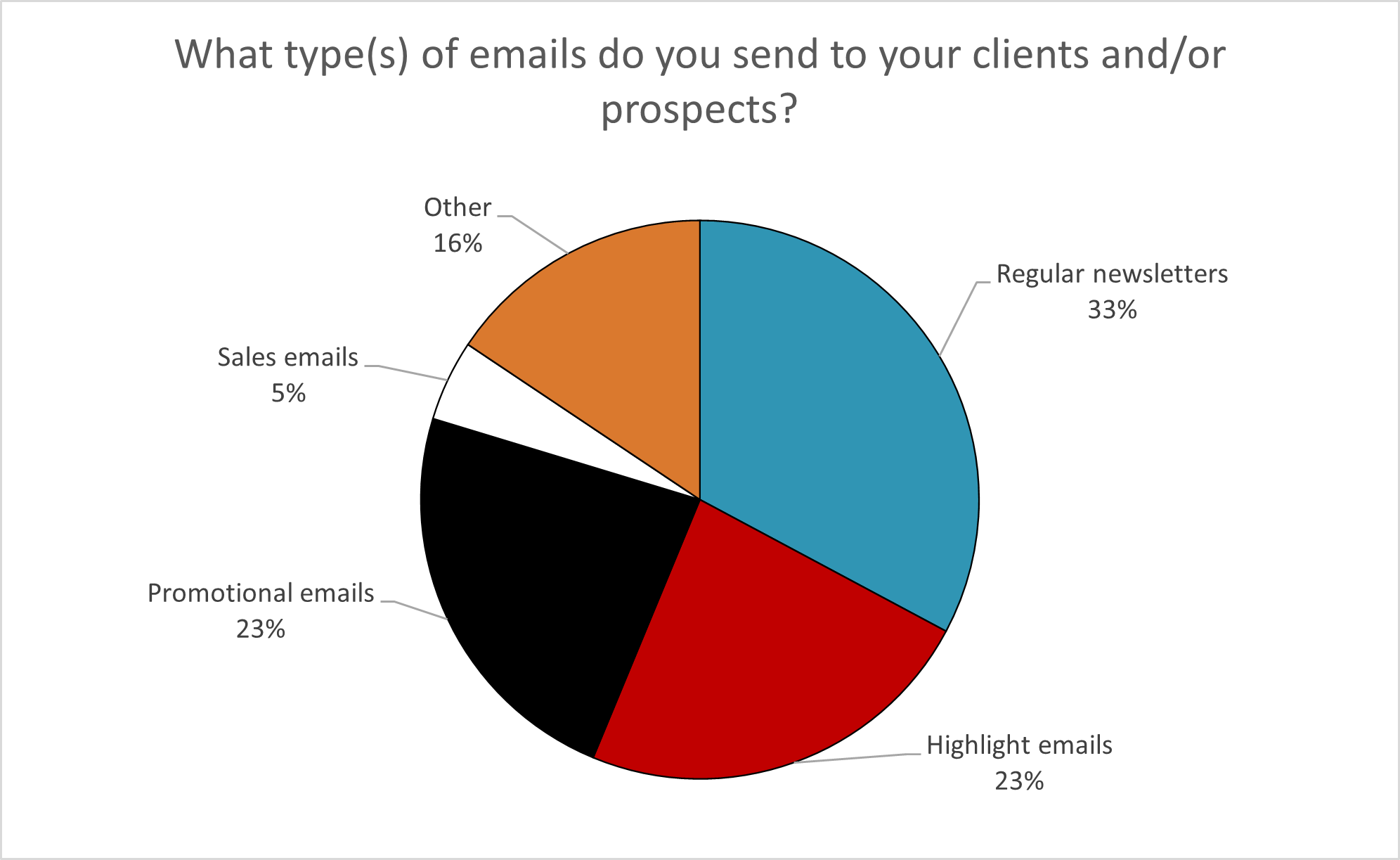
The main types of email marketing campaigns sent by the respondents included regular newsletters (33%), highlight emails (23%), and promotional emails (23%).

When asked for a brief overview of the firm’s email marketing strategy, objective responses ranged from simple holiday greetings to organized targeted campaigns. Some of the consistent qualitative response themes include:

  • Holiday greetings
  • Announcements such as new hire, employee promotions, new office, or office move
  • Sharing content produced by the firm like blog articles
  • Teaming and bid opportunity alerts to contractor and subcontractor lists
  • Event invitations around either webinars or attending conferences/tradeshows
Email Survey Image 3

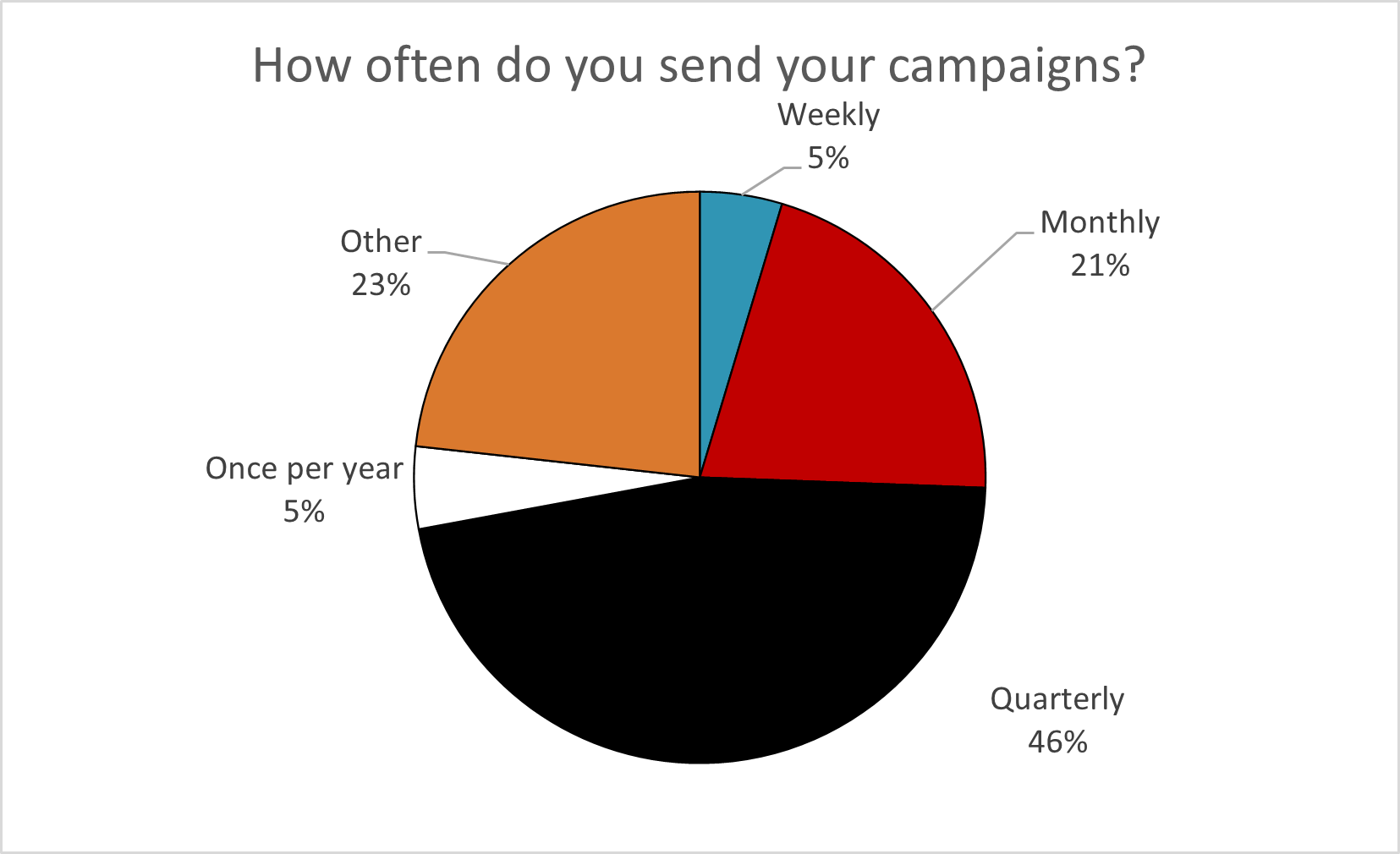
When asked how frequently email campaigns are sent, nearly half of respondents send their email campaigns quarterly (46%) with another 21% sending monthly. Some of the other responses included bi-weekly sends as well as sending depending on specific promotions.
Email Survey Image 4

Email Marketing Changes Due to Pandemic

Another reason for conducting this survey was to gauge how email marketing strategies and engagement have changed, if at all, during the pandemic. Since the beginning of the pandemic, many face-to-face meetings and conferences have been canceled or transformed into virtual events. Staying in front of clients and prospects is critical for maintaining relationships for professional services firms. And, email marketing may be one way the pandemic has affected this.

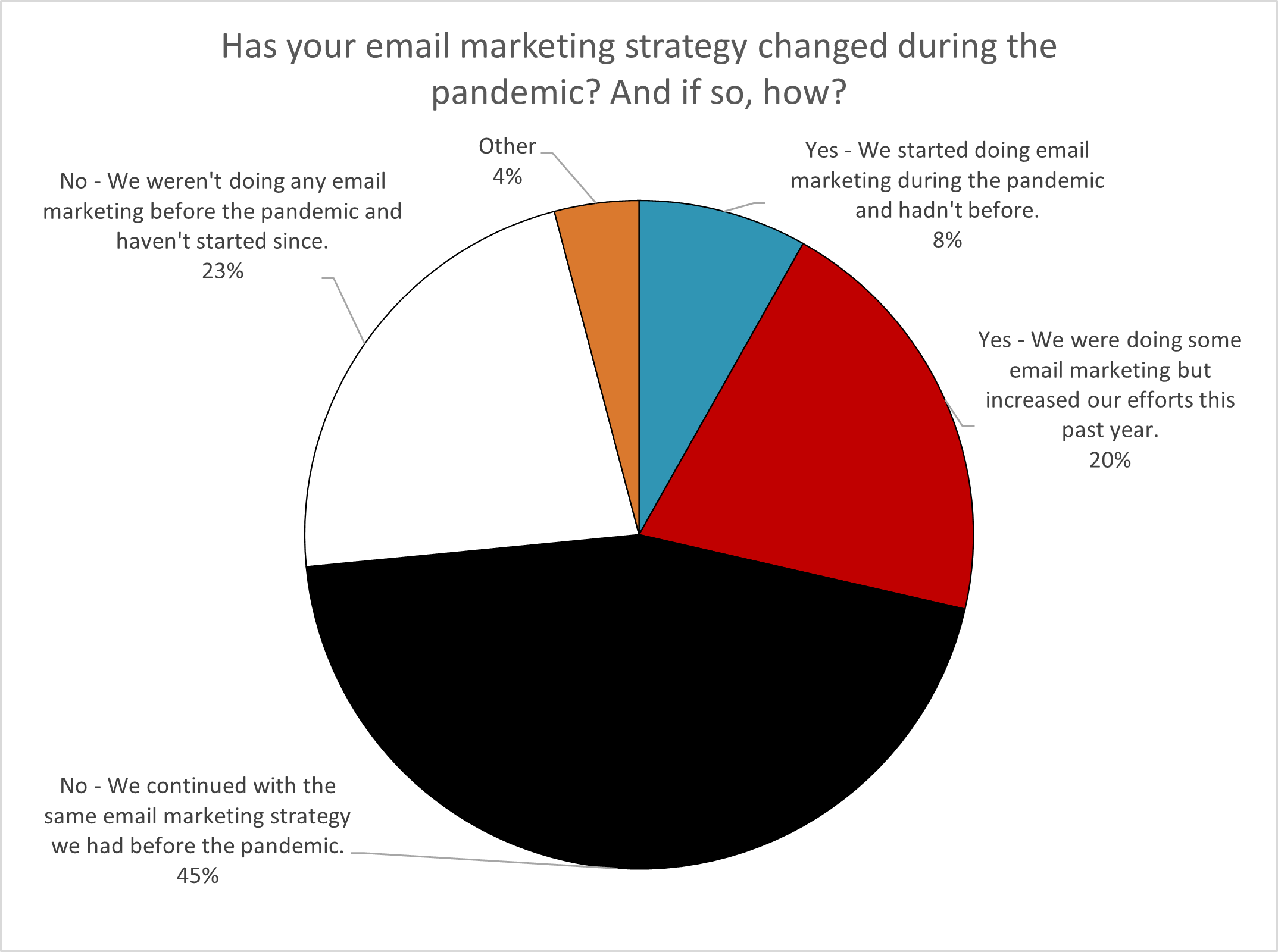
First, we wanted to know if the firms’ email marketing strategy changed during the pandemic. Nearly half of the responses said their email marketing strategy DID NOT change (45%) while 20% indicated that they did increase the amount of email marketing efforts during the pandemic. Interesting is that 23% of the responses were not doing any email marketing before the pandemic and still haven’t started.
Email Survey Image 5

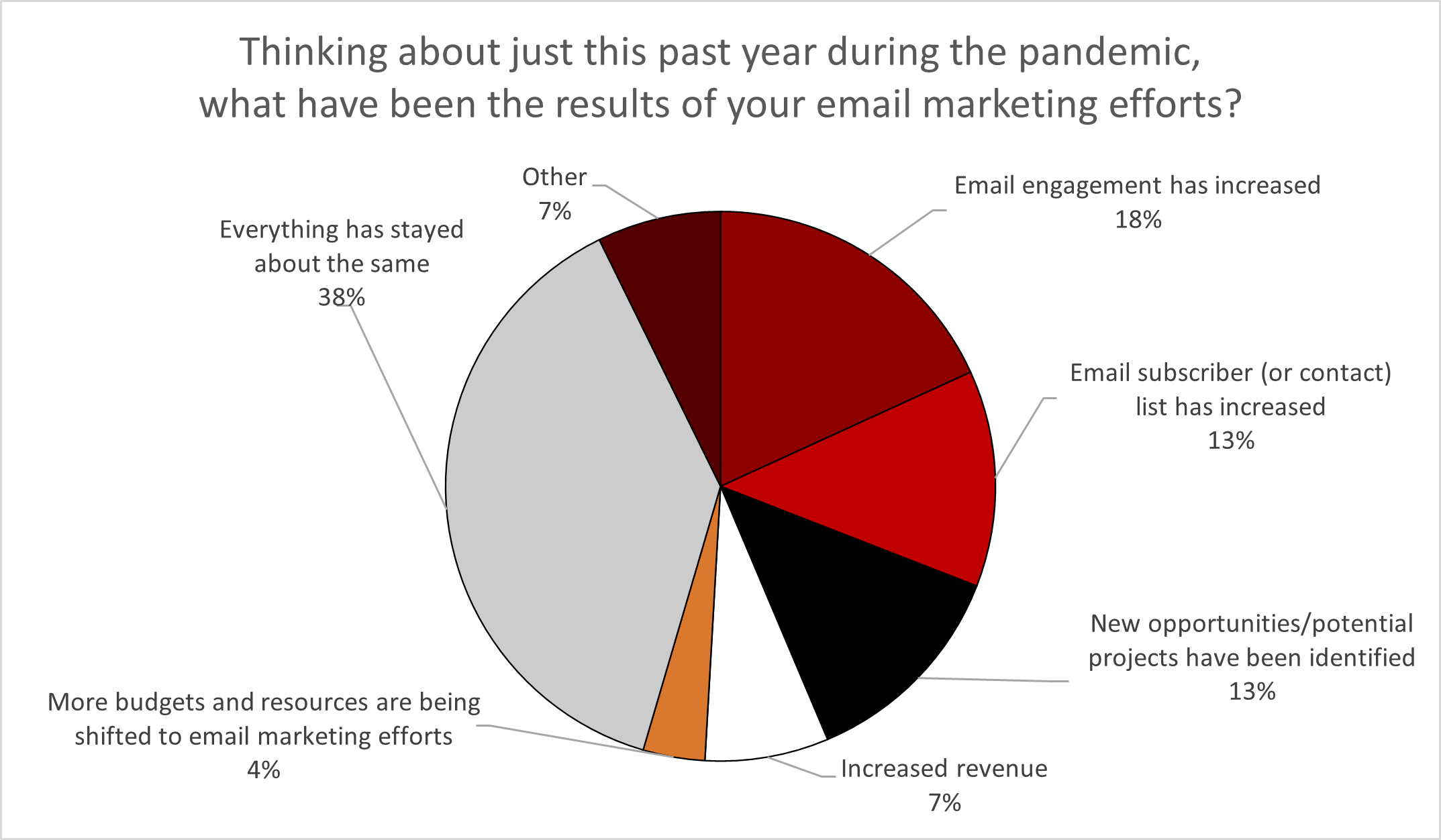
Next, we wanted to gauge the results of the firms’ email marketing efforts during this past year, regardless of any changes to their email marketing strategy. According to the responses of this survey, the majority said that everything has stayed about the same (38%). However, 18% did say that their email engagement has increased.
Email Survey Image 6

What’s Next

This is just a preview of the email marketing trends for professional services firms’ survey results. More results and recommendations will be shared on the June 30, 2021 webinar. During that webinar, Full Sail Partners along with a very special guest will be talking about:

  • Why email marketing is a must-have for professional services firms,
  • What’s working right now for B2B firms,
  • How to get started in email marketing,
  • Resources available from Full Sail Partners and SubjectLine.com

To register for this free webinar, click the image below.

Common Blunders Made by Marketing Teams

Posted by Full Sail Partners on Apr 28, 2021 12:00:00 AM

What were they thinking? #SendNoods was a social media marketing campaign launched by Kraft foods in October 2020 to coincide with National Noodle Day to promote its famous macaroni and cheese. Back in 1985, Coca-Cola released a sweeter new formula known as “New Coke” to win back younger customers that switched to Pepsi only to be mocked for sacrificing its own identity. Then in 2010, Gap decided to redesign its beloved and established logo. After what must have been countless hours in meetings and who knows how much money, Gap released its new WordArt inspired logo. It caused a massive backlash from loyal customers and is known as one of the largest rebranding blunders in history. 


Whether your company is a big national brand or a small to medium sized business, everyone is prone to having a mishap when executing a marketing campaign. 


Perplexed by a blunder

Architecture and engineering firms are no different. Have you heard of the same firm submitting on the same proposal? Or, someone from your firm meeting with the same client the week before and you had no clue? 


However, it seems like many of these marketing snafus were avoidable if more due diligence was practiced. Reflecting upon the aforementioned marketing blunders, here are some common areas marketing teams overlook when creating an effective marketing campaign.  


Not Really Knowing Your Clients 


Thinking you know what your clients like and want can quickly upend any marketing effort before it begins. Because believe it or not, your assumptions are likely wrong. However, you can gain insight into your clients by practicing some due diligence by asking about feedback on previous marketing efforts and having conversations with key decision makers about their experience with your firm. What you thought your firm excelled at might actually be one of its biggest downfalls and this is something you surely do not want to promote as it will lead to future failures.  


At A/E firms it’s common to make assumptions about what’s really important to a client for a particular project. Your marketing and business development teams may craft an entire message campaign, including the proposal and presentation, based on those assumptions. What happens if you made the wrong assumption? Getting that feedback directly from the client helps to minimize the risk of making assumptions. 


Unclear Messaging 


Convincing a consumer to make a purchase is already difficult enough. Adding confusion with misleading or hard to comprehend information is for certain a marketing campaign killer. When creating your core messaging, you need to identify what problem you are solving with your product and how this benefits the end user. Additionally, this needs to be tested and optimized to resonate with your audience in a clear and concise fashion.  


Common in our industry is messaging that includes industry jargon and overusing acronyms. To ensure a more effective message, make sure the content can be understood by even those with no technical background. 


Using Bad (or No) Data 


Today, great marketing efforts are formulated around data. There is so much data out there and your firm probably collects and stores endless amounts of information about your clients, contacts, and projects. However, if your data is poorly organized and maintained, it’s likely old and misleading. In other words, bad data is just as bad if not worse than having no data.  


Having a robust CRM system, like Deltek Vantagepoint, will allow you to organize your data, and be able to analyze and find trends you can use to strengthen your marketing efforts. A CRM system also allows you to track what potential projects your firm is pursuing and contact interactions. This helps avoid the embarrassment of multiple people from your firm bidding on the same project! 


Testing 123... 


Great marketing campaigns are the result of trial and error. Even the brightest of marketing minds will agree that not all great ideas are effective. However, there are things that can be learned by testing that can be incorporated into a strong and impactful marketing campaign. Furthermore, most marketers use a A/B testing which uses two forms of something to learn which is more effective. This testing allows marketers to ensure their messaging resonates with their audience and does not offend anyone. 


Failing to Follow RFP Instructions  


In the AEC industry, many proposals are crafted with a focus on team qualifications rather than fee. Strong proposals can take countless hours and may never be “perfect.” The hope is that your client will read your proposal and select your team for the work. However, what if it never makes it to the review team?  


When a request for proposals is advertised, there are often fine-print details regarding the deliverable, such as font size, spacing, and page limitations. Even one page too many could disqualify your team from the review process. Before you put countless hours into that large, or small, proposal, be sure you read, reread, and understand the submittal details before getting started.   


Learning from Past Experiences 


Doing the same thing over and over again is considered insanity to many people. Well, if anything, it will probably drive you insane to continue to see the same poor results repeatedly. During the execution of a marketing campaign, it’s important to keep track of what is and isn’t working, and noting lessons learned that can be applied to future marketing efforts.   


Noting the results and best practices in a marketing campaign record is easy with Vantagepoint. This way your entire marketing and business development team can access and learn from the past experiences.  


Are You Willing to Share?  


Have you experienced a marketing blunder at your firm? Or, seen one in the industry? Share your experience in the comments below so we can learn from each other.

Finding Success in Marketing Efforts with Deltek Vantagepoint

Posted by Ryan Felkel on Mar 3, 2021 12:00:00 AM

Marketing is a necessary function in business, and AEC firms are no exception. First off, there’s general brand awareness, and then there are the marketing campaigns that firms spend resources on to drive quality leads. Marketing efforts cover a variety of outreach methods such as conferences, sponsorships, golf tournaments, and email campaigns. Can you name the projects awarded to your firm as a result of particular marketing efforts? What campaigns would you consider a success based on the efforts and dollars spent? Let’s see how Deltek Vantagepoint marketing campaigns can help you with your marketing efforts.

Marketing Campaign ROI

Organize Marketing Efforts

For each marketing effort, information can be collected and organized in one place inside a Vantagepoint marketing campaign record. The marketing campaign name, its description, associated promotional project used for budget trackingmarketing campaign manager, and marketing manager are all fields that may be useful to planning efforts.

Beyond the marketing campaign record, organizing a marketing plan in the same system as your CRM allows for efficient associations. With Deltek Vantagepoint, teams can associate resulting projects in pursuit and awarded projects to the marketing campaign that led to that effort. Therefore, you have visibility to:

Measure Costs Against Goals

A Revenue Goal can be identified as you begin the campaign. Other monetary fields are populated based on project information in your system. There are fields for Actual Revenue, which recognizes dollars from awarded projects associated back to the campaign, and Potential Revenue, which recognizes dollars from projects in pursuit. A promotional project can also be created for the marketing campaign to track time and expenses. Using the promotional project number, Actual Costs are populated on the marketing campaign. This gives a quick view of the success of the marketing campaign as it relates to resulting projects.

Build Email Lists or Tally Responses

It’s not always about the dollars. For events in which attendee information should be collected, responses can be tracked using contacts in CRM. The responses, or contact list, can be used to create mailing lists or distribute follow up information.

Stay on Target with Activities

With each marketing campaign comes tasks and to-do lists. Those activities can be managed and tracked in the marketing campaign record. This brings all activities together, whether it’s registering for an event, completing sponsorship information, creating marketing materials, or making reservations. Deltek Vantagepoint allows Activities to be assigned to other employees so the appropriate team members will see their Activities as well.

Measure the Effectiveness

Tying actual revenue to a marketing campaign gives firms the opportunity to measure the effectiveness of various marketing efforts. By doing so, firms can determine which efforts to repeat and which ones to modify or discontinue. One example is conferences. Many dollars can be spent on industry conferences, and we simply cannot attend all. Using marketing campaigns, teams can see the return on effort. These metrics can help prioritize event involvement for future years and be an integral part of strategic marketing and business development plans.

Be Smarter with Vantagepoint

As Deltek users, marketers can take advantage of the marketing campaigns in Vantagepoint and discover which marketing efforts work the best. Based on what these marketing campaigns identify, your firm can strategically plan better. Additionally, by using marketing campaigns in Vantagepoint, the marketing department can easily translate their outreach efforts to a monetary value.

The Value of Vantagepoint for Business Development

Posted by Melanie LoBue on Dec 9, 2020 12:00:00 AM

For professional services firms, business development can be completed both with dedicated resources and/or “seller-doers.” Because our firms have touchpoints with multiple people at our client organizations, information gathering and sharing becomes a critical piece to the success of our business development. When our firms can successfully manage the numerous interactions, identify projects that add to our pipeline, and collect the right information to position our firm better than our competitors, we win more projects, improve client satisfaction, and increase loyalty.

CRM on the go

The abilities of Deltek Vantagepoint CRM can provide business developers, project managers, marketing staff, and executives with real-time information on all of the client touchpoints, project pipelines, marketing and service efforts. This ensures all firm goals are being met and provides for the shared resource of firmwide data. Deltek Vantagepoint’s CRM strengthens your business development in the following ways:

Record Interactions On-the-Fly

The power of a CRM comes when everyone records conversations or information related to interactions with clients and contacts. Vantagepoint CRM provides users several ways to record these Activities and Touchpoints.

  1. Web Brower – You can access Vantagepoint to record a contact interaction from your computer, laptop, tablet or phone using any web browser.
  2. Hey Deltek! – Watch out Alexa, because there’s a new voice command in town! Deltek has developed its very own voice automated service. You can use this now in the web browser and coming soon to the CRM mobile app. Simply record an activity by speaking to Hey Deltek!
  3. Mobile CRM App – The Vantagepoint CRM app is available for both iOS and Android devices. Access all of your Firms, Contacts, Activities, and Projects inside the app. You can use your phone’s native talk to text feature to automatically log activities and meeting notes.
  4. Outlook Connect – Coming in early 2021 is the new Vantagepoint Outlook Connect. This integration includes a contextual email pane to view contact details, search Vantagepoint and create new records from your email. You will also be able to sync your contacts and calendar directly from Outlook to Vantagepoint. Connect also includes a scheduling assistant to help you find the perfect meeting time without all of the back and forth emails.

Vantagepoint makes it easier than ever for busy business development and technical professionals to log the critical information needed to build strong relationships with your clients.

Easily Uncover Client and Contact Relationships

Vantagepoint associates its Hub and Record information throughout the database. There are Hubs for Firms, Contacts, and Projects that are all interconnected. This means that you can associate any firm that is involved in a project – from teaming partners to program managers and general contractors. And, each time a firm is associated to a project, that project then appears on that firm’s record in the Firm Hub. This same association works for contacts and employees as well. It also gives your business development team the insight into the relationships of your firm with your clients, contacts, employees, and projects – all in one location!

Support the Entire Business Development and Project Lifecycle

The business development process often begins with targeting clients, then getting to know contacts at those client organizations. Through this effort, projects are identified. At this point, your team begins preparing for the pursuit of that project through teaming, proposals, and/or presentations. The goal is to win that project and perform so well that you are awarded with repeat work.

Deltek Vantagepoint is designed specifically to support the entire project lifecycle beginning with the earliest business development stages. When you are targeting clients, you will be utilizing the Firms, Contacts, and Marketing Campaigns Hubs. In those you can begin to gather information about contacts and activities.

Then as a project is identified, it’s logged into the Projects Hub in a pursuit stage. You will continue to use this same record through the pursuit and proposal stages. When this project record is created, a plan is also created so your project manager can begin to allocate resources and develop estimates.

When you are awarded the project, you will continue to use that same project record and update the stage and budget. All of the intelligence gathered in the pursuit of the project remains in the same project record you will continue to use to perform the project. This gives your business development and marketing staff the complete picture and history for that entire project.

Bring Everything and Everyone Together

Not only does the Vantagepoint solution encourage a collaborative environment, but it brings all your firm’s business development processes into one unified platform. This enables business developers to do their jobs better. Be sure to check out our entire Deltek Vantagepoint mini-series to see how the product can help your employees and firm.

Focus on the Future with Sales Forecasting

Posted by Ryan Felkel on Oct 21, 2020 12:00:00 AM

Forecasting

Are you simply betting that your future will be bright? Or are you using your data to plan for tomorrow? As my data-loving, gal-pal, Stacey Ho, CPSM, puts it: “Forecasting is a little bit of science, and a little bit of crystal ball.” In this blog, I’ll share what forecasting can tell you, and how to get started today using anything from Excel to a major ERP finance software system. Your firm, no matter what size, can take small steps to plan for a bright future.

What is forecasting?

Forecasting is a way to use your pipeline to demonstrate potential future sales. It helps your firm make smarter decisions or know when to course correct. Forecasting can tell you if you need to identify more work, improve your hit hate, recognize “must-win” opportunities, or even when to hire more staff.

Get Started with Forecasting

To get started with forecasting, you will need to set yourself up for success. This is done through aligning the right people, process, data, and technology:

PeopleYou will first want to have a good understanding of who is responsible for data collection, maintenance, input, etc. and who will be gathering and reporting on the data. Consider who has both the knowledge and the time to put the forecast together. Lastly, make sure you have buy-in from your firm leadership.

ProcessOnce you have the people identified, it is time to start working on the process. This includes setting sales goals for your firm, so you have them to compare the forecast to and which can be developed using a top-down or bottom-up approach. You will also want to determine the frequency in which you report the forecast and how often you will update it. The frequency can be weekly, monthly or quarterly. I recommend beginning with quarterly and eventually increasing to monthly for firms just starting to forecast, Additionally, you will need to decide how far out into the future your forecast goes. The two most common forecasts are the current calendar or fiscal year and a rolling 12-month report.

DataTo build your forecast you need data. This includes dates, dollars, and status. I will go into more detail regarding the minimum data you need to build a forecast in just a bit.

TechnologyOnce you have identified people, process, and data, you will have a pretty good idea of what type of technology is needed. CRM systems, like Deltek Vision and Vantagepoint, are developed specifically to make reporting forecasts seamless and automated. Once the information is entered into the system, you can build reports or dashboards easily, segment the data by office or market, and schedule the reports to be delivered automatically.

What are the Minimum Pieces of Information for Effective Forecasting?

Since a forecast is predicting your sales into the future, there are some minimum pieces of information you need to record to develop a forecast report. Those pieces of information are:

  • Opportunity or Potential Project Name – The report is a cumulation of all your future potential projects. So, ideally every opportunity or potential project would be entered into your CRM system.
  • Anticipated Fee – In order to forecast expected sales, you will need at least an estimate of anticipated fee for each opportunity.
  • Date – This can be a date for when you expect the contract, when the proposal is due, or when you expect to begin work on the project. Again, because the forecast is based on a date range, you need to input some date to base the report on. I would recommend capturing a contract or expected start date. No matter what type of date field you choose, be sure to enter and update that data field consistently among all your opportunities.

There are some other data fields that will make your forecast reports even better:

  • Probability – Chances are you are not going to win every opportunity you pursue, so I like to apply a probability to each opportunity. This probability is the likelihood your firm will win the opportunity.
  • Weighted Fee – Weighted fee is what you get when you multiply the estimated fee by the probability. When you calculate this, and use the weighted fee in your forecast, it is more conservative than just using the estimated fee. Sometimes, this gives you a better idea of what your sales will be.
  • Office or Market Segments – I like to develop my forecast reports around the same segments as the other financial reports my firm does. So, if your firm reports P&L around offices, divisions, or studios, then you can set up your forecast reports the same.

Maintaining the Forecast

Now that you have set up your initial forecast report, make sure you maintain it on whatever frequency you decided above. Maintenance encompasses:

  • Data Auditing – This includes routine data updates such as updating the contract or estimated start dates, updating estimated fees, and probabilities.
  • Actualizing – Data actualizing happens when you turn the opportunity into a sale. This involves marking opportunities as wins or losses, updating the estimated fee to the actual final negotiated contract amount, and changing wins to 100% probability if you are using a weighted fee.

How to Use Your Forecasts

While forecasting can tell your firm if it will meet its goals, there are some other uses of sales forecasting. In my experience, forecasts have been used to:

  • Identify your top 10 or “must-win” projects that will allow you to meet or beat your goals
  • Know where your future work is coming from, specifically what clients or markets
  • Understand how increasing your probability (chances of winning) can affect your entire forecast
  • Develop estimated plans of efforts for all your potential projects and combine those with your contracted backlog effort. You can assign resources (named or generic) and see how utilized your teams are.

Get a Clear Picture of the Future

Stop guessing what the future will look like for your firm by developing a sales forecast. With some minimum information that is tracked in a CRM like Deltek Vision or Vantagepoint, you can easily build a forecast report that will give your firm a clear picture of the future. Ready to get started?

Marketing Plays Well with Others

Posted by Ryan Felkel on Oct 7, 2020 12:00:00 AM

Marketing can integrate

Those in marketing for professional services have a level of knowledge they had to build, likely for a field they did not pursue, and use that knowledge of services to build a brand. In doing so, marketers paint a picture of the firm that they promote. Usually marketing professionals find themselves helping many departments throughout the firm. Not only is collateral client-facing, but marketers often have a responsibility to market to the firm internally. Over the years, I have found many marketers to be integrators in a firm so let’s check out how marketing plays well with others:

Know the Brand

The brand is more than the firm’s identity and reputation. According to an SMPS article, “…strong branding is viewed through three lenses: overall firm branding, personal branding, and employer branding. All three are crucial to a strong brand foundation—and all three are connected in important ways that contribute directly to your firm’s success.”

Marketing has the fun responsibility of viewing the firm with a broader lens and shining the best light on firm strengths. As marketers believe in the services the firm can provide, they can use various channels to get the right message to the right audience. Therefore, knowing internal teams is just as integral as knowing clients.

A lot can change in a firm, whether it be people, services, or goals, and marketers need to be in the know of company happenings to properly communicate the appropriate message. After all, the only constant is change. Marketers find themselves having to be very flexible with messaging as well as keeping up with the dynamic structure of the firm.

Master the Service Lineup

Professional services firms typically have printed material, a digital footprint, and many proposals created for specific clients. Marketers must have knowledge of the firm’s services and a strong bond with technical staff to collaborate and create content. While a majority of technical staff has vast knowledge of what services its group offers, it’s important to educate everyone on all of the firm’s offerings, even if at a very high level. This can lead to more aware project managers as well as cross selling. All marketers should take advantage of education opportunities.

Knowing that many marketers have a great understanding of the firm’s services, they can become integrators within the firm, matching up employees that can benefit from bigger discussions. Collaborations do not stop with technical departments.

Recruit Like a Pro

Great minds come together for the greater good when human resources and marketing collaborate. Recruiting can be quite time-consuming; however, attracting top talent can tighten the candidate funnel. Pulling together human resources’ knowledge, the firm’s brand, and creatively crafting the right message can yield strong new recruits for consideration.

To that note, a firm’s digital footprint can play a huge role in a candidate’s interest. Using social media as a recruiting strategy can have phenomenal results. According to harver.com, 92% of recruiters use social media in their efforts. It is a way to engage passive candidates and employees, make connections, and share quality content.

Naturally, recruits or potential candidates google the firm and can be quick to judge on initial findings. It is imperative that a firm’s brand stand out on social media, such as LinkedIn, and on the firm’s website and network.

Set Standards from the Start

After an offer is accepted, it is also beneficial to include marketing in onboarding efforts to educate the new hire on the following, at a minimum:

  • Branding guidelines (colors, logos, firm names, and more)
  • Branded swag
  • Proposal resume building
  • Email signature
  • Collateral that covers all firm services

As marketers share branding guidelines and set brand expectations from the start, new hires are immediately in the know when it comes to firm resources that are client-facing.

Own that Hat Closet

Marketers may notice that they wear many hats as time passes at a professional services firm. Each hat will give different insight into the firm and potentially challenge the “norm.” There are conversations with all roles of the firm, from C-suite to staff level. All of these collaborations help build the firm’s message that is distributed through email campaigns, mailers, proposals, onboarding, and both digital and social content. With each hat that is worn, many areas are weaved together for a more cohesive firm and a stronger brand.  

The 41st Annual A&E Deltek Clarity Report: Business Development Trends

Posted by Hubspot System on Sep 9, 2020 12:00:00 AM

Deltek Clarity 41st

“The only constant in life is change.” In the business development world, truer words have never been spoken. The 41st Annual A&E Deltek Clarity Report was conducted at the beginning of 2020 and shows how companies performed during the 2019 fiscal year. Since then, much has changed in the world. The United States is officially in a recession - defined as two consecutive quarters of negative economic growth. Recessions in the A&E industry have proven to be a high-pressure exercise in change management. So, what can we learn from the Clarity report and also from previous recessions in the A&E industry?

Business Development Trend Challenges

The Clarity report showed that challenges from a few years ago remain the same. Time is always a challenge, especially finding time to nurture client relationships. Competition for work continues to get tighter and many firms still struggle to identify new prospects. The A&E industry is overall accustomed to in-person interactions. That dynamic has changed drastically in 2020, requiring firms to identify new ways to develop connections and build relationships.

Getting into Position

Firms that participated in the study were asked to share in which markets they expect their firm’s position to grow, tread, or decline. Over the next 18 months, the transportation market takes the lead at 67% of firms expecting to grow there. Next up is the water/wastewater/stormwater market, followed by the health care market. Firms can remain flexible and be ready for a market shift given the election year and the global pandemic. Market research is always important, and now proves this notion even more.

Tracking the Hit Rate

The Clarity report shows that there’s room for improvement in how firms can use hit rate as a valuable metric. The six-year trend has varied from a 40% - 50% hit rate. Recently, more small and medium-sized firms have formalized a go/no go process, but consistency may be the biggest challenge. Formalizing the system can streamline processes, dedicate resources effectively, and drive the hit rate up. Firms should push business development teams to focus on quality of pursuits, rather than quantity. This is even more important when resources are limited to avoid burnout.

Bringing in the Work

As seen in the 41st Annual Deltek Clarity report, most roles within a firm have some level of responsibility for business development. Executive teams take the lead on the responsibility along with business development staff if that is an option. Marketing groups seem to lead some efforts and the seller/doer model is common in A&E firms. Regardless of who is bringing in the business, only 41% of firms have a formal business development process. Streamlined processes could ensure teams are working efficiently and communicating effectively.

As part of broader marketing efforts, the study asked about marketing techniques for the first time. The survey showed social media posts are the primary marketing technique used by 87% of firms. Traditional trade shows and exhibits are a primary technique for 65% of firms. From there, thought leadership and content marketing are of importance as this showcases the industry experts. This will be a good one to track year after year to see where the trends take us. The survey also asked about the importance of these techniques over the next five years. Social media remains at the top, followed by thought leadership. Trade shows and exhibits surprisingly bump down to the number four spot. In today’s marketing, focusing on your online presence is even more critical.

The Outlook for Business Development

Change brings opportunities. Now more than ever, business development teams should concentrate on strategic planning to narrow in on how to refocus existing business opportunities and develop new business prospects. Firms focused on being flexible and adaptable will continue to flourish in our ever-changing world.

Improve Your Email Marketing Response Rates

Posted by Melanie LoBue on Jul 3, 2019 12:00:00 AM

Over the past decade, email marketing has become a leading channel to generate brand and product awareness. Even better, unlike snail mail, marketers are able to get actual information about who opened the email and who followed the call to action. As a result, marketers can quickly determine what messaging is resonating with their target audience. Let’s take a look at some of the things you can do to increase the effectiveness of your email marketing efforts.

Email Marketing

Use a Good Sender Name

Having a good sender name is extremely important. People are less likely to open an email that comes from a “no-reply” sender name and email address. Instead, use a sender name and an email address that the recipient might recognize. For example, if you’re emailing existing clients about a new product offering, consider using the name of their account representative from your company.

Have a Strong Subject Line

Upon receiving an email, the recipient usually looks first to see who sent it and then reads the subject line. The subject line can be the determining factor as to if the email recipient will actually even open and read the email. Email subject lines should get to the point and not be too long.  Furthermore, clearly state what information you are sharing inside the email. Consider using triggers words like “sale” and “proven” to increase interest in your messaging. Lastly, always use the preheader text field that is available in all email marketing platforms. The preheader text provides a place to add a summary of the email.

Use Catchy Graphics

Graphics are an important element to an email. Maybe it can be something fun that relates to the messaging of the email or it might just be company logo. Graphics help break up the text and make the email less overwhelming to the recipient. Another type of graphic to consider is an emoji. Emojis have become very popular over the past few years and they are a great way to communicate.

Format and Layout

“The best email I have gotten is one that is a giant block of text,” said no one ever. For the messaging of your email, text should be short and broken up to make the email scannable for the recipient. Some ways to break up text are to use short paragraphs, lists and bullet points. As mentioned before, use graphics to help break up the text. Also, make sure the call to action is clear to the recipient. It needs to stand out and should clarify the next steps for the reader.

Test Different Days and Times

With a 40-hour work week, there are several days and times you can chose to deploy your email. By breaking up your target list of recipients, you can test several different days and times to send your email to determine which time is best. For instance, you might find that your targets are more likely to open emails in the evening. If this is the case and let’s say the email is going to several time zones, you may consider breaking up the target list by time zone and deploying the email to ensure all recipients receive the email in the evening of their time zone.

Segment Your Email List

One of the last things you want to do is send an email with irrelevant content to a recipient. If you’re promoting a marketing product, it is less likely that an accountant is going to find your information useful. Additionally, you do not want to be sending the same people multiple emails a week, especially with irrelevant content. This will likely result in high unsubscribe rates.

Start Improving Your Email Success Rates

Now to the most important thing…testing, testing, and more testing. A/B testing is a marketer’s best friend. A/B testing involves creating two different subjects, graphics, messaging, and format/layout to determine what resonates with your audience. Once you have created two versions, segment your target list in two and send one half one version and the other half the other version. Then sit back and start to compare the success of each email to determine what increased your email success rate.

Ways to Track Marketing Success

Posted by Jennifer Renfroe on May 29, 2019 12:00:00 AM

Digital Marketing

When you are determining what marketing techniques are going to be the best for your company, there are some important things to consider. It’s common for business owners to cast a wide net in their initial marketing plan, throwing everything they can against the wall to see what sticks. However, continuing to throw money at a marketing strategy that is not generating conversation will result in loss of revenue and time. Fortunately, there are ways that you can avoid this by tracking the success of your marketing techniques and being able to adjust the ones not yielding results.

Website Analytics

Let’s start with one of the easiest and most common methods of tracking marketing success: website analytics. Utilizing this method, you can see who is coming to your site and from what sources. This lets you know which marketing tactics are creating the most clicks and how those clicks could be converted into leads or sales. A lot of website analytic tools are easy to setup and simple to use.

Email Outreach

Email marketing is easy to track and measure. Most email marketing platforms offer a host of data that will help you gauge the efficiency of your email campaigns. Your task is to find those metrics that best suit your email marketing goals and to keep an eye on them. There are many different things that are important to look at when it comes to the success of email marketing. Deliverability, open rates, click-through rates, conversation and bounce rates. These all can give you a better idea of how your email marketing campaign is going.

Phone Tracking

Call tracking is one of the most effective ways to evaluate lead generation sources. By taking advantage of call tracking technology, you can see what marketing ventures are generating the highest number of phone calls. This gives you the opportunity to keep track of who is calling from where and gauge where your budget is best spent.

CRM Tracking

Customer Relationship Management (CRM) helps sales staff stay organized and track marketing campaign results. Using a CRM software, sales professionals create profiles for each prospect including name, company, phone number, lead source, and any other relevant information. CRM platforms not only lead the way in tracking initial marketing efforts but continue to serve in following the future of client dealings.

Save Time and Effort by Tracking Marketing Success

Tracking marketing success is quite effective when using the right techniques. You can learn what works and what doesn’t when marketing to contacts to create more business and ultimately generate more income for your firm. Using a tool like the Deltek CRM, you can easily.

Track Business Development with Informer Business Intelligence

Posted by Ryan Felkel on Feb 20, 2019 12:00:00 AM


Business Intelligence Business development is crucial to the future of any company. Therefore, efficiently tracking it should be a top priority. So why are so many firms still using outdated spreadsheets that require so much effort to review? Well, once they get their hands on the Informer business intelligence (BI) tool, executives, business developers and marketers alike will be asking themselves that very question. Let’s see how the Informer BI solution will add value to your firm.

Colorful Graphics Save Time

The days of having to spend hours reviewing the specifics of opportunities and the sales pipeline on black and white pieces of paper are over. With Informer, colorful graphics draw attention to the information you seek. Essentially, you can set up your graphical dashboard using whatever dash parts you feel are the most important and drill down into the details as needed. These dashboards refresh automatically to keep your data up to date.

Different Visual Options

With Informer BI, there are different visual options available. Based on the fields selected, Informer automatically creates different visuals and you can choose from a saved list. You can customize your chart visuals depending on what you would like to see and how you would like to see it. Chart types vary from trends to pie charts to bar graphs to scatter plots. There are even geographic heat maps that show where your core opportunities are and where your firm needs to do more business development.

Keep a Finger on the Pulse of Business Development

Business developers are concerned with the health of the sales pipeline. They, of course, want opportunities sold as fast as possible and a way to track the win rates. Another great feature of Informer BI is the option to set up alerts when opportunities are closed. When an alert comes in, you will be drawn back to your dashboard to see what has changed. Informer even allows you to set up comparison boards with side by side displays. You can track win rates from month to month, year to year or even by location.

Get Informer Now

There is no need to waste any more time with those old fashioned and dated spreadsheets. Informer BI shows you exactly what you need to know about your business development as the opportunities unfold. Even more, Informer integrates with Deltek Vantagepoint and Vision. So, what are you waiting for?


Latest Posts