Full Sail Partners Blog | Professional Services (3)

Posts about Professional Services (3):

The How-To Guide for Understanding Capacity Calculations in Deltek Vantagepoint Resource Management
Posted by Terri Agnew, CPA on Sep 28, 2023 12:00:00 AM

9-28-23_ResourceMgmt Views - Banner

Using the Resource View in Deltek Vantagepoint is a quick and easy tool for project-based firms to determine which employees are properly scheduled or utilized, and/or those who may not have enough or too many hours planned. This view has a lot of valuable information on one screen and can sometimes seem a bit overwhelming. So, the content provided here in this blog, which is utilized with Resource Planning licensing, will assist you with the questions like “What do the blue/red/grey colors mean?” or “How is the utilization % calculated” and help make this form one of the most important tools in your firm’s resource management toolbox.  

Three Show Capacity Views 

There are three different options to monitor your resources: Planned Hours, Scheduled %, and Utilization %. Below you will find illustrations showing how these three views are calculated for you to better understand the information Resource View is displaying. 

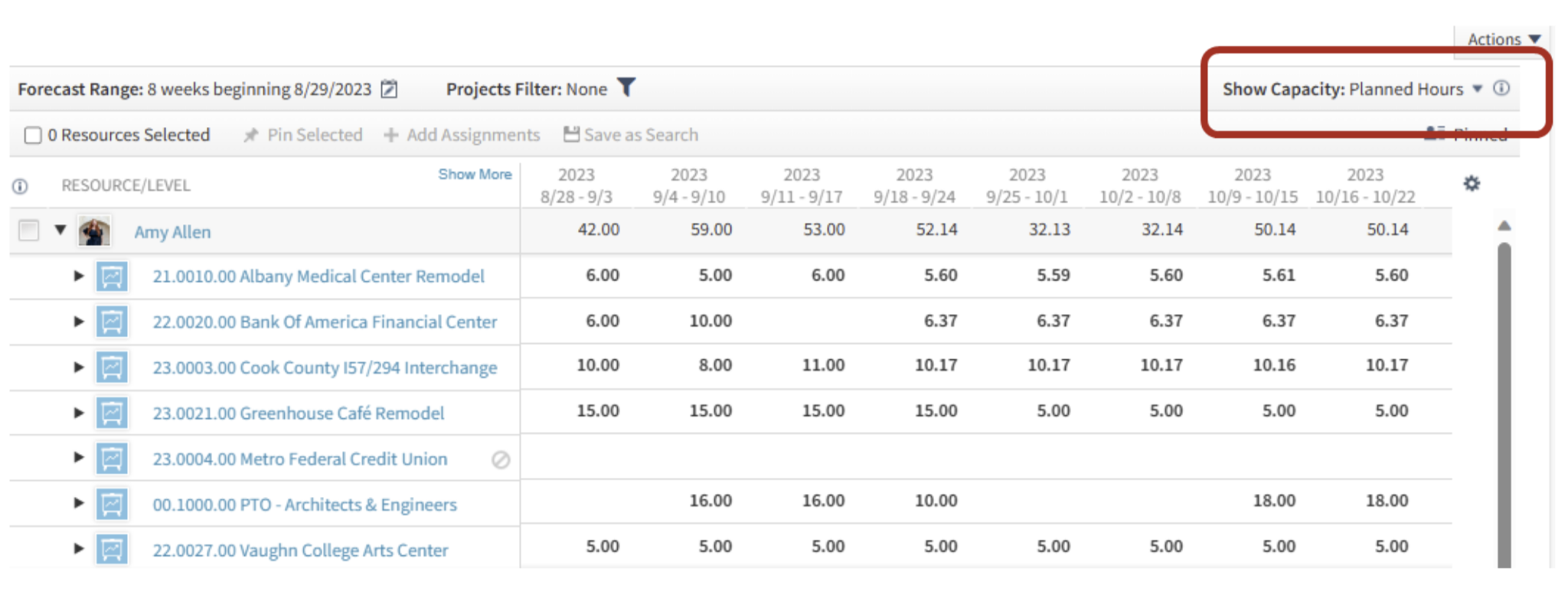
Planned Hours 

Planned Hours is the simplest of the calculations as it is what it says it is – all planned hours! Use this view to simply check each selected resource's total planned hours for the time period shown in the Forecast Range. Planned hours will be shown for all published plans for ALL types of projects – overhead, promotional, and regular projects. Planned hours will show even if the project is showing a capacity calculation of excluded from scheduled and utilized % on the project’s summary pane. 
ResourceMgmt_01

Scheduled %

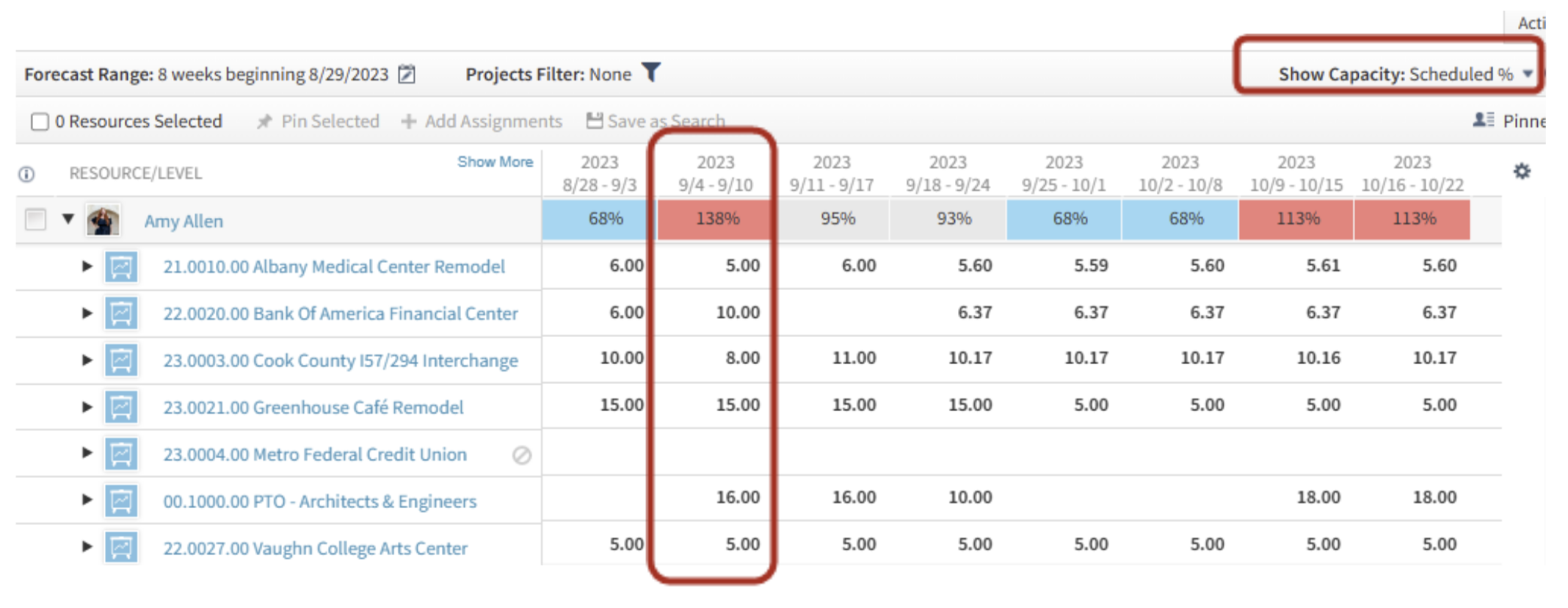
When you change the view from Planned Hours to Scheduled %, you will notice the “heat map” will appear. This “heat map” is used to visually draw a user’s attention to which resources are properly scheduled (grey), under scheduled (blue), or over scheduled (red) based on the firm’s chosen thresholds (Settings > Resource Planning > Resource Settings). 
ResourceMgmt_02

The Scheduled % is a calculation of Planned Hours divided by Available Hours for the resource. This view is great to use to get an understanding of if a resource is too busy (red) or has availability to be assigned to more projects (blue) or if they are appropriately scheduled during the timeframe (grey). 

  • Planned Hours - this calculation will include all types of projects (regular, promotional, & overhead). However, if a project shows as “Excluded from Scheduled and Utilization” on the Project’s Summary tab, those planned hours will not be used in this calculation. Note that excluded hours will still show the hours when the details are expanded for the resource. 
  • Available Hours - these are calculated using the employee’s standard hours from their employee hub, less any non-workdays as indicated in Settings > Resource Planning > non-Workdays. 

In the example shown below, I will break down the calculation for the week of 9/4 – 9/10 where Amy Allen is showing over scheduled at 138%. 

Planned Hours / Available Hours = Scheduled %      =     44 / 32 = 138% 

Planned Hours = 59 total hours planned less 15 hours for Greenhouse Café Remodel as that project is currently set to “Exclude from Scheduled and Utilization” in the project. The numerator is 59 -15 = 44 hours. 

*Note when you click on the blue link of each project, a small summary box for the project will appear where you can easily see if a project is “included” or “excluded” from Scheduled and Utilization. 
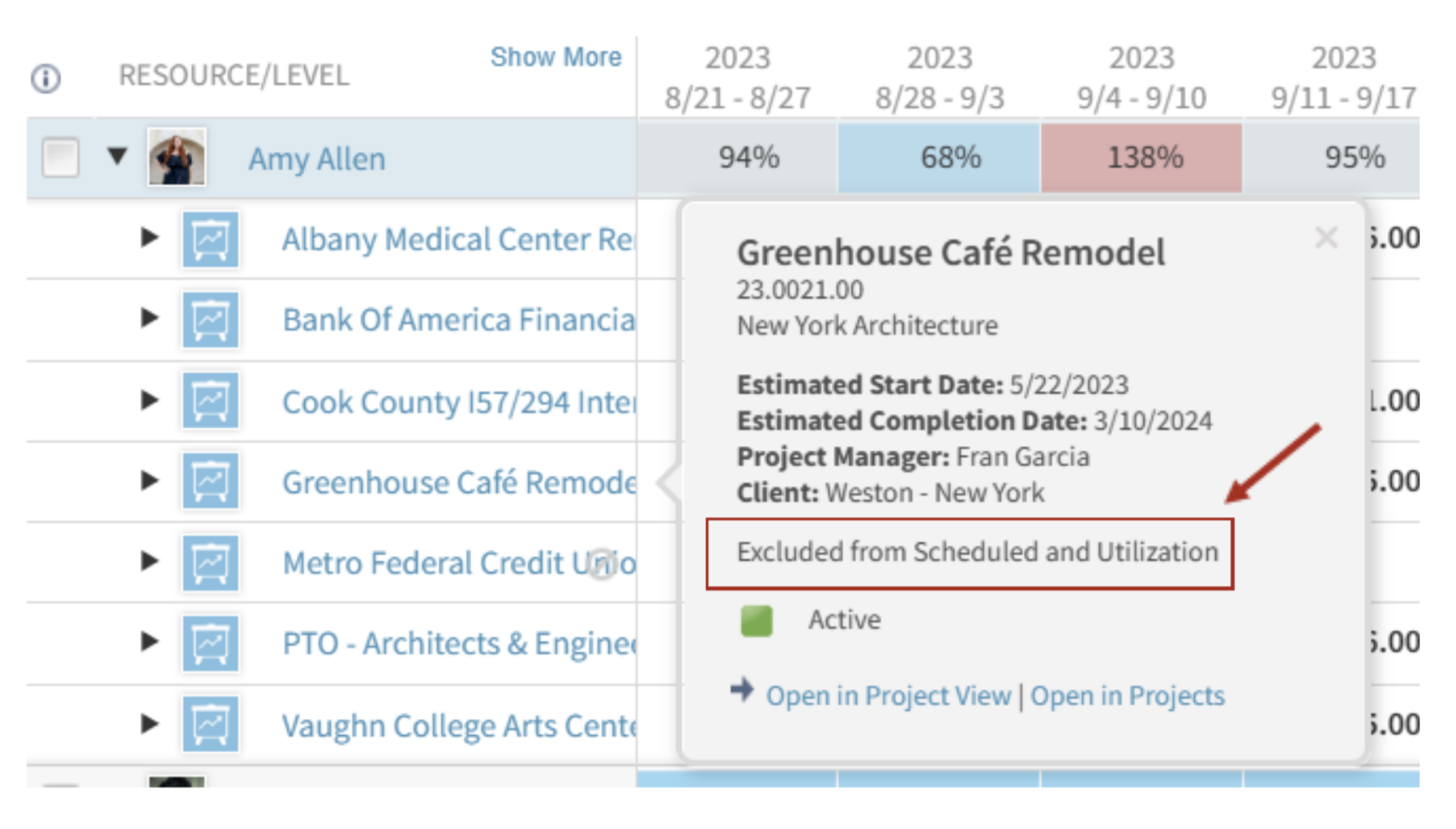
ResourceMgmt_03

Available Hours – Amy Allen’s standard hours are set as 8 hours per day in her employee hub, which is typical for a full-time 40-hour/week employee. The week of 9/4 – 9/10 contains a Labor Day Holiday in the company’s non-workday settings. As discussed earlier, holiday hours are excluded from available hours. Therefore, the denominator is 40 – 8 = 32.  

 *Note that when you click on a resource’s name, the Employee Card will appear. On that employee card, you will find the Hours/Day in the bottom right of the Profile Tab. 

Now, the shading!  What is this heat map telling you?   

Understandably, being scheduled at 138% would seem to be over scheduled just because it is a relatively large number, but the system is compared to the firm’s Resource Planning Settings. In my demo database shown here, the blue shading indicates under scheduled as under 90%, and the red shading for over schedule when over 105%. Grey is “just right” of 90 – 105%, which this firm has indicated as appropriately scheduled.    

In summary, in my database, a full-time, 40-hour/week employee would show as properly scheduled (grey) if the scheduled hours are between 36 (90% x 40) and 42 hours, under-scheduled would be less than 36 hours (blue) and over scheduled as over 42 hours (red). 

Utilization %

The Utilization % will show the percentage of the planned hours for billable projects (regular/won projects) and those In Pursuit projects marked as “included in scheduled and utilization”. Use this view to show how an employee is tracking against their Target Utilization. Even if an employee is well scheduled, in the example above, if several of the projects are either overhead or In Pursuit and not included in scheduled and utilization, the employee may be shown as under-utilized.  
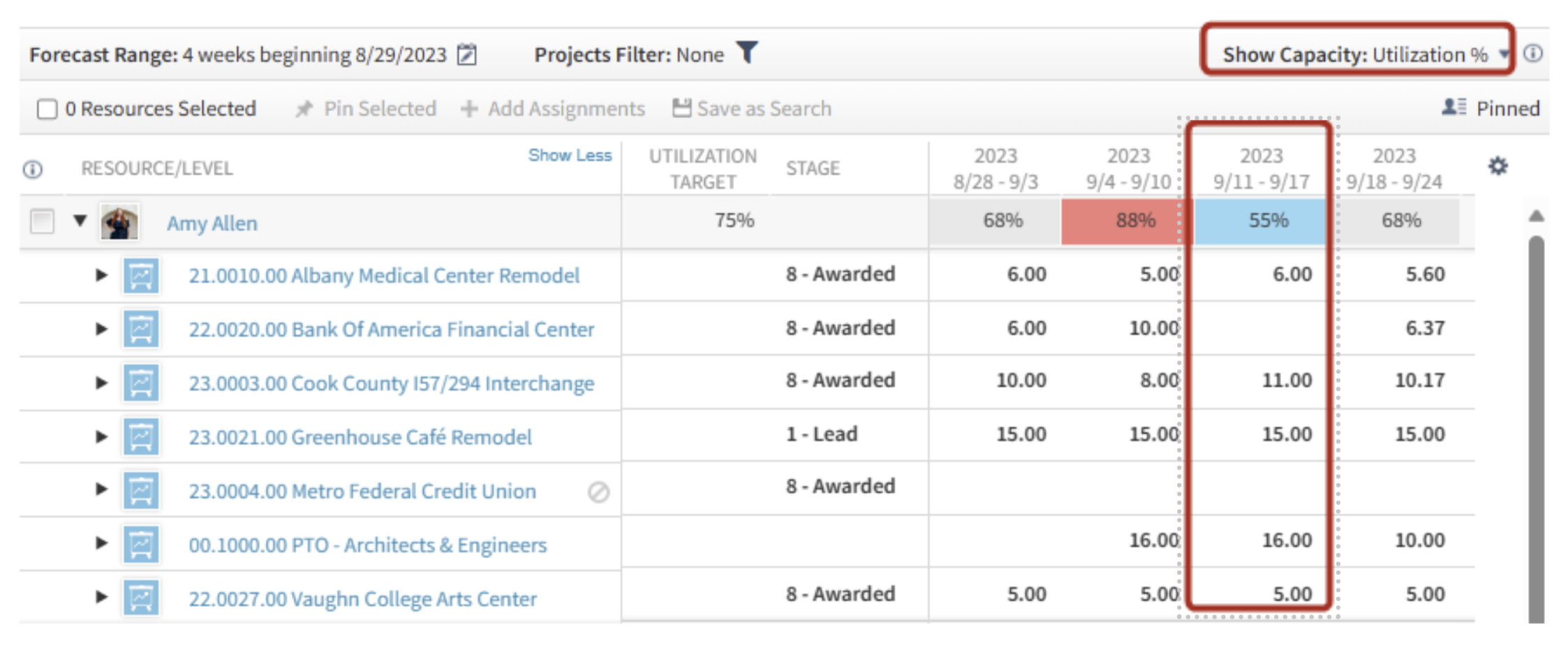
ResourceMgmt_04

Utilization % is a calculation of Total Billable Planned Hours divided by Available Hours (same calculation as above). 

Total Billable Planned Hours only includes regular projects, no promotional projects nor overhead projects. Regular projects will be all those in the Stage Step of Won and any In Pursuit that are “Included in Scheduled & Utilization” Capacity calculations. 

For this example, I will be showing the calculation for the week of 9/11 – 9/17 from the picture above. In this view, I am also showing a few additional columns in the middle grid that help demonstrate if a project is “billable” or not.   

As you can see, I have one project that is a Lead Stage – Greenhouse Café Remodel, and as discussed above, that project is Excluded from Scheduled and Utilization so those hours will not be included in the numerator. Additionally, there is one project that is overhead (no stage listed), which is PTO.   

Total Billable Planned Hours / Available Hours = Utilization %      =     22 / 40 = 55% 

Total Billable Planned Hours = 53 total hours planned less 15 hours for Greenhouse Café Remodel as that project is currently set to “Exclude from Scheduled and Utilization” in the project, less the PTO hours of 16. The numerator is 53 -31 = 22 hours. 

Available Hours (as stated above) are calculated using the employee’s standard hours from the employee hub, less any non-workdays. This week does not have a holiday and this employee’s standard hours are 8 hours/day so the Available Hours = 40. 

Shading for Utilization %: 

To understand the heat map for the Utilization %, the formula considers each employee’s Utilization Target, which is set in the Employee Hub. This employee, Amy Allen, has a Utilization Target of 75%. 

The threshold calculation is the Utilization % divided by the employee’s Utilization Target. 

For the week ending 9/17, Amy’s planned Utilization % is 55% divided by the target of 75% equals 73%. In my demo database shown here, the blue shading will be under-utilized if the utilization % is under 90%, red shading over 105%, and “just right” or grey is between 90 – 105%. Therefore, since Amy’s threshold calculation is 73%, she is showing blue as that is under-utilized in my database. 

Capacity Calculations Made Easy with Resource View 

So, in summary, the Resource View in Deltek Vantagepoint has a lot of valuable information on one screen. You can use it to navigate to three different views to understand (1) how many hours an employee has planned in total (Planned Hours), (2) if the employee is over/under scheduled (Scheduled %), and (3) if the employee is over/under utilized by simply navigating between the three options in “Show Capacity”. Project based firms should be making the most of the resource management tools available within Deltek Vantagepoint! To learn more about this feature and other Resource Management tools, please visit our webinars located here: Webinars for Project Manager Rockstars! 



From Learning to Networking: Navigate Deltek ProjectCon 2023 with Full Sail Partners

Posted by Lindsay Diven on Sep 14, 2023 12:00:00 AM

08-31-23 ProjectCon Banner 02

Why Deltek ProjectCon 2023 is a Must-Attend Event 

Are you prepared to propel your project-based business to the forefront of industry excellence? Look no further than the horizon of Deltek ProjectCon 2023 – an indispensable event for professionals deeply entrenched in project-focused industries. Overflowing with motivation, education, and unparalleled networking prospects, this year's conference emerges as an irreplaceable milestone on your journey.  

As proud sponsors, exhibitors, and presenters, Full Sail Partners eagerly extends an exclusive invitation to navigate this transformative journey, set to unfold at the enchanting Gaylord Palms Resort in Orlando, Florida, from October 16 to 18. Deltek ProjectCon isn't just a conference; it's an experience designed to empower you and your project-based firm.  

First off, here's a closer look at 3 big reasons why you ought to immediately circle this event on your calendar and claim your spot. 

#1: Learning Beyond Limits 

The Deltek annual conference boasts an impressive lineup of 300+ engaging sessions across 15 racks that promise to deepen your product knowledge and provide valuable insights into industry trends. Earn Continuing Professional Education (CPE) credits as you discover innovative solutions and services that will fuel your project success. Whether you're a seasoned professional or just starting your journey, the learning opportunities are boundless. 

Take a moment to review the session catalog here. 

#2: Forge Unbreakable Connections with Your Fellow Deltek Users 

Connectivity is key in the world of project-based business, and Deltek ProjectCon offers unparalleled networking opportunities. Engage with Deltek experts, peers from your related industry, fellow attendees, and, of course, the Full Sail Partners’ Crew! From one-on-one meetings to interactive braindates, you'll forge authentic connections that can propel your career and business forward. 

#3: A Fusion of Fun and Learning 

Deltek ProjectCon understands that it’s not all about business; it’s about having fun and building memories that matter too. Immerse yourself in special networking events, participate in philanthropic activities, and let loose at the epic customer appreciation party. It's a chance to relax, unwind, and recharge while still gaining valuable insights. 

If those reasons alone don’t give you enough motivation to come to Deltek ProjectCon this year, just remember that the Full Sail Partners’ team of experts will be available to conference attendees. We will not only be active participants in the event but will be presenting a valuable learning session that is one of a kind. And just like every year that Deltek has put on the annual conference, we will be bringing the knowledge that comes with more than 275 years of experience with Deltek products. 

Full Sail Partners: Your Guide to Project Management Superpowers 

As we step into our role as sponsors, exhibitors, and presenters at Deltek ProjectCon 2023, Full Sail Partners offers an exciting opportunity to witness our expertise firsthand. Brace yourself for a front-row seat to our presentation, "Unlocking Vantagepoint Integration Superpowers with Blackbox Connector," scheduled for Tuesday, October 17, at 2:00 p.m. ET.  

In this informative session, we’ll unveil how our turnkey Deltek Vantagepoint integration can revolutionize your connections with third-party applications. Say goodbye to coding headaches and hello to our seamless Blackbox Connectors for ADP Workforce Now, SAP Concur, Entrinsik Informer, Intuit Mailchimp, and more. Our low-code implementation strategy saves time, cuts costs, and eliminates upgrade worries, unleashing the true power of Blackbox Connector to transform your business with efficiency and productivity. 

Here’s what you can expect to learn during our session: 

  • Unveiling the key benefits of turnkey Deltek Vantagepoint integrations and their far-reaching effects across diverse business functions. 
  • Unpacking the tactical deployment of low-code strategies, ensuring seamless Deltek Vantagepoint system integration with third-party applications. 
  • Identifying avenues for process enhancement through harnessing the prowess of Blackbox Connector. 
  • Hearing compelling tales of successful Blackbox Connector implementations, directly from user experiences. 

Join our presenters, Pete Nuffer and Sarah Gonnella, in this very enlightening and inspiring session. To ensure you don't miss out, make sure to include our session on your must-attend list. You can conveniently add it to your program by clicking here 

Unraveling the Full Sail Partners’ Experience 

The engagement doesn't stop after the presentation. Our experts are excited to connect with you at kiosk 5A in the lively XPO hall. Keep an eye out for our easily recognizable red shirts – the Full Sail Partners’ Crew is ready to address your questions, provide live demos, and assist you in realizing the full capabilities of your solutions. This is a valuable chance to tap into our collective expertise and equip yourself with the resources necessary to invigorate your project management pursuits. 

And we love meeting new clients “in real life” as well as catching up with familiar faces. So, stop by and say hi! 

Unlock Your Project Management Future at Deltek ProjectCon 2023 

If you're primed to amplify your project-based firm and open the door to unprecedented achievements, then Deltek ProjectCon 2023 beckons. Save the dates – for October 16 to 18 – and immerse yourself in the world of learning, connection, and fun to be had this year at the Gaylord Palms in Orlando, Florida. The horizon of Deltek Project Nation awaits you, and together, we shall cultivate a future where your project management prowess knows no bounds. 

Ready to secure your spot? Click the image below to register for Deltek ProjectCon 2023 today! Be sure to mention you heard about the conference from Full Sail Partners during your registration. We're eagerly counting down the days until we meet you there. We can't wait to see you! 


Overall Trends from the 44th Annual Deltek Clarity A&E Report

Posted by Evan Creech-Pritchett on Jul 13, 2023 12:00:00 AM

07-13-23 44th Clarity AE Report_Banner

Deltek has recently unveiled the 44th Annual Clarity A&E report, providing an exclusive glimpse into the 2023 outlook of the Architecture and Engineering (A&E) Industry. Overall, while growth may cool down from 2022's excitement, the construction and engineering sectors remain optimistic. Challenges like rising costs, staffing shortages, and inflationary pressures are driving firms to focus on staff retention, development, and diversity initiatives. 

Furthermore, with limited resources, strategic project selection is key. Though investment in supporting technologies has dipped, firms are revving up plans for tech implementation. Despite costs, A&E firms still shine with solid net revenue growth and improved operating profit. Here, in this blog, we will do a quick review of the overall trends seen from the 44th Annual Deltek Clarity Study.

Technology Trends

Firms are prioritizing strategic technology plans, cybersecurity, and business process improvement to achieve digital maturity and address challenges such as rising costs and talent management. While there is a desire to make strategic technological improvements, the report indicates a disconnect between goals and implementation, with firms relying on manual data entry instead of leveraging technology solutions effectively.

Data and cybersecurity remain the top IT operations challenges for firms, with cyberattacks posing a significant threat. Rising technology costs and the need to prioritize applicable trends also hinder technology adoption. However, firms are aiming to transform their use of technology, leveraging it as a competitive advantage and fundamentally changing how their businesses are run and the services offered to clients. Overcoming these challenges and maintaining a harmonious relationship between technology, project execution, and company strategy will be crucial for firms to emerge as the most competitive in the industry.

Business Development Trends

Firms face increased competition and fewer awarded proposals, necessitating strategic planning and resource utilization for conservative revenue growth. To address this, firms should focus on qualifying clients aligned with their strengths, diversify into favorable markets, and nurture existing client relationships with skilled BD talent and technology.

The A&E industry remains strong, but rising costs and staffing challenges require diligent pursuit of strategic opportunities for sustainable growth. Firms can enhance their focus by implementing formal go/no go processes, leveraging CRM solutions, and adopting hybrid BD models combining a dedicated staff with seller/doer approaches. Emphasizing opportunity evaluation and internal collaboration can benefit smaller firms. Adapting to market changes, investing in technology and talent, and prioritizing client relationships is crucial for firms to thrive in the evolving business landscape.

Project Management Trends

The 44th Annual Deltek Clarity report reveals that project managers (PMs) face challenges in gaining visibility into project management KPIs and lacking the necessary tools to manage them effectively. While there is a positive trend with more projects staying on track for schedule and budget, staffing shortages continue to hinder project performance. To tackle these issues, firms should invest in internal project manager training, better project management tools, and training for the next generation of project managers.

Staffing challenges remain the top obstacle for A&E firms, impacting project delivery and potentially causing burnout among existing staff. To address this, firms are focusing on internal training and upskilling current employees. However, comprehensive training and professional development are crucial to equip PMs with the required skills. Additionally, improving project information management, quality control, and collaboration can enhance project performance and mitigate risks. Emphasizing both financial and non-financial KPIs, along with leveraging project technology and financial tracking tools, can lead to improved project outcomes and profitability.

Human Capital Management Trends

A&E firms are focusing on developing and cross-training existing staff to meet project demands amid challenges in staffing and rising hiring costs. They prioritize succession planning, performance management, and talent nurturing to improve retention. To address talent acquisition challenges, firms are re-evaluating position requirements, considering trainable candidates with complementary skills, and offering competitive compensation. Engaging diverse candidates, providing upskilling opportunities, and championing operational tools are crucial for attracting and retaining talent.

In the competitive talent landscape, firms must strategically attract and retain employees by adapting to evolving workforce preferences, such as remote work options and positive company culture. They shift engagement strategies, offer visible career development plans, and track key performance indicators related to employee management and retention. By implementing these approaches, firms aim to improve their talent acquisition processes and support project profitability.

Financial Management Trends

Firms achieved significant financial success in 2022, surpassing their bullish goals and delivering improvements in operating profit. They effectively leveraged direct labor costs and subconsultants to drive revenue growth, outpacing growth in headcount and wages. Strategic investments were made during favorable economic conditions, resulting in strong revenue growth and improved financial metrics.

However, firms are facing several financial challenges that need to be addressed to sustain their performance. Finding and retaining qualified staff remains the top concern, although firms have been successful in leveraging their workforce and achieving high net revenues per employee. Increasing profitability and managing growth are also key areas of focus. Firms are refining their strategies, utilizing technology and process improvements to reduce project delivery costs and balance out rising labor costs.

To maintain their financial performance, firms need to prioritize the overall health and satisfaction of their workforce. Retaining and developing impactful talent through cross-training and internal promotions are crucial. Additionally, driving timely project completion, effective billing, and collection processes are vital for capturing revenue and maintaining cash flow. Investments in business process improvements and financial management training for PMs are key areas of focus to sustain growth and manage financial returns.

Continue to Gain Valuable Insight into the A&E Industry

The 44th Annual Deltek Clarity report continues to provide valuable insight into the Architecture and Engineering industry. In this most recent study, firms are advised to prioritize technology adoption, strategic business development, effective project management, and talent management to be successful. Embracing technology trends, addressing staffing challenges, and focusing on financial management are key areas of focus for sustainable growth and profitability.

By leveraging the recommendations from the Deltek Clarity report, firms can navigate market changes, enhance their operations, and stay competitive. For more information, the entire Clarity report can be downloaded for a comprehensive view. However, don’t forget to keep an eye out for our future blogs where we will be quickly reviewing each trend of the report in more detail.


How to Measure a Project’s Financial Health

Posted by Theresa Depew on Jun 22, 2023 12:00:00 AM

06-22-23 Financial Health_Banner

When it comes to assessing the financial well-being of our projects, we know that relying solely on project invoices is like gazing at the tip of an iceberg while missing the grandeur beneath the surface. At Full Sail Partners, we understand that true success lies in exploring a variety of analytics and statistics. Let's dive into the world of project metrics and discover the key to unlocking financial prosperity. 

The Essentials to Determining a Project’s Financial Health 

To begin with, there are a few essential components we must consider when determining a project's financial health. Every project should be documented with: 

  • Current and Accurate Fee: A clear understanding of the project's fee is vital. It serves as a baseline for evaluating profitability and making financial decisions throughout the project's lifecycle. 
  • Work Breakdown Structure (WBS): A well-defined WBS that aligns with the project's fee and scope helps us accurately allocate costs and resources. It provides a framework for tracking expenses and ensures that financial evaluations are aligned with the project's objectives. 
  • Proper Revenue Recognition Method: Selecting the appropriate revenue recognition method is crucial for accurate financial reporting. It ensures that revenue is recognized in a manner that reflects the project's progress and performance accurately. 

Understanding the Components of a Project's Financial Health 

To truly focus on the financial success of a project, we rely on job-to-date (JTD) as our measurement of time. Now, let's explore some key statistics that can be found or created using Deltek Vantagepoint’s Project Earnings Report: 

Profit or Variance  

This metric allows us to compare revenue/earnings with costs incurred. For projects billed on time and materials (T&M), a zero variance indicates profitability, as the project profit is built into the billing rates. However, a negative variance suggests the need to write off charged time. For fixed fee/lump sum projects, the goal is to minimize costs while still delivering on scope and quality. 

Projected Profit or Variance  

Calculating this metric involves updating and managing the estimate to complete (ETC). By combining the ETC with the JTD cost, we derive the estimate at completion (EAC). Comparing the EAC to the Fee allows us to gauge the project's health upon completion and identify potential scope creep. By analyzing actual and projected profit together, we can establish four scenarios and develop a matrix approach for reviewing a project's financial health: 

  • Scenario 1: JTD shows a profit, but there is a projected reduction in that profit moving forward. This indicates the need for careful cost management to maintain profitability. 
  • Scenario 2: JTD shows a profit, and continued or increased profit is forecasted. This demonstrates a healthy financial trajectory. 
  • Scenario 3: JTD shows a loss, but some or all of that loss can be mitigated moving forward. This calls for identifying and addressing the factors contributing to the loss and implementing corrective actions. 
  • Scenario 4: JTD shows a loss that will continue or grow. In this case, it is crucial to evaluate the project's viability and explore strategies for minimizing further losses. 

Direct Labor Multiplier 

This metric is crucial for managing a specific project and aligning with the firm's overall goals. It measures how much revenue is generated per labor dollar charged. The estimated multiplier is determined at the project's inception, and it's important to have a basis of comparison when evaluating this statistic. 

Work in Process (WIP)  

WIP is calculated as the difference between project revenue and the amount invoiced. Monitoring WIP helps mitigate any potential risks to project earnings. If revenue is accrued, it's vital to consider the time associated with billing and collection. Deferring revenue can minimize or mitigate risks effectively. 

Backlog  

This metric indicates the remaining revenue to be earned, representing the future available revenue stream. When combined with all projects, it forms a significant line on our Key Performance Indicator (KPI) graph. Additionally, it reflects the required full-time equivalent man-hours to complete and deliver contracted work. It's worth noting that backlog can be derived from the ETC, showcasing the interconnectedness of these metrics. 

It's crucial to note that all these metrics work in tandem, complementing and informing each other. For instance, backlog can be derived from the estimate to complete (ETC), demonstrating the interconnected nature of these indicators. By considering them collectively, we gain a comprehensive understanding of a project's financial health and can make informed decisions accordingly. 

Measuring a Project’s Financial Health is Multifaceted and Continuous  

At Full Sail Partners, we believe that measuring the financial health of a project requires a multifaceted approach. By relying on a variety of analytics and statistics, we gain a holistic understanding of the project's financial landscape. Project invoices, while important, are just one piece of the puzzle. 

To make our projects truly profitable, it is essential to continually measure and monitor their financial health. By utilizing a range of metrics and closely tracking project milestones, you can proactively identify potential shortcomings and take corrective actions before they escalate. This approach empowers project managers and the entire team to drive success, deliver value to clients, and optimize financial outcomes. 

Deltek Vantagepoint: Empowering Project-Based Consulting Businesses for Financial Success 

In conclusion, measuring a project's financial health goes beyond relying solely on project invoices. By leveraging various analytics and statistics, including key performance indicators, milestones, and specific metrics like profit or variance, projected profit or variance, direct labor multiplier, WIP, and backlog, you gain a comprehensive view of a project's financial status. This comprehensive approach allows you to make informed decisions, mitigate risks, and steer projects toward profitability.  

So, embrace these valuable insights, keep a close eye on your project's financial well-being, and unlock the path to sustainable success in your project-based consulting business. To see how Deltek Vantagepoint supports good project financial management, watch the webinar below!  

Outsourcing HR Functions Can Help Professional Services Firms Meet Their Human Capital Management Needs

Posted by Tasia Grant, PHR on Sep 21, 2022 12:00:00 AM

2022 - Outsourcing HR_ Banner

The professional services industry is still currently facing challenges ranging from financial rebounds and technological transformations to the need for human capital management (HCM) adjustments. Specifically, some of the top HCM trends affecting the professional services industry are:

  • The expectation of mobility - Employees and job seekers are looking for companies that have the structure and technology to accommodate remote work. Also, many companies have redesigned their physical office layouts and performance management plans to account for remote staff.
  • Power shift to employees and applicants - The shortage of viable talent has shifted the supply and demand dynamics where the employees and candidates feel empowered to ask for what they want and have options if those requests are not accommodated. 
  • Struggles to find the right fit for positions due to skills gap issue - Due to the great resignation and the influx of early retirees, there is a gap between those seeking work and those actually qualified for the hiring needs. 
  • Workplace balance is no longer a “buzz” term or trend; it’s a real thing - The pandemic caused most to reflect on their priorities and many changed their mindsets, habits, and lifestyles to cater to the well-being of themselves and their loved ones, even if it involved making employment sacrifices.

What does HR have to do with these trends?

The human resources function is key to effectively addressing these HCM shifts. Organizational leadership is increasingly aware that attention to the needs and wants of their current and potential employees is pivotal to their growth and success. So, they are reevaluating their processes, procedures, incentives, and benefits to account for these trends, and outsourcing HR is a part of that consideration. 

What are the primary essential functions of HR? 

The primary HR functions are Human Resources Information Systems (HRIS), Benefits Administration, Talent Acquisition & Onboarding, Employee Relations, Training & Development, and Compensation (Payroll/Total Rewards). These functions are all critical to addressing these impacting HCM trends. 

What role can these HR functions play in affecting these trends aka challenges? 

The expectation of mobility: 

Having an effective HRIS system to electronically manage and house employee data has become common and necessary to maintain efficient communication, consistency, integrity, and security. This also allows the data to be managed from any location where technology is accessible. 

Power shift to employees and applicants / Struggles to find the right fit for positions due to skills gap issue: 

Development and management of attractive, competitive benefits and compensation plans will impact retention of existing employees and attract top talent. Offering performance management and training & development that supports career development is a sign to current and potential employees that their worth is valued and sends the message to them that being with the company also brings and ROI for them. Employee relations and training & development are being redesigned so that the quality, availability, and frequency of meetings and training are consistent whether in-person or virtual. 

Workplace balance is no longer a “buzz” term or trend; it’s a real thing: 

Efficient benefits administration ensures that providing the best health insurance options, a fair and generous leave policy, a well-structured retirement plan, and additional employee perks are top priorities for a company that invests in the well-being of its greatest asset…its employees. 

“Total rewards” is the combination of benefits, compensation, and rewards that employees receive from their organizations. Where wages and bonuses are still important to employees, intrinsic rewards are equally important. So, recognition, workplace flexibility, and career opportunities provide them with that. 

Having a dedicated, experienced HR professional is a must for all professional services firms 

The HR functions needed to address HCM trends require specific skillsets and knowledge bases, such as: 

  • HRIS – Knowledge of HR software, familiarity with business analysis tools, exposure to technological functions and jargon
  • Benefits Administration – Foundation of most benefit plan designs, knowledge of benefit coverage laws and market trends
  • Talent Acquisition & Onboarding – Negotiation skills, data analytics, experience with recruiting software, social media management, sourcing experience
  • Employee Relations – Excellent communication and people skills, great listening and observation skills, conflict management techniques, knowledge of performance management plans, experience conducting appraisals and grievances
  • Training & Development – Project management skills, coaching skills, knowledge of and experience with training software, presentation skills, organizational skills
  • Compensation – Financial education background, proficient Excel knowledge, payroll experience, total rewards knowledge, ability to conduct salary analysis 

Furthermore, these descriptions just skim the surface of what’s required to perform these HR functions. The extent to which each skill set is needed or required depends on factors like the firm type, size of the firm, and firm goals. Surprisingly, some professional services firms have designated a payroll manager or executive for the task of performing these HR duties in addition to their primary responsibilities. Yet, to be most effective in addressing these HCM trends, these professional services firms need a dedicated, experienced HR professional. 

How can outsourcing HR functions help professional services firms? 

HR outsourcing is the use of an outside service to handle some or all of a firm’s HR tasks. Many firms have designated teams within the HR department to handle the different functions. Often, though, smaller organizations (100 employees or less) don’t have the physical capacity or financial ability to support multiple people performing those duties or even one full-time dedicated HR person to work in a generalist capacity. Moreover, firms that are not necessarily small but are transitioning into larger organizations, and may be assessing their needs, may want to slowly grow their core teams.   

Outsourcing HR functions can provide the necessary resources without requiring the full commitment of new employees. Especially in cases where an executive has been the designated HR professional, outsourcing HR functions will allow that business leader to focus on core business processes. Also, the employees will appreciate having a person who is specialized in employee-related issues and is not a direct decision-maker in their career trajectory. Finally, HR consultants can be an additional resource to professional services firms by providing additional support, guidance, and advice in areas where there may be a skills gap, knowledge gap or even a lack of time and resources. 

Outsourcing HR functions has many pros to help meet HCM needs 

Pros 

  • Access to HR expertise 
  • Saves money because firms don’t have to hire new full-time employees 
  • Opens access to additional benefits 
  • HR connections can lead to lower cost benefits and access to other global resources 
  • Maximizes compliance 
  • Minimizes legal risks 

Cons 

  • Leadership may feel a lack of control 
  • Might feel impersonal to employees 
  • Risks with intellectual property access 
  • Service quality control  

Undoubtedly, every professional services firm requires certain functions that are focused on HR needs/wants and provides a neutral, trusted and knowledgeable resource that supports both the firm’s and the employees’ well-being. To address the shifting Human Capital Management trends in the present and future of the professional services industry, HR professionals are a necessity. For those firms that are not able or do not want to hire a designated HR professional to handle these significant HR functions, outsourced HR is the right choice to meet these changing HCM needs. Click the image below to learn more and see if this is an option for your firm.

The 43rd Deltek A&E Clarity Study Predicts Positive Changes for Business Development

Posted by Amanda Roussel on Sep 7, 2022 12:00:00 AM

2022-ClarityReport_BD_Banner

According to this year’s Deltek Clarity Architecture & Engineering (A&E) Industry Study, it is looking to be a landmark year for the architecture and engineering industry with net revenue growth forecasted to grow to 17.6%. A&E is doing quite well despite the pandemic with the highest net revenue growth in the last ten years at 11.4%. This increase is assisted by A&E’s market position, which is expected to either grow or remain steady in markets across the board. Most notably water/waste/stormwater, transportation, and industries that fall under the “other” category (such as life sciences and senior living) are predicted to see great increases. As a result, firms will not only need to strategically pursue the right projects but will also need to grow and develop a staff to deliver on these projects.


Top Business Development (BD) Challenges 

The ever-changing nature of the business world is continuing to keep firms on their toes with new challenges. Unlike the previous year, a majority of firms (78%) have identified that finding and retaining qualified staff has been a struggle for them. This is coupled with other mass-reported problems such as staffing shortages and difficulty retaining employees. Staffing challenges have a direct impact on business development, not only lacking adequate staff to conduct business development activities but also not being able to provide the most qualified teams to win and deliver on projects. 

Time to nurture client relationships is the top business development challenge for A&E firms according to the report. With favorable market conditions, new opportunities will be plentiful which poses a challenge for firms to keep up with their clients. Time is money and time is also in short supply. With the reporting firms revealing an average work backlog of nearly 9 months, it is clear that companies must find a way to increase productivity. Upskilling business development talent and streamlining the BD process will help to free up time to strategically nurture client relationships. 

Other top BD challenges from the study include increased competition and identifying prospects. Firms must differentiate and hone branding across thought leadership and social marketing channels to distinguish themselves in the marketplace. Additionally, with a positive industry outlook this year, firms will need to be more strategic in pursuits that work best for their company’s strengths. 

Increased Formal Business Development Process 

Of the companies surveyed, 45% have a formal business development process, which is an increase going up from 39% the previous year. Though this means that 55% of firms surveyed still do not have any formal business development process. In these cases, responsibility for business development tasks is most often pushed to the executive team, project managers, and marketing staff. While dedicated business development staff may not be necessary in every case, it is important not to overlook the kind of work they do. Most notably, they tend to client relationship development, proposal development and networking, but they have plenty of other duties as well. Their jobs help to create new business opportunities, and within the last year active client relationships, requests for proposals and networking placed in the top five sources of new opportunities in the surveyed firms. 

A Positive Year for Proposals Requires Evaluation 

As suggested by the Deltek Clarity study, operating in a market with limited resources but high demand, the go/no go process is significant to evaluate the projects firms will pursue. While the number of firms employing the go/no go process has increased in the last year, there is still a large population who do not utilize it in the slightest. Of the companies who reported, 22% don’t use any kind of go/no go process. Listed below are the top three questions that businesses ask when deciding whether or not to accept a proposal: 

  • Is it a good fit for the type of work we do? 
  • Do we have an existing relationship with the client? 
  • Do we have the staff to deliver the project?   

This method of weeding out less profitable projects is more useful than ever, as a significant rise in the number of proposals submitted and the number awarded in firms of all sizes was observed. In-kind, the average win rate of proposals has increased in the last year to 49.2%, the highest it’s been since the beginning of the COVID-19 pandemic. The average capture rate is also up from the previous year, now standing at 48.5%. 

Marketing Techniques Present and Future 

A majority of businesses reported using social media posts for marketing, with only 16% not indicating any use. This was followed by client-specific marketing at 67%, trade shows/exhibits at 56%, email marketing at 54% and thought leadership at 42%. The order of these marketing methods is projected to change, however, with the study offering up that client-specific marketing could overtake social media marketing within the next five years. Thought leadership is predicted to advance to third place among important marketing techniques, with trade shows/exhibits and email marketing falling more and more by the wayside. 

Business Development Initiatives 

Based on this year’s study, some of the priority business development (BD) initiatives for A&E firms are hiring additional staff, earlier identification of opportunities and requirements and expanding geographically. Since BD has not been spared from staffing challenges, and firms are seeing more proposals, projects, and nurturing opportunities, the focus on obtaining the best-qualified staff is of tantamount importance. Another area that has grown in importance is the geographic expansion of firms requiring yet again additional staff. One more initiative to identify opportunities and their requirements remains top of the list as well. Teams shouldn’t be wasting time and their resources on projects that are not winnable. 

Final BD Outlook from Deltek Clarity 

The 43rd Deltek A&E Clarity study found that while the world still is not clear about the pandemic, things are looking up for the industry. The top problems of participating firms are not dire, and by focusing on the employee base and current client relationships, these issues can be fixed. This year’s Deltek Clarity report also noted that freeing up time is necessary to clear the obstacles in the way of each business regarding BD. To remedy this, employing the go/no go process and better utilizing the tools provided by Deltek to streamline the BD process is suggested. 

How does your company stack up to those that participated in the survey? For a more in-depth look at the data behind the 43rd Deltek A&E Clarity study, use the link below to receive the report for free right now! 


Automated Bank Feeds with Deltek Vantagepoint for Professional Services Firms

Posted by Joel Slater on Aug 17, 2022 12:00:00 AM

2022-VP Automated Bank Feeds 02

Most likely of great interest to Vantagepoint users is that Deltek is continuing to roll out rapid enhancements to Vantagepoint in order to drive purposeful innovation and efficiency. One of the latest improvements being made possible is by a new partnership and integration with Plaid. This integration with Plaid offers professional services firms the ability to automate the update of transactions in Bank Reconciliation in Vantagepoint. Well, what is this all about, and how can professional services firms make this happen?

About Plaid

Plaid powers thousands of financial apps and this convenient integration will allow professional services firms to connect their banks to Deltek Vantagepoint in a secure way. With Plaid, firms can control whom their data is shared with and for how long. Additionally, whenever firms use a Plaid-powered app, their security is of the utmost importance meeting or exceeding industry standards. 

Bye-Bye Manual Entry 

Most Deltek Vision clients were already aware of the ability to manually upload a file from their bank to import bank transactions. The key word here, being MANUAL. Now check out the good news - with Deltek’s latest release of Vantagepoint, that process has now been vastly improved with automated bank feeds. That’s right! No more manual import is required. The integration currently supports over 11,000 banks across North America, with more being added regularly. As of the Vantagepoint 5.0 release, this integration is available to both on-premise and Deltek Cloud clients. There is no separate purchase or licensing required.   

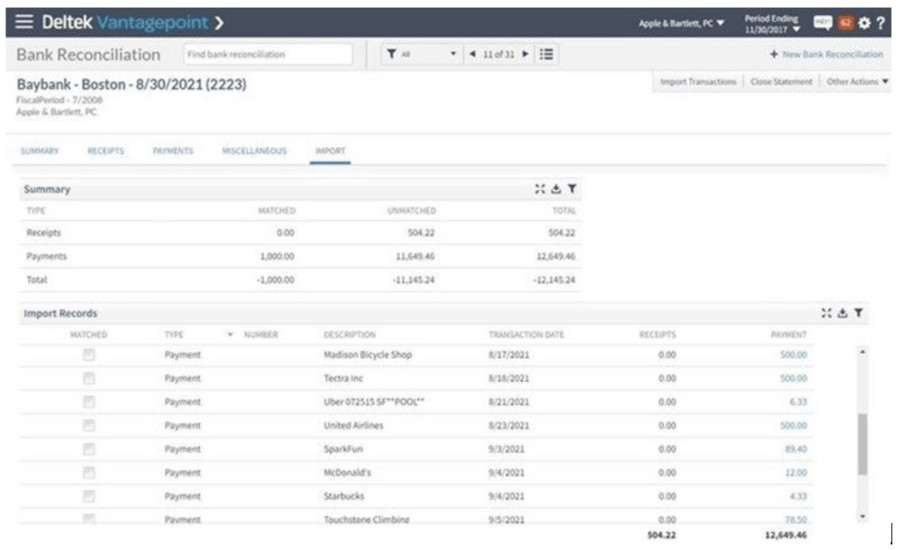
 Instead of the more time-consuming, manually administered import process, a professional services firm’s latest bank transactions are seamlessly imported into the accounting system. After import, they are reflected in the Bank Reconciliation record. It is then taken a step further by automatically matching imported records to posted payments and cash receipts.  

Setup Using the Plaid Assistant 

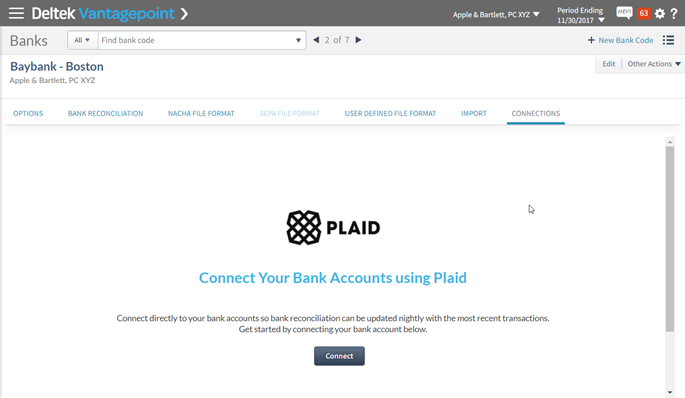
Most Deltek Vantagepoint clients can get started with this convenient solution today. They will first need to connect their supported bank within Vantagepoint settings (Settings > Cash Management > Banks). From there, that process will guide them through selecting their bank, logging in using their existing bank credentials, and then selecting the account that they want to connect to all using the Plaid setup assistant.  

If their banks require multi-factor authentication or OAuth, the process will be similar, while still incorporating those additional security steps to enter needed credentials. For step-by-step instructions, professional services firms can reference this video, or the relevant Deltek Vantagepoint help file 

undefined-Aug-15-2022-10-42-26-88-PM

After the connection is established, transactions which have cleared a professional services firm’s bank will automatically feed into Deltek Vantagepoint Bank Reconciliation on a nightly basis. System administrators can change the date on which Vantagepoint starts the daily transaction import into Bank Reconciliation in addition to the time of day that the import is run. Firms also have the flexibility to manually refresh transactions through the day.  

Bank Automation 01

Need More Help with Bank Feed? 

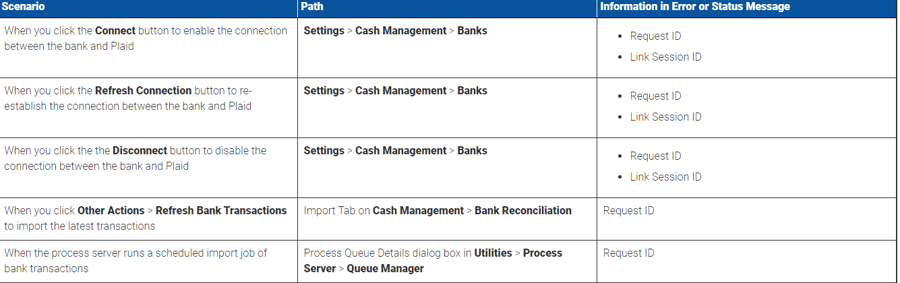
 If there is ever an error related to a firm’s bank connection with Plaid, there are some messages now displayed in Vantagepoint to help with troubleshooting. Firms should note the IDs and let Deltek customer care know. Here are some common scenarios that have been dealt with already. 

Streamlined Bank Reconciliation  

Professional services firms using Deltek Vantagepoint now really have it made in the shade. With the Plaid integration and ensuing automatic bank feeds, bank reconciliation has become even more streamlined. Without the need for manual downloads, firms now have much more time to manage other financial matters, ensuring improved efficiency. Firms should get started with this latest enhancement today! 


Click the image below to learn about how Deltek Vantagepoint powers project-based firms. 


Top A&E Firm Human Capital Management Challenges from the 43rd Annual Deltek Clarity Study

Posted by Tasia Grant, PHR on Aug 10, 2022 12:00:00 AM

2022 - 43rd Clarity_Human Capital Management_ Banner

It’s no surprise that finding and retaining top talent is a challenge facing every architecture and engineering (A&E) firm in North America but what specific human capital management (HCM) challenges are there? How do firms compare to the industry and what do the numbers really tell them? This overview is the first piece in a two-part series that will dig into the HCM specific challenges revealed from the 43rd Annual Deltek Clarity Study.  

Every Department Impacted by Staffing Shortages

Almost every area of the Deltek Clarity Study cited human capital management (HCM) towards the top, if not the number one challenge to growth. Many industries, including A&E, have been affected by the great resignation. Specifically, firms are saying it’s hard for them to win more business because they’re not necessarily certain that they can go ahead and staff projects. Hiring additional staff has become of paramount concern for A&E firms right now.  

The top financial challenges indicated from the Clarity study are finding and retaining qualified staff. This isn’t about a certain number of staff, but really finding qualified people that can handle the type of work and the different projects the firms have. This need is leading to more career development and training initiatives by A&E firms.  

Similar top challenges are cited in the project management area, including staff shortages and inexperienced project managers. So, how do firms develop project managers? How do they get the project managers up and running so they manage projects effectively? Part of the solution is hiring more experienced project managers, but other top initiatives include developing internal project manager best practices and investing in internal project manager training. 

Top Challenges for Human Resources 

The study asked what the top three challenges were for managing human resources. The number one response was retaining employees followed very closely by employee engagement/experience. Firms are realizing that they need to really become proactive in their retention and engagement efforts.  

No longer are firms just competing with companies in their own geographic region. With the rise of remote work, A&E firms are competing with other firms located across the country and talent is being recruited away from other areas. Other top challenges included career development, planning and performance management.  

Top Talent Acquisition Challenge 

The Deltek Clarity Study asked about the top acquisition challenges A&E firms are facing. The top response was the availability of good candidates in the marketplace. Based on this, it might be a good time for firms to step back to look at how they can change their practices or modernize their efforts to support recruiting.  

Specifically, this requires identifying what a good candidate means to the firm. The firm should ask what makes somebody who handles a role in the firm successful at it? Does the firm basically just review previous job descriptions or job profiles and reuse those? Has the firm really looked at what makes people successful in their specific role and in the firm as a whole from a culture perspective? 

After doing this initial analysis, the firm should evaluate what it is doing to diversify. Diversifying the talent pools makes sure that the firm is putting itself in the best position to find candidates that meet the profile developed. Also, the firm should consider what roles can be handled remotely. 

Firms should think about this from both angles – first doing a good job of understanding what makes people successful at the firm and then diversifying the talent pools to widen the marketplace. 

A&E Industry HR Statistics  

To give some idea of how a firm fits within the North American A&E industry, here are some high-level statistics related to human resources from the 43rd Deltek A&E Study: 

  • Employee turnover has increased a little from the previous year and is at 13.6%. 
  • Staff growth overall is up to 3.2% which means that despite a higher turnover rate, firms are still growing.  
  • However, offers accepted decreased and is sitting at 77.4%.  
  • Only about 50% of firms in the survey had more open positions last year, while this year’s survey saw 65% of firms with more open positions.  
  • The time to fill positions is becoming longer and longer, with 50% of firms saying it’s taking 60+ days to fill open positions.  

Gen Y Has Taken Over 

The Deltek Clarity Study looked at both generational composition firm wide and by management level. Firm wide, the Millennials (Gen Y) have taken over the greatest portion of staff making up 39%. It’s important to note that Gen Z is coming right up behind which really starts to play into how firms develop their culture and organization.  

The top-level leadership roles in organizations are currently held by Gen X, nearly 70%, but the study reveals that in the first to lower-level management, the younger generations are beginning to take over a lot of those positions. This is great because firms are starting to see new thoughts, new processes, modernization, and a lot of variety and diversity. A&E firms will continue to see this trend in terms of those generational shifts to the younger generation from a management perspective which will affect recruiting, retention, and talent development.  

Top Tools Used to Develop Talent 

Firms cited coaching and mentoring, external education programs, and leadership development programs as their top three tools used to develop talent. The very top method is coaching and mentoring. Firms should ensure that coaches and mentors are available to make the best impression on employees. Firms should not just rely on who has been at the firm the longest for choosing their mentors and should make sure that these mentors are equipped with the right skills to bring other staff along.  

Engaging Employees Too Late 

The Clarity study showed that 86% of firms conduct exit interviews, but these interviews are often too late. Many times, these type of exit interviews are not as effective for getting honest responses from the employees because they are simply trying to get through the exit process and leave the firm. Unfortunately, many firms are spending a lot of time on this strategy rather than on other strategies such as stay interviews or pulse surveys.  

Only 30% of firms conduct pulse surveys. Pulse surveys are quick hit surveys where the firm can get answers. They can be sent to the recent hires on their onboarding experience, for example. The idea is to gauge the pulse in real time throughout the course of the year.  

Dig Deeper into the 43rd Annual Deltek Clarity Report 

To get more details on A&E firm HCM trends or other interesting findings, download the full Deltek A&E Clarity report. Click the image below to grab a free copy of the report along with a scorecard to chart the firm’s results. Don’t forget to stay tuned for the second installment in this series that will share some ways firms can use this information to improve processes and help meet some of these HCM challenges. 


How AEC Firms Can Stay Ahead of the Talent Game with Reskilling and Upskilling

Posted by Tasia Grant, PHR on Jun 1, 2022 12:00:00 AM

2022-HRTL-Reskilling-01

IIn life, the good news must always be taken with the bad. In the architectural, engineering and construction (AEC) industry, the good news is that a massive federal infrastructure bill was signed into law that will help keep the industry growing in 2022. The question, though, is whether bad news will outweigh that good news for the AEC industry. Much like the impacts of the 2008 recession, according to an article in Civil Engineering Source, throughout 2021, supply chains, high prices for construction materials and labor shortages were affecting the entire AEC sector. So how can Human Resources departments address some of the trends that are being seen?   

AEC Trends and Tackling the Challenges 

Many leaders in professional services firms are tackling labor-related obstacles by evaluating their retention and talent acquisition programs. With the ongoing retirement of Baby Boomers, the increasingly technical (and digital) nature of work, rising wages and the “Great Resignation” of 2022, many employers at professional services firms are faced with skill gaps, problems attracting and hiring top job candidates and employee engagement retention problems.  

 Let’s take a closer look at each of these challenges:  

  • Feeling the Boom: With the departure of Baby Boomers, replacing the most senior and experienced professionals is an overwhelming challenge facing the industry. Most firms agree they can find new graduates, but their employment doesn’t replace those with 40 years of experience.   
  • Transform or Die: The pandemic required firms to rethink their digital adoption, but much of the AEC industry is still managed on paper including blueprints, design drawings, supply-chain orders, progress reports, punch lists, etc.  
  • Under Pressure: In the past, the main challenge was finding the work. Now one of the main challenges is how to keep the workers. Employers are feeling the pressure to raise wages or be forced with losing key talent. 
  • Gap-o-Rama: Graduates unfortunately don’t learn all of the necessary skills required for real-life work in the AEC industry. Additionally, with the constant change in technology, existing employees require learning new technology skills to stay competitive.  
  • Retaining Talent: During the pandemic, many employees re-evaluated what they wanted in life and from their employers. Many firms learned this lesson the hard way.  

Despite these talent woes, there is a solution for Human Resources professionals that is right up under their noses. Reskilling and upskilling are trending talent management tools that are being explored and implemented to address these challenges and ensure that growth stays consistent and progressive. Let’s take a deeper dive into what reskilling and upskilling are and the benefits each can bring to the professional services industry.   

Reskilling Versus Upskilling 

Reskilling is theprocess of employees learning new skills to move onto new roles within their current company while upskilling is a workplace trend that facilitates continuous learning by providing training programs and development opportunities that expand an employee's abilities and minimize skill gaps. The primary difference is that reskilling prepares an employee for movement into a new role within the company whereas upskilling prepares an employee for movement in their current career track within the company. Reskilling and upskilling are not just trendy or popular remedies. The professional services industry has found benefits for both the employers and employees, so it ultimately is a win/win. 

Benefits to Leaders 

  • Improves retention. Employees stay longer when they see evidence that their company is invested in learning and development. 
  • Keeps up with the industry. Maintaining highly skilled and knowledgeable employees keeps the organization competitive in the industry. 
  • Moderates recruiting costs. With the increasing costs of backfilling positions, reskilling might be a good alternative to letting go of current employees and hiring new ones with a different skill set, if the needs of the organization change.  
  • Attracts desired talent. Offering continuous staff training enhances the company’s reputation and brand image as an employer. 
  • Improves employee engagement. Potential and current employees want professional development and training opportunities in their job, and they will look for opportunities that provide these options. Upskilling satisfies these employee demands. 
  • Optimizes employee productivity. Improving employee engagement will ultimately increase productivity. 
  • Bridges the age gap. While generational differences can sometimes be a source of conflict in the workplace, when managed effectively, they can be a powerful source of innovation and adaptability.  

Benefits to Employees 

  • Feel more valued. When employees believe that the company is investing in them to improve their professional profile or give them new opportunities, it reinforces their loyalty. 
  • Have more opportunities for career advancement. Upskilling focuses on improving current employees' skill sets, usually through training, so they can advance in their jobs and find different roles and opportunities within the company. 
  • Increases their professional confidence. One of the primary benefits to employees is that upskilling can help to boost confidence anddevelop stronger, more capable teams in the business. 
  • Builds better relationships between employees and managers. As managers and employees collaborate on their employees’ career paths and provide leadership and mentoring during the training and development process, knowledge sharing, trust, and respect evolve organically.  

Repurpose Talent 

The bottom line is professional services firms are in the best possible position with continuous technological advancement, growing leadership flexibility, and external financial resources to successfully develop and implement upskilling and reskilling programs. Executives, senior leaders, human resources professionals, talent acquisition professionals, training & development specialists, or even HRIS experts, should join the upcoming webinar “Rebounding and Staying Ahead of the Game:  Attract and Retain Top Talent using Reskilling and Upskilling” on June 9th. During this webinar, find out what the so-called “Great Resignation” of 2022 is, hear case studies about other firms (especially in the AEC industry) who have successfully implemented these programs, and learn steps that organizations can take to develop a program that caters to firms’ talent management needs and goals. 


A Few of My Favorite Things About Deltek Vantagepoint Reporting

Posted by Terri Agnew, CPA on Apr 6, 2022 12:00:00 AM

2022 - Vantagepoint Favorite Things-01-1

In my prior experience as a Controller of Architecture and Engineering (A&E) firms, I was often the “go-to” person for creating reports for PMs and Executives using Deltek Vision. Over time, I learned exactly which tab(s) the options were on for the various reports, which navigation menu item to choose to find the report base I needed, and even which color names were my favorites to use for the group headings.  Now with Deltek Vantagepoint, report creation has been made even easier with a few excellent enhancements. So, with the musical the Sound of Music in mind, let’s highlight the Deltek Vantagepoint report upgrades as “A few of my favorite things” …about reporting!  Feel free to “sing” along. 

Favorite Thing #1 - Organization of Reporting Menu

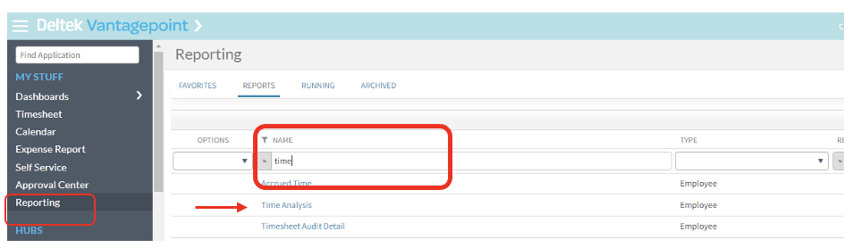
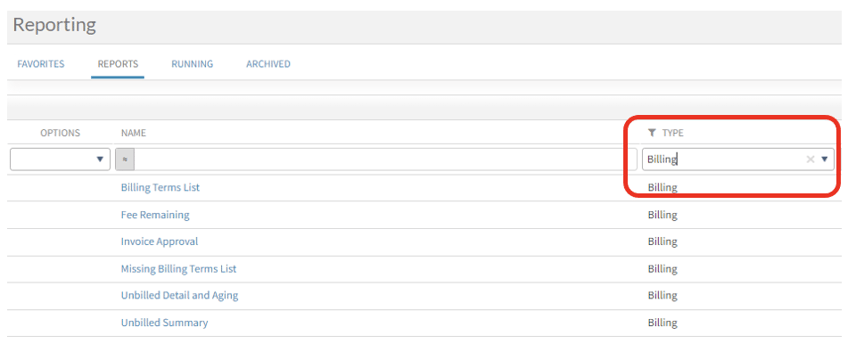
My first “favorite thing” may not be as pretty as “raindrops on roses” but it sure will save time!  Unlike Deltek Vision, Vantagepoint has only one Reporting option on the Navigation menu. All the standard base reports are now found on one “Reports” tab within Reporting. Likewise, all Saved Global/Personal reports will be listed on one “Favorites” tab. Instead of navigating through a dozen + menu items to find the report needed, now simply search for the report by name on either tab or filter by the type of report if you choose.    

For example:  Don’t scroll through the full list searching for the Time Analysis Report. Using the name of the report, start typing “time” in the search bar and “voila”, the report will populate.   

Fav_Things-01

Just even knowing the type of report rather than the name of the report, it can be filtered based on report type and list just those reports. This filter is like navigating the reporting menu tree in Vision.  

Fav_Things-02

Favorite Thing #2 – No more than 4 Option Tabs!   

Unlike the many “whiskers on kittens”, there are no more than four tabs to review for reporting options.  In Deltek Vision, some reports had two tabs, and some had up to seven! In Deltek Vantagepoint, at most there are only four tabs. 

Fav_Things-03

Columns & Groups:   Always start by deciding how the report should be grouped/sorted and which columns are wanted on the report. Keep in mind the headings of the columns can still be changed just like as in Deltek Vision but now there is only one header, not a header line 1 and line 2.   

Options:  This tab contains all “other” options for the report selected. Time selections, activity options, budget options, financial detail options – if the report has the option, this is where to find them all!  Having all the options consolidated to one tab makes it easier when creating a report as the user can simply skim through the options available from top to bottom.  There is no need to go from tab to tab any longer! 

Chart:  Not all reports have the ability to utilize charts, so this tab is not always an option. However, if the report data makes sense to also be shown in a bar, pie or line chart, this is the tab to set it up. 

Layout:  This is the tab with the choice to override the report defaults for report layout (portrait vs landscape), paper size, font, borders, headings & footers.  Advanced tip:  If a user has special options for a report, consider adding the options selected as a note in the footer for a reference as needed. 

Favorite Thing #3 – Easy Searching for Columns & Groups  

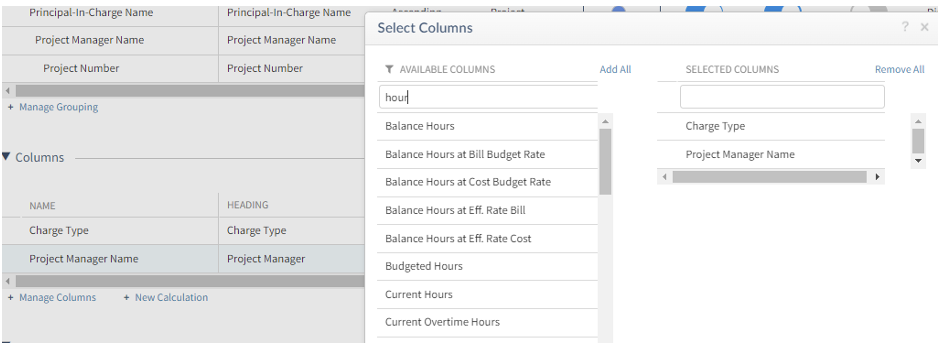
My third “favorite thing” is how easy the column and group options can now be selected in Deltek Vantagepoint. This may seem basic but having one quick and easy selection area is as satisfying as some “crisp apple strudels” with my coffee. 

Does the user want to know part or all of the name of the column or to add YTD data columns only? Does the user want all columns for hours? Use the filter! It will save time as there is no need to scroll through the long list of column options. 

Fav_Things-04Favorite Thing #4 – Colors for Grouping & Headers, now Actual Colors not Words!!   
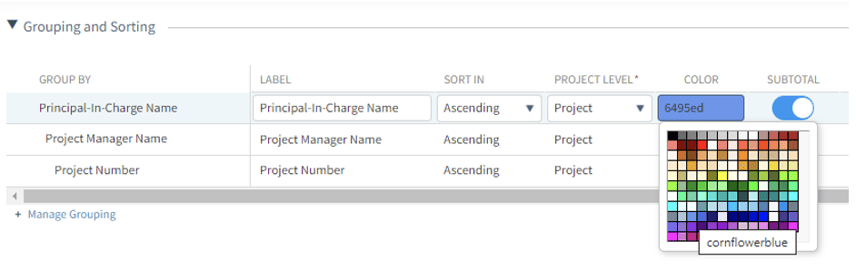
Let’s face it, sometimes data is boring and can be hard to read if there is too much of it on one page!  Adding some color to grouping labels can help the eye focus in on a particular detail.  The new color selections in groupings & headers are related to my favorite thing #2Want a blue like “blue satin sashes”? In Deltek Vision, to figure out if that blue was cornflower blue or light steel blue, the user had to select the color by name, preview the report and decide if it was the color desired. Now the color selection actually shows the true color visually! 

Fav_Things-05

Another great place to use colors to brighten up a report is in the Column Heading. This option can be found on the “Layout” tab of reporting. Use a nice bright color to liven up what used to be a basic black & white report. Better yet… does the firm have an approved color palette? Find out the color codes for the firm’s colors and type in the code of the color to use in reports. Now reports will match the company branding. The user doesn’t have to be limited to the 140 colors shown in this grid. Here is a website that shows more color options:  Color Hex Color Codes (color-hex.com). Select a favorite color or the company’s brand color to liven up those reports! 

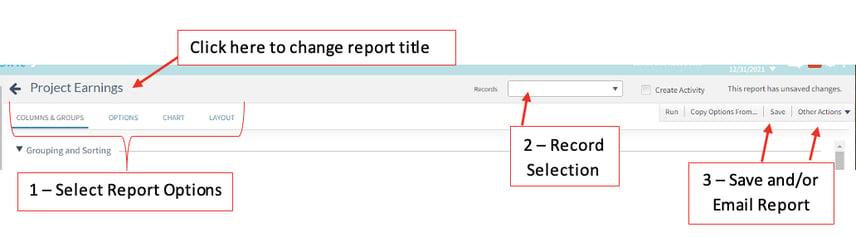
Favorite Thing #5 – Select Report Options, Records and Save the Report - All from One Screen! 

My last favorite thing about Deltek Vantagepoint reporting reminds me of “brown paper packages tied up with strings”. Deltek took three areas from Vision reporting and combined them to one page. In Deltek Vision, users had to go to one screen for Options, go back to the main reporting page and navigate to a second screen for the records selection, navigate again to the main reporting page and go to a third screen to save the favorite report. In Deltek Vantagepoint, all three of these reporting functions are executed from this main reporting screen! 

Fav_Things-06

Two more quick reporting tips… (1) don’t miss that the report title can be changed directly from this screen as well! Simply click on “Project Earnings” and rename this report to whatever makes sense for the organization.  (2) Users can also email the report directly from this main screen from the “Other Actions” options. 

Enjoy the Enhancements of Deltek Vantagepoint 

While Deltek Vantagepoint users cannot all sing with the voice of Julie Andrews in the Sound of Music, they can certainly benefit from this list of “my favorite things.” In fact, users may discover more to add to this list! In the meantime, let these Deltek Vantagepoint enhancements make reporting a lot easier because like Maria said when feeling sad, “I simply remember my favorite things and then I don’t feel so bad.”   


Click the image below to learn how to add the powerful, feature-rich ERP to your toolbox and get your team working on the same page of the same book.

Latest Posts