
Full Sail Partners Blog | Ryan Felkel (15)

Posts by Ryan Felkel:

Full Sail Partners Strengthens Consulting Team with the Addition of Matt McCauley

Posted by Ryan Felkel on Jul 11, 2016, 12:00:00 AM

Matt McCauleyFull Sail Partners, a Deltek Premier Partner, announces that Matt McCauley EA, MS has joined the firm as a Principal Consultant. Mr. McCauley’s hire expands the Full Sail Partners’ team to more than 30 professionals focused on technology solutions. His extensive knowledge of the Deltek product set and proven consulting expertise are an ideal match to help clients streamline business processes and achieve greater efficiency from their Deltek Vision ERP system.

With more than 20 years in the professional services industry, Matt has the insight that will allow him to identify the unique requirements of our clients. He specializes in Deltek Vision’s Core Applications, Resource Planning, VPM, and most recently, Fixed Assets.

“My prior experience as a CFO and a Deltek Vision client will help me bring a client-based end user approach to Vision consulting,” said Matt. “I’m excited to work closely with clients to implement Vision in a way that complements their business processes and to improve operational efficiencies.” 

Throughout his career, Matt has worked as both a client and a consultant, providing a unique perspective during client implementations. As a CFO and Deltek Vision user, Matt led the Vision conversion effort for his firm and managed Vision prior to becoming a consultant. Additionally, Matt has completed the PSMJ Project Manager and Financial Manager Boot Camps, and is an Internal Revenue Service Special Enrolled Agent, a Federally Licensed Tax Practitioner.

“We are excited to have Matt join the Full Sail Partners’ team,” said Scott Seal, Vice President of Consulting. “Matt’s background in Accounting and Project Management, both as a Deltek Vision Power User and Vision Consultant, provides more depth and expertise to our collaborative consulting team. Matt’s extensive 20+ years’ of experience in the professional services industry allows him to provide unique insight that will help our clients to better leverage their Deltek Vision systems.”

For more information, please contact Full Sail Partners’ Marketing Communications Department. Interested in learning more about the Full Sail Partners' team? Check out our crew!

Facts about Client Data Integrity

Posted by Ryan Felkel on Jul 6, 2016, 12:00:00 AM

Garbage in, garbage out! Believe it or not, this is a real term in the field of computer science and it has an acronym, GIGO. More importantly, this theory can be applied to the data integrity in a client relationship management (CRM) software. Marketing decisions are only as good as the data used to make them. If the data in a CRM are incomplete and erroneous, developing strategic decisions becomes nearly impossible. In other words, it’s like throwing ideas at a wall and waiting to see what sticks. According to data experts, many businesses are struggling to maintain a CRM database with consistent and usable information about their clients. Look below to see what these experts have to say about client data integrity.

Hiring Smarter in a Competitive Workforce Market

Posted by Ryan Felkel on Jun 17, 2016, 12:00:00 AM

Hiring SmarterFinding and hiring the right talent is a lengthy and administratively burdensome process. The amount of time and money spent announcing job openings and qualifying applicants is barely quantifiable, but we all understand that the price is high. Add in the tasks created by legal requirements and corporate responsibility, and the process becomes crushing for even the most seasoned and organized recruiter. Therefore, hiring smarter in a competitive workforce market is critical to lowering costs of recruiting the top talent.

The Hiring Team

Businesses of all sizes use teams to conduct the hiring cycle. The decision makers on the teams are often professional staff whose primary role is to produce. The cost of time spent by these members can be massive and results in reduced attention to mentorship, production, or development. Having a portal that allows managers to see the progress of the hiring cycle and quickly identify their own action items is an integral to saving time.

The Job

Even if the job announcements are fully standardized, they must still be posted to each site of choice. Each site has its own format and requirements, forcing recruiters to take the same actions multiple times.

Using a tool that allows for automated posting to multiple sites and tracking of non-automated postings is an important time saving device. Having visibility into the applicant pipeline and notification alerts that action is needed helps streamline the requisition process.

The Applicants

There is a shortage of talent. There is no shortage of applicants.

Qualifying applicants and moving them through the hiring process is a time-intensive effort often plagued by manual processes. The mechanics of receiving an application, reviewing the data, and ranking the applicants are most often conducted via email or paper and creates risk legal risks without clear and objective criteria and measurement.

The ability to build a database of applicants who do, may, or do not meet the hiring criteria is highly valuable for this and the next hiring cycle. Hiring smarter requires retaining past applicants’ information so your firm has a deep pool of possible talent for future positions.

The Communications

The hiring process is full of action items for the recruiter. Traditional tools used to communicate with applicants and candidates often force recruiters to create a physical paper trail and allows important communications to slip through the cracks. Scheduling interviews and tracking the stage of candidates as well as memorializing the results, can become overwhelming in a multiple interview process. Leveraging the use of the database, automation, and tacking abilities, including bulk letter submissions, allows recruiters to save time and provides a reference for later use.

Hiring Smarter With the Right Tool

Every role in a firm is best served by having the right tools in place. Hiring smarter requires investing in a tool designed for the recruiting function that allows for not only time savings, but also optimization of the process, risk reduction, and increased satisfaction by hiring team members and applicants alike.


Topics:  
HR

Fascinating Facts about Timesheets in Deltek Vision

Posted by Ryan Felkel on Jun 8, 2016, 12:00:00 AM

Timesheets, Timeclock For project-based firms, timesheets are essential to ensure that an employee’s time is reflected to a specific project. I’m sure you already knew this, but do you manage timesheets correctly in Deltek Vision? Here are some facts and best practices for different scenarios to help you better manage timesheets in Deltek Vision.
Intro to Timesheets in Deltek Vision

Hopefully, one of the first things your Deltek Vision Consultant explained to you about timekeeping is that timesheets create payroll cost not payroll. As a “nuts and bolts” accountant, at least one side of our brain struggles with processing this information. So let’s break it down: 

  1. The employee’s job cost rate on the accounting tab of their info center should represent their rate of pay. If they are true hourly, this is quite easy to determine. On the other hand, if they are salaried the hourly rate should reflect their annual salary divided by 2080 hours.
  2. If adjusted salary job costing is used, the amount should reflect their salary based on the configured interval. For example, weekly, biweekly or a set number of days.

How Timesheets Work

When a timesheet is posted an amount based on the hourly rate multiplied by the hours charged is applied to the selected projects. Thereby creating direct or indirect (overhead) labor/payroll cost in the General Ledger. The credit created by the timesheet can go to either one of two places: 

  1. The Income Statement as job cost or payroll variance - This account is an overhead line item used to adjust the total of the timesheet posting to the actual payroll distributed. Furthermore, amounts that remain in this account after the payroll journal entry has been entered reflect a net of uncompensated overtime (OT) for salary staff (negative amounts), and based on this process, the premium portion of OT for hourly staff (positive amounts).
  2. The Balance Sheet as a payroll liability - After the payroll journal entry has been entered, the remaining amount needs to be reclassified to the Income Statement as stated above.

Accounting Tip for Paid Time Off

Have you ever noticed your Paid Time Off (PTO) balance not being relieved even during peak vacation periods? You might want to consider booking PTO taken to the Balance Sheet. To do this, you need to configure timesheet postings for PTO to go to a PTO liability account. Then when time off is taken and posted, the debit entry reduces the liability. Based on a true computed liability, an entry can be made on a pre-determined interval to accrue additional PTO and book the expense. If you are using benefit accruals in Vision, the entry can be taken from that report.

Handling Leave without Pay

Many firms fail to account for leave without pay (LWOP) properly. Sure, there is a need to track hours for statutory purposes when employees are on leave, however, no payroll cost should be recorded. The simple fix is to enable cost rate tables and attach one to LWOP projects. The table should contain either a labor code(s) or a list of employees with a ZERO job cost rate. This will override the employees default job cost rate and avoid any recording of payroll costs.

Punch the Clock

Some of this might seem complicated at first, but these best practices should help keep your books in order. I hope that this has taken the mystery out of Deltek Vision timesheets. Now punch the clock and update your timesheets.


3 Critical Connections for Project-Based Firms

Posted by Ryan Felkel on Jun 6, 2016, 12:00:00 AM

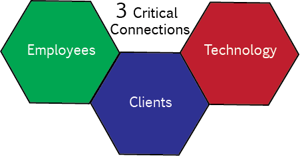
Three Critical Connections Let’s admit it, running a business has plenty of challenges. Why create more by overlooking the critical connections that support your business? Throughout my tenure as a business owner and entrepreneur, I have found three connections a business must have to reduce the challenges. These are connections with employees, clients, and technology. Let’s take a look at the importance of these three connections.

Connections with Employees

For starters, firms need to create a workforce that are driven to work hard and are enthusiastic about their jobs. To achieve this, employers must find ways to create connections with employees that shows them you see them as people, not just employees.

The easiest way to show an employees you see them as people is to engage them. For example, use meetings as a time to let everyone express their ideas. Ask for their opinions, and ask them to think critically about things. At the end of the meeting, people walk away feeling as if they contributed to the better good of the organization. For more about connecting employees, check out the “9 Ways to Connect with Employees” blog.       

Connections with Clients

For project-based firms, it’s important to connect with clients throughout the entire project lifecycle. Ponder this question. Have you ever completed a project for a client and you believe they are completely satisfied with your services, but find out later that they were not happy? Sometimes even a client you know may feel uncomfortable telling you something is bothering them. So how do you identify there is an issue?  

First, work with the client to setup expectations before a project starts. Secondly, continuously check-in with a client on a regular basis during the project lifecycle to manage expectations of the entire team. One of the best ways to do this is through an automated feedback process. Watch this vlog, “Client Connections – Create Unique Client Experiences” for more ideas about connecting with clients. 

Connections with Technology

Most if not all businesses use technology to support their operations. The question here is, how many different systems does a business use and how do they connect? In reality, they usually don’t seamlessly connect and share information. As a result, critical business data is stored in multiple systems, making it difficult for business leaders to make informed decisions.

For businesses to be successful, systems and applications must be in place to support all departments. Although each application is designed to support a specific function of the business, the data for these systems should start with a core ERP system and have the ability to connect to other critical systems. This allows for clear visibility throughout the entire organization. Interested to learn how you can connect to other external systems? Watch this vlog, “Systems Connections – Is Your Critical Technology Connected?” to learn more.    

Connecting It All Together

A project-based firm is so much more than the service they provide; rather, it is a network of connections that require special attention. It is important to connect and communicate with employees and clients in order to build a sturdy foundation for your business to grow from. Connecting with technology is equally as important, as doing so can maximize efficiency in operations while also providing an edge against competitors. Ensuring that these three critical connections are a priority is simultaneously ensuring your business will be successful.   


9 Ways to Connect with Employees

Posted by Ryan Felkel on May 17, 2016, 12:00:00 AM

Connect with EmployeesWhat is the lifeblood of your business? Some might say clients and others might say employees. I tend to agree with the latter. Every company needs employees that are enthusiastic about their job and care about the company. Additionally, employees need to bring excitement and drive every day they show up to work in order for companies to be competitive. But how can a boss or employer create driven workforce? Simply by connecting with their employees. Let’s take a look at ways to connect with employees so your company can thrive.

Nine Ways to Connect with Employees

  1. Create Dialogue – The act of conversation in itself is a way to stay connected with employees. Far too often though, bosses find themselves leading conversations and doing most of the talking. As a result, employees are not engaged and the conversation is one-way. This doesn’t have to be the case. Whenever you are engaged in conversation with employees, it’s important to ask open ended questions to encourage employees to express their ideas and opinions.
  2. Keep Your Ears Open – You have two ears and one mouth for a reason. This might sound cliché, but it’s still a good thought to keep in mind. In reality, many people don’t understand how to listen. A good listener remains patient, absorbs what other people are saying, and ask engaging questions for clarity. More importantly, some people express ideas better than others, but that doesn’t diminish the value of their ideas.
  3. Give Ownership to Employees – I’m not saying give them actual ownership, although that could be appropriate at times. What I mean is to allow employees to own responsibilities and tasks within the organization. Give them the power to make decisions that truly affect their job and performance.  
  4. Provide a Career Path – Words and actions are two different things. Telling an employee they are doing well and they have a promising career with the company sounds nice, but it lacks an actual roadmap or path to where they are going and how to get there. Instead, find out what the employee’s career goals are and figure out a way to get them there. Put this in writing, and include challenging responsibilities to drive their personal growth. Additionally, include clear milestones that allow the employee to see they are achieving their goals.
  5. Educate Employees – Education doesn’t stop when you leave school and start a career. Even more, the skills we learned in school might not be exactly applicable to where your career path is going. Any company can train their employees, but how many of you educate your employee beyond their job responsibilities? Spend time educating about soft skills and even topics that help employees grow as a person. Investing in employee education provides a path to connect with your workforce. It also shows you care.
  6. Provide Guidance to Employees – One of the best learning opportunities for employees come from their boss. Furthermore, bosses provide more than explicit knowledge; they also provide a great deal of tacit knowledge. Here’s the difference. Explicit knowledge is formalized and documented. Whereas, tacit knowledge is more situational based knowledge. This experienced based knowledge is hard to teach, but as a boss, you’re in the perfect place to teach this based on your past experiences by applying this knowledge to current situations. For more about knowledge sharing, check out this whitepaper.
  7. Be Flexible with Employees – Technology has changed the way we work. The good thing about this is that many professional jobs can be accomplished from nearly anywhere with an internet connection. Additionally, these roles are no longer working from to 8:00 to 5:00, Monday through Friday and some days are longer than others are. Value your employee’s time and recognize the need for positive work to personal life balance. This allows you to connect with employees through trust, and that you know they will manage their responsibilities.
  8. Honesty is the Best Policy – Honesty is a powerful personal characteristic to exemplify. In fact, honesty is a characteristic that most, if not all leadership guides list as a key characteristic of a good leader. The reason for this is employers that are honest build confidence and trust with employees.   
  9. Always Remain Calm – Keep calm and connect with your employees. In other words, overreacting to stressful situations builds a wall between bosses and employees. By remaining calm and not screaming, employees find bosses more approachable and open minded.

Make It about the Employee

What this all boils down to is that employees want to be seen as people and to know that the company is invested into them. So in order to connect with employees, your goal should be to create a culture that empowers employees and shows you value them. After all, you want them to value the company as well.  

Creative Billing Can Improve Your Cash Flow!

Posted by Ryan Felkel on Apr 29, 2016, 12:00:00 AM

Cash FlowCreativity, when used in the accounting world, is usually considered a “no-no”. However, I am not talking about misrepresenting the state of affairs. In fact, I am talking about the exact opposite - providing the client exactly what you told them to expect at the beginning of the proposal process. Let’s take a look at how setting client expectations early can improve your firm’s cash flow. 

Setup a Project Process

I am not saying that project management and marketing get to dictate accounting functions, but I am saying that it is imperative that accounting work with project managers and marketers to ensure the signed agreements match the accounting schedule and billing possibilities. To do that, accounting needs to understand the needs of the client and the project managers, as well as the functions and limitations of the software they use for accounting and billing.

From there, you can create a project set up process that easily allows the project managers to see where they are in the project in relation to the budget and plan. This ensures the invoices match what the client was told to expect. As a result, clients are more likely to pay on time and you can count on the cash flow coming in from your clients.

Understand Reporting and Timing Requirements

In many cases, clients have specific reporting and timing requirements – some are reasonable and some are not. Involving accounting at the front end of the project to have discussions with the clients about what is possible and not possible will go a long way to ensure a smoother billing/collection process down the road.

However, accounting can’t become obstinate with the “we don’t do things that way approach.” There has to be a willingness to work with the others to solve the issues between the client desires and the current accounting process. Having he accounting staff work directly with the client to resolve the issues will ensure both understand where the other is coming from.  

Have the Right Accounting System

Understanding what the client needs and understanding what is possible in the billing system allows accounting to bridge the gap. Of course, having a system that offers many options to bill the client helps too. At a minimum, your system should allow you to create billing cycles that allow for most client timelines.

The better systems will allow for billing to be prepared with multiple options for the way the labor and expense are handled. Additionally, they have ways for managing fees and additional items such as credits. The best systems allow for changes in the invoice format so the final product has the required information in more or less where it is needed. Again, flexibility, creativity and patience are often needed.

Let the Cash Flow

Remember that a good collection process begins by communicating with the client - take the time to understand their needs and explain what is possible. Create a billing process that is flexible enough to support client expectations and is efficient enough to be managed internally. Doing so will go a long way in avoiding issues down the road.

Bid/No Bid – When to Decide During the Proposal Process

Posted by Ryan Felkel on Apr 20, 2016, 12:00:00 AM

Bid_No_Bid_Proposal_Process.pngOften times, upper management views the proposal process as a “cost of business” and don’t put forth a concerted effort to control proposal related costs. There are several ways to increase the cost-effectiveness of your proposal process, and starting with a bid/no bid process is the first step.

Did you know that 40% of AE firms have no formal bid/no bid process? This is according to the 36th Annual Deltek Clarity AE Report. For that reason, I’m going to focus on the importance of the bid/no bid process. More specifically, why the decision can be made during any phase of the proposal process. 

Notification of New Opportunity

Let’s start by saying that if you’re receiving notification of a new opportunity within your industry when the request for proposal (RFP) is issued, your business development team is already crippling your chances of winning that opportunity. This is a huge red flag to include in your bid/no bid process. On the other hand, if they have a great relationship with the prospective client, they probably have a decent understanding of the scope of work and the project requirements. Either way, this is the first opportunity your company has to decide whether to bid or not to bid.

Honesty is the best policy, so be honest with yourself! If you specialize in building parking garages and the RFP is for a bridge, your chances of winning are already slim. Sure, you want to branch out and do more than build parking garages, but is this client the one that’s likely to give you that chance? Odds are, probably not.

Release of the RFP

Now you have the RFP that in a perfect world has a detailed scope of work and all the requirements. This is when the page turning begins with a detailed review of every word. Does your proposed solution work within the stated budget? Have you revealed any obscure requirements that are red flags? When evaluating your solution and the requirement, create a risk management plan and think about how your company has managed similar risks in the past. 

There’s the old adage, you can’t fit a round peg in a square hole. In other words, if you can’t provide a solution within the requirements of the RFP, your chances of winning are already greatly diminished. Instead proposing on this opportunity, utilize your resources on an opportunity within your company’s skill set.

During the Proposal Preparation Process  

As you begin to develop your solution, keep in mind that it’s still not too late to abandon the RFP. In some cases, the client may issue amendments or provide clarity that changes the scope of work. Other times, the proposal preparation team may find that the proposed solution has become more complex than originally thought or certain costs were overlooked. 

Usually people say “better late than never” as an excuse. However, in this case, it’s absolutely honorable to walk away from an opportunity before committing your company to something it might have difficulty delivering. In the end, winning the work doesn’t guarantee a profit or a happy client. 

Winning with a Bid/No Bid Decision

In the proposal world, there are always two winners for each RFP. Obviously, the company that wins the bid, but the less obvious is the first company to decide to focus their resources on other business opportunities. As a proposal manager, you want to increase your win rate, and at the same time, upper management has the need to win more revenue. While this puts the two sides at odds, agreeing to an effective bid/no bid process can significantly increase your proposal cost-effectiveness and possibly increase revenue for the company.   


Full Sail Partners Hires Amy Balassone to Extend the Full Sail Partners Brand to Professional Services Firms

Posted by Ryan Felkel on Apr 18, 2016, 12:00:00 AM

Headshot_1.jpgFull Sail Partners, a Premier Partner for Deltek and the Client Feedback Tool, is pleased to announce the hire of Amy Balassone in the role of Direct Marketing Associate. In this role, Amy will work with the marketing and sales team to communicate the value of Deltek Vision to the professional services industry. With more than 12 years of customer service, sales, and marketing experience, Amy will conduct market research on management consulting firms to extend the Full Sail Partners brand beyond the AE industry.

“What has impressed me most about the company is their customer service and dedication to their clients, “ says Amy Balassone, Direct Marketing Associate. “I feel privileged to be a part of a company that takes a consultative sales approach to ensure prospects are the right fit for the software. That customer focused mentality is what makes this company great and easy to work for.”

Amy will support the company’s growth goals and provides the firm with the brand awareness development experience needed for Full Sail Partners to help project-based firms develop their systems and processes.

“Amy’s tenacious, yet easy-going personality combines the right touch needed to target new verticals,” said Sarah Gonnella, Full Sail Partners’ Vice President of Marketing and Sales. “We are extremely honored to have Amy join our team. What is most impressive about Amy is her drive and resourcefulness. Her varied experience with marketing and sales along with her previous experience in the Navy as a data systems technician brought the right mix for this position.”

Measure Your AEC Firms Performance with the Deltek AE Clarity Report

Posted by Ryan Felkel on Apr 6, 2016, 12:00:00 AM


Deltek AE Clarity Report.pngHow did your firm perform last year? Did you do better than the prior year? I’m sure the majority, if not all AEC firms, evaluate their performance in comparison to prior years, but do they evaluate how they performed against similar firms within their industry? Fortunately, the Deltek AE Clarity Report provides unique insights into the AEC industry that make an accurate comparison possible.

Each year, Deltek working in conjunction with ACEC, ACEC Canada, and SMPS, conducts an industry study that draws from over 250,000 data points provided by more than 350 US and Canadian firms of all sizes. This one of a kind study provides real insight into the AEC industry to enable firm leaders to make strategic decisions to increase their competitiveness and help their firm’s growth. As part of this study, Deltek takes an in-depth look and analyzes participants’ financial condition and market outlook, including:

  • Operating Profit
  • Net Labor Multiplier
  • Staff Growth Rates
  • Backlog
  • Utilization Rate
  • Net Revenue Per Employee
  • Current Ratio
  • Other Key Financial Metrics

Real Results Your AEC Firm Needs to Know

Prior results from AE Clarity Reports provided industry-specific insights about the most profitable trends in the AEC industry. Some key findings from the 36th Deltek AE Clarity Report were:

  • Firms that work on water, wastewater, and storm water projects, expect their work in the market to grow by 59%, the highest percentage of all surveyed markets. Additionally, markets in which more than half of respondents work in expect their business to grow. These include commercial sector respondents who expect a 58% increase, roads and bridges markets with an increase of 57%, and surveying and GIS sector with an increase of 55%.
  • Markets in which respondents are least optimistic for growth are public facilities with an increase of 38.4%, the hospitality sector with an increase of 38.5%, and a 45.4% increase in the residential sector. Nonetheless, these are still encouraging numbers!                                                                                                                                                        
  • AE firm leaders reported that the top three factors influencing the success of their companies are the right people, which was cited by 75.7% of respondents, long-term relationships with clients was by cited by 74.7%, and 65.5% of respondents said their firm reputation influenced their firm’s growth. How does client retention affect your profits? Learn the formula to calculate this here!
  • There’s even more positive news in last year’s AE Clarity Report. Of the AE firms that participated in the survey, they responded that they had a proposal win rate of nearly 50%. Further positive news is that 42.9% of respondents reported that their win rate has increased either slightly or significantly in the past two years. On the other hand, 12.3% reported that they experienced a drop in their win rate during the same period.
  • The top choices for business development responsibility were the executive team that drove 84.7% of their efforts and project managers who drove 68.6% of the business development efforts. One might suspect this comes from developing meaningful relationships with existing clients.
  • Overall, about 60% of AE firms said they employ a go/no-go process in at least some situations. Of these, 29.2% said the employ process for all opportunities, and 30.6% for specific cases, especially “strategic” opportunities.
  • Top ranked project management challenges included accurate project cost forecasting, and difficulties with collaboration and communication. On the other hand, one statistic showed that 75% of projects were currently on or under budget for the majority or survey respondents.

So how did your firm stack up against these results from the 36th Deltek AE Clarity Report?

What’s New in the 37th Annual Deltek AE Clarity Report?

Great question! But just as important, what do you do with this information? Learn what Deltek experts think and how they use this information at an upcoming AE Clarity Tour stop near you. The 37th Annual AE Clarity Report will be out soon!

Latest Posts