Full Sail Partners Blog | Professional Services Firms (2)

Posts about Professional Services Firms (2):

Understanding the Impact of the Organizational and Work Breakdown Structures in Deltek Vantagepoint
Posted by Jenny Labranche on Apr 11, 2024 12:00:00 AM

05-25-23 Organizational Structures_banner

Welcome to the matrix, you have the power to build a solid structure and allow your data to flow.  However, it is beneficial for one to understand the difference between Work Breakdown Structure (WBS) and Organizational Breakdown Structure (OBS) before you lay that foundation. During both the implementation of Deltek Vantagepoint and throughout a firm’s growth, professional services firms should understand the connection between the Organizational Breakdown Structure and the Work Breakdown Structure.  

A typical first step is to consider whether the firm needs to re-organize these structures. Whether it be the uniqueness of each, or the relationship between the two, the attention paid to these early stages of development is instrumental to the flow and reporting of information in your Deltek Vantagepoint database. In the following, we’ll explore some areas to consider when designing these structures in your database.  

Organizational Breakdown Structure (OBS)

When it comes to designing the Organizational Breakdown Structure (OBS) in Deltek Vantagepoint, it's important to consider the specific needs of your professional services firm. The OBS can range from simple to complex, depending on the size and requirements of your organization. Here are some examples of different OBS approaches.  

  • Location Approach: With this approach, the OBS is organized based on the physical locations of your offices or project sites. Each location represents a hierarchical level in the structure, allowing you to track and manage projects and resources across different geographic areas.  
  • Discipline/Department Approach: In the discipline or department approach, the OBS is structured around different functional areas or departments within your organization. This allows for efficient resource allocation, project assignment, and collaboration within specific areas of expertise.  
  • Market Sector or Business Development Driven: This approach focuses on organizing the OBS according to your firm's market sectors or business development strategies. Each market sector or business development unit can be assigned a hierarchical level, enabling you to analyze performance and profitability based on these segments.  

Deltek Vantagepoint provides flexibility in designing your OBS, offering up to five hierarchical levels to accommodate your specific requirements. It also allows for the allocation of overhead requirements within the structure of the database. If you plan to utilize the multi-company functionality in your database, it's important to reserve level one for different companies within your enterprise.   

Financial accountability is a crucial aspect of any professional services organization. When building your OBS, it's essential to consider the financial implications. For example, if you use a two-level OBS structure, such as office and department, each combination will generate an income statement. This means that someone within your organization should be responsible for reviewing and managing these statements.  

Deltek Vantagepoint also enables the extraction of various cross-sections for combined financial reporting. For instance, if you have a mechanical department in three offices, you can create a mechanical income statement that provides accountability at different levels:  

  • Office Accountability: You can track the financial performance of each individual office separately, gaining insights into the profitability and expenses associated with specific locations.  
  • Office/Department Accountability: This level of accountability allows you to analyze the financial performance of different departments within each office. It helps in evaluating the contribution of each department to overall profitability.  
  • Overall Department Accountability: By consolidating the financial data of the mechanical department across all offices, you can assess the department's overall performance and make informed decisions regarding resource allocation and strategic planning.  

The OBS in Deltek Vantagepoint offers the flexibility to design a structure that aligns with your professional services firm's needs. By carefully considering the OBS approach, financial accountability, and the ability to generate cross-sectional reports, you can effectively manage projects, resources, and profitability within your organization.  

Projects and the Work Breakdown Structure (WBS)

The Work Breakdown Structure (WBS) is a critical component that determines how a project is organized and how revenue and costs flow within a professional services firm. Most firms find it effective to build their WBS based on project budgets, aligning with the fee and scope defined in the client contract using a bottom-up approach. The best practice is to build your WBS to mirror your contract for smooth management of resources, budgets, and billing.    

Deltek Vantagepoint provides the flexibility to define up to three levels in the WBS, commonly referred to as Project, Phase, and Task. However, these labels can be customized to match your firm's preferences. Furthermore, the WBS allows for the assignment of accountability within a project. You can designate a project manager, as well as phase and task managers, based on their scope and budget responsibilities.  

It's important to note that project builds and WBS structures do not have to be identical across all projects. While each professional services firm may have its own unique requirements, it is generally recommended to have at least one WBS level 2 for every project, indicating another variation in the WBS. Additionally, projects can be built with no WBS level 3 or only certain portions of the WBS level 2 extending into the WBS level 3.  

The OBS and WBS structures function both individually and in tandem to support overall financial and operational accountability within your organization. At the lowest level, the WBS drives how revenue and costs are allocated within the OBS. Here are some additional factors to consider when working with the OBS and WBS structures:  

  • "Mirroring" the OBS in WBS for Overhead Projects: For projects involving overhead costs, it can be beneficial to mirror the OBS structure within the WBS. This helps ensure that the appropriate overhead costs are accurately assigned to specific projects, allowing for better cost tracking and financial reporting.  
  • Combinations of Cross-Charge, Intercompany Billing, and High Accountability in WBS: Consider how cross-charges, intercompany billing, and high levels of accountability will be incorporated into your WBS. Deltek Vantagepoint offers capabilities to support these requirements, allowing you to accurately allocate costs between different departments, offices, or business units within your professional services firm.  

By carefully considering these aspects of the OBS and WBS structures, you can establish a robust framework for financial and operational accountability within your professional services organization. Deltek Vantagepoint empowers you to customize and tailor the OBS and WBS to meet your firm's specific needs, ensuring accurate project tracking, cost allocation, and financial reporting.  

Is it Time to Update Your OBS and WBS Structures? 

In the ever-evolving landscape of professional services firms, it's crucial to regularly assess and update your Organizational Breakdown Structure (OBS) and Work Breakdown Structure (WBS) in Deltek Vantagepoint. As your business needs change and evolve, it becomes imperative to optimize your system to ensure it aligns with your current requirements. This is where Full Sail Partners can help. There is no one size fits all, and with the guidance of our consultants, we can help you develop a solution.   
 
By combining project attributes, you can create a powerful framework that enables efficient project management, resource allocation, and financial reporting. However, implementing such changes requires expertise and guidance from both functional and data consultants to ensure a smooth transition. We specialize in Deltek Vantagepoint consulting services, including OBS and WBS optimization.  

Our experienced consultants can work closely with your team to analyze your current structures, identify areas for improvement, and design a new and more productive system tailored to your unique needs. Timing and cutover planning are critical to the success of any system update. Our consultants will guide you through the entire process, ensuring that the implementation is seamless, minimizing disruption to your operations, and maximizing the benefits of the new OBS and WBS structures.  
 
Now is the perfect time to get creative and strive to get the most out of your Deltek Vantagepoint system. Don't let outdated structures hold your firm back. Explore the possibilities of a Navigational Analysis and let us help you unlock the full potential of Deltek Vantagepoint and drive efficiency, profitability, and growth within your organization. Learn more about how a Navigational Analysis can help your firm by clicking the image below.  

Management of Change Series: The Many Faces of Marketing in Managing Change

Posted by Evan Creech-Pritchett on Jan 18, 2024 12:00:00 AM

01-18-24 Marketing Managing Change-Banner

Marketing is like the Swiss Army knife of a company. Whether it's analyzing market trends, crafting messages that resonate with customers, or collaborating with top-tier decision-makers, marketers are the glue that holds these diverse aspects of a business together. By actively embracing change, they not only stay ahead of the curve but also contribute significantly to the company's adaptability and long-term success. Let's explore a bit about what marketing entails and how it is beneficial for companies to embrace change.  

The Many Faces of Marketing in Managing Change

The External Researcher

Marketing serves as the economic detective, constantly staying ahead of industry and economic developments. The role involves continuous research and analysis, with a particular focus on external factors that impact the business. Marketing often uncovers the initial clues to market change, making it an integral part of the change detection process.

This role involves monitoring competitor movements, tracking consumer behavior shifts, and anticipating economic trends. By interpreting these clues, marketers not only provide early warnings about potential disruptions but also position the company strategically to proactively respond to emerging opportunities. In essence, they act as the business's radar, navigating through the dynamic landscape to ensure it stays on course despite the change in economic currents.

The Positioner/Communicator

Once change is detected, marketing's role evolves into that of a positioner and communicator. The task is to internally convey the change to the executive team and then respond through market communications to customers, essentially defining the company's market positioning. Internally, marketing collaborates with the executive team to determine necessary business changes, constructing communications that help employees understand the impact of the change positively and accurately. In positioning, marketers look into the perspectives of customers, competitors, and industry analysts, communicating through various channels such as social media, articles, papers, and presentations. These external communications demonstrate the company's awareness and capability to navigate a changing environment while providing value to customers. The Executive Team Participant

Marketing teams function as analysts, consistently monitoring the industry landscape to anticipate future business trajectories and align the company accordingly. Serving as the middleman of both customer relations and the company's positioning, marketing assumes a pivotal role in internal transformations. Effective communication stands as a cornerstone, entailing the reinforcement of core messages through systematically delivered and timely directives. Leveraging a proactive communication approach across various channels ensures that our workforce is well-informed at every step of the way, fostering an environment valuing input and feedback.

The Technology Evolver

While marketing spearheads internal changes, it must also adapt its own processes, especially in terms of technology. Forbes.com refers to this as "Adaptive Marketing," emphasizing that marketers must embrace change rapidly and radically due to evolving technologies. Implementing process changes and calculating organizational impacts become differentiators, emphasizing that technology alone does not solve problems; it merely highlights them.

One such technology is AI. Marketers use AI to make engaging social media captions and blogs, leveraging algorithms that analyze user behavior for optimized language and style. Additionally, AI tools curate video content by identifying and cutting out snippets of interest, intelligently captioning them for social media sharing.

This integration not only expedites content creation but also helps to build personalized connections with the audience. Embracing AI is crucial for marketers navigating evolving technology, offering efficiency and a competitive edge. The integration of AI into marketing processes allows for a responsive approach, aligning campaigns with ever-changing audience preferences. In the era of adaptive marketing, AI serves as a powerful ally, adding to human creativity and driving impactful, data-driven initiatives.

The Influencer of the Company Culture

Having a good company culture is important. It's like the secret sauce that helps our team do their best work. At Full Sail Partners, our organizational culture revolves around collaboration and adaptability to change, and we prioritize creating an engaging and fun work environment.

This commitment is evident in the events our marketing team organizes, both internally and externally. These events also serve several purposes. Beyond providing a source of enjoyment, they are designed to strengthen team bonds, encourage idea sharing, and even attract new talent. Whether it's a casual gathering or a virtual meet-up, these marketing events play a pivotal role in maintaining connectivity and enhancing collaborative efforts within our team.

Furthermore, we emphasize open communication as a fundamental aspect of our work culture. Ensuring that every team member has a voice is of paramount importance to us. We value the contributions of each individual, fostering an atmosphere where everyone feels acknowledged and appreciated. In our recent company get-together, we had everyone share where they were and what the weather was like. It was a cool way to get everyone involved, and since our team is all over the place it was interesting to hear the range of weather. Marketing also created the "Virtual Water Cooler" on our Microsoft Teams where folks can post birthdays, life events, and other non-work things. This positive atmosphere contributes to the resilience and adaptability of our work culture, particularly in the face of dynamic changes in the marketing and technology landscape.

Marketing Roles Organically Manage Change

Adapting to change is a constant in the business world, and marketing teams play an organic and pivotal part in ensuring smooth transitions. Marketers continuously engage in market research, create internal communication strategies, and position businesses effectively to keep them ahead. Functioning as early detectors, they monitor external factors, providing crucial insights for strategic adjustments.

Moreover, once a change is on the horizon, marketers collaborate with leadership to ensure a positive and accurate message to the team. And, as with our own team, marketing excels at fostering a positive company culture through organized events, both in-person and online, strengthening team bonds and fortifying our work culture. In essence, the many faces of marketing naturally set the stage for managing the ongoing challenges of a dynamic business environment.


Running an Effective Meeting: 4 Key Strategies for Productive Collaboration

Posted by Sarah Gonnella on Jan 4, 2024 12:00:00 AM

01-04-24 MARKETING MEETING - Banner


In today's fast-paced professional services firms’ environments, meetings play a crucial role in fostering collaboration, aligning teams, and achieving organizational goals. However, ineffective meetings can be a drain on productivity and morale. To ensure that meetings are valuable and efficient, it is essential to follow certain best practices. In this blog post, we will explore four key aspects of running an effective meeting: setting clear objectives and goals, planning the meeting and agenda, employing a skilled facilitator, and having a diligent note-taker.

1. Objective and Goals of the Meeting:

The success of any meeting hinges on having a clear objective and well-defined goals. Before scheduling a meeting, it is crucial to determine how it aligns with the broader growth efforts and yearly goals of both the team and the organization. By doing so, the meeting becomes a strategic tool for progress. Participants can better understand the purpose of the gathering and how their contributions fit into the larger picture.

For example, the goal of a marketing, business development, or sales-oriented meeting is to ensure you are accomplishing the goals set out in your yearly business plan. Within the Architectural, Engineering, and Construction (AEC) industry, that includes ensuring you know what is going on with your project pursuits. Key objectives in bi-weekly meetings would include knowing recently won/lost pursuits, new pursuits and managing follow-up on upcoming proposals, along with understanding resource forecast projections. An example core objective in a quarterly meeting would be evaluating where you are against your goals.  

2. Meeting and Agenda:

To run a productive meeting, careful planning is essential. The meeting should involve the relevant team members and decision-makers who can contribute to the agenda items. The agenda itself should be thoughtfully structured, with a focus on deadlines and the outlined steps needed to meet them. By sharing the agenda in advance, participants have time to review and prepare, ensuring a more engaged and productive discussion. Balancing chit-chat time and getting down to business is important, as it fosters team cohesion while still maintaining a professional atmosphere. Coming out of the meeting, attendees should know their action items and tasks to accomplish.

3. A Good Facilitator:

A skilled facilitator plays a vital role in guiding the meeting towards its objectives while ensuring active participation and collaboration. The facilitator should encourage open discussion, allowing all voices to be heard. Additionally, the facilitator should review outstanding items from previous meetings to track progress, providing context for the current discussion.

Staying focused and time-conscious is crucial, as it helps keep the meeting on track and ensures that all agenda items are addressed. If new topics arise that are not on the agenda, the facilitator can suggest moving them to a "parking lot" list, to be covered either if there is enough time or in the next meeting. A good facilitator is like a good train conductor who sees the path ahead and knows when to slow down and when to speed up to accomplish the items that are most impactful to keep the department or company running smoothly.

4. Note-Taker:

An often-underestimated role in meetings is that of the note-taker. The note-taker should diligently document meeting minutes, capturing important discussions, decisions, and action items. By doing so, a reliable record of the meeting is created which ensures that information is not lost. Clear documentation of action items, next steps, and responsible parties is crucial for accountability and follow-up.

Furthermore, sharing the meeting minutes afterward is essential to keep all participants informed and ensure that everyone is on the same page. With the advent of AI, note-taking might become a thing of the past. I know our team has been exploring software that will assist with analyzing the content, offering summaries, outlining tasks with due dates, and even providing insights based on the discussion.

Follow Key Strategies to Ensure Productive Meetings

Running an effective meeting requires careful planning, active facilitation, and diligent note-taking. By setting clear objectives and aligning the meeting with broader goals, you create a purpose-driven environment. Thoughtful planning, involving the right people, and sharing the agenda in advance help participants prepare and contribute effectively. A skilled facilitator encourages collaboration, keeps the meeting on track, and addresses outstanding items. Lastly, a diligent note-taker documents important insights and ensures that action items are clearly defined. By following these strategies, you can transform meetings into productive spaces that drive progress and foster teamwork at your professional services firm.

Top 5 Deltek Vantagepoint Mini-Demos of 2023

Posted by Evan Creech-Pritchett on Dec 28, 2023 12:00:00 AM

Client Newsletter_Banners-02

As Full Sail Partners launches another exciting new year, we thought it would be a great time to reflect back on the Top 5 Deltek Vantagepoint Mini-Demos of 2023! Chosen for their popularity, they showcase cutting-edge features that have resonated with users across diverse roles in professional services firms. Each leverages the expertise of our various presenters to create a profound impact on your use of Deltek Vantagepoint. Whether project managers, finance experts, or sales and marketing leaders, these mini-demos were designed to elevate your proficiency with Deltek Vantagepoint. So, without further ado, here are the top 5 mini-demos of 2023! 

#5: Finance & Project Accounting Oversight in Deltek Vantagepoint Dashboards 

Kicking us off at number 5 we have "Powering Project Success with Deltek Vantagepoint – Finance & Project Accounting Oversight in Deltek Vantagepoint Dashboards." In this demo, Theresa DePew, Senior Finance Consultant, showcases the transformative potential of Vantagepoint dashboards. She provides insights into navigating critical financial metrics such as revenue, expenses, and profitability. Theresa's expertise ensures that you not only gain a comprehensive understanding of these dashboards but also acquire the skills to make informed decisions and take proactive measures in managing your finances and projects adeptly. 

Some of Theresa’s favorite dashparts, including Profit & Loss (P&L), Accounts Receivable (AR), Cash Receipts, Billing Review, and Draft Invoice Approval, are featured prominently in this mini demo. These dashparts serve as integral tools, offering quick snapshots of income statements, simplifying collection tracking, and streamlining billing processes. Use this Deltek Vantagepoint mini demo to learn how to enhance your skills and leverage the ultimate tool for success in project management. 

#4: Different Ways to View & Manage Resources in Deltek Vantagepoint 

Learn the capabilities of Deltek Vantagepoint's Resource View with our fourth most popular mini-demo, "Powering Project Success with Deltek Vantagepoint – Different Ways to View & Manage Resources in Deltek Vantagepoint." Here, Principal Consultant, Terri Agnew, demonstrates how to make Resource View an essential asset in your resource management toolkit. 

She guides you through the three distinct capacity views offered by this powerful tool. Explore Planned Hours for a simplified understanding of your team's scheduled workload, utilize Scheduled % to identify resource allocation through a heat map, and delve into Utilization % to effectively track resource utilization against targets. This mini demo offers the insights needed to optimize your team's scheduling and utilization with Deltek Vantagepoint. 

#3: Utilize Schedule Dependencies for Resource Planning 

Coming in at our third most popular mini-demo is "Powering Project Success with Deltek Vantagepoint – Utilize Schedule Dependencies for Resource Planning." This time, Terri shows you how pivotal schedule dependencies can be for resource planning. This mini demo takes you through the creation of four distinct types of dependencies and illustrates three different methods for applying dependency relationships between phases, tasks, and labor codes. 

Terri also explains how schedule dependencies empower you to build meaningful relationships within your project, providing a holistic view of the overall schedule. This mini demo not only demonstrates the practical application of these features but also emphasizes their significance in easily updating schedules as dates change allowing you to elevate your project management capabilities. 

#2: Maximizing Efficiency and Accuracy in Invoice Creation with Vantagepoint's Mark-Up on Draft Invoices Feature 

For our second most popular spot, we have the mini-demo "Powering Project Success with Deltek Vantagepoint – Maximizing Efficiency and Accuracy in Invoice Creation with Vantagepoint's Mark-Up on Draft Invoices Feature." Here, Theresa DePew, Senior Finance Consultant, demonstrates the prowess of Deltek Vantagepoint's mark-up on draft invoices feature, showcasing how it can streamline your invoice review process, minimize errors, and enhance overall efficiency. The mark-up feature enables quick additions or removals of items, fee adjustments, and the inclusion of notes or comments for additional context.  

In this mini-demo, Theresa guides you through the creation of a draft invoice, demonstrating how to mark-up items, adjust fees, and incorporate vital notes, ensuring your clients receive comprehensive and accurate information. Also spotlighted are time-saving techniques such as reusing common billing items and tracking invoice status and history. See how Deltek Vantagepoint's mark-up on draft invoices feature can elevate your billing process and contribute to more effective client relationship management.  

#1: Project Management Oversight in Deltek Vantagepoint Dashboards 

Last, but certainly not least, we have "Powering Project Success with Deltek Vantagepoint – Project Management Oversight in Deltek Vantagepoint Dashboards” at our number 1 spot! In this mini demo, our expert, Rana Blair, Principal Consultant, demonstrates how these dashboards can revolutionize your workflows and provide invaluable insights. Whether you're a project manager, finance or project accounting professional, or a sales and marketing guru, this mini demo is tailored to focus on specific areas of business, driving your success to new heights. 

The number one rated mini demo offers visibility into crucial metrics such as budget, schedule, and resource allocation, allowing you to identify potential issues and take proactive steps to keep your projects on track. Rana also points out her favorite dashboards and dashparts, including My Team’s Project Performance Dashboard, My Project Performance Dashboard, and My Project Percent Complete Entry from Dashboards. Get crucial insights into budgets, schedules, and resources to elevate your project management game. 

Powering Your Project Success in 2024 

Now that you’ve been able to review the Top 5 Deltek Vantagepoint Mini-Demos of 2023, it is an ideal time to choose what topics best fit your professional services firm. Whether you're needing to sort out your finances, manage resources, create invoices, or keep tabs on projects, these top five mini-demos can help ensure you get better at fully utilizing your Deltek Vantagepoint system in the new year. They are available to watch on demand, and as always, Full Sail Partners would love to assist you in further exploring these Deltek Vantagepoint features.  

To find these mini demos as well as the others that are part of our Powering Project Success with Deltek Vantagepoint click the image below. 

From Good to Great: How Strong HR Practices Propel Professional Services Firms Forward

Posted by Tasia Grant, PHR on Jul 20, 2023 12:00:00 AM

07-20-23 From Good to Great How Strong HR Practices Propel Professional Services Firms Forward_Banner

It is often the case that many professional services firms underestimate the need for robust Human Resources (HR) functions until they find themselves in a critical situation. Some firms may recognize the need for assistance but struggle to determine the specific type of support required. Here are common statements we frequently hear from clients:  

  • “We have purchased our new HRIS system and are ready to implement but we don’t have structured HR processes and procedures in place, so we don’t know where to start.” 
  • “We are a small family-oriented company that has managed so far with payroll, our admins and our executives taking care of the main Human Resources needs.” 
  • “The managers are responsible for addressing the employee concerns and needs for their departments.” 
  • “We have experienced so much turnover, especially in our HR Department. We need to assess our job descriptions and determine what we really need as a company.” 

Do any of these situations resonate with your firm? If so, it is clear that your organization would greatly benefit from the expertise of an HRNA (Human Resources Navigational Analysis). 

The Consequences of Neglecting HR Guidance 

First and foremost, let us consider the profound impact of operating a firm without an HR department or the guidance of an HR professional. This includes, but is not limited to, the following: 

  • The potential for litigation issues such as discrimination or harassment lawsuits. 

  • Low employee morale results from insufficient workforce engagement efforts, ineffective recruiting practices, subpar performance management, and undefined company culture. 

  • Non-compliance with company policies and relevant governmental regulations. 

  • High turnover rates due to non-competitive benefits and compensation plans, inadequate or unstructured training and development programs, and a lack of employee recognition initiatives. 

Statistics That Highlight the Necessity of Dedicated HR Personnel 

According to a recent 2023 article in LegalJobs, several HR statistics support the essential requirement for dedicated staff and leadership in managing HR functions. Consider the following: 

  • 43% of HR professionals find it challenging to recruit employees due to intense competition. 

  • 60% of candidates abandon job applications if they are overly complex. 

  • Nearly 30% of new employees quit within the first three months. 

  • 74% of new employees believe they have not reached their full potential. 

  • 61% of newly hired employees do not undergo company culture training. 

  • Onboarding processes have helped 71% of employees better understand their roles and responsibilities. 

  • Diverse companies are 70% more likely to penetrate new markets. 

  • Highly motivated and committed teams are 21% more effective.

  • 41% of highly motivated teams exhibit lower absence rates. 

  • 67% of employees value a respectful relationship with their employer. 

  • 84% of HR departments believe that employee recognition increases engagement. 

  • 82% agree that recognition enhances morale and happiness. 

Build a Strong Foundation with the HRNA Approach  

Our HR Consultant can assist your professional services firm in addressing and potentially avoiding these challenges through the Human Resources Navigational Analysis (HRNA). This comprehensive evaluation provides your firm with a thorough review of current HR systems, documents, and processes, encompassing the entire employee lifecycle. 

The process commences with a discovery phase, involving gathering information through written and verbal means with key stakeholders. This enables our HR Consultant to assess your firm's goals, mission, leadership perspectives on HR, and the existing organizational practices and policies. Subsequently, a meeting with decision-makers is held to develop an action plan based on critical business issues and leadership priorities identified during the discovery phase. 

Next, our HR Consultant compiles a detailed assessment report that includes findings in the focus areas identified and provides recommendations to address the areas requiring further attention. Upon distributing the HRNA report to the client and reviewing it together, we determine the subsequent steps and how we can assist in implementing the recommended measures. 

The Benefits of Pursuing an HRNA 

Clients who have undertaken the HRNA process have experienced a transformative journey. They have found themselves more receptive to change and transition than they initially anticipated. Moreover, this process illuminates the significant impact of effective HR functions on a professional services firm's brand, reputation, longevity, success, and bottom line. 

If your professional services firm is eager to move forward with a Human Resources Navigational Analysis, click the image below to take the next step towards strengthening your HR functions and driving your firm's growth. 


4 Really Good Reasons Your Professional Services Firm Should Automate the AP Process

Posted by Theresa Depew on Apr 27, 2023 12:00:00 AM

04-27-23 4 Good Reasons to Automate AP_Banner

Accounts Payable (AP) is one of the main tasks performed daily in a professional services firm’s accounting department. The process can be labor-intensive and very manual, especially when a firm has not embraced new technologies.  It’s hard to determine why so many professional services firms have not made the jump to a paperless accounts payable process. Maybe it’s the daunting fear of errors, or simply the fear of changing the process? Let’s review the benefits of automating the AP functions for your professional services firm and try to put any fears to rest!   

1. Going Paperless and Reducing Errors 

Generally, as with many professional services firms, accounts payable has been a paper-heavy process that has required printing, copying, filing, and retrieving paper. Additionally, the task itself has been a labor-intensive manual process that can already fall prey to human error. With errors already being something that may happen without automation, this proves that using automation is nothing to be feared by your professional services firm. By automating the AP process, invoices are stored digitally, reducing paper costs and reducing the time needed to process AP. So, automating AP at your professional services firm all the while saves money and actually increases accuracy. 

2. Improving Employee Productivity 

As mentioned before, Accounts Payable is a repetitive and time-consuming manual task. The process typically involves first receiving the paper invoice, then sending it for manual signature approval, and then data entry of all data into the accounting software. However, when automation is embraced by your professional services firm, invoices can be uploaded directly into the database, then electronically approved, and invoices posted. Thus, using automation and reducing AP task time, allows employees to focus efforts on more profitable pursuits instead of spending time on repetitive tasks. 

3. Gaining Control of the Procurement Process

Enforcing purchasing policies can be a struggle if there is no way to approve them before the purchase is made. Using an automated AP solution allows professional services firms to set up an approval process based on the firm’s policy for procurement. With automation, accounting team members can ensure the policy was followed and speed up the time it takes to have a purchase order approved. Gaining control of the procurement process allows for full transparency, with no more receiving vendor invoices without knowing the details being given about the purchase.  

4. Working Smarter with Vendors

A final plus of using AP automation at your professional services firm is that vendors can submit invoices to a designated email or webpage. This in and of itself greatly reduces the risk of lost invoices and allows for easy upload into the accounting system. Furthermore, receiving digital invoices for processing ensures on-time payments, which of course makes the vendor happy and reduces the number of communications back and forth. Fewer communications back and forth with vendors additionally saves your professional services firm further time and effort which is working smarter, not harder. 

Automate Your Professional Services Firm’s AP Process 

Hopefully, after now realizing the benefits of automating your professional services firm’s Accounts Payable process, you can fully understand that automation is not something to be feared. It’s clear to see that automating AP will reduce errors and save money, and what professional services firm doesn’t want that? So, knowing that automation can save money and reduce errors, is your professional services firm ready to embrace technology and start automating your Accounts Payable Process?  


Eleven Reasons Vantagepoint's Project-Based ERP is Right for Your Firm

Posted by Sarah Gonnella on Mar 23, 2023 12:00:00 AM
03-23-23 11 Factors When Selecting Project Accounting Software - Banner rev

How do you know when it is time for your professional services firm to move to enterprise project management tools or ERP? There are many factors to consider in your decision. Although you may be familiar with the name Deltek, you might not be aware of its latest solution, Vantagepoint. You might be surprised by all of its new capabilities. Not to mention that Deltek Vantagepoint’s cloud pricing ensures your firm stays up to date with the latest enhancements and reduces the burden on your IT team. We've outlined 11 important items to think about when looking at new project accounting, resource management, and client relationship management (CRM) software tools for your business.   

1) Not Your Mama’s Accounting Software

The first thing you will notice about Deltek Vantagepoint is that it’s very approachable with a modern look and feel. AE firms have come to know Deltek for its robust capabilities, but now users of Vantagepoint are talking more about its intuitive and user-friendly capabilities. This new solution is breaking down silos and getting teams to work more collaboratively because of its new project lifecycle design.  

2) Simplified Access Anywhere, Anytime

Let’s face it, not everyone works from his or her desk these days. Being able to access information anywhere and anytime is no longer a luxury, rather, it is an expectation. Deltek Vantagepoint provides users the ability to enter their time and expense data right from their phone or tablet rather than having to get on a computer and access the system directly. Users with CRM can also view and log Contacts, Activities, and Pursuit information. Deltek Vantagepoint also now includes an integration with Outlook that provides two-way synchronization of your contacts and calendar items within your Outlook email application.  

3) Reduce Manual Entry  

One of the best new features of Deltek Vantagepoint is its Intelligence Character Recognition (ICR) capabilities which simplify and improves the accuracy of expense reporting by reading text from receipts and populating the information into your expense report. This capability is also used to allow users to capture business cards or to create a new contact. The “Hey Deltek” feature allows users to speak directly to Vantagepoint and acts similarly to “Siri,” “Alexa” or “Google.” Users can use the feature to quickly find a record or to quickly add a new contact, pursuit, activity, or reminder.   

4) Streamlined Processes  

When Deltek approached the design of Vantagepoint, it had two decades of providing the gold standard of project-based solutions under its belt. Additionally, feedback and suggestions were received over those years on areas that users wanted to see improved. Some of these key areas included:  

  • Merging Clients/Vendors, Leads/Contacts, and Opportunities/Plans/Projects to reduce redundancy 
  • Ability to manage project performance in one centralized area  
  • Easily assign and reassign resources and redistribute plan hours 
  • Plan for the unpredictable changes - Deltek Vantagepoint allows project managers to control the details of their projects, whether they want to look back at JTD or look forward with ETC 
  • Improved billing tools notify invoice approvers electronically that a draft is ready for review, and approvers can use the draft invoice approval feature to mark up and enter comments using the new PDF editor function 
  • Approvals happen electronically with no more paper approval or emails to keep track of any longer 
  • Email templates are available when sending electronic payment remittances in the Vendor Payments, Employee Payments, and Payroll Payments applications saving accounting users' time. 
  • Automated bank feed improves efficiency with bank reconciliation 

5) Decision Ready Information 

Deltek continues to provide more improvements to filters, dashparts, and dashboards for ease of use for the end user. To get the most out of your software, firms need the ability to easily create, manage, and monitor projects, since projects are at the core of any project-based company. Deltek Vantagepoint delivers just that. Through a streamlined project creation process, using visuals and dashboards, project managers are able to focus on project performance through a centralized project hub. Those using Resource Planning have further capabilities through a highly developed and scalable resource management tool.  

6) Easily Create Automated Routines with Workflows 

Even though Deltek Vantagepoint is purpose-built with professional services firms in mind, firms may still need the ability to further automate processes and functions. With built-in workflows, your firm can automate front-end processes like sending emails, and alerts, updating fields, and running processes or reports automatically. In addition, stored procedures can be customized to automate non-standard processes on the back end.  

7) Integrated Systems 

Many firms have data silos with disparate systems. This separation between team members can increase inefficiencies and keep the firm from reporting on one truth for the company. Many of Deltek’s competitor ERPs are separate systems that have to share data back and forth through integration. Deltek Vantagepoint provides accounting, planning, resource management, and CRM all in one system. Firms can work as a team and build upon each other's data to gain a holistic view of the company and processes.  
 
However, there are times when firms will need to connect separate systems. For example, to their HR or marketing solutions. That is when Deltek Vantagepoint’s open APIs can be utilized. Vantagepoint has a RESTful API service, which is perhaps the most popular approach to building APIs. The RESTful service for Deltek Vantagepoint empowers programmers to build custom applications that interact with Vantagepoint. Integrations help ensure firms get the most out of their investment by sharing data between critical systems. Sometimes firms have in-house programmers that can leverage Deltek Unionpoint, while others prefer a seasoned development team, like the Blackbox Connector team, to build out their solutions.  

8) Work Breakdown Structure 

Enterprise project management accounting software becomes a “must-have” for firms that want to track detailed information around deliverables. How do you know if it is suitable for your firm? Your firm may need the ability to:  

  • Break down a project into manageable work elements by separating out the deliverables for the project 
  • Identify the start and end time of each deliverable 
  • Define the overall budget for the deliverables as well as the entire project 
  • Attach key persons to the project for reporting 
  • Set up work breakdown structures to show the effort required to achieve an objective 

By having the right software for your firm, you gain the ability to track detailed cost estimating and provide guidance for future development and controls. The ability to break a project into manageable work elements, and track the elements, allows firms to better estimate future projects while maintaining the projects that exist today.  

9) Accrual and Cash Capabilities 

Many firms want the ability to run cash books alongside accrual books to get the most accurate view of where the business stands with income and debts. Income and expense tracking is integral to project accounting software. While a cash basis may give you a better idea of where the firm stands with actual cash, the accrual method can show the ebb and flow of the overall business income and debts for the most accurate view of the overall organization and long-term profitability.  

10) Audit Trail 

Many firms require modifications that fit their project-based firm. In QuickBooks and other software, Excel workarounds with manual manipulation are required outside of the software. This can impact the firm’s audit trail. Vantagepoint has the capability of running reports for changes made in key records as well as the ability to see the financial audit trail, which is important for the firm to be compliant with GAAP, IFRS/FASB, or any other requirements.  

11) Security 

Security is one of the most important features of a program because it either allows or restricts employees from seeing sensitive information such as costs or other employees' sensitive information. Your firm will need to be able to provide access to the system for many roles in the company to work holistically with the organization’s needs. Without this ability, there is no visibility, and management of the system and processes becomes very difficult. It is important for all players to have access to the information they require to manage their duties and keep the business running smoothly.   

Gold Standard of Project-based ERP Systems for Professional Services Firms 

If you haven’t seen Deltek Vantagepoint, it is time to talk to a partner like Full Sail Partners to see why Deltek Vantagepoint is the flagship ERP solution when it comes to professional services firms. Whether you’re a 10-person or a 2,000-person firm, Deltek Vantagepoint is designed to help manage the entire project lifecycle better than any of its competitors. This intuitive, powerful solution puts your people and projects at the center of your business so you can be more efficient, productive, and profitable. Be sure to check out our latest mini-demonstration by clicking the image below or reach out to us today


6 Steps for Accurate Reporting in Deltek Vantagepoint

Posted by Terri Agnew, CPA on Mar 16, 2023 12:00:00 AM

03-17 6 Steps Accurate Reporting Banner

As a “Power User” or Deltek Vantagepoint System Administrator, you will often get requests from users for information from the system. Project Managers may need revenue totals, labor spent compared to budgets, or planned versus actual data. Executives may want to understand key performance indicators (KPIs) such as utilization, and revenue compared to budget or cash balances.  

Each user has a variety of needs, and as a Power User, it is your job to interpret their requests and provide the users with the best report in the ideal format to assist them in making business decisions. This article will walk you through the 6 steps you should take to create an accurate report and reduce the need for multiple report iterations. Use these steps next time a user asks for a report! 

1. Understand the Question(s) the Report is Supposed to Answer  

When someone thinks they need some sort of data, often they just ask for the data itself like “Can you get me a project detail report for XYZ Project?” However, you don’t know what they want to use it for, or what question they are trying to answer by using the report, the report they are asking for may be the wrong solution for their actual need. They will then come back and ask for another report until they get the data, so they really need to answer their question(s) or solve their problem.   

If you get a generic request for a report, first stop and ask what they are looking to use it for. Ask questions like: 

  • What is the issue you are trying to solve with the report?  
  • What data point(s) are you looking for – actuals, budgets, contract/compensation, revenue, profit, etc.?  
  • Do you need transactional details vs. just summary totals? What timeframe are you looking for (current month, YTD, JTD)?  
  • Which projects/records do they need?  
  • What output do you want it in?  
  • Is this data you need on a regular basis, and if so, at what interval? Based on this question, maybe they need a scheduled report or even a Dashpart instead.  

All these questions will help you give the user the data they are looking for, and hopefully eliminate revisions needed if you hadn’t asked the questions upfront. 

2. Decide on Deltek Vantagepoint Standard Report Base to Utilize 

Based on the questions asked, you will then need to decide what Vantagepoint Standard Report to utilize as the base of the report. Here is an example of how to go through some of the questions: 

Question: Tell me a little about what you are trying to use this report for. What question or issue is it to help you answer? Answer: I have a project that isn’t performing as well as I thought it should; the profit margin is low. I’m trying to figure out what phase of the project is going “south.” 

Question: OK, what specific data points are you looking for? Answer: Project Actuals compared to Compensation and Budget by phase. If you don’t know if their budget is from the plan or project budget worksheet, you would need to verify this data point. 

Question: Do you need transactional detail or summary totals? Answer: Summary totals will work. OK, I’m now leaning toward the Project Earnings or Project Progress report, not a Project Detail report.   

Question: What timeframe(s) do you need the data for? Answer: JTD will work.    

Question: Since you said you need to compare to your budget; do you want to see the overall budget amount or ETC and EAC? Answer: Good question; I’d like to see JTD, ETC, and EAC.   

As you can see, you start building the report as the questions get clarified. In fact, their initial request for a Project Detail report may have been entirely inaccurate for what they truly need this report for. 

3. Select the Records Needed 

In the example I have been using, the user was asking about one project. However, often you need to verify which records you need. After you have clarified that, I recommend selecting your records first. This recommendation is for two reasons: (1) record selection is at the top of the screen, so why not fill it in first? and (2) when I am done selecting my options, I want to run the report right away. If I don’t select the records first, I may accidentally run the report for ALL records…YIKES, No thanks!   

4. Review the Options Needed 

With Deltek Vantagepoint, the reporting options menu is now consolidated to two tabs – Columns & Groups and Options. On occasion, you may want a chart or to change the layout but for the most part, these first two tabs are all you need. Since the options are condensed, the best practice is to start at the top and hit all of them. This way you won’t miss something like selecting final totals, the correct budget option, or if you needed to uncheck the “activity” option. 

5. Preview for Accuracy 

ALWAYS! Prior to giving a user a report, even if it is a report that you have used many times, always preview the report first. Missing one little box, like not unchecking the activity box, will result in a blank report. Preview the report. Make sure it answers the question in the first step. Are all the data points needed represented? Are the records correct? 

6. Confirm the Output 

The most popular type of output for a report is a PDF or physical printout. However, there are many other options available. Deltek Vantagepoint can export reports to Excel, Word, and even PowerPoint. Additionally, now that Vantagepoint has dynamic dashparts, many firms are finding that when a user is asking for a report, they may find it useful to create a dashpart to have on-demand access to this information quickly and easily.   

Once you are satisfied with the report, contact the user with output options and confirm the best output. Sometimes after you present the draft report to the user, you may find that this is a report that should be scheduled out on a regular basis or shared with a group of individuals’ favorite report list. Or maybe a dashpart would be useful to access the information on a regular “on demand” basis? 

You may also want to ask questions like “Is this information something you would like on your projects weekly, monthly, on-demand?" or “Is this information something you feel other managers also could use on a regular basis?”  

Accurate Reporting With Deltek Vantagepoint Allows for More Efficient Decision-Making 

In conclusion, accurate reporting is essential for making informed business decisions in Deltek Vantagepoint. As a Power User or System Administrator, it is crucial to understand the user's needs and interpret their requests to provide them with the best report in the ideal format. By following the six steps outlined in this article, you can create accurate reports that answer the user's questions, reduce the need for multiple report iterations, and eliminate the possibility of errors. Always preview the report before sharing it with the user and confirm the output options that suit their needs. Accurate reporting in Deltek Vantagepoint is vital to help your organization make informed decisions and improve overall business efficiency. 


Dos and Don'ts When Implementing Your CRM

Posted by Amanda Roussel on Mar 9, 2023 12:00:00 AM

03-02-23_Dos-and-Donts-Implementing Banner

It’s no shock that technology is constantly changing. While some firms are accustomed to decentralized pursuit and marketing data, others are recognizing the need to consolidate platforms and streamline processes. In doing so, teams are discovering that a shared resource offers more transparency and accountability if executed smoothly. What are you waiting for? 

My years as a proposal specialist, marketing coordinator, marketing director, and now a CRM consultant have shown me that not all firms, or systems, are the same. There are often similarities regarding firm priorities, but people and processes can vary greatly. Let’s look at some pointers from the success stories and perhaps some lessons learned from others.  

Approach as a Team 

DO: Approach a CRM implementation with a TEAM mindset. 

The more successful implementations not only have executive support throughout the process, but they have executive engagement and involvement. This takes a commitment of time and effort from the leadership team as well as other stakeholders. Stakeholders may include members of the leadership team, marketing, and business development, seller/doers, proposal coordinators, and more.  

In Deltek Vantagepoint, everyone is using the same system and the same data, but for multiple purposes. This is certainly a team project, whether you would like to admit it or not. This concept is likely a change from previous processes.  

DON’T: Expect the marketing team to implement and roll out to the entire firm. 

There’s more to Deltek Vantagepoint CRM than marketing. It’s true! A strong CRM can guide how your firm identifies, pursues, and wins work. By capturing the right data, results can be analyzed and strategies adjusted.  

Engage Stakeholders 

DO: Think about business processes as a whole.  

It can take a large team of people in various roles to win work. Everyone has a part in the process, and representatives from those roles should be included in the implementation team. In Deltek Vantagepoint, many roles touch even just one project record. Business developers, proposal coordinators, project managers, finance teams, and project accountants all have a vested interest in recording data. The process needs to be seamless and support business processes. 

Ask questions, and then ask more! A few to get you started include:  

  • Where do groups track efforts?  
  • What reports are modified outside of Vantagepoint?
  • What information do you want to know but have no way of knowing?
  • How many emails are sent to find out who talked to John Doe recently? 
  • What are the pain points in the process of winning work?

DON’T: Assume an individual or small group has all the answers to the above questions.  

Each role has an interest in different parts of the process. Use this opportunity to address as many as possible while implementing CRM in Deltek Vantagepoint.  

Manage Expectations 

DO: Identify firm priorities to focus on.   

What are the primary goals? And what is the timeline to accomplish these? Priorities usually identify themselves after stakeholders converse and discuss wish list items. Here are more questions to prioritize:  

  • Does the firm want to have a clean pipeline?
  • Does the firm want to utilize project forecasting?
  • Does the firm want to know what is being spent on the pursuit of work? 
  • What is the return on effort for marketing initiatives?
  • How easily can a contact list be created for a holiday mailer? 

Secondary priorities can come into the fold after the primary priorities are rolled out. For firms new to CRM, there are recommended stepping stones to build upon and each of those takes some time. After all, a CRM implementation is usually rolled into a potentially busy workload. Identifying priorities and creating realistic timelines helps team members understand what’s important now and what to look forward to in the future.    

DON’T: Expect to successfully roll out a complete CRM in a few months. 

On the surface, that’s potentially an achievable goal. However, it may be more transactional than impactful. Do it right and go for impact!  

Make Decisions 

DO: Identify needs, discuss solutions, and make decisions.  

Making decisions allows for configurations to be made and tested. Once tested and confirmed that the process and system meet user needs, then document and execute it. Most CRM configurations can be modified and adjusted as needed. You must start somewhere though.  

DON’T: Delay decisions.  

I see implementations lose steam when decisions take too long. Sometimes this is due to not having the right team members around the table. Teams must include decision-makers and doers.   

Educate  

DO: Socialize the concept of CRM with employees.  

Introduce bite-size pieces of visuals, data, or processes in company meetings. By nature, some employees may become CRM champions or power users. Give them access and let them promote CRM with the implementation team. It’s always great to identify those cheerleaders within the firm that naturally promote a CRM because they believe in the process and trust the data.  

DON’T: Shock your users and give them a manual. 

People don’t typically like surprises. CRM implementation is no different. Helping others recognize what’s in it for them can go a long way. Even without the presence of a formal CRM platform, some employees are likely tracking CRM-like information. Perhaps it’s in a spreadsheet, email platform, another CRM tool, a notebook, or even their heads! Introduce them to a new tool to increase efficiency. 

Be Open to Adaptation  

DO: Recognize that this is a fluid and ongoing effort.  

Your business is constantly changing, which means your CRM system will need to adapt to those changes. A well-implemented CRM has an accompanying maintenance plan and onboarding steps.  

DON’T: Think you’re done after your go-live date.  

Tweaks will be made along the way, and workflows may change your life!  

Everyone Should be Involved When Implementing CRM 

There are many best practices to learn from and take advantage of here. While CRM is a tool that was historically used by marketing teams, Deltek Vantagepoint offers so much more than that. A theme that should be promoted throughout an implementation is “our system.” A CRM implementation is a group effort and everyone throughout the firm should be considered and involved throughout the process. 


No Cost? No Catch? No Way! Discover the Truth About Deltek Vantagepoint Planning

Posted by Rana Blair on Feb 27, 2023 12:00:00 AM


02-23-23_planning_banner REV

Deltek Vantagepoint features a free Planning tool that is available for use by EVERY user on ANY type of project. That’s right! The Vantagepoint Project Planning application is free with Back Office and ready to use without additional licensing costs! 

Your team can enjoy the benefits of using a modern project planning tool with no messy integrations or boring training sessions. With just a few steps, your firm can go from looking in the rearview mirror to careening toward excellence using a modern predictive planning tool. Just open the software, get a little Best Practices assistance from your friendly Deltek Vantagepoint Planning Consultant, and get users trained. Then watch how it improves awareness and performance. 

Login now and you can access… 

  • Plans for any Project Charge Type. 
  • Overhead Projects – Wonder where the IT time goes? Use the Plan to review JTD Spending on Labor and Expenses! 
  • Promotional Projects – Need to be conscious of the spend on pursuing projects? Create a plan to set expectations and monitor spending! 
  • Regular Projects – Set up the plan and budget for resources and review at any time.

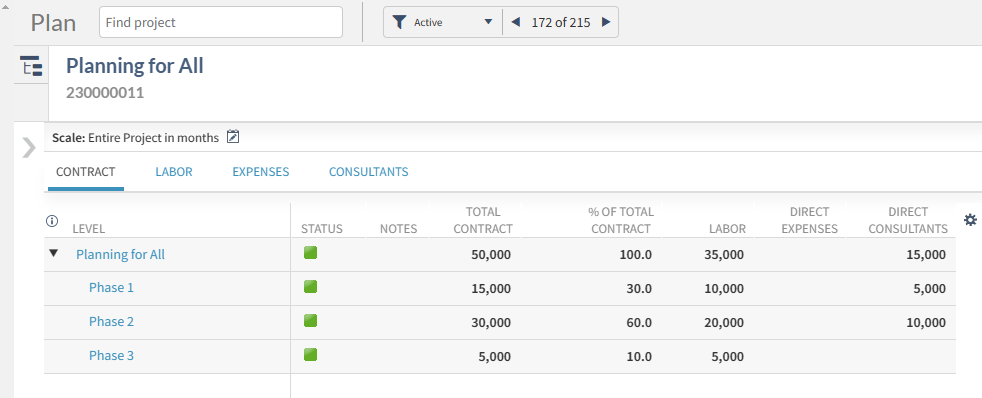
Contract Information 

Planning provides users with key information on the contract values stored in the Contract Management section of the Project. When the Contract is updated in the project, it is updated in the plan automatically! WOW! 
 Table

Description automatically generated

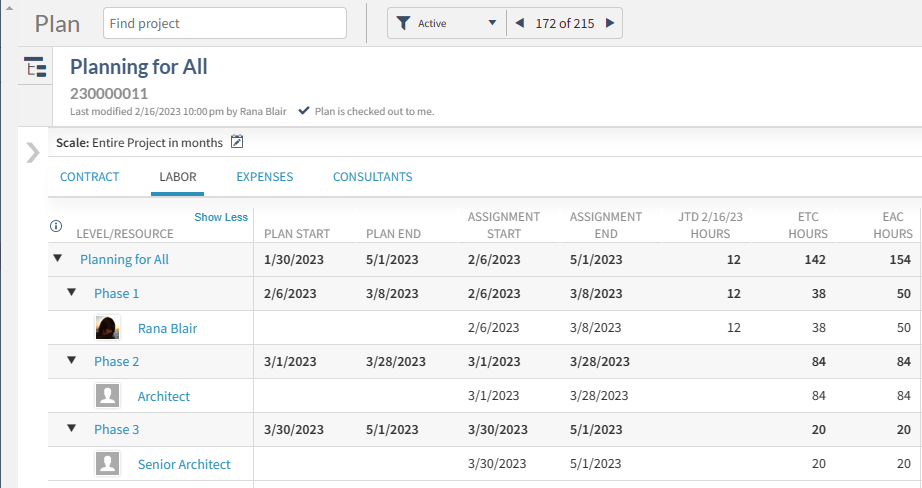
Labor JTD Review and ETC Planning 

Using the plan to view JTD Labor and enter the remaining hours needed to complete the work is simple and provides immediate feedback on the expected total hours. 

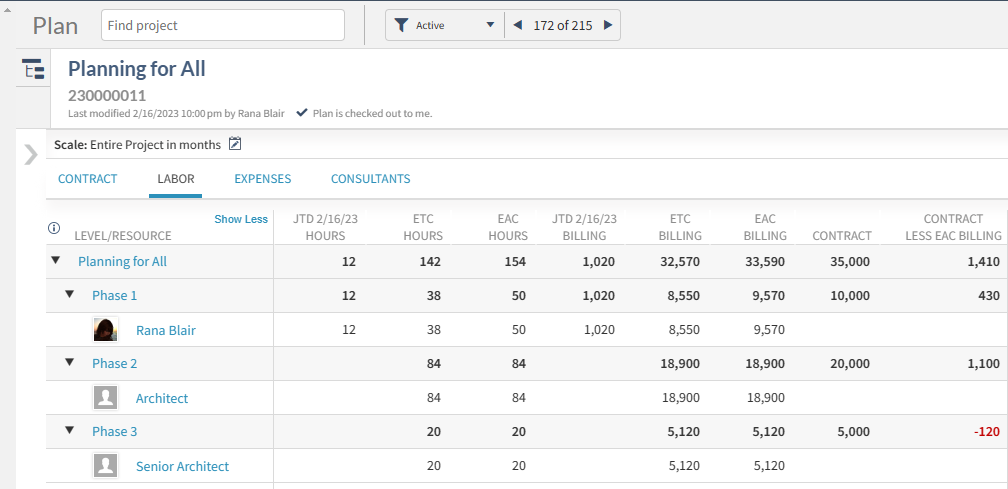
Table

Description automatically generated

This information automatically calculates dollars spent and projected at Billing or Cost values and generates a forecast of project performance. 

Table

Description automatically generated

Planning for Expenses and Consultants 

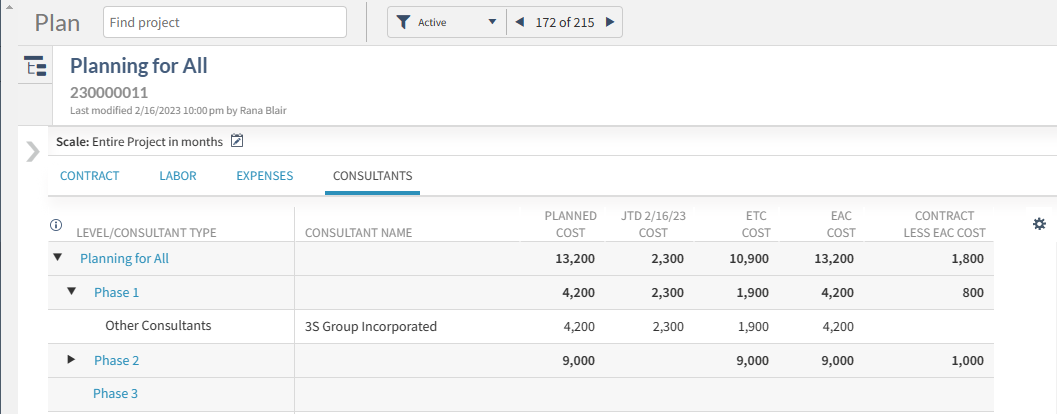
Expense & Consultant budgets can be planned in dollars, and like the Labor, the posted amounts are updated in the plan automatically. 

Table

Description automatically generated
 

Visibility EVERYWHERE! 

Viewing project performance in the plan effectively replaces the boring black & white reporting we’ve been forced to use all these years! It’s so exciting!  

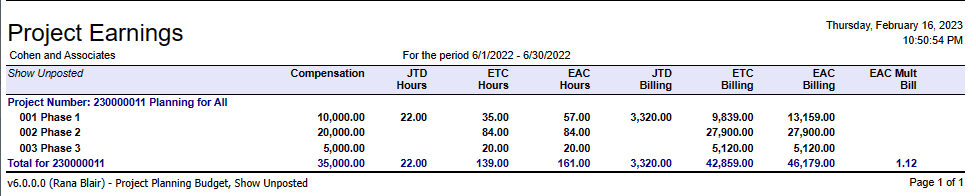
Want to keep your reports? You can have them at no extra charge. The data from the plans can be used in most Project reports by simply changing the Budget Details to Project Planning Budget and choosing the right columns. 

A picture containing text

Description automatically generated  A screenshot of a computer

Description automatically generated

But Wait, There’s More!  

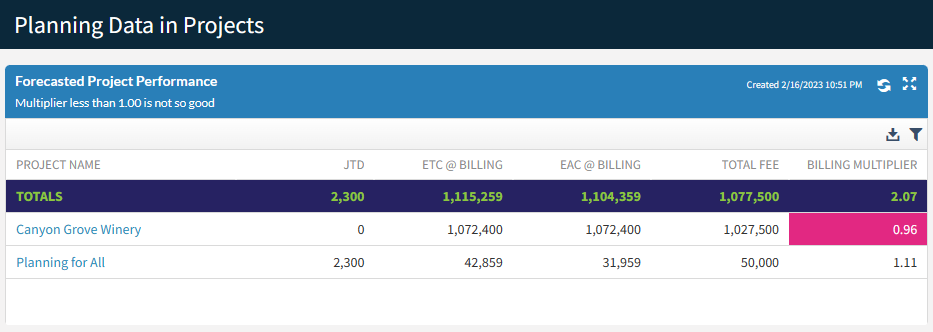
Want a reporting tool that updates automatically when your plan changes? You can have it! See the same information from the plan in a colorful Deltek Vantagepoint Dashboard! Just wow! 

Graphical user interface, application

Description automatically generated

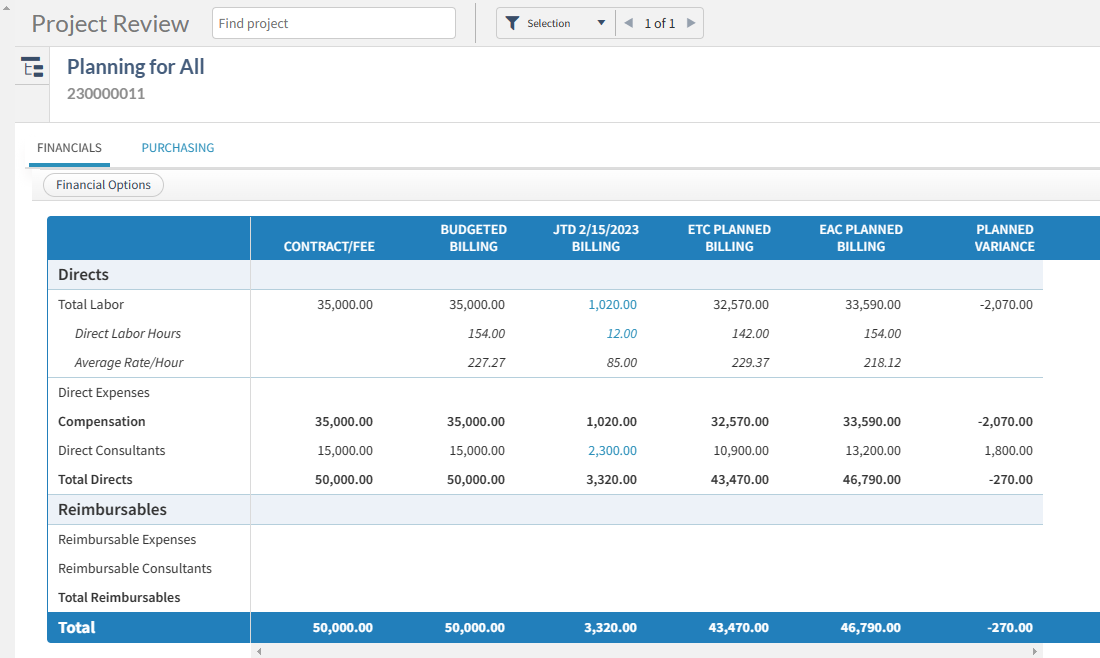
Do you feel like you must choose between the Budget tool and the Planning application? Well, you can have both! Review Planned Data next to Budget data in the new Vantagepoint Project Review. Accountants can have their place and Project Managers can too! 

Table

Description automatically generated

And there’s even more! Implementing use of the Planning tool allows your firm to extend the investment with Planning Resource and Budget Alerts. Planning data can even be used to streamline and validate Timesheet Entries. 

All This for ZERO Easy Payments 

Let’s review the features you get for ZERO Easy Payments! 

  1. Labor, Consultant, and Expense Planning  
  1. Planning by Employee and Generic Resource 
  1. Real-time Labor visibility (including unposted time!) 
  1. Data Visibility in applications, reports, dashboards 

How Can So Much Be Free? 

It’s simple, the tool has been scaled to fit the current needs of firms of all sizes. Adoption of the basic tool is easy, and the benefits easily recognized. Today, you can dabble in the Planning tool with little investment. And when you are ready for more, simply add licenses without losing any of the momentum you have achieved. 

What is included in the licensed Vantagepoint Planning and Resource Management application? 

As of Vantagepoint 5.5, features available to licensed users fall into four categories: 

  • Usability Features 
    • Schedule Tab with exportable Gantt chart 
    • Schedule (Task) Dependencies  
    • Planning Subrows to display Planned and Actual values for Hours, Cost, Billing in time scale periods 
    • Planning Assignments displayed on the Employee Card 
    • Bulk Redistribution of Hours and Variance Spreading 
  • System Extensions 
    • Project Pursuit Stages 
    • Revenue Forecast Application 
    • Estimated Fee and Probability fields 
    • Planning Exports 
  • Visibility 
    • Project Planning Reports 
    • Planning Dashparts such as My Upcoming Assignments  
    • Resource Planning Data in the Calendar Timesheet 
  • Resource Management  
    • Resource View, Project View, and Reporting 
    • Generic Assignments Dashparts 

Getting So Much for So Little 

You might be wondering, “How can so much come for so little?” It’s simple, the tool has been scaled to fit your needs now and in the future. Today, you can dabble in the Planning tool with little investment or risk. And when you are ready for more, simply add licenses without losing any of the momentum you have achieved. 

Whether your firm has zero or hundreds of licenses for Deltek Vantagepoint Resource Planning, the need to manage project performance is universal. The steps for input and maintenance are all the same regardless of how far you want to take the data.  Act Now!  Get started with Planning today!  


Latest Posts