Full Sail Partners Blog | Building Business (12)

Posts about Building Business (12):

What Singer Adele and Business Building Strategies Have in Common
Posted by Sarah Gonnella on September 07, 2012

marketing campaigns, Business Building Strategies, Measuring Return on InvestmentAnyone that knows me, knows I love music and sing karaoke.  I was learning one of Adele’s songs and listening to the lyrics: “Should I just keep chasing pavements, even if it leads nowhere?” I started thinking about the things we chase in our own life that lead nowhere. Even though this song by Adele is referring to love, it really can apply to pursuing business or ways to grow business.  Does your firm have a way to analyze if the business you chase is leading anywhere?  Better yet, do you know what efforts are paying off?  Below are things to consider when evaluating the effectiveness of your business building strategies:

Are You Chasing the Flavor?
A recent client described that each week they discuss the potential business everyone is pursuing.  However, each sequential week everyone was chasing the flavor of the week.  She had no idea what happened to the previous week’s pursuits and if anyone was even following up until she received a proposal request.  To avoid chasing the flavor and ensure your firm is following-up on all opportunities, consider these steps:

  1. Document All Stages with Action Items: You don’t need a proposal to document the opportunities you are pursuing.  Even if business is in a discovery or assessment phase, documenting these efforts with actions items can remind you to follow-up. 
  2. Identify Trends and Outstanding Items: Using an integrated system allows marketing and executives to track the progress of the entire company through reports to identify if there are trends or items that are outstanding.
  3. Administrator and Automation: Identifying someone to administer and review your pursuits is critical to ensuring progress. Also look at ways to automate alerts to remind you when you should follow-up.
  4. Win/Loss Report: It’s important to know how successful you are. Knowing the history of past pursuits can help future go/no-go decisions and improve your win rate. By developing a win/loss report and evaluating how successful you are by department, opportunity champion, and the type of project can help you make better decisions in the future.

Are You the Nurturing Type?

Many of us attend events, are a part of an organization, and are involved in business development efforts in hopes to nurture business.  However, most individuals and firms don’t know the effectiveness of their efforts.  To ensure your firm is making good use of your time, consider these steps: 

  1. Network vs. Attend: Not every event you attend will result in business.  There are many reasons to network.  However, showing up to an event doesn’t equate to networking. After attending an event log who you talked with. What did you discover about the individual and what was important to them?  Think about how you might follow-up with that individual. Maybe there is a subject they are interested in, someone they want to meet, a project they are working on, or you found out something about their personal life. How can you use your knowledge or connections to follow-up?  Social media is making it easier to connect with people and stay up-to-date with their changes. Be sure to personalize your request.
  2. Get Involved: If you are a member of an organization, take the plunge and be active.  Think about your audience when you chose an organization and then get involved in a committee, the board, or become a speaker. Volunteering can help you gain exposure, connect you with decision makers, and allow you to demonstrate your expertise. Joining SMPS was one of the best decisions I could have made for my company and career.
  3. Return on Investment: We all tend to hear the phrase, measuring Return on Investment related to effectiveness of business efforts.  Another way to look at ROI is ask yourself, if you had to pay for the marketing or business effort out of your own money, do you think it would be worth the effort?  A great way of looking at the marketing effectiveness is to track the time you spend toward business development efforts and compare it to the business you obtained from those efforts.  When you compare the expense vs. the business you received, was it worth the effort? Sometimes efforts take months or even years to pay off. So to determine trade show ROI or events that happen on a yearly basis, allow two years to determine the effectiveness. 
  4. Building Business: Most people look at clients as Existing or New.  I would challenge you to look at them as one of three categories: Prospective, Nurturing, and Maintenance. Prospective clients are those you want to do business with, maintenance clients are those you continue to do business with, while nurturing clients are those you’ve done business with or have recently received business from.  Your message and how your firm will gain business from all categories will vary. Keeping in mind that it is seven times easier to maintain an existing client than is to go out and get a new client; moving clients to the maintenance category is the goal.  So where should you spend your time and how do you know when you are effective?  First you need to define what justifies a maintenance client.  Is it the number of projects or dollar amount over a period of time?  With an integrated database system, your data can trigger when the criteria is met and send out an automated report.  This information informs “Client Champions” and executives when client business increases or decreases and provides marketing with insight for nurture campaigns.

I hope my inspiration from Adele will help your firm build business and avoid chasing pavements. Let us know what inspires you and what your firm does to ensure growth. View our webinar: Get the Most from Your Conference.
Full Sail Partners and Deltek Take Action with SMPS

Posted by Sarah Gonnella on August 14, 2012

While much of the country endured 100+ temperatures, the attendees at the annual Society for Marketing Professional Services (SMPS) Build Business Conference in San Francisco experienced daily highs of 72 degrees. Although the temperatures were low, the event was burning with energy as attendee's embraced this year's theme of "Take Action".  

At the conference, Deltek announced a strategic alliance with SMPS. The partnership will include identifying best practices and trends to advance technology's role in the architectural, engineering, and construction (AEC) industry. Additionally, mySMPS added a collaborative space for Deltek Users and SMPS members to interact, ask questions, and provide feedback on improvements.

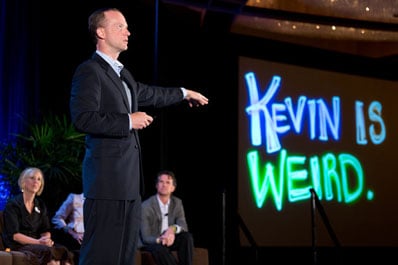
SMPS National President Kevin Hebblethwaite

Full Sail Partners is a proud supporter of SMPS as demonstrated through active involvement of its employees and consultants. Full Sail Partners’ CRM Consultant Kevin Hebblethwaite officially took on the role of SMPS National President and announced the board’s plans for the upcoming year. A “scan” of the marketplace through a survey has been deployed to the SMPS membership. The purpose of the survey is to incorporate the feedback into the society’s long-term plans. The survey currently has a 24% response rate and is expected to continue to increase. Expected key initiatives, supported by survey responses, include marketing integration, expansion of SMPS’ education offerings, and the development of operational standards and toolkits for local chapters.

At the event, Kevin brought a chuckle to the audience as he officially announced he's "weird" and encouraged others to embody a spirit of thinking that is not limited by sticking with the norm.  Kevin explains further that “politely shaking things up a bit can often short-circuit the path to success in areas such as relationship development, process improvement and differentiation.”

SMPS Atlanta Wins Striving For ExcellenceFull Sail's Director of Marketing and Business Development, Sarah Gonnella, also attended the event and is entering her second year term on the SMPS National board's Technology Committee and contributes to SMPS Connection and the Marketer. At the end of August, Sarah rolls off of the SMPS Atlanta Board and joins Kevin Hebblethwaite as a Past President of the Chapter. Both are proud to be part of such a strong chapter, which received 1st place Striving for Excellence Awards for website and large chapter. “SMPS is one of the best organizations in the AEC industry. I encourage those involved in business development, marketing and strategic planning at their company to actively get involved. The organization really does advocate, educate, and connect members,” remarked Sarah Gonnella.  To find out more about the a, e, and c of SMPS view this video: http://www.youtube.com/watch?v=syHFDKAxsW4.
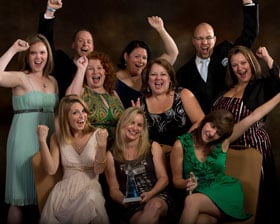
Scott Seal, Director of Service Development, is a new comer to the SMPS network and joins the host chapter, San Francisco.  “I’ve heard a lot of great things about the organization and I look forward to getting involved on a local level. The conference was a great way to kick-off my experience. As demonstrated by the awards, I’m excited to be associated with such a great chapter,” commented Scott Seal.   The San Francisco Chapter's President, Alethea O'Dell, was recognized as the President of the Year. Her gracious acceptance speech brought laughs and tears to the audience as she thanked her "Big, Bold, Bad A$$" board and committee members.

Full Sail Partners looks forward to “Dreaming Big” in Orlando, Florida at next year’s conference and encourages you to share your story about SMPS or your conference experience.

KPI Insight for Project Managers

Posted by Full Sail Partners on July 17, 2012

A Cautionary Example of Using KPIs

If a Project Manager Falls Down in the Forest and No One is Around to See It, Does the Project Manger Still Get the Quarterly Bonus?

I have been giving a great deal of thought to KPIs (Key Performance Indicators) lately.  One thought was about the idea of the unintended consequences of putting a “suite” of KPIs (KPIs are like potato chips, you can’t have just one. . .) in place, specifically for Project Managers.

How will their behavior change?  Will measuring chargeability for their project teams cause the employees to be more utilized or cause billable project to become less profitable?

Let me throw out an example.  This example is based upon a real client and provides KPI insight. The Names have been changed to protect the innocent.

Company A wanted to incentivize their project managers to produce more revenue.  So, after months of discussion and planning, the partners setup revenue targets for each PM based upon past performance and a generously favorable potential revenue prediction for the next year.  The Project Managers would be paid a bonus at the end of each Quarter for any Revenue they brought in over the projected target.  This was very generous, and all the partners agreed that this would drive business revenues higher.

Except it didn’t happen exactly the way they wanted it to.

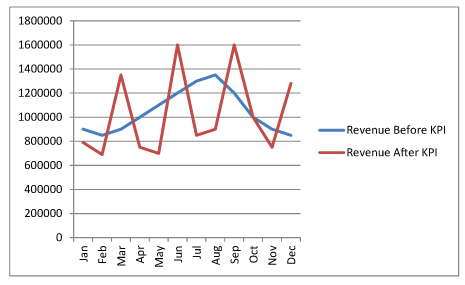
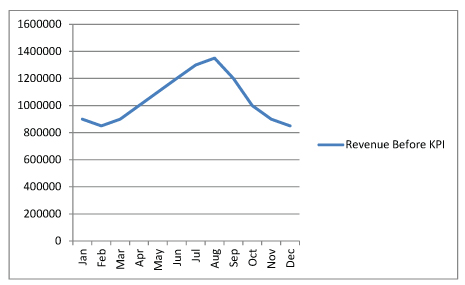
Here is a graph showing how their revenue was before this particular KPI was put in place:

KPI Key Performance Indicator Before


And here is the before and after picture:

KPI Key Performance Indicator After


Ouch!

This of course caused their accounting team to load up on antacids for most of the year.  Their KPI (and bonus program based on that KPI) had encouraged some behavior that was not necessarily good.  The Project Managers did not care about recognizing any revenue (and by extension, billing the client) until the end of the quarter, and when they did, they typically over-recognized and over-billed.

This problem caused a cascade through-out the organization.  Clients noticed and started to question why this month’s bill was so much larger that last month’s.  Average AR started to go up.  Cash flow went down.  Lines of credit had to be accessed to make payroll (and pay the quarterly bonus).

How could this have been prevented?  Looking back, it is obvious right?  But at the time, this sounded like a great idea and everyone was committed to making it successful.

  1. Too much focus on one KPI is not a good thing.  They should have used several measurements that touched upon AR, Chargeability, and (Project Managers cover your ears!), Client Satisfaction.
  2. Quantitative measurements are great, but we also need some Qualitative measurements in the mix.
  3. Involve many different types of people in your KPI development.  Someone might have pointed out this scenario at the beginning if the partners had not developed this on their own.

Which brings me to my final point... KPIs only help if you review them frequently and action is taken based upon them.  A well designed KPI exists to measure performance and if adjustments are not made based upon them...then no one saw the Project Manager fall in the forest.

View webinar on KPI Insight for Project Managers.

Kona: A Free Communication and Collaboration Software Tool

Posted by Sarah Gonnella on July 16, 2012

Deltek - KonaThe SMPS National Technology Committee 2012 survey revealed the top 3 technology topics professional services marketing and business developers would like more information on is communication tools, customer relationship management systems, and collaboration tools. The results of this study are probably not surprising.  People are on the go and are collaborating with multiple groups in different locations at a fast pace.  We have demands from work, family, and other organizations to keep track of.  The key ingredient needed is effective communication and collaboration.  

Social media allows people to connect and communicate, but one missing piece is still the collaboration and organization to get things done. A new collaboration software tool is looking to tackle this issue.  Kona is an online space for any group to privately connect, organize, discuss, and get things done together.  The tool is specifically for people involved with multiple groups like, project teams, volunteer organizations, membership clubs and even family events.  Kona keeps track of everything each person is responsible for and discussing across all spaces in one personalized place.  The current tool was developed by Deltek and is in beta.  Kona is FREE and available through the internet and also has a mobile app. 

As an example, let’s say that you are pursuing 3 proposals, you are director of an association committee, and you also need to organize your family activities.  Kona allows you to create five separate spaces for each of these items (separate space for each proposal, one for your committee, and one for your family).  You can invite separate people to each space. Those that are a part of the association don’t need to view you’re your family and proposal information, for example.  So you just send committee members an invite to your committee space.  However, you have the ability to view the discussions and tasks that occur over all 5 spaces.

For marketers, one of the biggest struggles when dealing with teaming arrangements is keeping communication in one location and making sure everyone is aware of decisions. Now you can quickly communicate through a discussion thread versus strings of emails which may or may not hit all of the right parties.  Since you can access Kona through an app you don’t have to be at your computer to join the conversation, which is great for those on a job site.  Agreed upon tasks are outlined with due dates.  You are able to upload files so the entire team can view.

The current capabilities continue to be tweaked so for those that would like to influence the development of this collaboration tool there is still time.  For those that need a way to communicate among disparate groups check out Kona (www.kona.com) and let us know what you think.  

Like Kona on Facebook: http://www.facebook.com/KonaLife
Follow Kona on Twitter: http://www.twitter.com/kona_life

To check out more features and compatibility requirements, visit iTunes: http://bit.ly/KY4JNd.  You can also search “Deltek” from your iPhone apps.  You can also view an introduction of the tool on YouTube: http://www.youtube.com/watch?v=clEEzM0RZr4.

To view a presentation, join us on July 19, 2012 at 1:30pm ET.

Click me

Latest Posts