Full Sail Partners Blog | Full Sail Partners (2)

Posts by Full Sail Partners:

Key Insights for Business Development from the 45th Annual Deltek Clarity Study

Posted by Full Sail Partners on Jul 25, 2024, 12:00:00 AM

07-18-24 Deltek Clarity - Business Development  - Banner

To help your firm address the evolving challenges in the architecture and engineering (A&E) industry, we’ve gathered key insights from the 45th Annual Deltek Clarity Architecture & Engineering Industry Study. This analysis of business development trends reveals the strategies successful project-based firms are using to navigate issues such as increased competition, project complexity, and talent acquisition hurdles. We'll also highlight the importance of adapting marketing strategies to the digital landscape, the benefits of strategic collaboration, and the growing role of technology in enhancing efficiency. By leveraging these insights, firms can position themselves for sustained growth and long-term success in a competitive market environment.

Optimistic Growth Forecasts

First, let’s start with the good news. The study reveals an encouraging trend, with firms projecting a net revenue growth of nearly 11% year-over-year. Despite the backdrop of shifting challenges, this growth signifies a positive outlook within the industry. However, achieving this growth comes with its own set of hurdles. One of the prominent challenges identified is the increasing competition within the A&E sector, fueled by globalization and the entry of new market players. With more firms vying for projects, differentiation becomes crucial for sustaining growth and profitability. Additionally, the study underscores the growing complexity of projects, driven by evolving client demands, regulatory requirements, and technological advancements. As projects become more intricate, firms must adapt their processes, workflows, and skill sets to deliver innovative solutions while meeting quality standards and deadlines. Moreover, talent acquisition and retention emerge as critical concerns for firms aiming to scale operations and expand market reach.

Adapting Marketing Strategies

A&E firms must adapt their strategies to fit an evolving digital landscape to keep up with consumer behavior. While traditional methods like print media and trade shows are still relevant, firms are increasingly focusing on digital marketing and content creation. They use thought leadership content to establish themselves as industry leaders and strategically leverage social media to engage clients and showcase their projects, enhancing their brand presence and generating leads.

This shift in marketing strategies underscores the importance of integrating traditional and digital approaches. Firms must be agile, continuously evaluating the effectiveness of their efforts and staying updated with the latest trends and tools. In doing so, they can ensure their marketing initiatives are not only relevant but also impactful in reaching their target audience.

Win Rates and Collaboration

Win rates for A&E firms remained stable year-over-year, with the overall capture rate experiencing a slight increase to 48.7%. These metrics underscore the importance of strategic networking and prospecting in securing new business opportunities. It’s important to note that the win rate measures the number of proposals submitted to the number of proposals awarded, capture rate measures the total dollar value of the proposals submitted compared to those awarded. Firms are increasingly focused on finding suitable teaming partners and leveraging their networks to source and close new projects. This emphasis on collaboration and relationship-building extends beyond traditional boundaries, as firms seek to form alliances with complementary service providers, subcontractors, and industry peers.

By expanding their network of collaborators, firms can access new markets, capitalize on emerging opportunities, and mitigate risks associated with project delivery. Furthermore, the study highlights the growing significance of client relationship management in driving business development success. With client expectations evolving rapidly and competition intensifying, firms must prioritize client satisfaction, retention, and loyalty to maintain a competitive edge in the market. This requires a proactive approach to understanding client needs, anticipating challenges, and delivering value-added services that exceed expectations.

Diversification Strategies

A notable trend identified in the study is the emphasis on diversifying project portfolios. While revenue from top clients grew, A&E firms are recognizing the importance of expanding their client base to reduce the risks associated with consolidated revenue across a few key clients. This diversification enhances resilience in the face of economic uncertainties, market fluctuations, and industry disruptions. It also enables firms to adapt to changing market dynamics, capitalize on emerging trends, and seize opportunities in more niche segments or emerging markets.

Harnessing Technology for Efficiency

As staffing challenges persist, A&E firms are turning to technology to enhance their efficiency. The Deltek Clarity study reveals that 46% of firms now utilize formal business development processes, with a slight uptick among small and large firms. This indicates a growing recognition of the importance of technology-driven solutions in navigating the competitive landscape.

With an 86% surge in awarded contracts driven primarily by large firms, there's a clear correlation between technology adoption and business success, particularly with AI. Despite this, there's a consensus among industry experts, including Megan Miller, CPSM, Director of Product Marketing at Deltek, that firms are only scratching the surface of AI's potential. While AI holds promise for streamlining marketing operations and enhancing BD outcomes, there's a pressing need for deeper exploration and integration of these technologies to unlock their full potential in the A&E industry.

Future Outlook and Recommendations

Looking ahead, project-based firms are advised to challenge themselves to be more selective in their pursuits, focusing on projects with the highest likelihood of success. The rise in proposal volume underscores the importance of refining go/no-go criteria and leveraging formal business development processes to prioritize opportunities effectively. Additionally, the study emphasizes the growing importance of content marketing and thought leadership in shaping firms' market positioning and visibility.

By addressing key challenges, leveraging technology, and adopting strategic initiatives, project-based firms can navigate growth opportunities and position themselves for long-term success in a competitive market environment. Need to hear more? Take a look at this year's Architecture & Engineering Industry Study now!
What's New in Vantagepoint 7.0?

Posted by Full Sail Partners on Jun 6, 2024, 12:00:00 AM

06-06-24 Whats New in DVP 7 - Banner

Deltek Vantagepoint 7.0 is finally here, and it brings a bunch of new features and enhancements aimed at improving automation, efficiency, and the general user experience. With a focus on providing better data visibility, integrating artificial intelligence, and enhancing the overall user interface, this update promises to change the way professional services firms manage their projects, finances, and resources. Let’s look at a brief overview of the things that’ll get you excited to jump into Deltek Vantagepoint 7.0!

Simplify PTO Updates for Plans

This update ensures more accurate project plans by automating absence requests and making staff availability more visible. This automation helps to improve resource management, allowing project managers to anticipate and plan for workload gaps effectively. The result is enhanced project delivery with fewer disruptions and more predictable outcomes.

3_autoupdatepto

Streamlined Financial Processes

One of the standout features of Vantagepoint 7.0 is the automation of financial processes. This includes streamlining the procure-to-pay process and automating time-consuming billing processes. By eliminating manual, error-prone tasks, finance teams can focus on more value-adding activities, improving efficiency and accuracy in financial management.

Enhanced User Experience and Adoption

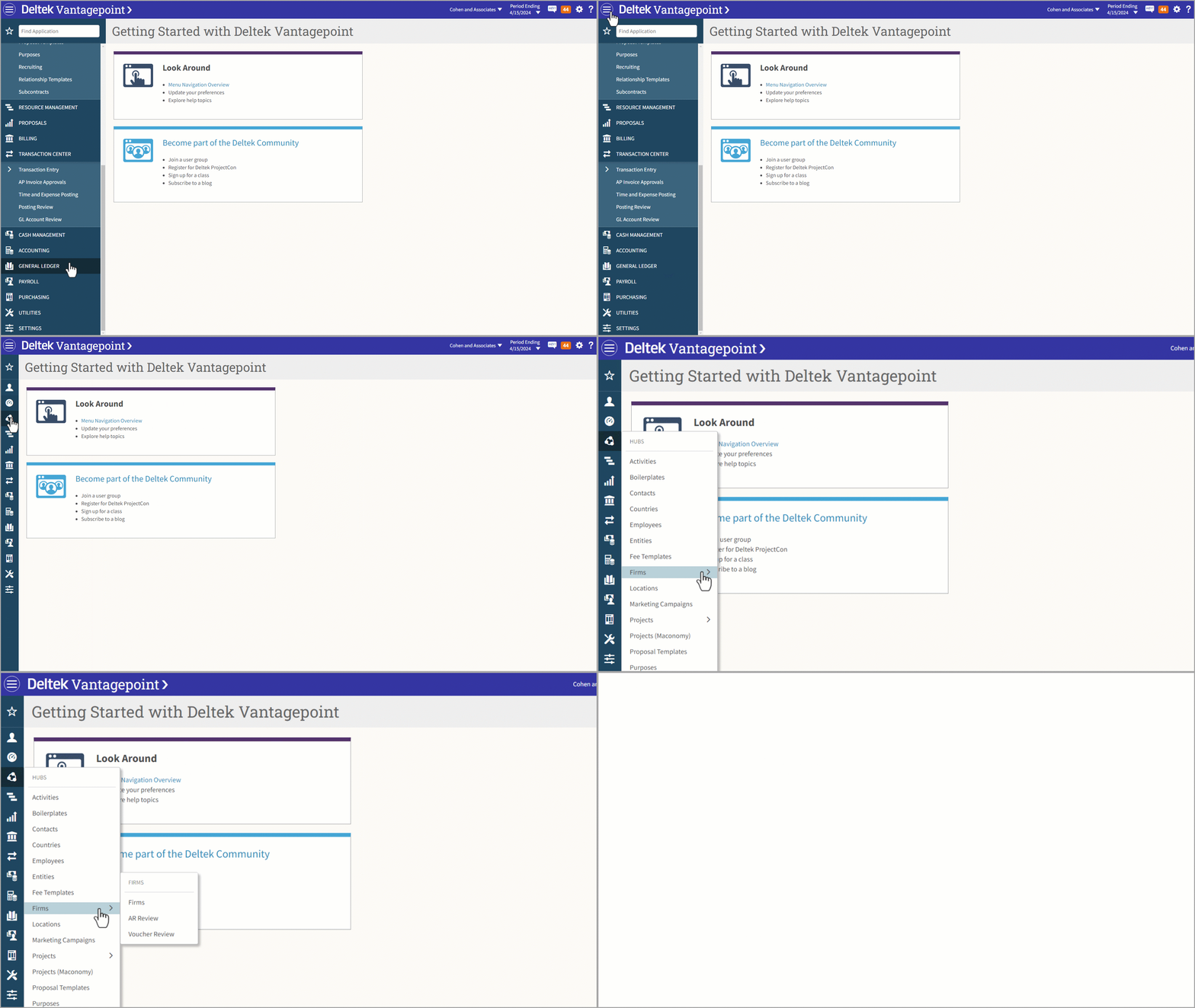
Next up on the list of improvements is the intuitive user interface with enhanced navigation menus, keyboard shortcuts, and fly-out menus. These improvements are designed to boost user adoption by making the platform easier to navigate and use. With features like explicit save in list view and bulk update capabilities, users can perform tasks more efficiently, leading to improved data quality and user satisfaction.

1_navig2

Empowered Business Intelligence and Flexibility

Deltek Vantagepoint now supports stand-alone Analysis Cubes, allowing users to create and utilize multi-dimensional cubes for business intelligence and advanced reporting. This feature provides the power of cubes without the need for visualization tools like Tableau, enabling connections from various BI tools, like Excel. This flexibility empowers users to leverage their data more effectively for strategic decision-making.

Modernized User Interface

The updated user interface maximizes your screen real estate and simplifies navigation. With a redesigned navigation menu, fly-out menus, and an updated color scheme, users can access information quickly and efficiently. The ability to track new records and improve navigation among them will further enhance the user experience.

Advanced Usability Enhancements

Usability improvements include explicit save in list view, bulk update capabilities, and advanced WBS (Work Breakdown Structure) search. These features allow users to update multiple fields for multiple records simultaneously and simplify data imports. Additionally, defined hubs and mobile capabilities for Time & Expense (T&E), absence requests, and CRM touchpoints make the platform more versatile and user-friendly.

Project Smart Summaries™

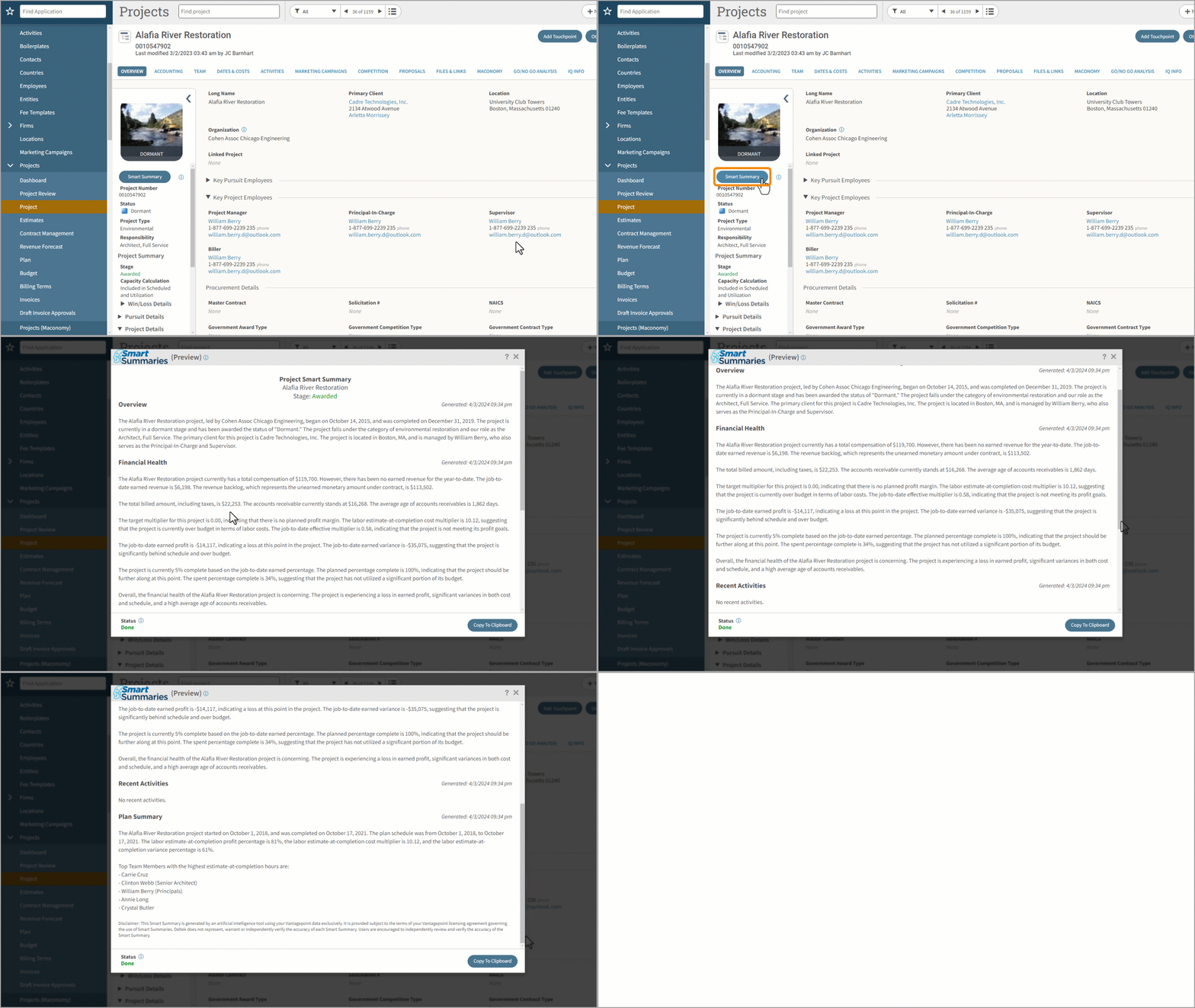
Leveraging generative AI, new Project Smart Summaries™ transform project information into actionable intelligence. Users can generate concise summaries that highlight project financial health, recent activities, and plan status. This feature reduces the time spent on data review and enhances the ability to make informed decisions quickly.

2_projsummary2

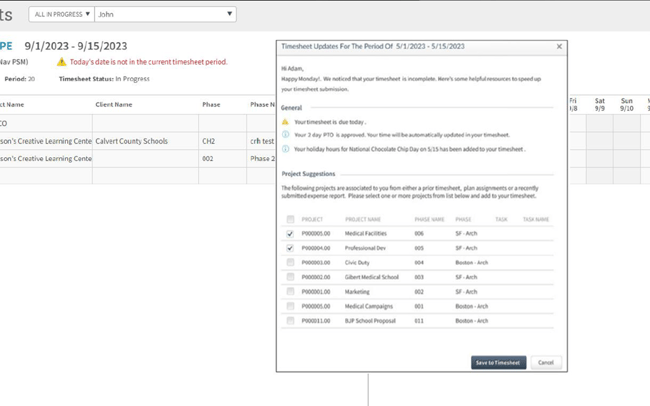
Timesheet Assist

This feature streamlines timesheet entry by suggesting projects based on user activity and resource assignments. By analyzing past timesheets, project plan assignments, and timesheet reminders, Timesheet Assist helps users complete their timesheets more accurately and efficiently.

Enhanced Accounts Payable Insights

Vantagepoint 7.0 delivers greater visibility into accounts payable (AP) details on dashboards. Finance leaders can quickly identify cash flow requirements, exception reporting, and company purchases. The ability to view details for pay-when-paid (PWP) and outstanding AP balances by the vendor on a single dashboard provides a clear insight into key AP metrics.

Streamlined Billing Terms Creation

New to Deltek Vantagepoint 7.0 is the ability to automate the creation of fee-based phase billing terms, making it easier to establish terms from the project work breakdown structure and compensation values. This automation improves the accuracy and efficiency of billing processes, reducing administrative overhead.

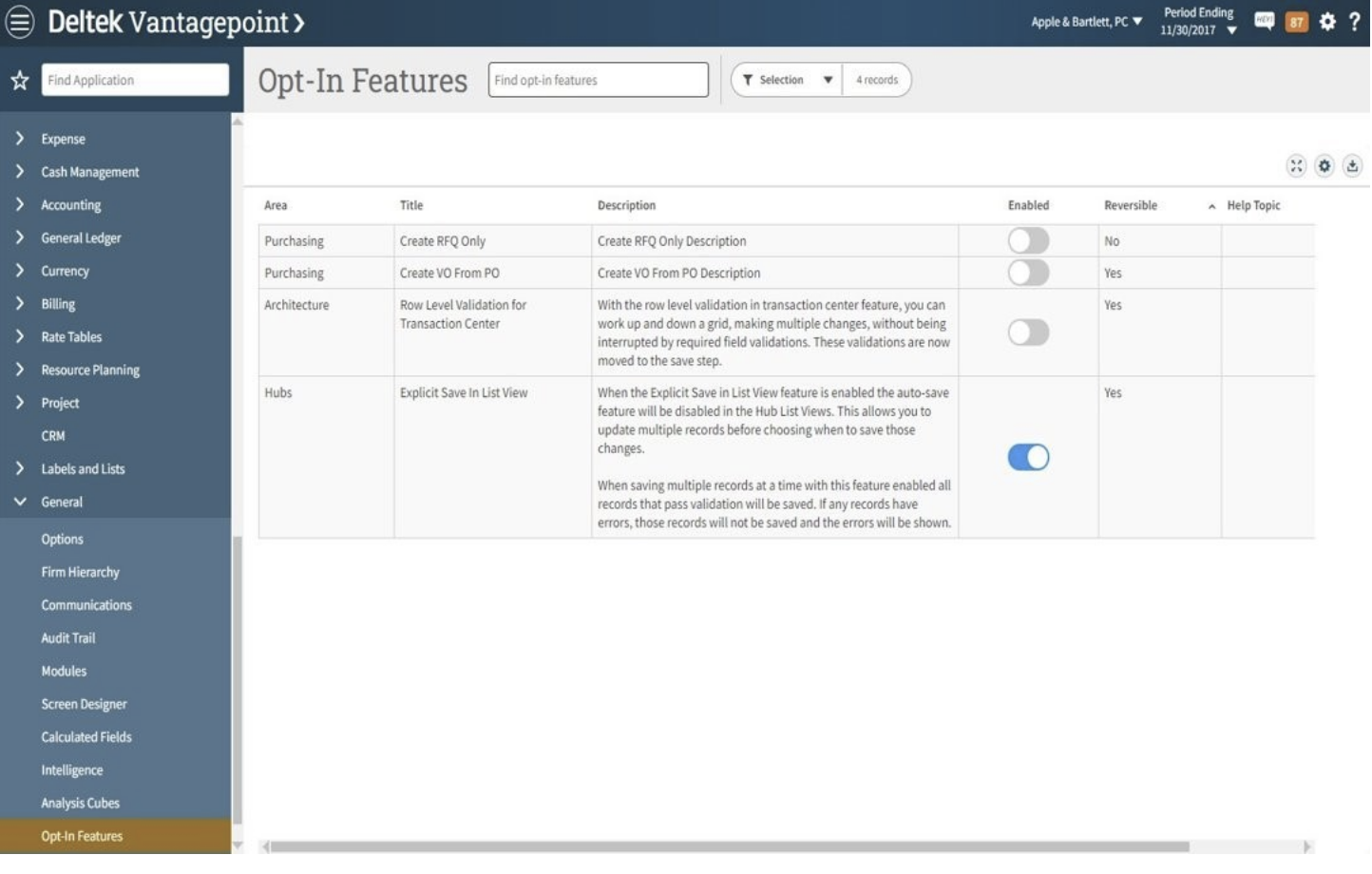
Opt-In Features for Controlled Rollout

Administrators have the option to enable a subset of new features for additional testing before full production deployment. This controlled rollout ensures a smooth transition and allows organizations to adapt to new functionalities at their own pace.

WhatsNewin7_04

Introducing Dela, Deltek's Digital Assistant

The newest and probably the most anticipated part of the 7.0 release is Deltek Dela – Deltek’s AI-powered Intelligent Business Companion. Dela is allowing those natural language interactions and prompts for users to take those and interrogate that data more intelligently, they can get answers without running reports. They don't have to dig through multiple dashboards, they don't have to open specific records.

You can have a conversation with Dela like you would with other AI software like ChatGPT. But it’s only your data, only your projects, only your clients so this data becomes much more relevant to your users, much easier to access, and gives your users that ability to interrogate and dig a little bit deeper when they just may not know where to go to get that information.

Today the focus of this is projects including project, financial details, employees, firms, contacts, and activities.

What else is new in Deltek Vantagepoint 7.0?

Deltek Vantagepoint 7.0 is set to revolutionize project management and business operations with its comprehensive enhancements and new features. By focusing on automation, efficiency, and improved user experience, this update promises to deliver significant benefits to users. From more accurate project planning and financial processes to advanced business intelligence capabilities and a modernized user interface, Vantagepoint 7.0 is a game-changer for professional services firms looking to enhance their project management and operational efficiency!

Want to see more on this update? We’ve got a webinar all about it! Click below to see What’s New in Deltek Vantagepoint 7.0!

New call-to-action


Topics:  

A Professional Services Firm’s Guide to Making Conferences Meaningful

Posted by Full Sail Partners on May 9, 2024, 12:00:00 AM

05-09-24 Conference Strategies - Banner

Conferences are more than just gatherings of like-minded professionals; they are opportunities for growth, networking, and strategic advancement. However, navigating them can be a bit daunting without a clear strategy in place. Let’s talk about some key concepts that will help your professional services firm on the way to mastering the art of impactful conference strategies.

Reframe Your Thinking About Conference Selection

Choosing the right conferences to attend is extremely important for maximizing your professional services firm’s time and resources. It is important to focus on more than just the prestige or popularity of an event; consider factors such as the relevance of topics covered, the caliber of speakers and attendees, and the potential for creating meaningful connections.

Moreover, you should consider the location and timing of the conference. Make sure that it fits well with your schedule and provides convenient access to travel arrangements. By reframing your thinking to prioritize quality over quantity, you can ensure that each conference you attend offers genuine value and opportunities for growth.

Discover How to Be Methodical and Objective in Your Approach

Approaching conference selection with a methodical and objective mindset can help streamline your professional services firm’s decision-making process. Start by clearly defining your goals and objectives for attending conferences. For example, are you expanding your professional network, gaining industry insights, or showcasing your expertise?

Next, conduct thorough research on upcoming conferences, evaluating factors such as agenda, speaker lineup, past attendee reviews, and cost-effectiveness. You should consider creating a checklist or rating system to objectively assess each conference's suitability based on your criteria. This allows for a more organized and informed selection process. By taking a systematic approach, you can identify the conferences that align best with your objectives and priorities.

Learn How to Be Mindful of Any Emotional Biases Influencing Your Decisions

It's essential to be mindful of any emotional biases that may influence your professional services firm’s conference selection process. Whether it's the fear of missing out on a popular event or because you’ve always attended, emotions can cloud judgment. Practice self-awareness and introspection to identify any biases at play like confirmation bias or sunk cost fallacy.

Furthermore, you should seek feedback from trusted colleagues or mentors. This helps to gain different perspectives and mitigate the impact of personal biases on your decision-making process. By approaching conference selection with a clear and rational mindset, you can make more informed choices that align with your firm’s professional goals.

Tips to Optimize Your Conference Strategy

Once your professional services firm has selected the conferences to attend, it's time to optimize your overall strategy to maximize your experience and outcomes. Start by creating a detailed itinerary, including sessions, networking opportunities, and any additional events or meetings. Leverage social media platforms such as LinkedIn to connect with fellow attendees and speakers before the conference. This will help facilitate meaningful interactions and collaborations.

Also, consider attending workshops or interactive sessions that offer hands-on learning experiences and opportunities to develop your skills. These activities will enhance the value you derive from the conference. During the conference, prioritize quality over quantity when networking, focusing on building genuine connections rather than collecting business cards.

Don’t Forget Your Follow Up Strategy

Finally, don't forget the importance of post-conference follow-up. One effective strategy is to have dedicated individuals responsible for follow-up tasks, so that no potential leads slip through the cracks. Whether it's sending personalized emails, brochures, or scheduling follow-up meetings, prompt and tailored communication can leave a lasting impression on your contacts.

You should also consider leveraging tools or systems to streamline the follow-up process. Scanning business cards or badges at conferences allows for the inputting of contact information directly into your database, and it is a very efficient way to track connections. By prioritizing follow-up efforts and utilizing available resources, you can maximize the return on investment from attending conferences.

Make Your Professional Services Firm’s Conferences Meaningful

Mastering impactful conference strategies requires a combination of strategic thinking, mindfulness, and proactive planning. Reframe your professional services firm’s approach to conference selection, adopt a methodical mindset, and be mindful of emotional biases; you can then optimize your overall strategy and make the most of your conference experiences.

Remember to prioritize quality over quantity and focus on building genuine connections. Furthermore, always follow up with your connections post-event. With these strategies in place, you'll be well-equipped to navigate the conference landscape with confidence and purpose.

Need a deeper dive into making your conferences count? We’ve got a LinkedIn Live with a conference guru that brings all these points and more together. Click below to watch today!


Why DEI&B Matter in Project Based Firms

Posted by Full Sail Partners on Mar 14, 2024, 12:00:00 AM

03-14-24 DEIB-Human Resources-Banner

Fostering Diversity, Equity, Inclusion, and Belonging (DEI&B) is not just a moral imperative but a strategic necessity for project-based firms. DEI&B creates environments that go beyond just diversity and inclusion, aiming to build equitable spaces where individuals feel welcomed, valued, and empowered. Surprisingly, not every company has a DEI&B initiative in place. Let’s review the core aspects of DEI&B, and what implementation strategies firms can use to promote these values.

Diversity

Diversity, the first pillar of DEI&B, acknowledges the variety of human characteristics and identities within a group or organization. It goes beyond just race and gender, encompassing various aspects that we don’t always think about such as age, ability and disability, socio-economic status, religion, nationality, and many more. In the context of project-based firms, where collaboration and innovation are key, recognizing and embracing diversity is especially important. Recognizing this is the foundation for fostering an environment where each team member's strengths and talents can thrive, ultimately contributing to the overall success of the projects and the organization.

Equity

Equity is about ensuring fairness, impartiality, and justice in the treatment of individuals, particularly in environments with historical disadvantages. Project-based firms need to actively address systemic biases, structural inequalities, and discriminatory practices. Achieving equity in a company involves creating policies and procedures that reward based on personal merit, ensuring everyone has an equal chance to succeed no matter what groups they may belong to.

Inclusion

Inclusion is the creation of environments where all individuals feel welcomed, respected, and valued. In project-based firms, inclusive practices involve actively embracing diversity and fostering a sense of belonging. This means creating spaces where people of diverse backgrounds, identities, and perspectives can thrive, express themselves authentically, and engage in meaningful collaboration without fear of discrimination.

Belonging

Belonging is the newest addition to DEI&B. It goes beyond diversity and inclusion, addressing individuals' emotional and psychological need to feel connected and respected within their professional environments. The feeling of belonging involves creating spaces where people can bring their whole selves to work, form genuine connections, and contribute to a collective identity and purpose.

Importance of DEI&B to Project-Based Firms

Beyond being morally imperative, DEI&B is crucial for project-based firms for several reasons: Fosters Positive Employee Engagement: DEI&B creates a positive and inclusive work culture, leading to higher employee engagement and satisfaction. Drives Innovation: Diverse teams bring a variety of perspectives and ideas, driving innovation and problem-solving in project-based settings. Broadens Talent Pool: Embracing diversity expands the talent pool, bringing in individuals with different skills, experiences, and viewpoints. Maintains Competitive Advantage: Companies with diverse teams often outperform their peers, maintaining a competitive advantage in the market.

Methods to Foster DEI&B in the Workplace

We’ve seen why DEI&B is important, but how do we go about putting these systems in place? Here are several ways that project-based firms can implement various initiatives to foster DEI&B:

  • Diverse Hiring Practices: Actively seek diverse candidates and create inclusive hiring processes. Remember to look deeper into the categories we don’t always recognize, like nationality, socio-economic status, and age.
  • Training and Education: Provide ongoing training on diversity, equity, and inclusion to enhance awareness and understanding.
  • Employee Resource Groups (ERGs): Establish ERGs to provide support, networking, and mentorship for underrepresented groups.
  • Flexible Work Policies: Implement flexible work policies to accommodate diverse needs and promote work-life balance. This can include options for hybrid and fully remote work.
  • Leadership Development: Invest in leadership development programs that prioritize diversity and inclusion.
  • Diversity Metrics & Accountability: Establish measurable goals and hold the organization accountable for progress.
  • Employee Engagement Activities/Events: Organize activities and events that encourage diversity and promote inclusion. These can be as simple as company mixers, sporting events, or other group activities.
  • Promotion of Diversity in Content and Marketing: Ensure that marketing materials and content reflect the diversity within the organization.

Making Diversity Programs Effective

Initiating diversity programs can be challenging, but it is essential for the success of DEI&B. Companies need to do three things in order to make an effective diversity program.

  1. First, you must recognize the full spectrum of diversity. As we’ve talked about already, not all aspects of diversity are easy to see. Understand that diversity encompasses various categories beyond gender and race, including gender identity, age, ability, religion, political beliefs, and socioeconomic status.
  2. Second, embed DEI&B in the company culture. Company culture is many things: the embodiment of a company’s values, its mission, and even its environment. DEI&B should be ingrained in the philosophy of the company.
  3. Finally, appoint DEI&B Leaders. Designate a group responsible for DEI&B programs and initiatives to ensure focused attention and progress. This group does not necessarily have to be management, instead, a dedicated team or individual can ensure focused attention and steady progress in promoting diversity and inclusion within the organization.

Conclusion

Embracing and valuing the concepts of DEI&B in project-based firms not only aligns with social responsibility, but also drives positive organizational outcomes. By actively fostering diversity, equity, inclusion, and belonging, project-based firms can create environments where individuals thrive personally and professionally, ultimately contributing to the success and innovation of the organization. To learn even more about DEI&B and how Full Sail Partners is helping firms with this initiative, check out the replay of our LinkedIn Live by clicking the image below.

Management of Change Series: The Many Faces of Marketing in Managing Change

Posted by Full Sail Partners on Jan 18, 2024, 12:00:00 AM

01-18-24 Marketing Managing Change-Banner

Marketing is like the Swiss Army knife of a company. Whether it's analyzing market trends, crafting messages that resonate with customers, or collaborating with top-tier decision-makers, marketers are the glue that holds these diverse aspects of a business together. By actively embracing change, they not only stay ahead of the curve but also contribute significantly to the company's adaptability and long-term success. Let's explore a bit about what marketing entails and how it is beneficial for companies to embrace change.  

The Many Faces of Marketing in Managing Change

The External Researcher

Marketing serves as the economic detective, constantly staying ahead of industry and economic developments. The role involves continuous research and analysis, with a particular focus on external factors that impact the business. Marketing often uncovers the initial clues to market change, making it an integral part of the change detection process.

This role involves monitoring competitor movements, tracking consumer behavior shifts, and anticipating economic trends. By interpreting these clues, marketers not only provide early warnings about potential disruptions but also position the company strategically to proactively respond to emerging opportunities. In essence, they act as the business's radar, navigating through the dynamic landscape to ensure it stays on course despite the change in economic currents.

The Positioner/Communicator

Once change is detected, marketing's role evolves into that of a positioner and communicator. The task is to internally convey the change to the executive team and then respond through market communications to customers, essentially defining the company's market positioning. Internally, marketing collaborates with the executive team to determine necessary business changes, constructing communications that help employees understand the impact of the change positively and accurately. In positioning, marketers look into the perspectives of customers, competitors, and industry analysts, communicating through various channels such as social media, articles, papers, and presentations. These external communications demonstrate the company's awareness and capability to navigate a changing environment while providing value to customers. The Executive Team Participant

Marketing teams function as analysts, consistently monitoring the industry landscape to anticipate future business trajectories and align the company accordingly. Serving as the middleman of both customer relations and the company's positioning, marketing assumes a pivotal role in internal transformations. Effective communication stands as a cornerstone, entailing the reinforcement of core messages through systematically delivered and timely directives. Leveraging a proactive communication approach across various channels ensures that our workforce is well-informed at every step of the way, fostering an environment valuing input and feedback.

The Technology Evolver

While marketing spearheads internal changes, it must also adapt its own processes, especially in terms of technology. Forbes.com refers to this as "Adaptive Marketing," emphasizing that marketers must embrace change rapidly and radically due to evolving technologies. Implementing process changes and calculating organizational impacts become differentiators, emphasizing that technology alone does not solve problems; it merely highlights them.

One such technology is AI. Marketers use AI to make engaging social media captions and blogs, leveraging algorithms that analyze user behavior for optimized language and style. Additionally, AI tools curate video content by identifying and cutting out snippets of interest, intelligently captioning them for social media sharing.

This integration not only expedites content creation but also helps to build personalized connections with the audience. Embracing AI is crucial for marketers navigating evolving technology, offering efficiency and a competitive edge. The integration of AI into marketing processes allows for a responsive approach, aligning campaigns with ever-changing audience preferences. In the era of adaptive marketing, AI serves as a powerful ally, adding to human creativity and driving impactful, data-driven initiatives.

The Influencer of the Company Culture

Having a good company culture is important. It's like the secret sauce that helps our team do their best work. At Full Sail Partners, our organizational culture revolves around collaboration and adaptability to change, and we prioritize creating an engaging and fun work environment.

This commitment is evident in the events our marketing team organizes, both internally and externally. These events also serve several purposes. Beyond providing a source of enjoyment, they are designed to strengthen team bonds, encourage idea sharing, and even attract new talent. Whether it's a casual gathering or a virtual meet-up, these marketing events play a pivotal role in maintaining connectivity and enhancing collaborative efforts within our team.

Furthermore, we emphasize open communication as a fundamental aspect of our work culture. Ensuring that every team member has a voice is of paramount importance to us. We value the contributions of each individual, fostering an atmosphere where everyone feels acknowledged and appreciated. In our recent company get-together, we had everyone share where they were and what the weather was like. It was a cool way to get everyone involved, and since our team is all over the place it was interesting to hear the range of weather. Marketing also created the "Virtual Water Cooler" on our Microsoft Teams where folks can post birthdays, life events, and other non-work things. This positive atmosphere contributes to the resilience and adaptability of our work culture, particularly in the face of dynamic changes in the marketing and technology landscape.

Marketing Roles Organically Manage Change

Adapting to change is a constant in the business world, and marketing teams play an organic and pivotal part in ensuring smooth transitions. Marketers continuously engage in market research, create internal communication strategies, and position businesses effectively to keep them ahead. Functioning as early detectors, they monitor external factors, providing crucial insights for strategic adjustments.

Moreover, once a change is on the horizon, marketers collaborate with leadership to ensure a positive and accurate message to the team. And, as with our own team, marketing excels at fostering a positive company culture through organized events, both in-person and online, strengthening team bonds and fortifying our work culture. In essence, the many faces of marketing naturally set the stage for managing the ongoing challenges of a dynamic business environment.


Running an Effective Meeting: 4 Key Strategies for Productive Collaboration

Posted by Full Sail Partners on Jan 4, 2024, 12:00:00 AM

01-04-24 MARKETING MEETING - Banner


In today's fast-paced professional services firms’ environments, meetings play a crucial role in fostering collaboration, aligning teams, and achieving organizational goals. However, ineffective meetings can be a drain on productivity and morale. To ensure that meetings are valuable and efficient, it is essential to follow certain best practices. In this blog post, we will explore four key aspects of running an effective meeting: setting clear objectives and goals, planning the meeting and agenda, employing a skilled facilitator, and having a diligent note-taker.

1. Objective and Goals of the Meeting:

The success of any meeting hinges on having a clear objective and well-defined goals. Before scheduling a meeting, it is crucial to determine how it aligns with the broader growth efforts and yearly goals of both the team and the organization. By doing so, the meeting becomes a strategic tool for progress. Participants can better understand the purpose of the gathering and how their contributions fit into the larger picture.

For example, the goal of a marketing, business development, or sales-oriented meeting is to ensure you are accomplishing the goals set out in your yearly business plan. Within the Architectural, Engineering, and Construction (AEC) industry, that includes ensuring you know what is going on with your project pursuits. Key objectives in bi-weekly meetings would include knowing recently won/lost pursuits, new pursuits and managing follow-up on upcoming proposals, along with understanding resource forecast projections. An example core objective in a quarterly meeting would be evaluating where you are against your goals.  

2. Meeting and Agenda:

To run a productive meeting, careful planning is essential. The meeting should involve the relevant team members and decision-makers who can contribute to the agenda items. The agenda itself should be thoughtfully structured, with a focus on deadlines and the outlined steps needed to meet them. By sharing the agenda in advance, participants have time to review and prepare, ensuring a more engaged and productive discussion. Balancing chit-chat time and getting down to business is important, as it fosters team cohesion while still maintaining a professional atmosphere. Coming out of the meeting, attendees should know their action items and tasks to accomplish.

3. A Good Facilitator:

A skilled facilitator plays a vital role in guiding the meeting towards its objectives while ensuring active participation and collaboration. The facilitator should encourage open discussion, allowing all voices to be heard. Additionally, the facilitator should review outstanding items from previous meetings to track progress, providing context for the current discussion.

Staying focused and time-conscious is crucial, as it helps keep the meeting on track and ensures that all agenda items are addressed. If new topics arise that are not on the agenda, the facilitator can suggest moving them to a "parking lot" list, to be covered either if there is enough time or in the next meeting. A good facilitator is like a good train conductor who sees the path ahead and knows when to slow down and when to speed up to accomplish the items that are most impactful to keep the department or company running smoothly.

4. Note-Taker:

An often-underestimated role in meetings is that of the note-taker. The note-taker should diligently document meeting minutes, capturing important discussions, decisions, and action items. By doing so, a reliable record of the meeting is created which ensures that information is not lost. Clear documentation of action items, next steps, and responsible parties is crucial for accountability and follow-up.

Furthermore, sharing the meeting minutes afterward is essential to keep all participants informed and ensure that everyone is on the same page. With the advent of AI, note-taking might become a thing of the past. I know our team has been exploring software that will assist with analyzing the content, offering summaries, outlining tasks with due dates, and even providing insights based on the discussion.

Follow Key Strategies to Ensure Productive Meetings

Running an effective meeting requires careful planning, active facilitation, and diligent note-taking. By setting clear objectives and aligning the meeting with broader goals, you create a purpose-driven environment. Thoughtful planning, involving the right people, and sharing the agenda in advance help participants prepare and contribute effectively. A skilled facilitator encourages collaboration, keeps the meeting on track, and addresses outstanding items. Lastly, a diligent note-taker documents important insights and ensures that action items are clearly defined. By following these strategies, you can transform meetings into productive spaces that drive progress and foster teamwork at your professional services firm.

Top 5 Deltek Vantagepoint Mini-Demos of 2023

Posted by Full Sail Partners on Dec 28, 2023, 12:00:00 AM

Client Newsletter_Banners-02

As Full Sail Partners launches another exciting new year, we thought it would be a great time to reflect back on the Top 5 Deltek Vantagepoint Mini-Demos of 2023! Chosen for their popularity, they showcase cutting-edge features that have resonated with users across diverse roles in professional services firms. Each leverages the expertise of our various presenters to create a profound impact on your use of Deltek Vantagepoint. Whether project managers, finance experts, or sales and marketing leaders, these mini-demos were designed to elevate your proficiency with Deltek Vantagepoint. So, without further ado, here are the top 5 mini-demos of 2023! 

#5: Finance & Project Accounting Oversight in Deltek Vantagepoint Dashboards 

Kicking us off at number 5 we have "Powering Project Success with Deltek Vantagepoint – Finance & Project Accounting Oversight in Deltek Vantagepoint Dashboards." In this demo, Theresa DePew, Senior Finance Consultant, showcases the transformative potential of Vantagepoint dashboards. She provides insights into navigating critical financial metrics such as revenue, expenses, and profitability. Theresa's expertise ensures that you not only gain a comprehensive understanding of these dashboards but also acquire the skills to make informed decisions and take proactive measures in managing your finances and projects adeptly. 

Some of Theresa’s favorite dashparts, including Profit & Loss (P&L), Accounts Receivable (AR), Cash Receipts, Billing Review, and Draft Invoice Approval, are featured prominently in this mini demo. These dashparts serve as integral tools, offering quick snapshots of income statements, simplifying collection tracking, and streamlining billing processes. Use this Deltek Vantagepoint mini demo to learn how to enhance your skills and leverage the ultimate tool for success in project management. 

#4: Different Ways to View & Manage Resources in Deltek Vantagepoint 

Learn the capabilities of Deltek Vantagepoint's Resource View with our fourth most popular mini-demo, "Powering Project Success with Deltek Vantagepoint – Different Ways to View & Manage Resources in Deltek Vantagepoint." Here, Principal Consultant, Terri Agnew, demonstrates how to make Resource View an essential asset in your resource management toolkit. 

She guides you through the three distinct capacity views offered by this powerful tool. Explore Planned Hours for a simplified understanding of your team's scheduled workload, utilize Scheduled % to identify resource allocation through a heat map, and delve into Utilization % to effectively track resource utilization against targets. This mini demo offers the insights needed to optimize your team's scheduling and utilization with Deltek Vantagepoint. 

#3: Utilize Schedule Dependencies for Resource Planning 

Coming in at our third most popular mini-demo is "Powering Project Success with Deltek Vantagepoint – Utilize Schedule Dependencies for Resource Planning." This time, Terri shows you how pivotal schedule dependencies can be for resource planning. This mini demo takes you through the creation of four distinct types of dependencies and illustrates three different methods for applying dependency relationships between phases, tasks, and labor codes. 

Terri also explains how schedule dependencies empower you to build meaningful relationships within your project, providing a holistic view of the overall schedule. This mini demo not only demonstrates the practical application of these features but also emphasizes their significance in easily updating schedules as dates change allowing you to elevate your project management capabilities. 

#2: Maximizing Efficiency and Accuracy in Invoice Creation with Vantagepoint's Mark-Up on Draft Invoices Feature 

For our second most popular spot, we have the mini-demo "Powering Project Success with Deltek Vantagepoint – Maximizing Efficiency and Accuracy in Invoice Creation with Vantagepoint's Mark-Up on Draft Invoices Feature." Here, Theresa DePew, Senior Finance Consultant, demonstrates the prowess of Deltek Vantagepoint's mark-up on draft invoices feature, showcasing how it can streamline your invoice review process, minimize errors, and enhance overall efficiency. The mark-up feature enables quick additions or removals of items, fee adjustments, and the inclusion of notes or comments for additional context.  

In this mini-demo, Theresa guides you through the creation of a draft invoice, demonstrating how to mark-up items, adjust fees, and incorporate vital notes, ensuring your clients receive comprehensive and accurate information. Also spotlighted are time-saving techniques such as reusing common billing items and tracking invoice status and history. See how Deltek Vantagepoint's mark-up on draft invoices feature can elevate your billing process and contribute to more effective client relationship management.  

#1: Project Management Oversight in Deltek Vantagepoint Dashboards 

Last, but certainly not least, we have "Powering Project Success with Deltek Vantagepoint – Project Management Oversight in Deltek Vantagepoint Dashboards” at our number 1 spot! In this mini demo, our expert, Rana Blair, Principal Consultant, demonstrates how these dashboards can revolutionize your workflows and provide invaluable insights. Whether you're a project manager, finance or project accounting professional, or a sales and marketing guru, this mini demo is tailored to focus on specific areas of business, driving your success to new heights. 

The number one rated mini demo offers visibility into crucial metrics such as budget, schedule, and resource allocation, allowing you to identify potential issues and take proactive steps to keep your projects on track. Rana also points out her favorite dashboards and dashparts, including My Team’s Project Performance Dashboard, My Project Performance Dashboard, and My Project Percent Complete Entry from Dashboards. Get crucial insights into budgets, schedules, and resources to elevate your project management game. 

Powering Your Project Success in 2024 

Now that you’ve been able to review the Top 5 Deltek Vantagepoint Mini-Demos of 2023, it is an ideal time to choose what topics best fit your professional services firm. Whether you're needing to sort out your finances, manage resources, create invoices, or keep tabs on projects, these top five mini-demos can help ensure you get better at fully utilizing your Deltek Vantagepoint system in the new year. They are available to watch on demand, and as always, Full Sail Partners would love to assist you in further exploring these Deltek Vantagepoint features.  

To find these mini demos as well as the others that are part of our Powering Project Success with Deltek Vantagepoint click the image below. 

What's New in Deltek Vantagepoint 6.5

Posted by Full Sail Partners on Nov 2, 2023, 12:00:00 AM

11-02 Whats New in DVP 6.5 - Banner 2

Deltek Vantagepoint announces an exciting new update, offering a wealth of tools and features to continue to increase collaboration and productivity for project-based firms. Vantagepoint 6.5 includes a substantial release filled with enhancements across multiple modules that benefits different user groups. In this article, I’ll be covering the top 5 features that I think will have the biggest impact in the daily usage. Without further ado, let’s jump right in! 


1. Accounts Payable (AP) Invoice Approvals Enhancements

This update brings significant time-saving enhancements to AP Invoice Approvals, including improvements to Intelligent Character Recognition (ICR), the introduction of a new field, and more. 

  • Intelligent Character Recognition (ICR): One of the standout features of this update is the integration of ICR for AP Invoice Approvals. With ICR, Vantagepoint can read details from uploaded AP Invoice files and automatically populate several key fields in the AP Invoice Approval form. These fields include Vendor, Address, Invoice, Invoice Date, Invoice Amount, and even Currency if you work with multiple currencies.  
  • Streamlined AP Invoice File Uploads: When you upload an AP Invoice file, the system provides a preview pane on the right side of the AP Invoice Approvals form, displaying the uploaded document. While this update may seem small, it’s incredibly helpful when managing multiple files within the same AP Invoice.  
  • Invoice Amount Field: ICR automatically populates the Invoice Amount field on the AP Invoice Approvals form with the total amount from the uploaded file. This field is now always editable, ensuring that the value matches the total amount in the Project Information grid. If there's a discrepancy, the system will display a warning message upon submission. 
  • Adjustable Right Pane: In the Transaction Center, when viewing the AP Invoice Approvals form in Detail View, you can now display a PDF of the AP invoice in a preview pane on the right side. This convenient feature allows you to simultaneously review the invoice while making edits to the invoice and project information. 

2. Smoother Vantagepoint Connections with API Enhancements 

Deltek Vantagepoint 6.5 introduces an array of powerful API enhancements to streamline your workflow. With new AP Invoice Approval API Endpoints, Third-Party Integrations API Endpoints, and the PUT Post Timesheet Entry API Endpoint, integrating with Vantagepoint has never been smoother. 

  • AP Invoice Approval API Endpoints: For those integrating with Vantagepoint, new API endpoints for AP invoice approvals are now available. These endpoints adhere to existing validations, restrictions, and security requirements at the application level, ensuring seamless integration. 
  • Third-Party Integrations API Endpoints: Another API-related enhancement is the introduction of Third-Party Integrations API endpoints. Just like the AP Invoice Approval endpoints, these follow established validation, restriction, and security protocols. 
  • PUT Post Timesheet Entry API Endpoint: To simplify timesheet management, the new PUT Post Timesheet Entry API endpoint allows you to post timesheets for individual employees or multiple employees at once. This API endpoint respects existing validations, restrictions, and security measures. 

3. Long-Awaited Dashparts Types  

The latest additions to Vantagepoint Dashparts offer customized metric presentations, extended role-based security, and improved functionality, streamlining operations for efficient data access and evaluation. 

  • Key Performance Indicator (KPI) Dashpart Type: With this new dashpart type, you can highlight crucial metrics for better data evaluation. Other customization features include changing the background and text colors, turning on/off sorting, selecting the date ranges, adding calculations, adding filters, and more. Even more, you can use the conditional formatting that will dynamically change the tile color when comparing KPI values to static values. 
  • Firm Dashpart Base: This new dashpart base displays firm-related information from the Firms hub, including vendors, clients, competitors, or government agencies. This enables quick access to relevant firm data directly from your dashboard. 
  • Role-Based Security for More Dashpart Bases: Role-based security settings, previously available for Employee dashparts, are now extended to several other dashpart bases, including AR Detail, Project, Project Detail, and Firm. This enhances data security and access control within your organization. 
  • Timesheet Floor Check System Dashpart: This new dashpart empowers you to perform employee timesheet floor checks directly from your dashboard. This feature replicates all actions available in the Floor Check dialog box in the Timesheets module, such as sending reminders, opening or printing timesheets, and checking timesheets from different periods. 
  • Dashpart Calculations: You can now create dashpart calculations based on selected columns in the current dashpart. These calculations respect filters and date ranges applied to the columns, allowing for more precise data analysis. Dashpart calculations are different from calculated fields, which are formulated from all available fields of a dashpart base. 
  • New Columns for the Project Detail Dashpart Base: Additional columns have been added to the Project Detail dashpart base to enhance cash flow visibility for clients using Paid when Paid (PWP) payment terms. These columns provide insights into invoice status, discounts taken, payment dates, and more. 
  • Update to the AR Comment Column: Users can now add or edit AR comments directly from drill-to dashparts with the AR Detail dashpart base, simplifying AR management. 

4. Improved Labor Resource Assignments and Unit Planning 

Deltek Vantagepoint 6.5 brings notable enhancements to the Planning module, aimed at improving the management of labor resources and unit planning within your projects. 

  • Fill Labor Resource Assignments with Planned Hours: On the Labor tab of the Plan form, a new feature called "Fill Hours Per Day" empowers you to assign planned hours to workdays for labor resources based on specific criteria. You can choose to allocate hours based on a set number of hours per workday or a percentage of the employee's hours per day. This streamlines the process of planning labor resources and ensures more accurate assignments. 
  • Unit Planning Enhancements: Unit Planning has also received improvements, allowing you to view planned, actual, and baseline unit data more effectively. This includes the ability to display sub-rows for unit quantities, cost, billing amounts, and allocation in each calendar period of your project plan. Additionally, you can now specify unit planning data export settings based on the desired timescale, whether by day, week, or month. 
  • Plan Expenses and Consultants in Calendar Periods: For companies using the Resource Planning module and planning expenses and consultants, Vantagepoint 6.5 introduces the ability to plan expense and consultant amounts in calendar periods within the Plan module. This feature enhances the granularity of your planning capabilities. System administrators can configure these options in Settings, and individuals can modify them for specific plans if they have the appropriate access rights. 
  • Show the Critical Path on the Gantt Chart: When it comes to project scheduling, understanding the critical path is crucial for project managers. In Deltek Vantagepoint 6.5, you can now visualize the critical path of your project directly on the Gantt chart within the Schedule tab of the Plan form. The critical path represents the sequence of tasks or phases that cannot be delayed without affecting the project's completion date. By toggling on the "Show Critical Path" option above the schedule grid, tasks or phases on the critical path are highlighted in red, making it easier to identify and manage them.

5. New Workflow Functionality

The workflow functionality in Deltek Vantagepoint has been enhanced with two significant features: 

  • After Completion Workflow Type: Vantagepoint 6.5 introduces the "After Completion" workflow type for Application workflows. This workflow type allows you to define additional actions that should occur on a transaction after it has been successfully posted to the database. This feature enhances automation and customization capabilities within your workflows, enabling post-processing actions tailored to your organization's needs. 
  • Support for Alternate Approvers: In the Approval workflows, a new set of options has been introduced to support alternate approvers. These options include "Do Not Allow Employees to Approve More than Once," which prevents an assigned approver from approving a record more than once, and "Do Not Allow Employees to Approve Records They Have Created," which prevents approvers from approving records they themselves created. These options enhance workflow management, impartiality, and control in the approval process. 

Enhancements Abound with Deltek Vantagepoint 6.5

Deltek Vantagepoint 6.5 introduces a wide range of enhancements and features designed to streamline operations, enhance security, and improve functionality across various modules. These updates empower organizations to make more informed decisions, increase efficiency, and maintain data accuracy in their day-to-day operations. With these improvements, Vantagepoint continues to evolve as a powerful and versatile solution for project-based businesses. To see these improvements and more, make sure to watch our “What’s New in Vantagepoint 6.5 Webinar” by clicking the image below.


New call-to-action

Topics:  

Project Management Trends from the 44th Annual Deltek A&E Clarity Study

Posted by Full Sail Partners on Oct 5, 2023, 12:00:00 AM

10-05-23 Deltek Clarity Recap-PM Trends_Banner2

Full Sail Partners has been closely following the annual Deltek Clarity Architecture and Engineering Industry Study, and in our previous blogs, we've delved into various aspects of this comprehensive report. As we continue our exploration of this year's 44th Annual Deltek Clarity study, we shift our focus to the critical realm of project management within the architecture and engineering (A&E) industry. This sector struggles with numerous challenges daily, and the study offers valuable insights into the current trends and issues affecting project managers. In this blog, we will dissect key findings from the study, particularly homing in on project management challenges and the strategic initiatives poised to address them. 

Project Management Challenges 

In the ever-evolving realm of architecture and engineering, project management is the linchpin of success. However, it's not without its formidable challenges. In this section, we'll delve into these critical challenges, from gaining better visibility into KPIs to grappling with staffing shortages. Furthermore, we will discuss strategies for overcoming them to achieve project management excellence. 

Visibility into Project Management KPIs: Project managers grapple with obtaining clear insights into key performance indicators (KPIs) and the tools required to manage them effectively. This issue affects project performance and client satisfaction. 

Projects on or Ahead of Schedule: 59.76% of projects are on track for schedule and budget. Despite this, staffing challenges continue to persist and impact project outcomes. 

Competing Priorities: A&E firms with well-defined roles, responsibilities, and efficient tools are better equipped to manage project resources. Quality control hubs, such as Centers of Excellence (CoEs) and Project Management Offices (PMOs), are instrumental in driving best practices. 

Staff Shortages: The industry continues to struggle with hiring and retaining skilled staff, with 62% of firms identifying it in their top 3 concerns. Offering tools, training, and attractive work cultures can help attract and retain next-generation project managers. 

Project Management Solutions 

Navigating the intricate landscape of project management in the architecture and engineering industry demands not just an understanding of the challenges but also the strategies to overcome them. In this section, we'll explore proactive solutions that address the industry's top project management challenges. From upskilling and training to streamline project management to harnessing collaborative platforms for improved effectiveness, and investing in technology for seamless connectivity, we'll unravel the keys to project management success.  

Addressing Top Project Management Challenges: To overcome these challenges, A&E firms are reducing their reliance on new project manager hires. Instead, they are focusing on upskilling, training, promotion, and formal career development planning to maintain productivity and deliverable quality. 

Project Management Effectiveness: Staffing issues, strong pipelines, and backlogs combined with increased staffing costs and skill gaps can hinder project management effectiveness. Collaborative platforms and regular training can help bridge these gaps. 

Connecting Teams and Using Systems: A common challenge is connecting all relevant teams on the same platform and ensuring employees use these systems correctly. This requires investment in technology and proper training. 

Project Management KPIs 

Effective project management necessitates careful planning and monitoring through various KPIs. While financial KPIs such as net revenue, profitability, and multipliers are well-tracked, there's room for improvement in non-financial KPIs like client satisfaction, schedule variance, and earned value.  

Balancing Financial and Non-Financial KPIs: Top financial KPIs like net revenue, profitability, and multipliers continue to be tracked by most firms at 94%, 93% and 83% respectively. However, firms showed less reliance this year on the non-financial KPIs like client satisfaction and earned value, at only 36% and 18% of firms tracking these statistics. Achieving a balance between financial and non-financial KPIs is essential for successful project management. Focusing solely on financial metrics can lead to oversight of critical project aspects. 

Project Reporting Accuracy: While A&E firms are gaining confidence in reporting project costs accurately, there's still room for improvement in reporting project schedules. Accurate schedule reporting is crucial for project success. 

Project Management Initiatives 

As the architecture and engineering industry continues to evolve, it's imperative to not only identify challenges but also to proactively address them through strategic initiatives. In this section, we will explore how A&E firms are taking forward-looking steps to enhance project management. These initiatives encompass investing in internal project management expertise, defining roles more clearly, and harnessing the power of technology and software tools to pave the way for a more efficient future in project management.  

Investing in Internal Project Management: A key priority for A&E firms is investing in internal project management, replacing the focus on hiring more qualified staff. Developing best practices and clearly defining roles for project management are also top priorities. 

Leveraging Technology: While technology can provide substantial support in project management, only a small percentage of firms are prioritizing investments in better software tools. Maximizing the value of existing tools and technology is crucial. 

Facing Challenges with Project Management Head on  

The A&E industry faces ongoing challenges in project management, including visibility into KPIs, staffing shortages, and maintaining project schedules and budgets. However, A&E firms are proactively addressing these challenges by investing in training, upskilling, and improved project management processes. Balancing financial and non-financial KPIs, accurate reporting, and leveraging technology will be essential for future success in the industry. By nurturing a culture of continuous improvement and transparency, A&E firms can enhance project management effectiveness and, ultimately, client satisfaction. 


Overall Trends from the 44th Annual Deltek Clarity A&E Report

Posted by Full Sail Partners on Jul 13, 2023, 12:00:00 AM

07-13-23 44th Clarity AE Report_Banner

Deltek has recently unveiled the 44th Annual Clarity A&E report, providing an exclusive glimpse into the 2023 outlook of the Architecture and Engineering (A&E) Industry. Overall, while growth may cool down from 2022's excitement, the construction and engineering sectors remain optimistic. Challenges like rising costs, staffing shortages, and inflationary pressures are driving firms to focus on staff retention, development, and diversity initiatives. 

Furthermore, with limited resources, strategic project selection is key. Though investment in supporting technologies has dipped, firms are revving up plans for tech implementation. Despite costs, A&E firms still shine with solid net revenue growth and improved operating profit. Here, in this blog, we will do a quick review of the overall trends seen from the 44th Annual Deltek Clarity Study.

Technology Trends

Firms are prioritizing strategic technology plans, cybersecurity, and business process improvement to achieve digital maturity and address challenges such as rising costs and talent management. While there is a desire to make strategic technological improvements, the report indicates a disconnect between goals and implementation, with firms relying on manual data entry instead of leveraging technology solutions effectively.

Data and cybersecurity remain the top IT operations challenges for firms, with cyberattacks posing a significant threat. Rising technology costs and the need to prioritize applicable trends also hinder technology adoption. However, firms are aiming to transform their use of technology, leveraging it as a competitive advantage and fundamentally changing how their businesses are run and the services offered to clients. Overcoming these challenges and maintaining a harmonious relationship between technology, project execution, and company strategy will be crucial for firms to emerge as the most competitive in the industry.

Business Development Trends

Firms face increased competition and fewer awarded proposals, necessitating strategic planning and resource utilization for conservative revenue growth. To address this, firms should focus on qualifying clients aligned with their strengths, diversify into favorable markets, and nurture existing client relationships with skilled BD talent and technology.

The A&E industry remains strong, but rising costs and staffing challenges require diligent pursuit of strategic opportunities for sustainable growth. Firms can enhance their focus by implementing formal go/no go processes, leveraging CRM solutions, and adopting hybrid BD models combining a dedicated staff with seller/doer approaches. Emphasizing opportunity evaluation and internal collaboration can benefit smaller firms. Adapting to market changes, investing in technology and talent, and prioritizing client relationships is crucial for firms to thrive in the evolving business landscape.

Project Management Trends

The 44th Annual Deltek Clarity report reveals that project managers (PMs) face challenges in gaining visibility into project management KPIs and lacking the necessary tools to manage them effectively. While there is a positive trend with more projects staying on track for schedule and budget, staffing shortages continue to hinder project performance. To tackle these issues, firms should invest in internal project manager training, better project management tools, and training for the next generation of project managers.

Staffing challenges remain the top obstacle for A&E firms, impacting project delivery and potentially causing burnout among existing staff. To address this, firms are focusing on internal training and upskilling current employees. However, comprehensive training and professional development are crucial to equip PMs with the required skills. Additionally, improving project information management, quality control, and collaboration can enhance project performance and mitigate risks. Emphasizing both financial and non-financial KPIs, along with leveraging project technology and financial tracking tools, can lead to improved project outcomes and profitability.

Human Capital Management Trends

A&E firms are focusing on developing and cross-training existing staff to meet project demands amid challenges in staffing and rising hiring costs. They prioritize succession planning, performance management, and talent nurturing to improve retention. To address talent acquisition challenges, firms are re-evaluating position requirements, considering trainable candidates with complementary skills, and offering competitive compensation. Engaging diverse candidates, providing upskilling opportunities, and championing operational tools are crucial for attracting and retaining talent.

In the competitive talent landscape, firms must strategically attract and retain employees by adapting to evolving workforce preferences, such as remote work options and positive company culture. They shift engagement strategies, offer visible career development plans, and track key performance indicators related to employee management and retention. By implementing these approaches, firms aim to improve their talent acquisition processes and support project profitability.

Financial Management Trends

Firms achieved significant financial success in 2022, surpassing their bullish goals and delivering improvements in operating profit. They effectively leveraged direct labor costs and subconsultants to drive revenue growth, outpacing growth in headcount and wages. Strategic investments were made during favorable economic conditions, resulting in strong revenue growth and improved financial metrics.

However, firms are facing several financial challenges that need to be addressed to sustain their performance. Finding and retaining qualified staff remains the top concern, although firms have been successful in leveraging their workforce and achieving high net revenues per employee. Increasing profitability and managing growth are also key areas of focus. Firms are refining their strategies, utilizing technology and process improvements to reduce project delivery costs and balance out rising labor costs.

To maintain their financial performance, firms need to prioritize the overall health and satisfaction of their workforce. Retaining and developing impactful talent through cross-training and internal promotions are crucial. Additionally, driving timely project completion, effective billing, and collection processes are vital for capturing revenue and maintaining cash flow. Investments in business process improvements and financial management training for PMs are key areas of focus to sustain growth and manage financial returns.

Continue to Gain Valuable Insight into the A&E Industry

The 44th Annual Deltek Clarity report continues to provide valuable insight into the Architecture and Engineering industry. In this most recent study, firms are advised to prioritize technology adoption, strategic business development, effective project management, and talent management to be successful. Embracing technology trends, addressing staffing challenges, and focusing on financial management are key areas of focus for sustainable growth and profitability.

By leveraging the recommendations from the Deltek Clarity report, firms can navigate market changes, enhance their operations, and stay competitive. For more information, the entire Clarity report can be downloaded for a comprehensive view. However, don’t forget to keep an eye out for our future blogs where we will be quickly reviewing each trend of the report in more detail.


Latest Posts